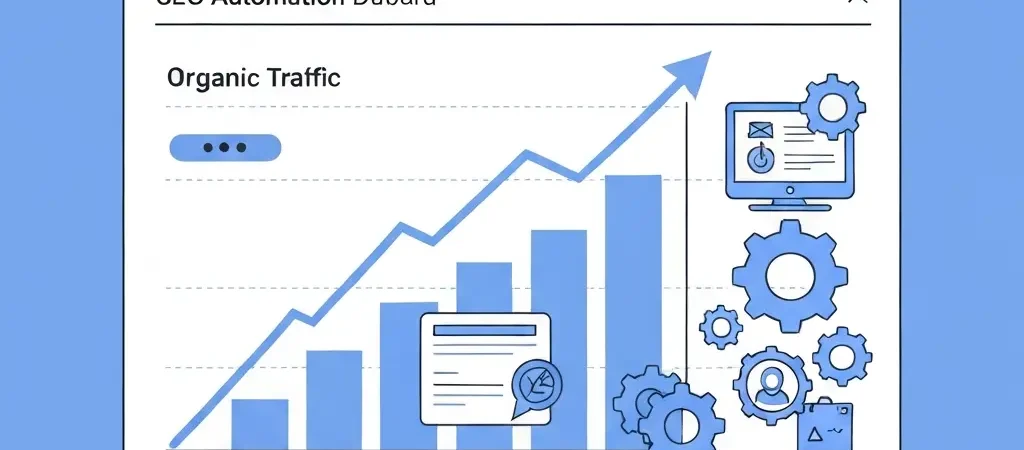
SEO Automation in 2026: How to Put Your Organic Growth on Autopilot
SEO automation in 2026 means something fundamentally different from what it meant five years ago. Early SEO automation was largely about automating spam — bulk link building, auto-generated doorway pages, scraped content. Today, SEO automation is about systematizing the legitimate, high-value activities that drive organic growth: content production, technical monitoring, rank tracking, and reporting. Done right, it multiplies team capacity without multiplying headcount.
This guide covers what SEO automation actually looks like in practice — which tasks are genuinely automatable, which tools handle them, and how to build an automation stack that grows organic traffic systematically.
What to Automate in SEO (and What Not To)
Automate These
- Content drafting and production: AI generates complete, SEO-optimized articles from keyword inputs — the biggest time savings available
- SEO metadata generation: Meta titles, descriptions, OG tags, schema markup — all generated automatically alongside content
- Content publishing and scheduling: Direct WordPress publishing with scheduling eliminates manual CMS workflows
- Rank tracking and monitoring: Automated position tracking across your keyword set with alert triggers
- Technical SEO crawling: Scheduled site crawls with automated issue detection and alerting
- Performance reporting: Automated dashboards pulling data from GSC, GA4, and third-party tools
- Internal link insertion: AI platforms can insert contextual internal links automatically at content generation time
- Featured image creation and upload: AI image generation with automatic upload to WordPress
Don’t Automate These
- Keyword strategy decisions: Which topic clusters to target requires competitive analysis and business judgment
- Link acquisition outreach: Relationship-building and personalized outreach can’t be effectively automated
- Brand voice configuration: Defining how AI represents your brand requires human judgment
- Quality review for high-stakes content: Pillar articles and content on sensitive topics warrant human review
- Strategic pivots: Deciding when to change your content strategy requires market intelligence
Content Production Automation
Content automation delivers the highest ROI of any SEO automation investment. A content operation that produced 4–8 articles per month manually can publish 20–60+ with AI automation — without additional headcount.
The Full Automation Stack
Authenova handles the complete content automation pipeline:
- Keyword cluster management → defines what gets generated
- AI generation → creates complete articles with all SEO elements
- Image generation → creates and uploads featured images
- WordPress publishing → pushes complete posts via native plugin
- Scheduling → distributes posts across your publishing calendar automatically
The automation runs continuously — once configured, the system generates, optimizes, and publishes content on its own schedule. Human input is required only for strategy updates and quality reviews.
Quality Automation Gates
Effective content automation includes quality controls:
- Minimum word count thresholds per content type (enforced at generation time)
- Required sections (FAQ, CTA, table of contents) that must be present in every article
- Draft-first workflows for pillar articles requiring human review before publishing
- Duplicate content detection to prevent overlap between new and existing articles
Technical SEO Automation
Technical SEO issues compound over time if left unchecked. Automated monitoring catches them before they affect rankings.
Automated Crawling and Alerting
Configure Ahrefs Site Audit or Screaming Frog to crawl your site weekly (daily for large sites). Set up email alerts for critical issues: new broken links, new 404 pages, drops in indexed page count, Core Web Vitals regressions, and new redirect chains. Most teams should address technical alerts within 24 hours — automation makes this possible without manual weekly audit work.
Google Search Console Monitoring
Google Search Console has built-in email alerts for critical issues: manual penalties, indexing problems, and security issues. Beyond alerts, use GSC’s API to pull data into automated reporting dashboards via Google Looker Studio — creating weekly performance reports that require zero manual data assembly.
Uptime and Performance Monitoring
Tools like UptimeRobot (free) or Pingdom monitor your site’s availability and alert you immediately to downtime. For performance regression monitoring, Calibre or SpeedCurve track Core Web Vitals in production and alert when performance degrades — critical for sites where AI content volume is growing rapidly.
Rank Tracking and Reporting Automation
Rank Tracking at Scale
Automated rank tracking across your full keyword set gives you visibility into which content is gaining and losing positions without manual checking. Both Ahrefs and Semrush provide daily rank tracking with automated change alerts. Configure alerts for: any keyword entering top 10, any keyword dropping 5+ positions from previous position, and featured snippet gains or losses.
Automated Reporting
Google Looker Studio (free) pulls data from Search Console, GA4, and most SEO tools via connectors. Build a monthly SEO performance report template that populates automatically — organic traffic trend, keyword ranking distribution, top-growing articles, top-declining articles, and content production metrics. This report takes 15 minutes to review vs. hours to assemble manually.
Content Performance Monitoring
Set up automated monitoring for articles that need updating: any article with impressions but CTR under 2% (likely a title/meta issue), any article that ranked in top 10 but has dropped below position 15 (likely needs a content update), and any article with 0 impressions after 90 days (indexing or quality issue). These alerts trigger content refresh workflows automatically.
Building Your SEO Automation System
Assemble your SEO automation stack in this order:
- Foundation (free): Google Search Console + Google Analytics 4 + Google Looker Studio for automated reporting
- Content automation: Authenova for AI content generation, image creation, and WordPress publishing
- Research and monitoring: Ahrefs or Semrush for keyword tracking, rank monitoring, and technical auditing
- Distribution: Buffer or CampaignOS for automated social media distribution of published articles
- Technical monitoring: UptimeRobot (free) + Screaming Frog (scheduled crawls) for site health monitoring
Start with steps 1–2. These provide the highest ROI and establish the measurement infrastructure needed to evaluate everything else. Add steps 3–5 as your content operation scales and the additional monitoring becomes necessary.
Platforms in adjacent fields like iQuitNow demonstrate how automation-first approaches work in behavioral health contexts — the same principle applies to SEO: systematize the repeatable, automate the measurable, and free human time for the judgment-intensive work.
Frequently Asked Questions
What is SEO automation?
SEO automation is the use of software tools to systematize and reduce manual effort in the SEO workflow. In 2026, legitimate SEO automation includes AI content generation, automated WordPress publishing, scheduled rank tracking, automated technical site auditing, and performance reporting dashboards. It explicitly excludes black-hat automation like bulk link purchasing, auto-generated spam content, or manipulative redirect schemes — these carry severe ranking penalties.
Is SEO automation safe? Can it get you penalized?
Legitimate SEO automation is safe and widely practiced by major brands. Google penalizes automation used to manipulate rankings — buying links, generating spam content, keyword stuffing. It does not penalize legitimate automation: AI-generated content that provides value, automated publishing workflows, scheduled rank tracking, or automated reporting. The safety of SEO automation depends entirely on what’s being automated and whether the output meets Google’s quality standards.
How much time does SEO automation save?
Time savings depend on which tasks are automated and your baseline processes. Typical savings: content drafting (4 hours per article → 30 minutes review = 87% reduction), publishing workflow (1 hour per article → zero = 100% reduction for automated publishing), rank tracking (4 hours/week → 30 minutes/week = 87% reduction), and monthly reporting (8 hours → 1 hour = 87% reduction). Total SEO automation can reduce time investment by 60–80% while increasing content output 5–10x.
Can SEO automation work for small businesses?
Yes — SEO automation is particularly valuable for small businesses and solopreneurs who lack the resources for a full SEO team. A solopreneur using Authenova for content automation can publish 20–30 articles per month while spending only 2–3 hours per week on review and strategy. This matches or exceeds what most SMB content teams produce manually at a fraction of the cost and time investment.
What is the best way to get started with SEO automation?
Start with the highest-impact automation first: content production. Set up an AI content platform (Authenova), configure one content strategy with 20–30 target keywords, and let the system generate your first 5 articles. Review them, refine the configuration, then enable automated publishing. Once content automation is running smoothly (2–4 weeks), add rank tracking automation and technical monitoring. Avoid trying to automate everything simultaneously — incremental adoption produces better results than trying to run a fully automated system from day one.
Automate Your SEO Growth with Authenova
Authenova is the SEO automation platform that handles content creation through WordPress publishing automatically. Set up your strategy, configure your keywords, and watch your organic traffic grow — with minimal ongoing manual effort.