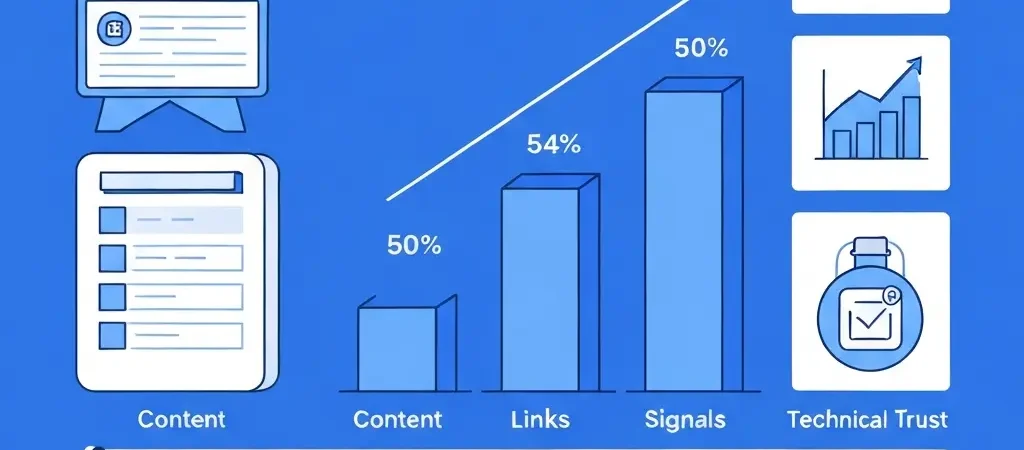
Domain Authority Building: A Data-Driven Playbook for 2026
Domain authority building is one of the most discussed and most misunderstood areas of SEO. “Domain Authority” as a metric was invented by Moz — it’s not a Google metric — but the underlying concept is real and important: some websites have accumulated enough trust, relevance, and link equity that they rank more easily than others across a broad range of queries. Building that accumulated authority is a long game, but it’s one of the most durable competitive advantages in organic search.
This playbook cuts through the mythology and presents a data-driven approach to authority building in 2026 — one that integrates link acquisition, topical content coverage, technical trust signals, and brand authority development into a coherent growth program.
What Is Domain Authority (Really)?
Let’s separate the metric from the concept:
The Moz metric: Domain Authority (DA) is Moz’s proprietary score (0–100) that predicts a site’s likelihood of ranking, based primarily on its link profile. It’s a useful proxy metric but has limitations — it doesn’t account for topical relevance, content quality, or Google’s actual ranking signals.
The underlying concept: Some sites rank more easily than others because they’ve accumulated a combination of link equity, topical depth, brand trust, and technical quality over time. This accumulated advantage is what practitioners mean when they discuss building “domain authority” — even if they’re not specifically targeting the Moz metric.
Google’s actual trust signals include: quality and relevance of external backlinks, E-E-A-T signals (authored content, citations, expert recognition), branded search volume (how often people search for your brand directly), topical coverage depth, and technical factors (Core Web Vitals, HTTPS, structured data).
Link Acquisition That Actually Works
Link acquisition is the most well-documented authority building lever. The research is clear: sites with more high-quality relevant backlinks rank more consistently than those without. But not all link acquisition tactics deliver equivalent ROI.
Content-Led Link Acquisition (Highest ROI)
Creating content that attracts links organically — because it’s the best resource on a topic, contains original data, or provides unique utility — is the most scalable and algorithm-proof link acquisition strategy. This includes:
- Original research and surveys: Data-backed articles that other sites cite as sources
- Comprehensive resource pages: The definitive guide to a topic that becomes a go-to reference
- Tools and calculators: Free utilities that provide ongoing utility and earn recurring links
- Proprietary frameworks and models: Named methodologies that others attribute when discussing the concept
Platforms like Authenova enable the content volume needed for content-led link acquisition — publishing enough high-quality content that statistically, some articles will attract natural links from relevant sites in your niche.
Digital PR
Journalist and blogger outreach (HARO, Connectively, Prowly) connecting your internal experts with publication opportunities. When subject matter experts from your company are quoted in relevant publications, you earn high-authority links from established media sites. Consistent digital PR over 12 months can generate 20–40 quality links from DA 60–80+ publications.
Strategic Partnerships and Link Exchanges
Mutually beneficial link exchanges with non-competing sites in adjacent niches — where each site links to genuinely useful resources on the other — remain a legitimate authority building tactic when done at low volume with genuine relevance. Tools like CampaignOS and other marketing platforms in adjacent niches make natural cross-linking partners for content-driven SaaS companies.
What Doesn’t Work in 2026
- Buying links from link farms or private blog networks (PBN risks are higher than ever)
- Mass guest posting on low-quality sites for link volume
- Directory submissions to general, low-editorial-standard directories
- Comment spam and forum signature links
Topical Authority as Authority Builder
Topical authority — comprehensive content coverage of a specific topic domain — contributes to domain-level authority through mechanisms distinct from link acquisition:
Branded Knowledge Panel
Sites that demonstrate deep topical expertise through comprehensive content coverage can earn Google Knowledge Panel entries. A Knowledge Panel is Google’s explicit recognition of your brand/site as an authoritative entity on your topic — a direct authority signal.
Topical Trust
Google’s quality evaluation systems assess whether a site’s content comprehensively and accurately covers its claimed topic area. Sites that cover topics incompletely — with gaps that leave key questions unanswered — may be penalized in topical relevance scoring even if their link profile is strong. Systematic content production through platforms like Authenova helps fill these gaps methodically.
Brand Signals and Entity Authority
In 2026, Google increasingly uses brand signals as trust proxies:
- Branded search volume: How many people search for “[Your Brand]” directly? Growing branded search signals growing brand awareness and trust
- Brand mentions (without links): Google can infer authority from brand mentions in relevant contexts even without a hyperlink — called “implied links”
- Social proof: Reviews, forum mentions, and community discussions about your brand signal legitimacy
- Author entities: Content authored by named experts with established Google Knowledge Graph presence carries higher E-E-A-T signals than anonymous content
Building Brand Signals
Focus on activities that increase brand visibility in your niche: podcast appearances, conference speaking, media coverage, community participation, and social media presence. These activities build brand search volume and create the citation patterns that Google uses to evaluate brand trust.
Technical Trust Signals
Technical factors contribute to authority by ensuring Google can efficiently crawl, index, and trust your content:
- HTTPS: Non-negotiable — HTTP sites are deprioritized
- Core Web Vitals: LCP under 2.5 seconds, INP under 200ms, CLS under 0.1 — Google uses these as ranking signals
- Structured data: Schema markup (Organization, Author, Article, FAQPage) helps Google correctly identify and classify your content and brand entities
- Site architecture: Clean URL structure, efficient crawl paths, proper canonicalization — these ensure your authority signals are consolidated rather than diluted
- Mobile optimization: Google’s mobile-first indexing means mobile performance directly affects rankings
Authority Building Timeline and Benchmarks
Setting realistic expectations prevents the discouragement that causes most authority building programs to be abandoned prematurely:
| Timeline | Benchmarks | Primary Focus |
|---|---|---|
| Month 1–3 | First long-tail rankings appear; 5–15 indexed pages | Content foundation + technical setup |
| Month 4–6 | 100–500 organic monthly sessions; DA 15–25 | Content velocity + first link acquisition |
| Month 7–12 | 1,000–5,000+ monthly sessions; DA 25–40; top-10 rankings for medium-competition terms | Topical coverage completion + link acceleration |
| Month 12–24 | 5,000–25,000+ monthly sessions; DA 40–60; competitive term rankings | Brand authority + pillar keyword rankings |
Frequently Asked Questions
How long does it take to build domain authority?
Building meaningful domain authority (DA 30–40, consistent top-10 rankings for medium-competition terms) typically takes 9–18 months for new sites with active content and link building programs. Established sites can see DA increases of 10–15 points in 6 months with focused link acquisition. The timeline depends heavily on publishing velocity, link acquisition rate, and niche competition levels. There are no shortcuts — authority accumulates through consistent, quality-focused effort over time.
Does DA (Domain Authority) actually predict Google rankings?
DA has moderate predictive value for competitive query rankings but is not a Google metric and can be misleading. High DA sites can underperform for specific queries if their topical relevance is weak; low DA sites can outperform in their niche if they have strong topical authority. Use DA as a rough competitive benchmark, not as a primary KPI. Google Search Console’s actual impressions, clicks, and position data are more actionable than third-party DA scores.
What are the best free tools for monitoring domain authority?
For free tools: Google Search Console (authority proxy metrics via ranking distribution and impressions), Moz’s free domain analysis tool (DA score), Ahrefs’ free webmaster tools (Domain Rating, backlink data for your own site). For paid tools that provide more comprehensive data: Ahrefs and Semrush offer the most complete domain authority and backlink analysis. Moz Pro provides the DA metric in its original form for those who use DA as a benchmark.
Can high-quality content alone build domain authority without link building?
Yes, but slowly. Sites publishing exceptional content without active link building do earn natural links over time (content-led link acquisition) and build topical authority through coverage depth. However, the link acquisition process is faster when supplemented with outreach, digital PR, or strategic partnerships. Pure content-only authority building is viable but extends the timeline to competitive rankings by 12–18 months compared to a combined content + link strategy.
Does a new site start with zero domain authority?
From Google’s perspective, new sites start without established trust signals — no link history, no topical track record, no brand entity recognition. From a Moz DA perspective, new sites start at DA 1. However, the “sandbox” effect (where new sites experience ranking suppression regardless of content quality) is real and typically lasts 3–6 months. Publishing consistently and earning your first external links shortens this sandbox period and accelerates initial authority development.
Accelerate Your Authority Building
Authenova powers the content side of domain authority building — comprehensive topical coverage through consistent, high-quality article production. Build the content foundation that compounds into long-term ranking authority.