<![CDATA[
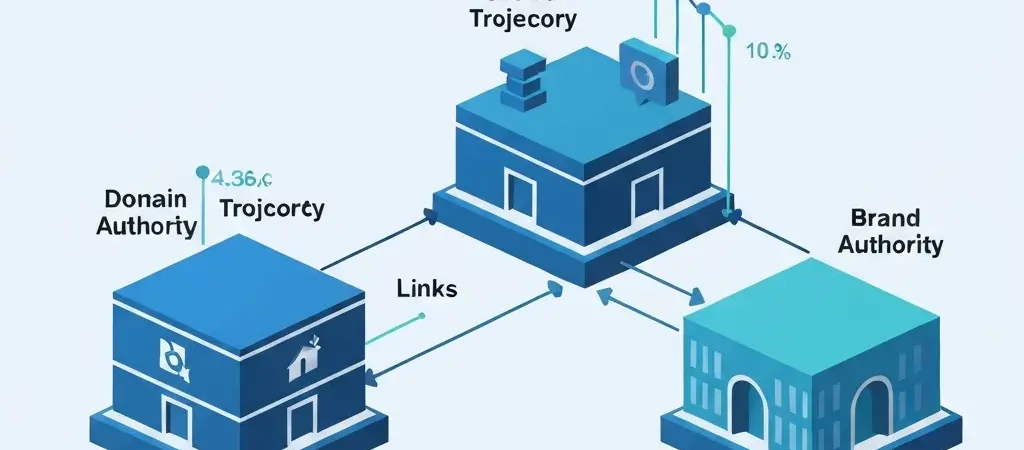
Domain authority is a proxy metric that estimates a website’s overall ability to rank in search engines, based primarily on its backlink profile. While Google has confirmed it does not use any third-party “domain authority” score, the underlying signals these scores attempt to measure — link equity, trust, and topical relevance — are fundamental to how Google evaluates sites.
What Domain Authority Actually Represents
Tools like Moz DA, Ahrefs DR, and SEMrush Authority Score each calculate domain authority differently, but they all attempt to quantify:
- Link quality: The authority and relevance of sites that link to you
- Link quantity: The number of unique referring domains
- Link diversity: Variety of linking sources across different sites, IPs, and geographies
- Growth trajectory: Whether backlink acquisition is trending positively
Google’s Actual Site-Level Signals
While Google does not use DA scores, patent analysis and official communications reveal several site-level authority signals:
- Site-wide PageRank: Aggregate link equity across all pages
- E-E-A-T assessment: Site-level expertise evaluation, particularly for YMYL topics
- Topical focus: Sites concentrated on specific topics receive authority within those topics
- Content quality consistency: Sites with consistently high-quality pages signal editorial standards
- Brand signals: Branded search volume, mentions, and entity recognition in Knowledge Graph
- User behavior aggregates: Site-level engagement patterns across all pages
The Authority Building Framework
Foundation: Technical Excellence
- Clean site architecture with logical URL hierarchy
- Fast, mobile-first performance
- Proper indexation management
- Robust internal linking structure
Pillar 1: Content Authority
- Publish comprehensive, original content on your defined topic areas
- Demonstrate expertise through depth, accuracy, and original data
- Maintain content freshness through systematic update schedules
- Structure content in topical clusters that demonstrate systematic knowledge
Pillar 2: Link Authority
- Earn backlinks from topically relevant, authoritative publications
- Create link-worthy assets: original research, tools, frameworks, data studies
- Pursue strategic digital PR placements in industry publications
- Build resource page links through genuinely useful content
Pillar 3: Brand Authority
- Build branded search demand through consistent marketing
- Maintain presence in industry conversations, conferences, and publications
- Develop recognizable frameworks and methodologies associated with your brand
- Ensure consistent entity information across all web platforms
Measuring Authority Growth
| Metric | Source | Frequency |
|---|---|---|
| Referring domains (total and new) | Ahrefs/Moz | Monthly |
| Domain Rating / Domain Authority | Ahrefs/Moz | Monthly |
| Branded search volume | Google Trends / Keyword tools | Quarterly |
| Share of voice for core topics | Rank tracking tools | Monthly |
| Average ranking position improvement | Search Console | Monthly |
| Unlinked brand mentions | Brand monitoring tools | Monthly |
Authority Building Timeline
Domain authority building is a long-term investment. Realistic expectations:
- Months 1-3: Foundation work — technical fixes, content strategy, initial content production
- Months 3-6: First results — initial keyword rankings, some backlinks from outreach
- Months 6-12: Momentum — ranking improvements accelerate, organic traffic grows measurably
- Months 12-24: Compounding — authority signals strengthen, new content ranks faster, competitive keywords become reachable
- Year 2+: Dominance — established topical authority means new content ranks within days/weeks, competitors struggle to displace you
Domain authority is not a number to chase — it is a byproduct of doing everything else right. Sites that produce excellent content, earn genuine backlinks, build real brand recognition, and maintain technical excellence naturally accumulate the signals that search engines associate with authority. Focus on the inputs, and the authority follows.
]]>