
AI SEO Automation: How to Double Organic Traffic in 90 Days
Most SEO professionals are stuck in a loop — manually researching keywords, briefing writers, editing drafts, building internal links, and then waiting 6 months to see if anything worked. Sound familiar? Here’s the hard truth: that workflow doesn’t scale. And in a search environment where AI content strategy is reshaping how rankings are earned, slow and manual is the same as invisible.
The good news? There’s a smarter path. Teams running AI SEO automation are producing 10x the content output, ranking for hundreds of long-tail keywords simultaneously, and compounding organic traffic gains month over month — without hiring a bigger team. This isn’t theoretical. It’s a documented, repeatable playbook you can deploy right now.
This guide breaks down exactly how to put your organic growth on autopilot — from keyword architecture and content production to automated internal linking and 90-day traffic milestones you can actually hit.

What Is AI SEO Automation (And Why It Actually Works)
Here’s where it gets interesting: AI SEO automation isn’t about removing humans from the equation. It’s about removing the repetitive, low-judgment work so your team can focus on strategy, brand voice, and the creative decisions that actually differentiate content.
According to the Content Marketing Institute’s 2025 B2B Benchmarks report, 77% of top-performing B2B content marketers are now using AI tools to scale content production. That number was under 40% just two years ago. The adoption curve is steep — and the gap between teams who automate and teams who don’t is widening fast.
What makes modern AI SEO automation different from the keyword-stuffed, spun-content disasters of 2015? Three things:
- Semantic understanding: Today’s AI models understand topical depth, entity relationships, and search intent — not just keyword matching.
- Structured architecture: Effective automation follows pillar-cluster frameworks that build topical authority systematically rather than publishing random articles.
- Google’s explicit guidance: Google has confirmed that AI-generated content can rank well when it meets E-E-A-T standards — meaning quality and helpfulness matter more than how the content was produced.
The practical implication? A well-configured AI content strategy can publish 20 optimized articles in the time it traditionally takes to publish 2. That velocity advantage compounds every single month.
The 90-Day Traffic Doubling Framework
Doubling organic traffic in 90 days isn’t a marketing headline — it’s a documented outcome when you execute the right sequence of moves. What most people miss is that it’s not about publishing volume alone. It’s about the order in which you build topical authority.
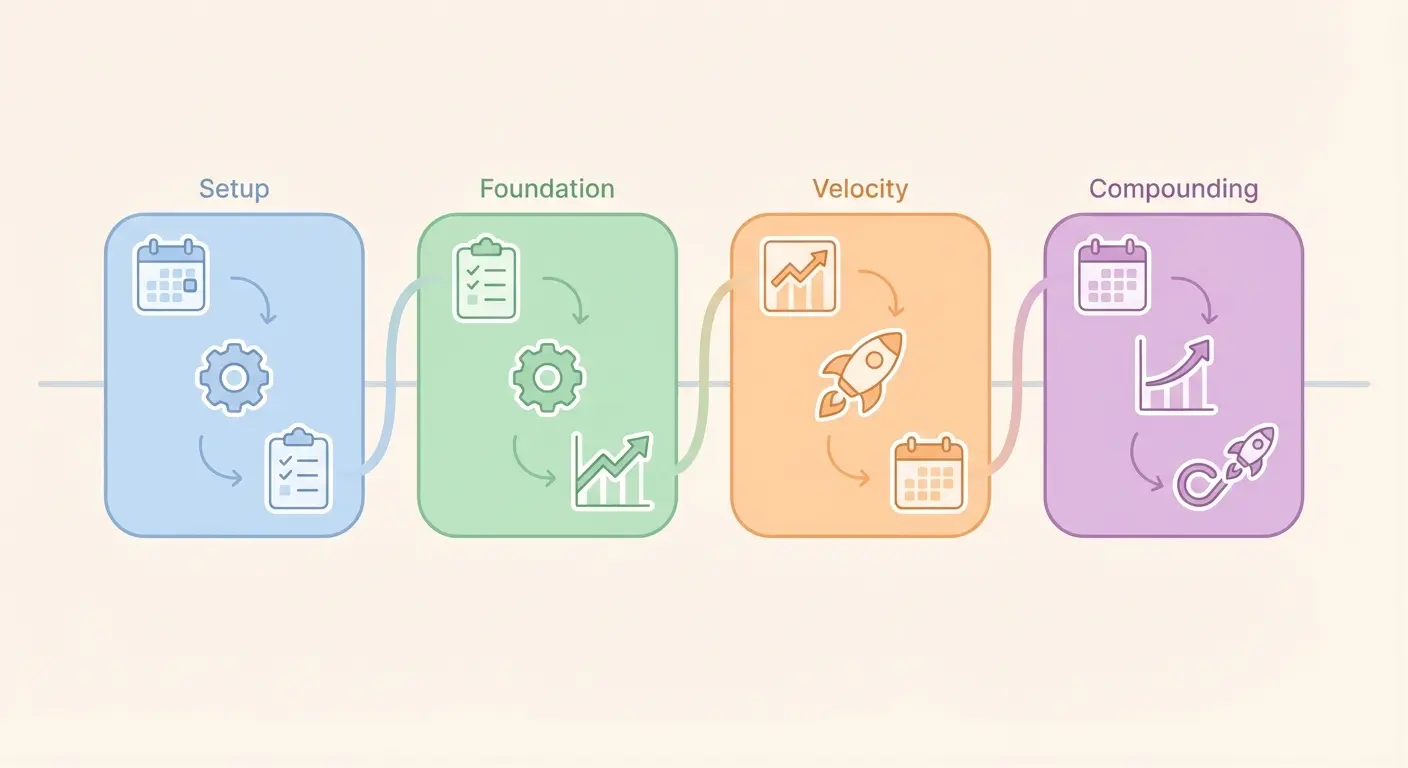
Here’s the framework broken into three phases:
Phase 1: Foundation (Days 1-30)
Weeks 1-4 are all about infrastructure. You’re not publishing for rankings yet — you’re setting up the architecture that makes rankings possible.
- Audit your existing content: Identify which pages have ranking potential that’s currently untapped (positions 5-20 for target keywords). These are your quick wins.
- Build your keyword cluster map: Group your target topics into 3-5 pillar themes, each with 8-15 supporting cluster articles. This is the skeleton your AI content engine will fill in.
- Publish your first pillar page: A comprehensive, 3,000+ word resource on your broadest topic. This becomes your internal linking hub.
- Configure your AI production pipeline: Set up your tools, templates, and publishing workflow so you can publish 3-5 pieces per week consistently starting in Phase 2.
Phase 2: Velocity (Days 31-60)
This is where the engine turns on. You’re publishing cluster articles consistently, building internal links back to your pillar, and targeting low-competition long-tail keywords that return traffic quickly — typically 3-6 weeks for new content in less competitive spaces.
- Publish 3-5 cluster articles per week targeting keywords with KD (keyword difficulty) under 30.
- Optimize existing content from your Phase 1 audit — update meta descriptions, improve header structure, add internal links.
- Monitor impressions weekly in Google Search Console. New content typically starts generating impressions within 2 weeks of indexing.
Phase 3: Compounding (Days 61-90)
By Day 60, your early cluster articles are starting to rank. Phase 3 is about reinforcing what’s working and expanding your topical footprint.
- Double down on winning clusters: Which pillar theme is driving the most impression growth? Add 5-10 more supporting articles to that cluster.
- Add second-tier pillars: Start building authority in an adjacent topic area that shares your audience.
- Build backlinks to pillar pages: Even 5-10 quality links to your pillar pages will amplify the authority flow to your entire cluster.
Keyword Strategy Built for Automation at Scale
Your keyword strategy determines whether your AI content engine produces rankings or just fills up a database with unread articles. The distinction matters enormously.
The core principle of automated keyword targeting is specificity over volume. A keyword with 200 monthly searches and KD of 8 will drive more traffic faster than a keyword with 8,000 monthly searches and KD of 75. When you’re running AI SEO automation, you can target hundreds of low-competition keywords simultaneously — which is where the traffic multiplier effect comes from.
For a practical deep dive into building keyword funnels that compound traffic, the long-tail keyword strategy guide covers this exact approach with concrete examples. It’s required reading before configuring your AI content pipeline.
Keyword Clustering for AI Content Production
Before your AI generates a single article, you need your keywords organized into clusters. Here’s the structure that works:
| Content Tier | Keyword Type | Target KD | Monthly Volume | Publishing Priority |
|---|---|---|---|---|
| Pillar Page | Broad head term | 40-70 | 2,000-20,000 | Week 1 (foundation) |
| Cluster Article | Subtopic modifier | 15-35 | 200-2,000 | Weeks 2-8 (velocity) |
| Supporting Content | Long-tail question | 0-15 | 50-500 | Weeks 4-12 (scale) |
| FAQ / Micro-Content | People Also Ask queries | 0-10 | 10-200 | Ongoing (compound) |
Tools like Semrush and Ahrefs both have keyword clustering features worth exploring. For a solid foundation in using Semrush specifically for AI-driven workflows, check out this beginner-friendly Semrush tutorial for AI SEO in 2025 — it covers the exact keyword clustering workflows that feed into an automated content pipeline.
AI Content Strategy That Earns Rankings
Publishing AI-generated content without a strategy is how sites get flagged for thin content or manual actions. Publishing AI-generated content with the right strategy is how sites go from 5,000 to 50,000 monthly sessions in under a year. The difference is entirely in execution.
Here’s what separates AI content that ranks from AI content that doesn’t:
Search Intent Alignment
Every piece of content needs to match the dominant intent behind its target keyword. This isn’t optional. An article targeting “best AI SEO tools” (commercial intent) needs a comparison table and product evaluations — not a definition of AI SEO. Your AI brief must specify the intent type before generation begins.
Topical Depth Over Surface Coverage
Google’s Helpful Content system rewards content that demonstrates genuine expertise on a topic. That means your AI-generated articles need to cover subtopics, address counterarguments, include specific examples, and go beyond what’s already ranking. A tool like Frase.io’s AI content brief generator can help identify the semantic concepts and questions your content needs to cover to compete with current top-ranking pages.
Human Editorial Layer
The highest-performing AI content strategies include a human editorial pass. Not a full rewrite — just a 15-minute review to add a specific data point, a first-person insight, or a nuanced perspective that pure AI generation won’t produce consistently. That’s what pushes content from “good enough to publish” to “good enough to share.”
For a full breakdown of the AI content workflows driving the biggest organic gains right now, the complete guide to AI-powered SEO content strategy covers tooling, pipeline architecture, and the specific prompting frameworks that produce rankable output at scale.
Automated Internal Linking: The Multiplier Most Sites Ignore
If there’s one area where AI SEO automation delivers disproportionate returns, it’s internal linking. Most sites — even well-run ones — have internal link structures that look like they were built by accident. Pages that should rank are isolated. Link equity pools in the wrong places. And fixing it manually across hundreds of articles takes weeks.
Automated internal linking solves this at scale. Here’s how it works in practice:
- Anchor text mapping: Your AI system identifies semantically related anchor phrases in existing content and automatically links them to relevant target pages.
- Hub-and-spoke enforcement: Every cluster article gets an automatic internal link back to its parent pillar, regardless of when it was published. No orphan content.
- New content integration: When a new article goes live, the system scans existing content for relevant anchor opportunities and adds links — so new content immediately inherits equity from older, established pages.
- Link depth control: No important page sits more than 3 clicks from the homepage. The system flags and fixes click-depth issues automatically.
The SEO impact is real and measurable. Sites that fix internal linking architecture typically see a 15-30% lift in impressions from previously underperforming pages within 60 days — without adding a single new piece of content. It’s one of the fastest ROI actions in the entire AI SEO playbook.
The counterintuitive insight? Internal links are more valuable than most people think — not because of PageRank math (though that matters) but because they tell Google how your content is related. Strong internal linking is how you communicate topical authority to search algorithms, not just to users.
Building Topical Authority with Pillar-Cluster Architecture
Topical authority is the reason some sites rank for everything in their niche and others rank for almost nothing — even when their individual articles look similar in quality. The difference is structural.
The pillar-cluster model creates a content ecosystem where each article reinforces the others. Your pillar page signals to Google that you cover a broad topic with depth. Your cluster articles demonstrate that you understand every subtopic within that area. Your supporting micro-content proves you’ve addressed every long-tail question users ask. Together, they create a topical footprint that algorithms read as genuine expertise.
This is the architecture behind every AI SEO automation success story worth studying. For a complete technical breakdown of how to build this architecture — including silo structure, URL taxonomy, and internal link patterns — the pillar-cluster content strategy architecture guide is the most practical resource available on the topic.
How Many Clusters Do You Need?
A practical starting point for most sites:
- New sites (0-6 months old): Build 2-3 topic clusters before branching out. Depth beats breadth at this stage.
- Established sites (6+ months, 50+ pages): Identify your 3 highest-potential topic areas based on existing impressions data, then build out 10-15 cluster articles per pillar.
- Authority sites (100+ ranking pages): Expand to 5-8 pillar themes with full cluster ecosystems. AI automation is essential at this scale — manual management becomes unworkable.
AI SEO Tools and Tech Stack for 2025
The right stack matters — but the wrong stack is a distraction. Here’s the honest breakdown of what each tool category does and which ones are actually worth the spend:
| Tool Category | Primary Function | Top Options | Essential? |
|---|---|---|---|
| Keyword Research | Cluster mapping, KD analysis, SERP intent | Ahrefs, Semrush | Yes |
| AI Content Generation | Pillar pages, cluster articles, supporting content | Authenova, Surfer AI, Frase | Yes |
| Content Optimization | NLP scoring, semantic coverage, on-page grading | Surfer SEO, Clearscope | Recommended |
| Performance Tracking | Rankings, impressions, CTR, indexing status | Google Search Console, Ahrefs | Yes |
| AI Visibility Monitoring | AI Overview tracking, SGE presence, entity coverage | Semrush One, Ahrefs | Increasingly Yes |
| Publishing Automation | Scheduled publishing, WordPress integration, schema | Authenova, WordPress + plugins | Yes (at scale) |
One area worth paying close attention to in 2025: AI visibility beyond traditional search. Google’s AI Mode is changing how content gets surfaced in search results, and optimizing for it requires a slightly different approach than traditional SEO. The Ahrefs breakdown of Google AI Mode is the clearest explanation of what’s changing and what SEO professionals need to adapt. Worth 20 minutes of your time.
On the monitoring side, running a regular AI visibility audit using Semrush helps you understand whether your content is appearing in AI-generated search responses — a metric that’s becoming as important as traditional rankings. Semrush’s guide to conducting an AI visibility audit walks through the process step by step.

How Authenova Puts SEO on Full Autopilot
Every piece of advice in this guide requires one thing: consistent execution. That’s the part where most teams fall short — not because they lack knowledge, but because manual processes don’t scale.
That’s the problem Authenova was built to solve. It’s an autonomous SEO growth engine that connects directly to your WordPress site, takes your strategy inputs, and runs the entire content production and publishing workflow on autopilot.
Here’s what the platform handles end-to-end:
- AI content generation: Pillar pages, cluster articles, and supporting micro-content — all structured for topical authority from the first draft.
- Automated internal linking: Every new article gets linked to the right pillar and cluster articles automatically. Existing content gets updated with links to new pages. No orphan content, ever.
- Topical authority architecture: Authenova builds your entire pillar-cluster content plan based on your target topics, then executes it systematically.
- Scheduled publishing: Content goes live on a defined schedule so your publishing velocity stays consistent — even when your team is focused elsewhere.
- Schema markup and on-page optimization: Every article includes proper heading structure, meta descriptions, keyword placement, and readability scoring automatically.
- Multi-language support: For teams targeting multiple markets, Authenova can produce and publish content across languages within the same workflow.
The brands using Authenova aren’t just saving time — they’re growing organic traffic at rates that would require a team of 5-8 content specialists to replicate manually. You can test the full workflow against your own site with a free trial, no credit card required.
Ready to put your SEO on autopilot?
Connect your WordPress site, define your strategy, and let Authenova’s AI generate and publish optimized, topically-structured content on a consistent schedule — while you focus on growing your business.
Measuring Results: Metrics That Actually Matter
One of the most common mistakes in AI SEO automation is measuring the wrong things. Publishing velocity is not a success metric. Neither is word count. Here’s what to actually track — and at what intervals:
Weeks 2-4: Leading Indicators
- Indexing rate: What percentage of your published content is indexed within 7 days? Below 80% signals technical issues.
- Impressions growth: Are new articles appearing in Google Search Console within 2 weeks of publishing? This is your earliest traffic signal.
- Click-through rate on new pages: If impressions are growing but CTR is flat, your title tags and meta descriptions need optimization.
Weeks 5-8: Momentum Metrics
- Position tracking on cluster keywords: Target KD 0-30 keywords should start appearing in positions 10-30 within 3-5 weeks for a site with existing domain authority.
- Pages per session: Good internal linking should push this above 2.5 as users follow topically related content.
- Crawl budget efficiency: Googlebot should be discovering and recrawling your cluster content regularly. Check crawl stats in GSC.
Weeks 9-13: Outcome Metrics
- Total organic sessions (month-over-month): Target 40-60% growth by Day 90 if you’re publishing 3-5 pieces per week on a site with moderate existing authority.
- Keywords in top 10: Track how many of your target cluster keywords have moved into the first page. This is the most direct measure of topical authority building.
- Organic traffic value: Ahrefs’ “Traffic Value” metric shows what your organic traffic would cost in paid search — a useful way to quantify the ROI of your AI SEO investment.
Fair warning: results will vary by domain age, existing authority, and niche competition. A 3-year-old domain with 50 existing ranking pages will see faster compounding than a brand-new site. Set benchmarks based on your current baseline, not on case studies from sites with different starting points.
Your 90-Day AI SEO Action Checklist
Here’s the full execution checklist, ready to drop into your project management tool:
Days 1-7: Setup
- ☐ Connect Google Search Console and verify all properties
- ☐ Run a full content audit (identify pages in positions 5-20)
- ☐ Set up keyword research tools (Ahrefs or Semrush)
- ☐ Define 3-5 core topic pillars aligned with your product/service
- ☐ Build keyword cluster map (pillar + 10-15 clusters per pillar)
- ☐ Configure AI content generation workflow (Authenova or equivalent)
Days 8-30: Foundation
- ☐ Publish first pillar page for highest-priority topic
- ☐ Optimize top 10 existing pages (title tags, internal links, schema)
- ☐ Publish 3 cluster articles per week targeting KD under 25
- ☐ Set up automated internal linking rules
- ☐ Submit sitemap to GSC and verify indexing
Days 31-60: Velocity
- ☐ Increase publishing to 4-5 cluster articles per week
- ☐ Publish second pillar page for priority topic #2
- ☐ Review GSC impressions weekly — flag any ranking pages for optimization
- ☐ Run AI visibility audit to identify AI Overview presence
- ☐ Begin outreach for 5-10 backlinks to primary pillar pages
Days 61-90: Compounding
- ☐ Identify top-performing cluster topics and expand with 5-10 supporting articles
- ☐ Publish third pillar page for priority topic #3
- ☐ Update pillar pages with new data, statistics, and internal links to new cluster content
- ☐ Run full content performance review: which pieces are in top 20 vs. beyond page 2?
- ☐ Set 90-day benchmarks for next quarter based on current trajectory
For a deeper look at keyword research workflows that feed into this checklist, this keyword research tutorial for Google and AI SEO is one of the clearest practical walkthroughs available — especially useful for teams setting up their first automated keyword clustering system.
Frequently Asked Questions
What is AI SEO automation and how does it work?
AI SEO automation uses machine learning tools to handle keyword research, content creation, on-page optimization, internal linking, and performance monitoring without manual intervention for each task. A typical AI SEO workflow connects keyword data from tools like Ahrefs or Semrush to an AI content generator, which produces optimized articles following a pillar-cluster architecture, then automatically publishes and links them through a CMS integration like WordPress. The result is the ability to produce and publish 10-20x more optimized content than a traditional manual team.
Does Google penalize AI-generated content?
No — Google explicitly states that it does not penalize AI-generated content as long as the content meets E-E-A-T standards (Experience, Expertise, Authoritativeness, Trustworthiness) and genuinely helps users. Google’s guidance on generative AI content confirms that the method of production is irrelevant; what matters is quality, helpfulness, and accuracy. Low-quality, spammy, or deceptive AI content will be penalized — just as low-quality human-written content would be.
How long does it take to see results from AI content automation?
Most sites start seeing impressions growth within 2-3 weeks of publishing AI-generated content on low-competition keywords. Meaningful click and traffic growth typically appears between weeks 4-8, with significant compounding visible by the 90-day mark. Sites with existing domain authority (DA 30+) and consistent publishing schedules of 3-5 articles per week regularly report 50-100% organic traffic growth within a quarter.
How many articles should I publish per week with AI SEO automation?
The optimal publishing frequency depends on your domain authority and content quality. For most sites, 3-5 well-structured cluster articles per week produces strong results without triggering quality concerns. Starting at 3 articles per week is advisable for newer sites, scaling to 5+ per week once you’ve confirmed that published content is indexing and ranking. Publishing volume alone isn’t the goal — each article needs to target a specific keyword cluster and link correctly to your pillar pages.
What’s the difference between AI content automation and traditional SEO content production?
Traditional SEO content production involves manual keyword research, human writer briefing, editing cycles, and manual publishing — a process that typically takes 5-10 hours per article. AI SEO automation compresses most of that workflow to minutes per article while maintaining structural and semantic quality through templated briefs and NLP optimization. The key difference isn’t just speed — it’s the ability to build complete topical authority across an entire keyword cluster in weeks rather than years.
Can AI SEO automation work for small or new websites?
Yes — new sites can benefit significantly from AI content automation because starting with a deliberate pillar-cluster architecture from day one builds topical authority faster than the random publishing patterns most new sites follow. The key adjustment for new sites is to target very low competition keywords (