
Topical Authority SEO: Boost Organic Traffic in 90 Days
Topical authority SEO separates websites that dominate their niche from those perpetually stuck on page two. You’ve published dozens of articles. Your technical SEO is clean. Backlinks are trickling in. But Google still treats your site like a newcomer every time you target a competitive keyword. Sound familiar?
The problem isn’t your writing. It’s not your domain age. What’s missing is a structural signal — one that tells Google’s systems you don’t just cover a topic, you own it. That signal is topical authority, and when built correctly through a pillar-cluster content strategy, it can shift organic traffic trajectories in under 90 days.
This guide breaks down exactly how.
What Is Topical Authority SEO?
Google’s systems don’t just evaluate individual pages — they evaluate domains. Specifically, they assess how thoroughly and accurately a domain covers a given subject relative to everything else published on the web. This is the core premise behind topical authority.
The concept draws heavily from Information Retrieval theory, particularly the work on document relevance scoring and entity-based search. Google’s Hummingbird (2013), RankBrain (2015), and BERT (2019) updates progressively shifted ranking signals away from exact-match keywords toward semantic understanding of topics and relationships between them.
Koray Tuğçu, widely cited in SEO circles for his research on topical authority, describes it as a function of “topical coverage breadth multiplied by depth” — meaning it’s not enough to write one exceptional pillar post. Google needs to see that your site can answer every meaningful question within a topic domain, from foundational definitions to hyper-specific edge cases.
What most people miss is the trust threshold concept. Before your site earns topical authority for a given cluster, Google essentially applies a kind of citation tax — your pages rank lower than they deserve until coverage reaches a critical mass. Once you cross that threshold, rankings lift across the entire cluster, not just for individual posts. That’s the 90-day inflection point this guide is designed to reach.
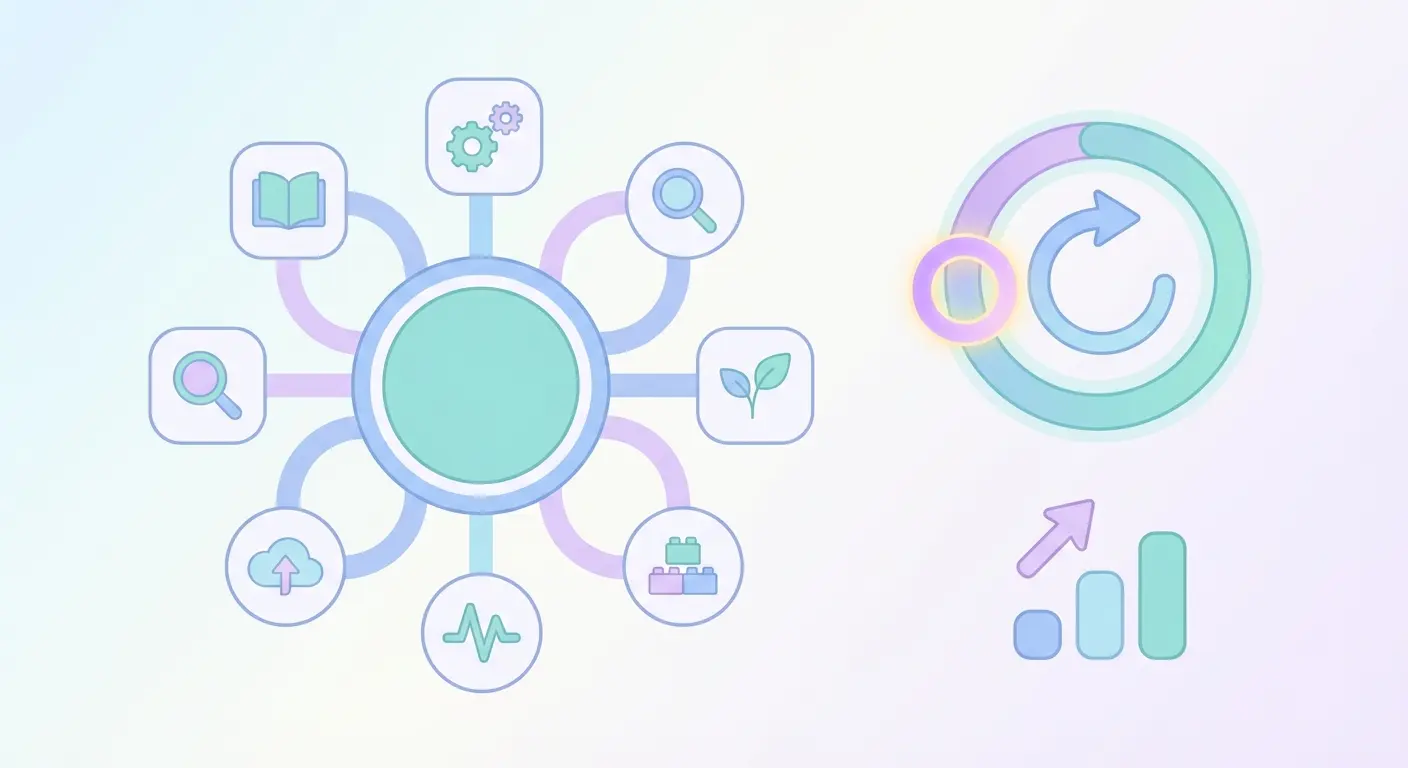
For a deep research foundation on this mechanism, the Topical Authority in SEO: The Definitive Framework for Building Domain Expertise explores the four-phase authority model with peer-sourced evidence.
Why Topical Authority Outperforms Traditional SEO
Traditional SEO operated on a simple assumption: target a keyword, optimize a page, build links to that page. That model worked reasonably well when Google’s algorithms were primarily string-matching engines. It’s increasingly unreliable now.
Here’s where it gets interesting: a 2023 analysis by Ahrefs found that websites with strong topical coverage consistently outranked higher-DR competitors on cluster-related keywords — even without page-specific backlinks. The authority of the domain’s subject-matter depth was doing the ranking work.
Compare the two models directly:
| Dimension | Traditional SEO | Topical Authority SEO |
|---|---|---|
| Core ranking signal | Page-level backlinks | Domain-level content coverage |
| Content strategy | Individual high-volume targets | Interconnected topic clusters |
| Keyword targeting | Primary + exact-match variants | Full semantic keyword universe |
| Internal linking | Ad hoc, opportunistic | Deliberate, hub-and-spoke architecture |
| Traffic resilience | Volatile — one page, one risk | Stable — cluster distributes authority |
| Time to ranking impact | 6–18 months per page | 60–90 days (cluster-wide lift) |
The compounding effect is the real advantage. Every new cluster page you publish doesn’t just rank on its own — it strengthens every other page in the cluster. HubSpot’s original research on topic clusters (which helped popularize the model in 2017) demonstrated this: after restructuring their blog into pillar-cluster architecture, they saw organic search traffic increase by 51% within six months. That’s cluster compounding at work.
There’s also a practical moat dimension. Once your site achieves genuine topical authority on a subject, new entrants face an asymmetric challenge. They’re not just competing with one of your pages — they’re competing with your entire content ecosystem.
Pillar-Cluster Content Strategy Explained
The pillar-cluster model is the structural implementation of topical authority SEO. Understanding its architecture is non-negotiable for anyone serious about organic growth.
A pillar page is a high-level, authoritative resource that covers a broad topic comprehensively — without going exhaustively deep on every subtopic. Think of it as a definitive overview that contextualizes the full scope of a subject. It targets a high-volume, head-term keyword and earns its authority by being the hub that connects to all surrounding cluster content.
Cluster pages are the supporting articles. Each one goes deep on a specific subtopic that the pillar page introduces but doesn’t fully explore. They target longer-tail, more specific keywords. Every cluster page links back to the pillar, and the pillar links out to each cluster — creating a closed content loop that concentrates topical relevance signals.

The internal linking structure isn’t decorative. According to Semrush’s research on topic clusters, pages within a well-structured cluster receive significantly stronger PageRank distribution than isolated pages targeting similar keywords. The architecture itself is a ranking signal.
For an architectural deep dive — including specific implementation phases, content gap analysis workflows, and how to measure cluster performance over time — the guide on Pillar-Cluster Content Strategy: Architecture for Topical Authority provides the complete technical blueprint.
The Three Content Layers
Most practitioners think in two layers (pillar + clusters). The highest-performing topical authority systems actually operate in three:
- Pillar Page (L1): Broad topic overview, 3,000–5,000 words, targets head keyword, links to all L2 pages. Example: “Content Marketing Strategy.”
- Cluster Pages (L2): Subtopic deep-dives, 1,500–2,500 words, target middle-tail keywords. Example: “Content Marketing KPIs” or “B2B Content Marketing Examples.”
- Supporting Pages (L3): Highly specific, question-answering content, 800–1,500 words, targets long-tail queries. Example: “How to Calculate Content Marketing ROI” or “What Is a Content Marketing Funnel Stage?”
L3 pages are where most topical authority builders leave traffic on the table. These hyper-specific pages are precisely what triggers Google’s trust threshold — they demonstrate you can answer the granular questions that only genuine subject-matter expertise produces.
The 90-Day Topical Authority Framework
The 90-day timeline isn’t arbitrary marketing copy. It’s based on Google’s crawl-and-reassessment cycles, the typical time required to build a minimum viable cluster (8–15 pieces), and observed ranking lift patterns across documented case studies.
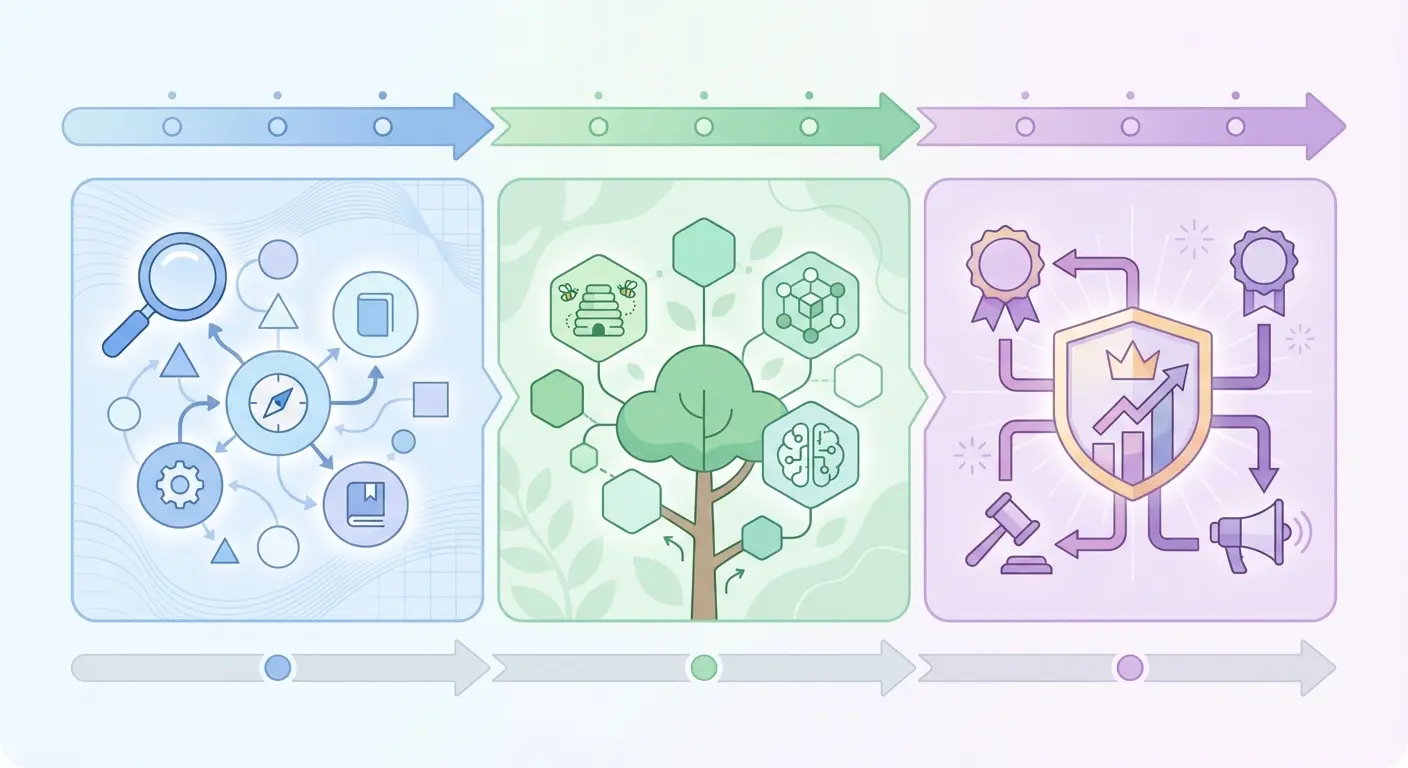
Here’s the framework, broken into three 30-day phases:
Phase 1 (Days 1–30): Topic Domain Mapping
Before publishing a single word, map your entire topic territory. This is the work most sites skip — and it’s why they plateau.
- Select your core topic domain: Choose a subject where you can realistically claim expertise and where search demand exists across the full funnel. Avoid topics that are either too broad (content marketing — owned by industry giants) or too narrow (one specific tool feature — insufficient search volume).
- Build your semantic keyword universe: Use tools like Semrush’s Keyword Strategy Builder to identify every meaningful keyword cluster within your topic domain. Group them by intent, not just volume.
- Audit existing content: Identify what you already own, what needs updating, and where the true gaps are. Most established sites have 40–60% of the content they need — just poorly structured.
- Design your architecture: Map which content will serve as L1 (pillar), L2 (cluster), and L3 (supporting). This is your content blueprint for the next 60 days.
- Establish baseline metrics: Record current organic impressions, average position, and organic sessions for all existing pages in your topic domain. You need a real baseline to demonstrate 90-day gains.
Phase 2 (Days 31–60): Cluster Build-Out
This is the execution phase. Speed matters here — Google needs to see a cluster forming, not isolated posts appearing weeks apart.
- Publish or update your pillar page first: It needs to exist before cluster pages can link back to it. A strong pillar page published without cluster support still signals intent to Google.
- Publish 6–8 cluster pages: Aim for 2 per week minimum. Each one should target a distinct keyword intent, link back to the pillar, and cross-link to at least one other cluster page where contextually relevant.
- Populate L3 supporting content: Target the specific questions and long-tail queries that your cluster pages surface but don’t fully answer. These are your traffic multipliers. The guide on long-tail keyword strategy as an SEO growth engine outlines a systematic approach to capturing this incremental demand.
- Submit sitemaps and request indexing: Use Google Search Console’s URL Inspection tool to request indexing for every new page as it goes live. Don’t wait for Googlebot to discover them organically.
Phase 3 (Days 61–90): Authority Consolidation
By day 60, if your cluster is properly structured, you’ll start seeing early ranking movements. Phase 3 is about consolidating and amplifying those signals.
- Identify pages gaining traction: Look for cluster pages moving into positions 8–15. These are your immediate optimization targets — a focused update can push them into the top 5.
- Add depth to underperforming pages: Pages not ranking yet often have thin semantic coverage. Add expert insights, data points, FAQ sections, or structured data to increase topical signal density.
- Build contextual backlinks to cluster pages: At this stage, targeted outreach for 3–5 editorial links to your pillar page will have a disproportionate positive effect on the entire cluster, not just the pillar.
- Expand to adjacent topic domains: Once the first cluster shows measurable authority, begin mapping the next adjacent topic. Each new cluster you build will receive a faster authority lift because your domain’s overall topical trust is accumulating.
Keyword Mapping and Semantic Clustering
Keyword mapping for topical authority works fundamentally differently than traditional keyword research. The goal isn’t to find high-volume, low-competition keywords in isolation. It’s to build a complete map of the semantic territory your topic occupies.
Google’s Knowledge Graph and entity recognition systems evaluate content not just for what words appear, but for which entities and relationships those words represent. A well-mapped cluster page doesn’t just target “email marketing automation” as a keyword — it covers the entities Google associates with that concept: drip campaigns, segmentation triggers, behavioral email, marketing automation platforms (Mailchimp, HubSpot, Klaviyo), and their relationships to conversion rate optimization.
The Semantic Keyword Mapping Process
Start with your head term and expand outward in four directions:
- Definitional queries: “What is X,” “X definition,” “X meaning” — these anchor your L1 and foundational cluster pages.
- How-to queries: “How to do X,” “X tutorial,” “X for beginners” — these populate your L2 cluster pages with instructional content.
- Comparison queries: “X vs Y,” “best X tools,” “X alternatives” — these create high-converting cluster pages that often carry commercial intent.
- Troubleshooting and edge-case queries: “X not working,” “why does X happen,” “X for [specific use case]” — these are your L3 supporting pages, and they’re where topical authority is actually proven to Google.
What most people miss in this process: negative space mapping. Identify what your competitors’ clusters are not covering. Those gaps are your fastest path to topical authority differentiation. A cluster that covers the same subtopics as every competitor offers Google no reason to rank you preferentially. Original coverage of under-served subtopics does.
Backlinko’s analysis of topic clusters found that pages targeting semantic keyword variants (rather than exact-match repetitions) consistently outperformed single-keyword-targeted pages in the same cluster — reinforcing that Google’s evaluation of topical relevance is entity-based, not term-frequency-based.
Measuring Topical Authority Gains
One of the persistent challenges in topical authority SEO is measurement. Unlike link-building, where you can count acquired links, topical authority accrual is a composite signal — which means you need a composite measurement approach.
Track these six metrics as your primary authority indicators:
- Cluster Organic Impressions (30-day rolling): Measure total impressions for all URLs within your cluster in Google Search Console. A rising impressions curve before rankings improve is a leading indicator of authority accrual — Google is surfacing your pages in SERPs before deciding to rank them prominently.
- Average Position (Cluster-Wide): Track the average position across all cluster pages, not just the pillar. A gradual improvement from 35 → 22 → 14 across the cluster over 90 days is the topical authority lift pattern.
- Indexed Page Count per Topic: Verify that all cluster pages are indexed. Unindexed pages contribute zero topical signal. A surprising number of authority-building failures trace back to indexing issues.
- Internal Link Coverage: Every cluster page should have at least 2–3 contextual internal links (from/to). Run a quarterly audit to catch orphaned content that’s bleeding topical signal.
- Keyword Coverage Expansion: Use Search Console’s query data to see if your cluster is ranking for keyword variants you didn’t explicitly target. This is direct evidence that Google recognizes your topical coverage — it’s surfacing you for the broader semantic territory.
- Featured Snippet Acquisition Rate: Clusters with strong topical authority disproportionately capture featured snippets, People Also Ask boxes, and knowledge panel associations. Track snippet captures per cluster as a qualitative authority signal.
Common Mistakes That Kill Topical Authority
Most topical authority failures aren’t failures of effort. They’re failures of architecture. Here are the five most common structural mistakes — and how to correct them.
1. Targeting Too Many Topic Domains Simultaneously
Spreading content production across five or six unrelated topic clusters is the fastest way to achieve topical authority for none of them. Google needs to see concentrated expertise. Pick one or two topic domains and build them to a minimum viable cluster (10–15 pages) before expanding. Depth before breadth — always.
2. Orphaned Cluster Pages
A cluster page with no internal links pointing to it is invisible to Google’s topical authority assessment. It’s not enough to publish the page — you need to ensure the pillar page links to it, and ideally 2–3 other cluster pages reference it contextually. Run a monthly internal link audit using Screaming Frog or Semrush’s Site Audit to catch orphaned content early.
3. Pillar Pages That Are Too Thin
Some practitioners publish pillar pages that are essentially long tables of contents with brief introductions to each subtopic. That’s not a pillar — it’s a navigation page. Pillar pages need to provide genuine standalone value: expert analysis, original frameworks, data, and actionable guidance. The target benchmark is 3,000+ words of substantive content, not 3,000 words of padded text.
4. Ignoring Search Intent Differentiation
Cluster pages need to serve distinct search intents, not just distinct keywords. If two of your cluster pages both target informational intent on the same subtopic with different keyword phrasings, you’re creating cannibalization, not coverage. Map each cluster page to a unique intent-keyword intersection before writing.
5. Publishing Without a Refresh Schedule
Topical authority isn’t a build-it-and-forget-it project. Google’s freshness algorithms reward content that’s actively maintained. A quarterly refresh schedule — reviewing for outdated data, adding new insights, updating internal links — is the difference between a cluster that sustains authority for 3 years and one that erodes within 12 months.
Tools for Building Topical Authority
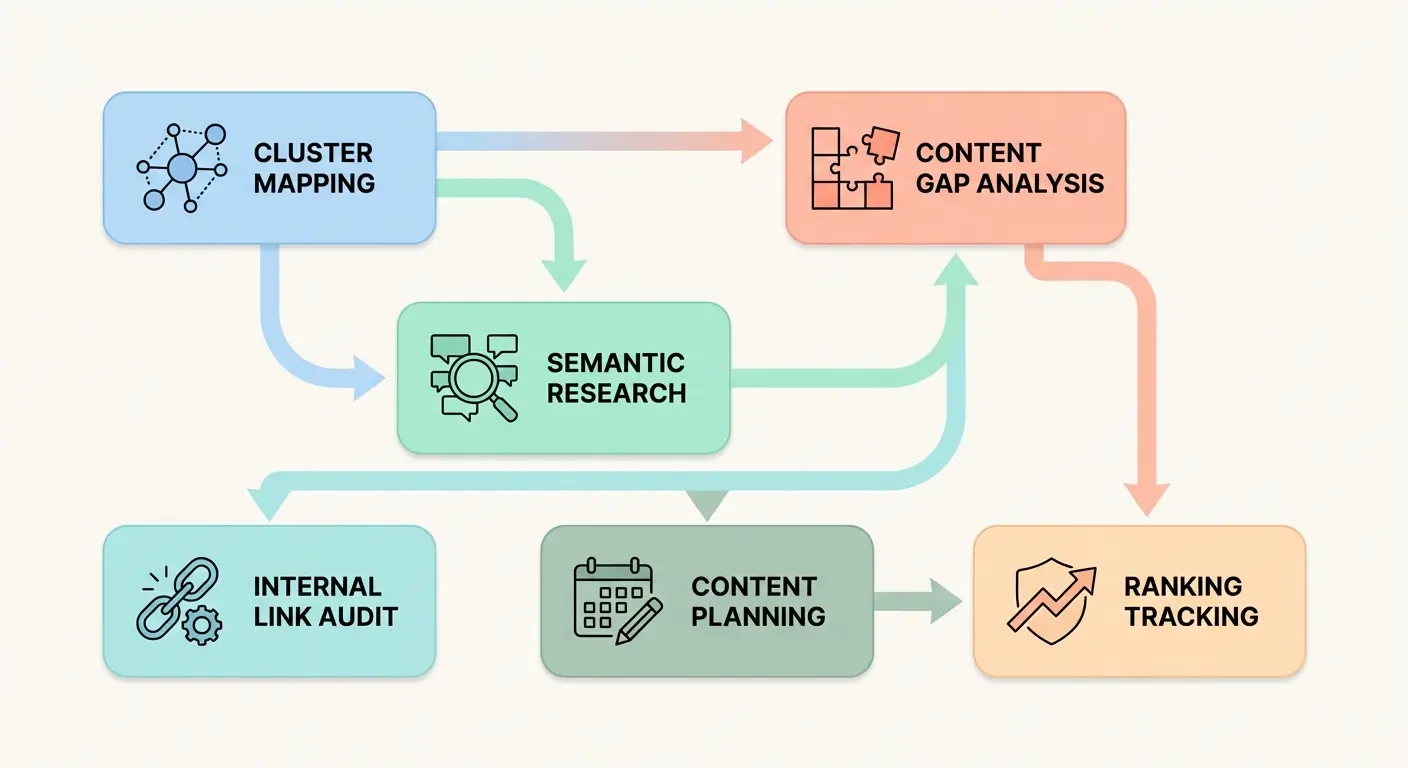
The right toolset doesn’t build topical authority — strategy and execution do. But the right tools accelerate both significantly. Here’s the stack that professional SEO teams actually use:
| Function | Tool | Primary Use Case |
|---|---|---|
| Cluster Mapping | Semrush Keyword Strategy Builder | Auto-generates topic clusters from seed keywords |
| Semantic Research | Ahrefs Keywords Explorer | Identifies semantic keyword variants and intent groups |
| Content Gap Analysis | Ahrefs Content Gap / Semrush Gap Analysis | Identifies subtopics competitors rank for that you don’t |
| Internal Link Audit | Screaming Frog SEO Spider | Maps internal link graph, finds orphaned pages |
| Ranking Tracking | Google Search Console | Cluster-wide impressions and position data |
| Content Planning | HubSpot’s Topic Cluster Tool | Visualizes pillar-cluster relationships and coverage |
The Conductor Topic Cluster guide also provides a practical free pillar page template that’s useful for standardizing your L1 content structure across multiple clusters.
For teams newer to the pillar-cluster model, HubSpot Academy’s lesson on creating topic clusters and pillar pages offers a structured introduction that complements the technical framework described here.
One counterintuitive note on tooling: the best topical authority insight often comes from manual SERP analysis, not software dashboards. Spend time reading the top 5 results for your target cluster keywords. Identify what they cover, where they’re shallow, and what questions they leave unanswered. That manual analysis will generate cluster content ideas that no tool’s algorithm would surface.
Your 90-Day Topical Authority SEO Checklist
Print this. Bookmark it. Run through it once a month to confirm you’re on track.
Foundation (Before Day 1)
- ☐ Selected primary topic domain with verified search demand
- ☐ Built complete semantic keyword universe (minimum 50 keywords)
- ☐ Grouped keywords into intent-based clusters
- ☐ Mapped L1/L2/L3 content architecture on paper
- ☐ Audited and categorized all existing content
- ☐ Established baseline metrics in Google Search Console
Month 1 (Days 1–30)
- ☐ Published pillar page (L1) — minimum 3,000 words
- ☐ Published 4–6 cluster pages (L2) with pillar backlinks
- ☐ All new URLs submitted for indexing via Search Console
- ☐ Internal link audit confirms no orphaned cluster pages
- ☐ Pillar page links out to all live cluster pages
Month 2 (Days 31–60)
- ☐ Published remaining cluster pages (target: 12–15 total)
- ☐ Published 4–6 supporting (L3) pages targeting long-tail queries
- ☐ Added structured data (FAQ schema, HowTo schema) where appropriate
- ☐ Cross-links added between contextually related cluster pages
- ☐ First ranking movement check — document cluster-wide average position
Month 3 (Days 61–90)
- ☐ Identified top-moving cluster pages for targeted optimization
- ☐ Refreshed any pillar or cluster page with outdated data
- ☐ 3–5 editorial backlinks acquired for pillar page
- ☐ Featured snippet opportunities identified and targeted
- ☐ 90-day metrics comparison: impressions, average position, organic sessions
- ☐ Next topic domain mapped and ready for Phase 1
Frequently Asked Questions
How long does it take to build topical authority in SEO?
Most sites see measurable ranking improvements within 60–90 days of launching a complete topic cluster (10–15 interconnected pages). Full topical authority — where your domain earns consistent top-3 rankings across a cluster without page-level link building — typically takes 4–8 months depending on competition, crawl frequency, and content quality. Newer domains with less existing authority may take longer to cross the trust threshold.
What is the difference between topical authority and domain authority?
Domain Authority (DA) is a third-party metric from Moz that estimates a site’s overall backlink strength — it doesn’t measure content coverage. Topical authority is Google’s internal assessment of how deeply and accurately your site covers a specific subject, built through content breadth, semantic depth, and internal link architecture. A site with DA 30 can outrank a DA 70 competitor on cluster keywords if its topical coverage is demonstrably stronger.
How many cluster pages do I need for a topic cluster to work?
A minimum viable cluster requires 8–12 pages (1 pillar + 7–11 cluster/supporting pages) to generate detectable topical authority signals. However, the most competitive topic domains require 20–40 pages of coverage before meaningful ranking lift appears. The right number depends on how many distinct subtopic intents exist within your chosen domain — map those first, then build to cover them systematically.
Does topical authority replace the need for backlinks?
No — backlinks remain an important ranking signal, particularly for highly competitive keywords. What topical authority changes is the leverage of backlinks. A cluster with strong topical authority gains more ranking benefit from each backlink acquired than an isolated page would. For moderate-competition keywords, topical authority alone can be sufficient to rank without targeted link building. For high-competition head terms, you need both.
What is a pillar page in content marketing SEO?
A pillar page is the central hub of a topic cluster — a long-form, authoritative resource that broadly covers a core topic while linking out to detailed cluster pages on each subtopic. It targets a high-volume head keyword, provides genuine standalone value (typically 3,000–5,000 words), and serves as the topical authority anchor that all cluster pages link back to, concentrating relevance signals for the entire cluster.
Can small or new websites build topical authority effectively?
Yes — and topical authority is actually a strategic advantage for smaller sites. Rather than competing with high-DA domains on broad terms, a new site can select a narrowly defined topic domain, build comprehensive cluster coverage within it, and achieve authority faster than attempting to compete across multiple broad subjects. Niche focus is a feature, not a limitation, when building topical authority from a low-authority baseline.
Share This Framework. Extend the Conversation.
Topical authority SEO isn’t a tactic — it’s an organizational approach to content that compounds over time. If this framework added clarity to how you think about content architecture and organic growth, share it with the strategists and content leads who’d benefit from it.
Ready to go deeper? Explore these connected resources:
- The Definitive Framework for Building Domain Expertise in SEO — the research-backed four-phase model behind the 90-day approach.
- Pillar-Cluster Architecture: Implementation Guide — the technical blueprint for cluster design, phase rollouts, and performance measurement.
- Long-