SEO Content Calendar: 5-Step Research Model for Authority
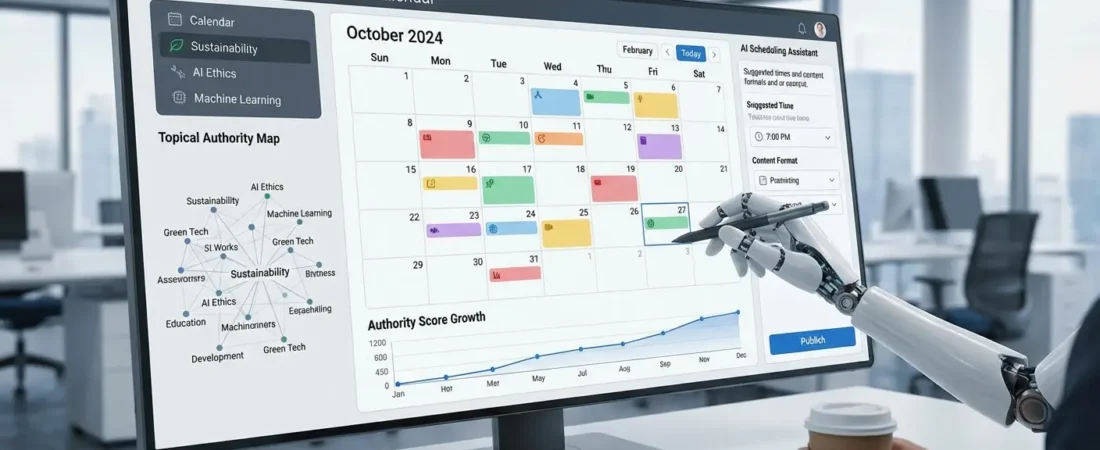
Most enterprise SEO content calendars are nothing more than editorial schedules dressed up in strategy clothing. They tell you when to publish, but they can’t tell you what to own. The result? Teams producing hundreds of articles per year that collectively move zero ranking needles — because the content is scattered across topics, disconnected from search intent clusters, and invisible to Google’s increasingly sophisticated semantic understanding of domain expertise.
Here is the real problem: topical authority and AI-driven content strategy for enterprise SEO have fundamentally changed what a content calendar needs to do.
It’s not a publishing schedule anymore. It’s a territorial claim on a subject domain — and without a research model behind it, you’re just generating noise.
Why Traditional Content Calendars Fail Enterprise SEO
The evidence is damning and consistent: Ahrefs’ analysis of topical authority signals repeatedly shows that sites publishing broad, disconnected content on loosely related topics consistently underperform against narrowly focused, topically coherent competitors — even when the latter have significantly fewer backlinks.
Traditional content calendars were designed for a different era. They optimized for publication frequency, editorial consistency, and keyword-level traffic. Each was a reasonable goal — for 2015. Google’s algorithms have since incorporated neural embeddings, entity recognition, and passage-level indexing. The semantic relationships between your content pieces now signal as much about your authority as any individual article’s on-page optimization.
What most people miss is that Google doesn’t evaluate content in isolation. The Helpful Content system and the broader Panda-lineage algorithms assess the entire site’s contribution to a topic. A single exceptional article surrounded by shallow, unrelated content loses authority signal. A network of 40 tightly clustered articles on a narrow subject domain — even if individually less polished — builds the kind of topical coherence that ranking systems reward.
The fix isn’t a better spreadsheet template. It’s a research model that defines the territory you’re claiming before a single word is written. That’s what the 5-step model below delivers.
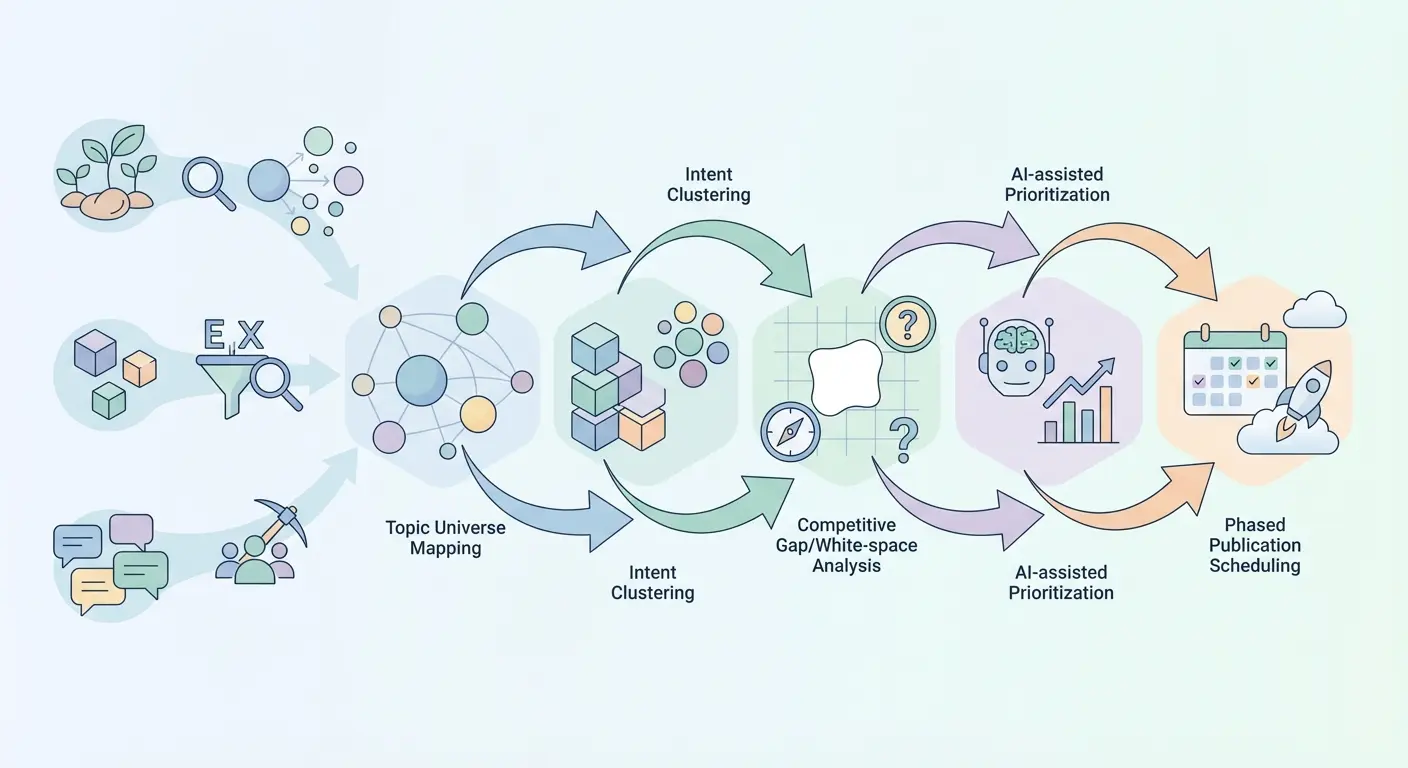
The 5-Step Research Model for an Authority-Building SEO Content Calendar
This model synthesizes established content strategy principles with the operational requirements of enterprise SEO programs running at scale. It’s designed to work whether your team produces 10 articles per month or 200 — and it’s built to survive Google algorithm updates because it mirrors how Google itself models topical expertise.
Step 1: Topic Universe Mapping
Before you schedule a single piece of content, you need a complete topographic map of your subject domain. Not a keyword list. A topic universe.
A topic universe is a structured taxonomy of every question, concept, process, entity, and sub-domain that a true expert in your field would need to address. It’s the difference between “we write about SEO” and “we have documented coverage of technical SEO, on-page optimization, link acquisition, local search, schema markup, Core Web Vitals, content strategy, and AI-assisted workflows — with internal cross-referencing between all nodes.”
Practically, you build this using three parallel research streams:
- Seed Keyword Expansion: Start with 5-10 core terms your audience universally searches. Expand through Semrush’s Topic Research, Ahrefs’ Content Explorer, or Answer the Public’s question graph to surface second and third-level subtopics.
- Entity Extraction: Use Google’s Natural Language API or a tool like InLinks to identify the entities (people, organizations, concepts, events) Google associates with your primary topic. These entities become mandatory content nodes.
- Forum and Community Mining: Reddit, LinkedIn communities, industry Slack groups, and G2/Capterra review sections contain the raw, unfiltered questions your audience actually asks. These are gold mines for long-tail nodes that keyword tools consistently miss.
The output of Step 1 is a topic taxonomy — typically 80-300 nodes for a serious enterprise program — organized into pillar topics, cluster subtopics, and supporting question pages. This taxonomy becomes the permanent backbone of your content calendar.
For the architectural layer of this work — how to organize pillar pages and cluster content structures — the pillar-cluster content strategy architecture framework provides the implementation blueprint that maps directly onto the universe you’ve just built.
Step 2: Search Intent Clustering
Not all nodes in your topic universe carry equal strategic weight — and volume alone is a misleading prioritization signal. What matters is the intent profile of each cluster.
Search intent is more nuanced than the standard informational/navigational/transactional/commercial trichotomy suggests. For enterprise SEO, you need a five-layer intent model:
| Intent Layer | User Signal | Content Format | Authority Value |
|---|---|---|---|
| Definitional | “What is X?” | Glossary, hub page | High — featured snippet capture |
| Procedural | “How do I do X?” | Step-by-step guide, tutorial | Very High — E-E-A-T signal |
| Comparative | “X vs. Y” | Comparison article, table | High — commercial intent |
| Diagnostic | “Why is X happening?” | Problem-solution article | Medium-High — trust builder |
| Validation | “Is X worth it?” | Research synthesis, case study | High — decision stage |
Intent clustering groups your topic universe nodes by this intent profile rather than by semantic similarity alone. A cluster on “enterprise content auditing” might contain definitional, procedural, diagnostic, and validation content — each serving a different stage of the audience’s journey, but all reinforcing the site’s authority on that subject.
The practical output of Step 2 is a priority matrix that cross-references intent type with business value and audience stage. This prevents the common failure mode of publishing 30 definitional articles that compete with each other while leaving the procedural and diagnostic angles — where real expertise signals live — completely unaddressed.
Step 3: Competitive Gap and White-Space Analysis
Here’s where the calendar stops being theoretical and starts making real strategic decisions.
Competitive gap analysis for authority building isn’t just “what keywords do competitors rank for that we don’t?” It’s a two-dimensional analysis: identifying gaps in topical coverage and gaps in content quality depth. Both create distinct strategic opportunities.
Coverage gaps are topics your competitors haven’t addressed at all — or have addressed so superficially that a well-researched article would immediately become the definitive resource. These are your white-space opportunities. Semrush’s topical authority research confirms that consistent first-mover advantage on emerging subtopics compounds over time as backlinks and engagement metrics accumulate.
Quality gaps are topics where competitors rank but their content is outdated, shallow, or structurally weak. The classic “10x content” principle applies here: if the ranking article is a 700-word generic overview from 2021, a data-rich, practitioner-level 2,500-word guide published today can outrank it within 90 days with proper internal linking support.
Run this analysis using Ahrefs’ Content Gap tool, Semrush’s Keyword Gap, or a manual SERP audit across your 20-30 highest-priority topic nodes. Document findings in a gap matrix that codes each node as: Own (you rank, they don’t), Contest (both rank, quality differential exists), Attack (they rank, you have a clear superiority angle), or Skip (dominated, low ROI).
The gap matrix directly feeds Step 4’s prioritization model — and it’s the step most enterprise teams skip entirely, which is why their calendars never compound into genuine authority.
Step 4: AI-Assisted Content Prioritization
At enterprise scale, prioritization is the hardest problem. You have 200+ topic nodes, a gap matrix with mixed signals, limited production capacity, and competing stakeholder priorities. Manual prioritization breaks down fast.
This is where AI tooling earns its budget. The model here isn’t “use AI to write content” — it’s “use AI to score and sequence the content production backlog.”
A robust AI-assisted prioritization model scores each topic node across four weighted dimensions:
- Traffic Potential Score (25%): Estimated monthly search volume weighted by click-through rate probability given current SERP features (AI Overviews, featured snippets, People Also Ask boxes).
- Authority Leverage Score (35%): How strongly does this topic node reinforce other nodes in the cluster? Hub articles that are internally linked by 8+ cluster pieces score higher than isolated long-tail articles.
- Competitive Opportunity Score (25%): Gap matrix rating combined with current Domain Rating/Authority differential against ranking competitors.
- Business Alignment Score (15%): Direct connection to revenue-generating products, services, or audience acquisition goals. Non-negotiable for CMO buy-in.
AI tools — whether GPT-4 class models, Clearscope, MarketMuse, or custom Python scripts running against your gap matrix data — can score hundreds of nodes in minutes and produce a ranked production backlog. The human judgment layer sits in validating the scoring weights and overriding edge cases where brand strategy trumps algorithmic ranking.
For the full picture of how AI tooling integrates into content production workflows at this scale, the complete guide to AI-powered SEO content strategy covers automation, velocity scaling, and quality control frameworks that complement this prioritization model.
Step 5: Phased Publication Scheduling
The final step converts your prioritized backlog into an actual calendar — but the sequencing logic here is critical and counterintuitive for many teams.
Most enterprise content programs publish horizontally: spreading production across many topics simultaneously. The authority-building model publishes vertically first — achieving genuine topical depth on one cluster before spreading to adjacent clusters.
The phased approach works in 90-day sprints:
- Phase 1 (Weeks 1-4): Pillar Foundation. Publish or optimize the primary pillar page for your first cluster. This is the 3,000-5,000-word cornerstone that all cluster articles will link to. No cluster articles go live until this page is indexed and optimized.
- Phase 2 (Weeks 5-10): Cluster Saturation. Publish 6-12 cluster articles targeting procedural, diagnostic, and comparative intent nodes within the cluster. Internal linking to the pillar and between cluster articles is mandatory at publication — not retroactive.
- Phase 3 (Weeks 11-12): Supporting and Reinforcement. Publish long-tail supporting articles, FAQ pages, and glossary entries that fill coverage gaps. Update the pillar page with new data and cross-links. Begin monitoring ranking signal lift.
- Phase 4 (Week 13+): Adjacent Cluster Expansion. Only after Cluster 1 shows measurable topical authority signals (ranking movement, organic CTR improvement, AI Overview inclusions) do you initiate Phase 1 for Cluster 2.
This sequencing is the single biggest structural difference between a content calendar built for traffic and one built for topical authority and AI-driven content strategy for enterprise SEO. Patience — and discipline — in the phasing model is what separates programs that compound from those that flatline.

How AI Overviews Change Content Calendar Strategy
The research is clear and the implications are significant. Semrush’s 2025 study on AI Overviews’ impact on search found that AI-generated answer boxes now appear for a substantial and growing percentage of informational queries — directly reducing organic click-through rates for some content categories while dramatically increasing them for others.
The calendar implication? Your topic nodes need to be re-categorized against two new AI Overview signals:
AI Overview Dominated Nodes are topics where Google’s AI compiles an answer from multiple sources. For these, the goal isn’t ranking #1 organically — it’s being cited as a source within the AI Overview itself. That requires structured, citable, data-rich content that reads like an authoritative reference document. The content calendar for these nodes should prioritize depth, schema markup, and original data over length or engagement.
AI Overview Resistant Nodes are topics where AI Overviews don’t appear — typically highly specific procedural content, opinion-driven analysis, case studies, and proprietary research. These remain strong organic click-through opportunities and should be weighted heavily in your calendar’s production allocation.
Google’s own announcements at Google I/O 2024 made clear that Gemini-powered search features will continue expanding. Calendars built without this segmentation are already operating with an outdated strategic model.
To understand the theoretical foundations of why topical coherence matters so much for AI-era search — and what the research says about entity-based ranking signals — the definitive framework for building topical authority in SEO covers the academic and algorithmic basis in detail.
The Calendar Execution Framework: From Model to Action
Research models without operational infrastructure stay in slide decks. Here’s the execution layer that makes the 5-step model function in real enterprise environments.
The Core Calendar Architecture
Your calendar needs four mandatory columns beyond the standard “title, date, author” fields:
- Cluster ID: Which topical cluster does this piece belong to? Every article must map to one primary cluster.
- Intent Layer: Definitional, procedural, comparative, diagnostic, or validation — using the five-layer model from Step 2.
- Internal Link Requirements: Which specific pages must this article link to, and which pages must link back to it? Specified at scheduling, not at publication.
- Authority Milestone: What ranking signal or topical coverage gap does this piece address? Connects individual articles to program-level authority goals.
For teams starting from scratch, HubSpot’s free editorial calendar templates provide a workable starting point for the structural layer — though you’ll need to add the cluster and authority tracking columns manually.
The Research-to-Brief Pipeline
Each scheduled article needs a research brief that captures: the primary and secondary entities the article must address, the competitor articles it needs to outperform, the required data points and original angles, and the internal linking map. Without this pipeline, even a well-sequenced calendar produces shallow content that undermines rather than builds authority.
For question-based research at the brief stage — identifying what real audiences are asking around each topic node — AnswerThePublic remains one of the most efficient tools available for surfacing the raw question vocabulary that makes content feel genuinely responsive to audience needs.
Fair warning: building this pipeline takes 2-4 weeks of setup investment. The return is a content program that doesn’t require constant manual coordination and oversight to maintain strategic coherence.
Governance and Review Cadence
Content calendars drift without governance. Schedule a monthly authority audit — not an editorial review, but a topical coverage audit — that answers three questions: Which clusters are achieving sufficient coverage depth? Where are ranking signals moving in the right direction? Which scheduled articles need to be reprioritized based on new competitive intelligence?
Measuring Topical Authority Progress in Your Content Calendar
Topical authority doesn’t move like traffic. It compounds slowly, then suddenly — and you need the right metrics framework to see it building before the rankings shift.
The measurement model for authority-building content calendars tracks three signal categories:
Leading Indicators (Measure Monthly)
- Topical Coverage Ratio: Percentage of your topic universe with published, indexed content. Target: 70%+ coverage within primary cluster before expanding to secondary clusters.
- Internal Link Graph Density: Average number of internal links pointing to each cluster’s pillar page. A well-connected cluster shows 8-15 internal links to the pillar from cluster articles.
- Featured Snippet Capture Rate: Number of SERP features (featured snippets, People Also Ask boxes, AI Overview citations) captured across your tracked topic universe.
Lagging Indicators (Measure Quarterly)
- Cluster Ranking Velocity: Average ranking position improvement across all articles within a cluster, quarter-over-quarter.
- Brand Entity Recognition: Whether your brand appears in Google’s Knowledge Panel results for your primary topic entities — a clear authority signal.
- Organic CTR by Cluster: Improving CTR across a cluster (not just individual pages) indicates Google is surfacing your content more prominently in response to topical signals.
What most measurement frameworks miss is the distinction between page-level metrics and cluster-level metrics. A single article underperforming on traffic is a page problem. An entire cluster underperforming is a topical authority problem — and it requires a different diagnosis and intervention. For teams building topical authority and AI-driven content strategy for enterprise SEO, this cluster-level lens is what separates programs that scale from those that stall.
Frequently Asked Questions
What is the difference between a content calendar and a topical authority calendar?
A standard content calendar schedules publication dates and assigns authors. A topical authority calendar maps every piece of content to a strategic cluster, intent layer, and internal linking requirement — ensuring that the cumulative body of content builds demonstrable expertise on a defined subject domain rather than producing isolated articles. The research model that precedes the calendar is what makes the difference: topic universe mapping, intent clustering, and competitive gap analysis define the territory before any scheduling decisions are made.
How many articles does it take to build topical authority in a content cluster?
Research from Ahrefs and Semrush suggests that meaningful topical authority signals emerge when a cluster contains 8-15 well-structured articles covering distinct intent layers — one pillar page, 6-10 cluster articles, and 2-4 supporting pieces. However, “enough” is always relative to competitor coverage depth. In highly competitive enterprise categories, 25-40 cluster articles may be necessary to differentiate. The vertical-first phasing model — saturation before expansion — accelerates authority signal accumulation regardless of the absolute number.
How does AI-driven content strategy change the SEO content calendar model?
AI-driven content strategy changes the calendar in two distinct ways. First, AI tools enable more sophisticated topic scoring and prioritization — processing hundreds of nodes against competitive, intent, and business value signals faster than any manual process. Second, the rise of AI Overviews in search results requires calendar teams to segment topic nodes by AI Overview susceptibility, adjusting content format and depth requirements accordingly. Topics where AI Overviews appear need highly structured, citable reference content; topics where they don’t appear remain strong organic click-through opportunities.
What tools are needed to execute a 5-step research model for an SEO content calendar?
The minimum viable toolkit includes a keyword research and gap analysis platform (Ahrefs or Semrush), a question-research tool (AnswerThePublic or AlsoAsked), a content optimization tool for briefs (Clearscope or Surfer SEO), and a project management layer (Notion, Airtable, or a custom Google Sheets architecture). Enterprise programs add AI scoring models, internal link analysis tools like LinkWhisper or Screaming Frog, and analytics dashboards that track cluster-level rather than page-level performance metrics.
How long does it take to see topical authority results from a structured content calendar?
Leading authority indicators — featured snippet captures, People Also Ask appearances, and internal link graph density — typically move within 60-90 days of a cluster reaching saturation. Lagging indicators like sustained ranking position improvements and organic CTR lift across a cluster usually become measurable at the 90-180 day mark. Brand entity recognition, the strongest authority signal, typically emerges after 6-12 months of consistent, high-quality cluster production. Enterprise programs that phase correctly and maintain production discipline see compounding returns accelerate significantly in year two.
Should enterprise SEO teams build topical authority across multiple clusters simultaneously?
The evidence favors vertical-first sequencing — achieving genuine depth within one cluster before expanding laterally — over simultaneous multi-cluster production. Spreading production capacity across 5 clusters simultaneously typically produces thin coverage in each rather than the saturation depth that triggers authority signals. The exception is when enterprise teams have sufficient production velocity (40+ articles per month) to saturate multiple clusters within the same 90-day sprint. In that case, clusters should be chosen for topical adjacency so internal cross-linking between clusters reinforces both.
Build the Content Authority Infrastructure That Compounds
The 5-step research model works. But the execution depth — particularly the architectural layer between topic universe and publication calendar — is where most programs either win or stall.
If this analysis has been useful, three resources will accelerate your program:
- Explore the pillar-cluster content strategy architecture for the implementation detail that connects your topic universe to your actual site structure.
- The definitive topical authority SEO framework covers the research and algorithmic basis for why the model above works — essential reading for teams making the case to senior stakeholders.
- For teams ready to operationalize AI tooling across content production, the AI-powered SEO content strategy guide maps the technology stack to the workflow decisions covered in Step 4.
Share this model with your team, cite it in your own research, or apply it directly. If it changes how your program operates, that’s the outcome worth building toward.