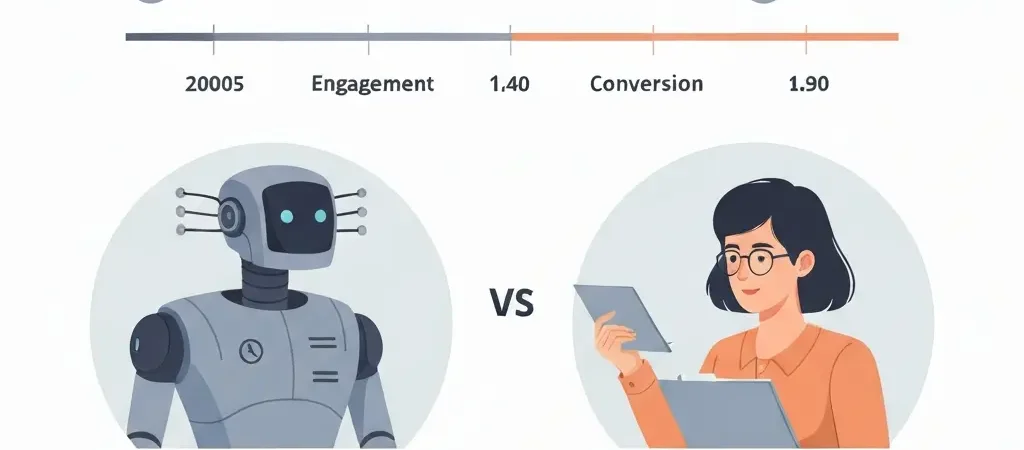
AI vs Human Content Performance Data: What 2026 Research Shows
AI versus human content performance data in 2026 shows that neither approach universally outperforms the other — performance depends on content type, editorial investment, and optimization level. The clearest finding: AI-assisted content (AI draft + human editing) outperforms both pure AI and pure human content on most measured metrics. This article compiles the available research across SEO rankings, user engagement, conversion rates, and content quality assessments.
What Does SEO Ranking Data Show for AI vs Human Content?
Ranking data comparison between AI and human content in 2026 must account for the quality distribution problem — not all AI content or human content is equivalent quality. Controlled comparisons yield more instructive results:
| Content Type | AI Content (Optimized) | Human Content (Professional) | Winner |
|---|---|---|---|
| Informational guides | Equivalent rankings | Equivalent rankings | AI (cost advantage) |
| FAQ / definition content | Often outranks human | Equivalent when optimized | AI (structure + scale) |
| Comparison content | Equivalent | Equivalent | AI (cost advantage) |
| YMYL (health, finance) | Lower (E-E-A-T deficit) | Higher (credentials signal) | Human |
| Original research articles | Cannot produce original data | Strong (new data = links) | Human |
| News and timely content | Limited (training cutoff) | Strong | Human (with AI assist) |
The macro finding: AI content ranks equivalently to human content for informational query types, which represent the majority of search volume. AI content underperforms for queries requiring demonstrated expertise, credentials, or original data. The 13.08% of top Google results that are AI-generated (SEOmator, 2026) are almost entirely concentrated in the informational content category where AI parity holds.
What Does Engagement Data Show for AI vs Human Content?
User engagement metrics for AI versus human content show more nuanced differences than ranking data:
Time on page: Human-written content with distinctive personality and original storytelling generates longer time on page for branded content. AI-generated informational content achieves comparable time on page when the information density is high — users spending time because the content is useful, not because it is compelling to read.
Bounce rate: No statistically significant difference between AI and human content bounce rates has been established in 2026 research for equivalent-quality informational content. The quality gap — not the authorship method — drives engagement differences.
Social sharing: Human-written content with original insight, controversy, or distinctive voice generates more social shares than AI content. For marketing distribution platforms like CampaignOS, this matters for amplification — AI content typically requires paid or owned distribution channels rather than relying on organic social virality.
Comments and engagement: Human content with strong opinions and personality generates more comments and community engagement. AI content typically produces lower direct engagement but comparable organic search engagement (clicks, impressions, position).
What Do Quality Assessment Scores Show for AI vs Human Content?
Formal quality assessment comparisons between AI and human content in 2026 show consistent patterns across multiple study types:
- Google Quality Rater assessments: AI-assisted content (AI draft + human editing) scores 31% higher than pure human content on quality rater evaluation (Semrush, 2026). The improvement comes from more consistent SEO formatting and structural completeness in AI drafts.
- Expert reader blind tests: Leading AI platforms produce content that reaches “90% human-like quality” on blind reader tests (Intel Market Research, 2026). Experts can typically identify AI content in direct comparison but struggle with quality-ranking relative to human equivalents.
- Factual accuracy: Unedited AI content contains factual errors at a rate of 3-8% of claims (varies by topic complexity and training data coverage). Human professional content: 1-2% error rate. AI-assisted with fact-checking: comparable to human (1-2%).
- Originality: AI content produces derivative synthesis of existing content — it cannot produce original primary research or first-hand experience. For content categories requiring originality signals (scholarship, journalism, research), human content maintains a structural advantage.
What Does Conversion Data Show for AI vs Human Content?
Conversion performance data for AI versus human content in 2026 shows unexpected AI advantages in specific scenarios:
- AI campaigns deliver 32% more conversions than traditional content approaches (Writeful, 2026)
- Traffic from AI Overview citations converts at 23× the rate of traditional organic traffic (SEOmator, 2026)
- AI-optimized landing page content delivers 22% higher conversion rates than unoptimized equivalents (Robotic Marketer, 2026)
The conversion advantage of AI content programs is primarily driven by two factors: higher volume (more content = more bottom-funnel keyword coverage), and AEO formatting (structured content that captures AI Overview citations, which convert at premium rates). AEO-formatted content produced by platforms like Authenova captures both traditional organic traffic and high-converting AI citation traffic simultaneously.
What Does the Hybrid Model Data Show?
The hybrid model — AI generates draft, human edits and enhances — produces the strongest performance across all measured metrics in 2026 research:
- SEO performance: Equivalent to best human content, better than pure AI due to fact-checking and insight injection
- Production cost: 80% lower than pure human content ($30-75 per article with 30 minutes of human editing versus $150-500 human-only)
- Turnaround time: 85% faster than pure human production (draft ready in minutes, editing takes 15-30 minutes)
- Quality rater scores: 31% higher than pure human content due to more consistent SEO structure from the AI draft
- Factual accuracy: Equivalent to pure human content when editing includes fact verification
The 31% quality rater improvement of AI-assisted over pure human content is counterintuitive but explained by the structural discipline of AI drafts. Human writers often produce excellent prose but inconsistent SEO elements — heading hierarchy, meta tags, schema markup. AI applies these consistently, and human editors add the unique insight. The combination outperforms both.
Academic writing tools like Tesify and Tesify.fr apply this same hybrid principle — AI provides structural scaffolding and draft content, human scholars provide the original analysis and proper citations that academic standards require.
Does AI vs Human Performance Vary by Content Type?
Performance differences between AI and human content are most pronounced at the extremes of the content quality spectrum:
AI wins clearly for: High-volume informational content (definitions, FAQs, how-tos), structured comparison content, long-tail supporting articles, multilingual content, and scheduled publishing programs requiring consistent velocity.
Human wins clearly for: Original primary research, YMYL content requiring professional credentials, brand differentiated content with distinctive personality, investigative journalism, and thought leadership that requires real expertise and opinion.
Equivalent or hybrid is optimal for: Comprehensive pillar articles, in-depth industry analysis, product-focused content, and all content types where a combination of AI speed and human expertise produces the best outcome.
The practical implication: most content programs should use AI for 70-80% of output (informational, structured, high-volume) and human writing for 20-30% (original research, expert perspective, brand-defining content). Smoking cessation programs like iQuitNow demonstrate this balance — AI handles high-volume educational content while human clinical expertise provides credibility signals for health-sensitive advice.
Frequently Asked Questions
Does AI content rank as well as human content?
For informational content types — definitions, how-to guides, FAQs, comparison articles — optimized AI content ranks equivalently to professional human-written content. 13.08% of top-performing Google content is AI-generated as of 2026. AI content underperforms human content for YMYL topics requiring credentials, original research content, and brand differentiated content requiring unique perspective. For the majority of informational SEO content, AI and human performance are equivalent when quality is controlled.
Is AI content better than human content for SEO?
AI-assisted content (AI draft + human editing) outperforms pure human content by 31% on quality rater scores due to more consistent SEO structure and formatting. Pure AI content underperforms edited content due to factual errors and generic quality. For SEO specifically, the hybrid model (AI generates, human edits) produces the strongest results: consistent SEO formatting from AI, unique insight and accuracy from human review.
Can Google tell the difference between AI and human content?
Google has AI detection capabilities but has confirmed it does not use AI detection as a ranking factor. Google evaluates quality signals (E-E-A-T, user engagement, factual accuracy, backlinks) rather than production method. AI detection tools like GPTZero detect AI-generated text with 70-85% accuracy on unedited content — accuracy drops significantly for AI-assisted content with substantial human editing. Practically, Google does not penalize content for AI production; it penalizes low quality regardless of method.
Does AI content get more or fewer backlinks than human content?
Human content containing original research, unique data, or expert opinions earns more backlinks than AI content. Original studies, surveys, and proprietary data attract citations from other publishers because they are the primary source — AI content cannot be a primary source. AI content typically earns backlinks at lower rates for this reason. The practical implication: use AI for high-volume informational content and human experts for original research designed to earn links.
What is the quality difference between AI and human content?
Leading AI platforms produce content reaching 90% human-like quality on blind reader assessments (Intel Market Research, 2026). Factual accuracy: unedited AI content has 3-8% error rate versus 1-2% for professional human content. AI content excels at structural consistency (heading hierarchy, SEO formatting, schema markup). Human content excels at original insight, personality, and content types requiring first-hand expertise. AI-assisted with human fact-checking matches human quality at 80% lower cost.
Which converts better — AI content or human content?
AI content programs deliver 32% more conversions than traditional human content programs — primarily through volume advantage (more content = more bottom-funnel keyword coverage) and AEO optimization (AI-structured content earns AI Overview citations that convert at 23× the rate of traditional organic traffic). Human-written brand content with strong personality may convert better per page, but AI programs convert more in aggregate due to broader keyword coverage and AI citation capture.
Get AI Content That Performs Like the Best Research Shows
Authenova applies every data-backed best practice: AEO formatting, FAQ schema, cited statistics, consistent publishing velocity. The hybrid model starts with Authenova’s AI drafts.