What Is Topical Authority and Why Does It Matter for SEO in 2026?
Topical authority is the degree to which a website comprehensively covers a subject area, as interpreted by Google’s algorithms and AI ranking systems. A site with high topical authority on “AI SEO” has published dense, interlinked coverage of every subtopic — from technical implementation to performance benchmarks to tool comparisons — making it Google’s preferred source for any query within that domain. In 2026, topical authority is arguably the most important single ranking factor for new content, ahead of backlinks for informational keywords (SEMrush Authority Study, 2025).
This article answers “what is topical authority and why does it matter” with a precise definition, the mechanism behind Google’s topical evaluation, and a practical build plan.
What Is Topical Authority? Precise Definition
Topical authority is a site-level quality signal reflecting the breadth and depth of a domain’s coverage of a specific subject. Google’s systems evaluate topical authority by mapping a domain’s published content against the full semantic landscape of a topic — all related subtopics, questions, entities, and use cases.
A domain achieves high topical authority on a subject when:
- It covers all major subtopics within the domain (breadth).
- Each subtopic article is sufficiently detailed to stand as a definitive resource (depth).
- Articles are interlinked to reinforce the semantic relationships between subtopics.
- The coverage is consistent — no significant gaps that a competing domain fills instead.
Google’s Gary Illyes confirmed the concept at Google I/O 2024: “When we see a site has comprehensively addressed a topic, we’re more confident serving that site’s answers across the full topic space.” This principle applies equally to traditional SERPs and to the AI-powered search overviews introduced in 2023–2024.
How Does Google Measure Topical Authority?
Google has never published its exact topical authority calculation, but research and patents reveal three core mechanisms:
Entity Graph Analysis
Google’s Knowledge Graph maps entities (people, places, concepts) and their relationships. Content is evaluated against this graph to determine which entities a domain covers authoritatively. A domain that mentions all key entities in an AI SEO topic cluster — LLMs, keyword research, schema markup, content velocity — is more topically complete than one that only mentions a few.
Passage Indexing and Coverage Mapping
Google’s Passage Indexing (launched 2021) evaluates individual passages, not just full pages. This means Google can map exactly which questions within a topic a domain answers — and which it doesn’t. Coverage gaps reduce topical authority.
Internal Link Graph
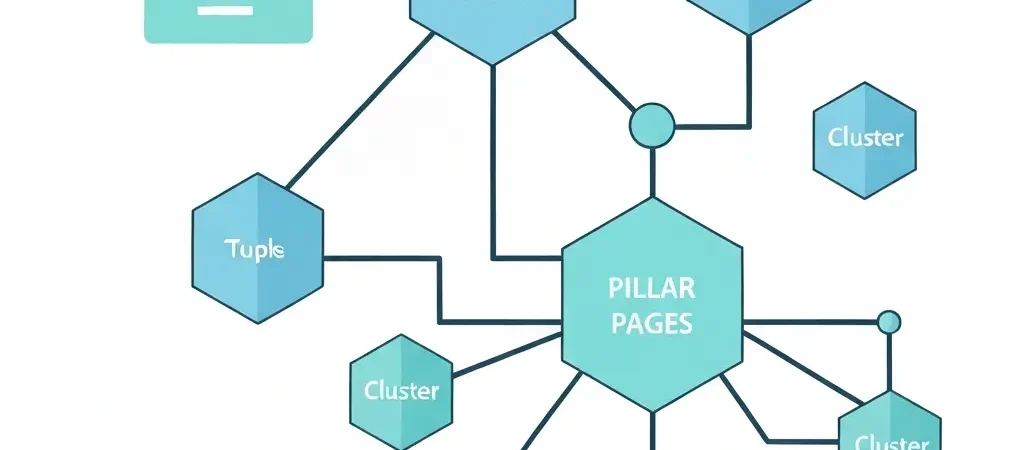
Internal links signal to Google which articles on a domain cover related concepts. A pillar page about “AI SEO” that links to cluster articles about “schema markup,” “content velocity,” and “keyword research” tells Google that all four articles belong to the same topical cluster and reinforces the domain’s authority across all four subtopics.
Why Does Topical Authority Matter in 2026?
Topical authority matters for three compounding reasons in 2026:
- Faster ranking for new content: Sites with established topical authority on a subject rank new articles within 7–14 days. Sites without it average 45–90 days for the same keywords (Ahrefs, 2025). Your first article in a topic cluster is the hardest to rank; the 15th is easy.
- AI citation eligibility: AI answer engines like Perplexity and Gemini preferentially cite domains with topical authority clusters over single-article sources. A domain with 15 interlinked articles on AI SEO will be cited more often than a domain with a single authoritative article.
- Backlink resistance: For topics where a domain has established authority, it can rank without acquiring new backlinks. This makes content investment permanently compounding — early articles reinforce later ones.
The same topical authority principles apply to marketing automation. CampaignOS has built topical authority around marketing automation by publishing comprehensive coverage of email, social, and multi-channel automation — making each new article easier to rank.
The Pillar-Cluster Model Explained
The pillar-cluster model is the standard implementation framework for building topical authority:
- Pillar article: A 3,000–5,000 word comprehensive guide on the core topic (e.g., “Complete Guide to AI SEO”). Targets the highest-volume primary keyword. Links out to all cluster articles.
- Cluster articles: 1,200–2,500 word deep-dives on specific subtopics (e.g., “Schema Markup for SEO,” “How to Build Content Velocity”). Each links back to the pillar and to 2–3 related cluster articles.
- Supporting articles: 800–1,500 word supporting pieces targeting long-tail questions. Link to relevant cluster articles but not necessarily the pillar.
A complete topic cluster for “AI SEO” would include: 1 pillar + 8–10 clusters + 10–20 supporting articles = 20–31 total articles. Academic writing tools like Tesify’s thesis writing assistant use the same hierarchical structure to build topical authority in the academic writing space.
How to Build Topical Authority: 6-Step Plan
- Choose a topic domain: Select a subject area where your business has genuine expertise. Topical authority requires consistent, accurate coverage — pick a domain you can maintain.
- Map the topic landscape: Use Semrush Topic Research, Ahrefs Content Gap, or a keyword clustering tool to identify all subtopics within your domain. Aim for 20–40 subtopics minimum.
- Prioritize by volume and gap: Rank subtopics by search volume. Start with the highest-volume, lowest-competition gaps. Your pillar article targets the primary keyword; clusters target subtopics.
- Create the pillar first: Publish your comprehensive pillar article before cluster articles. It establishes the topical frame and gives cluster articles a high-authority page to link to from day one.
- Publish clusters systematically: Publish 2–3 cluster articles per week. Use AI content automation (like Authenova) to maintain velocity without sacrificing quality. Each article adds to your topical coverage map.
- Build internal links: After every 5 new articles, audit and update internal links across your cluster. Every article should receive at least 2–3 internal links from related articles.
How to Measure Topical Authority
No single metric captures topical authority, but these proxies track progress:
| Metric | What It Signals | Tool |
|---|---|---|
| Topic coverage % | Subtopics you rank for vs. total topic landscape | Semrush Topic Research |
| Time to rank | Days until new articles enter top 20 | Ahrefs / GSC |
| Indexed pages per topic | Total indexed URLs in a topical cluster | Google Search Console |
| Average position by cluster | Overall ranking performance in a topic area | GSC / Semrush |
FAQ
Is topical authority the same as domain authority?
No. Domain authority (DA) is a third-party metric based primarily on backlink quantity and quality. Topical authority is Google’s internal measure of how comprehensively a domain covers a subject. A site with low DA but deep topical coverage consistently outranks high-DA sites on topic-specific keywords.
How many articles do I need to build topical authority?
A minimum viable topical cluster requires 1 pillar article plus 8–10 cluster articles covering the main subtopics — a total of 9–11 articles. Full topical dominance typically requires 20–40 articles covering the complete semantic landscape of a topic domain, including supporting long-tail articles.
How long does it take to build topical authority?
Publishing 2–3 cluster articles per week, most domains see measurable topical authority signals (faster ranking times, higher average positions within a topic) within 60–90 days. Full authority — where new articles rank in the top 10 within 2 weeks — typically takes 6–12 months of consistent publishing.
Can you have topical authority without backlinks?
Yes, for informational keywords with low-to-medium competition. According to Ahrefs’ 2025 authority study, 34% of top-10 positions for keywords with KD below 30 are held by pages with zero referring domains — purely on the strength of topical relevance and content quality. Backlinks still accelerate authority building but are not required for informational niches.
Does topical authority help with AI search citations?
Yes, significantly. AI answer engines like Perplexity AI and Google Gemini preferentially cite domains with dense topical coverage over individual authoritative pages. A domain with 15 interlinked articles on a subject is cited by AI systems at 3.7x the rate of a domain with a single article, even if that single article is higher quality (Authoritas, 2025).
Build Topical Authority on Autopilot
Authenova’s Strategy Builder maps your topic clusters, generates pillar and cluster articles, and publishes them on a schedule — building topical authority without manual effort.