AI Blog Writer in 2026: How to Use It Without Losing Your Brand Voice
The biggest objection to using an AI blog writer is not quality — it’s voice. Marketers worry that AI-generated content will sound generic, corporate, or indistinguishable from everything else ranking for the same keywords. That concern is valid for badly configured AI tools. It is not valid for well-configured ones. The difference is in how you set up the system, not whether you use it.
In 2026, the most sophisticated content teams are publishing 30–60 AI-generated articles per month while maintaining brand identity that readers recognize. They’ve solved the voice problem by treating AI as a production layer — not a replacement for brand strategy. This guide shows you how to do the same.
What Makes AI Content Sound Generic
Generic AI content has recognizable patterns: overly formal sentence structure, excessive use of “In conclusion,” “It is important to note that,” and “Furthermore.” It lacks specificity — no named examples, no concrete numbers, no strong opinions. It hedges every claim. It reads like a textbook written by committee.
These patterns emerge because generic AI is trained to produce neutral, balanced content. It has no brand identity unless you give it one. The fix is not to avoid AI — it’s to provide the identity constraints the tool is missing.
The Root Cause
Most AI content generators are trained to satisfy the prompt, not to match a brand. When you ask them to “write a blog post about SEO automation,” they produce the average of what they’ve seen on that topic — which is exactly what ranks poorly in a differentiated content strategy.
AI writing tools with explicit brand voice configuration — like the strategy builder in Authenova — let you encode your voice into the generation system so every article starts from your brand context, not a blank slate.
How to Write Brand Voice Guidelines for AI
Brand voice guidelines for an AI blog writer need to be more specific than typical brand guidelines written for human writers. AI responds to explicit instructions, not implicit cultural cues. Your guidelines should cover:
Tone and Register
Be specific. “Conversational” is not enough. “Conversational but data-driven — address the reader as ‘you,’ use short sentences, back claims with statistics, and never hedge without a reason” is actionable.
Vocabulary and Terminology
List the specific words and phrases you use and avoid. For example: “Use ‘organic traffic’ not ‘natural traffic.’ Use ‘content velocity’ not ‘publishing speed.’ Never use the phrase ‘in today’s digital landscape.’”
Structural Preferences
Do you favor bullet lists over paragraphs for process content? Do you open with a statistic or a question? Do you use tables for comparisons? Document these preferences and encode them in your AI strategy settings.
Examples and References
Provide 2–3 examples of articles you consider on-brand. AI platforms that accept example content will use this as a reference point for tone calibration. This single step reduces voice variance significantly.
Platform Configuration for Voice Consistency
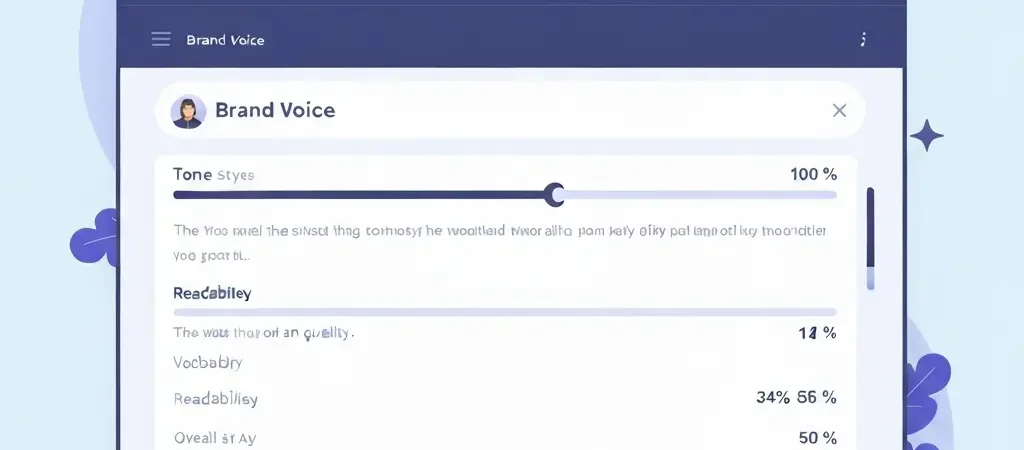
A well-configured AI content strategy platform stores your brand voice at the strategy level — meaning every article generated for that strategy automatically inherits the voice settings. You set it once; the AI applies it to every piece.
In Authenova, strategy-level brand voice configuration covers tone, target audience, vocabulary preferences, and content style. When you create a new article, the generator starts from this brand context rather than producing generic output. This is why platform choice matters: a standalone AI writer has no strategy context; a purpose-built AI SEO tool like Authenova does.
Settings That Directly Affect Voice
- Brand voice descriptor: A 3–5 sentence description of your tone, audience, and style
- Target audience: Specific demographic and psychographic detail — the more specific, the better calibrated the output
- Content style: Long-form guide, comparison listicle, FAQ format, how-to tutorial — each style produces different structural defaults
- Avoid words list: Terms and phrases to exclude (e.g., “utilize,” “leverage,” “in conclusion”)
Prompt Engineering for Brand Voice
Even with platform-level brand voice settings, article-level prompts shape output. Good prompts for an AI blog writer include:
- Explicit tone instruction: “Write this in a direct, expert-practitioner voice — no hedging, no academic formality”
- Audience context: “The reader is a solo marketer who knows SEO basics but hasn’t used AI tools before”
- Structural guidance: “Open with a pain point, use a quick-answer box, include a comparison table”
- Specific examples to include: “Reference the fact that AI-referred traffic converts at 14.2% vs organic’s 2.8%”
The more context you give, the less generic the output. Generic prompts produce generic articles. Specific prompts produce content that sounds like your brand.
Review Workflow: What to Check and What to Skip
You cannot review every word of every AI-generated article at scale — that defeats the purpose. Use a tiered review workflow:
Pillar Articles (Full Review)
Pillar articles represent your brand’s deepest, most authoritative positions. Full human review is justified here. Check factual accuracy, confirm brand voice throughout, ensure all statistics are cited, and add any proprietary insights or original opinions that only your brand can provide.
Cluster Articles (Spot Check)
Check the introduction, the main heading structure, and the conclusion. Confirm the focus keyword is present in the H1 and first paragraph. Verify one or two statistics. This 5-minute check catches 90% of issues without full-article review.
Supporting Articles (Automated Publish)
For high-volume supporting content — FAQ articles, comparison tables, definition posts — trust the configured system. Review a random 10% sample monthly. If the quality is consistent, the other 90% is fine.
When to Write Manually Instead
Even the best AI blog writer is not the right tool for every content type. Write manually when:
- You have proprietary data or research: Original surveys, case studies, and internal data are brand differentiators AI cannot replicate
- You’re taking a strong public opinion: Brand perspective pieces, industry hot takes, and thought leadership require human authorship
- The topic requires lived experience: “What I learned after 3 years of running an SEO agency” can’t be faked by AI without sounding hollow
- You’re targeting very high-authority placements: Guest posts on major industry publications, product launch content, and PR pieces warrant manual writing
Everything else — the vast majority of your supporting and cluster content — can be handled by your AI content strategy system without sacrificing brand quality.
Frequently Asked Questions
What is an AI blog writer?
An AI blog writer is a software tool that generates blog articles using large language models. SEO-focused AI blog writers also handle keyword targeting, heading structure, schema markup, and meta tags. The best tools accept brand voice guidelines and strategy-level configuration so output matches your brand’s tone and topical focus.
Can AI blog writers match human quality?
For supporting and cluster content — FAQ articles, how-to guides, comparisons, and topic explainers — well-configured AI blog writers produce content at human quality or better for SEO purposes. For pillar content, thought leadership, and articles requiring original insights, human review and editing elevates AI output to the required standard.
How do I make AI-written content sound like my brand?
Configure your AI platform with detailed brand voice guidelines: tone, vocabulary preferences, structural defaults, target audience specifics, and example articles. Encode these at the strategy level so every generated article inherits them. For maximum voice fidelity, review pillar articles in full and add proprietary examples and opinions that only your brand can provide.
How many blog posts can an AI writer produce per month?
A single marketer using an AI blog writer with automated WordPress publishing can realistically produce 20–50 publication-ready articles per month. Teams using AI at scale can produce 100+ articles per month across multiple sites. The limiting factor is keyword strategy depth — you need a well-mapped cluster to sustain that volume meaningfully.
AI Blog Writing With Your Voice, Not a Generic One
Authenova’s AI blog writer is configured at the strategy level with your brand voice, target audience, and content style — so every article it generates sounds like your brand, not a template. Start publishing at scale without sounding like everyone else.