What Is AI Content Generation for SEO? Complete 2026 Guide
AI content generation for SEO is the use of large language models (LLMs) — such as GPT-4o, Claude, and Gemini — to produce, optimize, and scale written content specifically structured to rank in search engines and surface as answers in AI assistants. It covers everything from keyword research and brief creation to full-article drafting, internal linking, and schema markup.
Here’s what most guides skip: the tactics that earned organic traffic in 2023 are table stakes now. The real competitive edge in 2026 is understanding why AI-generated content ranks — and when it doesn’t. This guide breaks down the mechanics, the data, and the exact structure you need.
What Exactly Is AI Content Generation for SEO?
AI content generation for SEO is the process of using AI language models to create written content — articles, landing pages, FAQs, product descriptions — that is intentionally structured to perform in search engine results pages (SERPs) and AI answer engines.
It’s not just about writing faster. The best AI-driven SEO systems handle semantic keyword clustering, heading hierarchy, internal link placement, schema markup, and topical authority architecture — tasks that previously required a team of specialists.
According to HubSpot’s State of Generative AI report, 68% of marketers using AI for content creation say it saves them more than three hours per piece. That’s not a marginal gain — it’s a structural advantage when compounded across hundreds of articles.
What most people miss is that the “AI” part is only 40% of the equation. The other 60% is the SEO architecture: how content connects to related pages, how headings signal topical depth, how schema markup packages answers for AI extraction. Get the architecture wrong, and the AI-written prose doesn’t matter.
For the concise, standalone definition and FAQ anchors, see the foundational resource: What Is AI Content Generation for SEO? The Complete Answer.
What Is Answer Engine Optimization (AEO) and Why Does It Matter in 2026?
Answer Engine Optimization (AEO) is the practice of structuring content so that AI-powered answer engines — ChatGPT, Perplexity, Google’s AI Overviews, Bing Copilot — extract and cite your pages when answering user questions.
Traditional SEO targets a position on a results page. AEO targets the answer itself. That’s a meaningful distinction: AI Overviews now appear on roughly 47% of Google searches (Search Engine Land, 2025), and Perplexity’s monthly active users crossed 15 million in late 2024. If your content isn’t structured for extraction, you’re invisible to a growing share of search behavior.
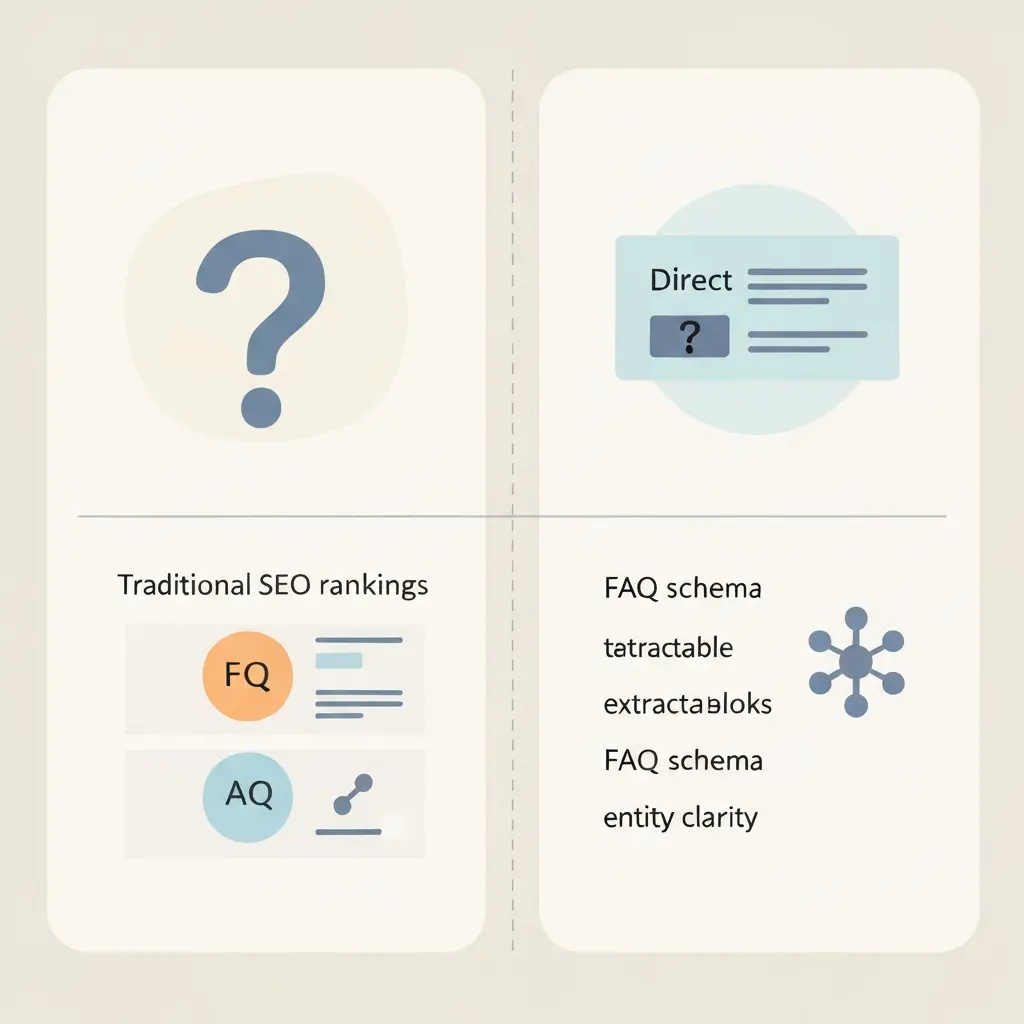
What makes content extractable for AI answer engines?
Three structural signals matter most: (1) direct answer placement — putting a clear, self-contained answer in the first 60 words of any section; (2) FAQ schema markup — using FAQPage and Question/Answer schema so AI crawlers can parse Q&A pairs; and (3) entity clarity — naming concepts, tools, organizations, and people precisely so NLP models can link your content to known knowledge graph nodes.
One counterintuitive insight: shorter, cleaner answers outperform long explanations for AEO — even though longer content often wins for traditional SEO. The skill in 2026 is writing content that satisfies both simultaneously: a 45-word extractable answer at the top, supported by 400 words of authoritative depth below it.
| Dimension | Traditional SEO | Answer Engine Optimization (AEO) |
|---|---|---|
| Primary target | Google SERP position | AI-generated answer citation |
| Content format | Long-form, keyword-dense | Direct answers + supporting depth |
| Key signals | Backlinks, E-E-A-T, page authority | Schema markup, entity precision, answer clarity |
| Measurement | Organic rankings, CTR | AI citation frequency, brand mentions in AI responses |
| Update cadence | Monthly algorithm updates | Model retraining cycles (30–90 days) |
76% of ChatGPT citations come from pages updated within the past 30 days — which means content freshness isn’t just an SEO signal anymore. It’s an AEO survival requirement.
How Does AI Content Generation Actually Work for SEO?
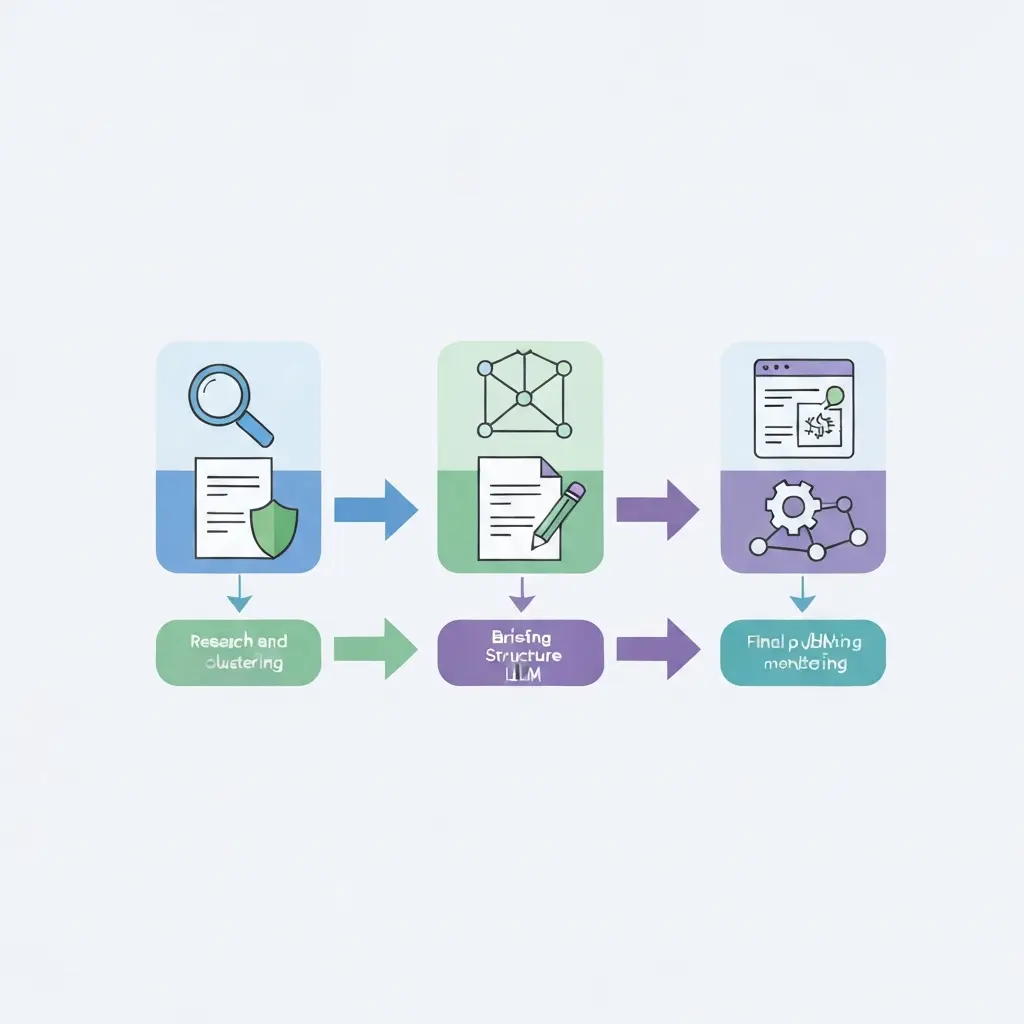
The process behind effective AI content generation for SEO runs in four distinct phases. Understanding each phase explains why some AI content ranks and some doesn’t.
Phase 1 — Research and keyword clustering
Before any text is generated, an SEO-oriented AI system analyzes search intent, identifies semantic keyword clusters, and maps content gaps versus competitors. Tools like Semrush’s AI-powered workflow guides show how keyword data feeds directly into content briefs, cutting research time by up to 60%.
Phase 2 — Brief and structure generation
A content brief defines the target keyword, secondary keywords, heading structure, word count, internal link targets, and schema type. This is where most DIY AI content fails — writers skip structured briefs and get generic output. A detailed brief is the difference between content that ranks and content that drifts.
Phase 3 — Drafting and on-page optimization
The LLM generates the draft within the brief’s constraints: heading hierarchy, keyword placement at 1–2% density, FAQ sections with schema markup, and meta descriptions under 155 characters. According to Ahrefs’ analysis of AI for SEO, teams using structured prompting with SEO guardrails produce content that requires 40% less post-editing than unstructured AI drafts.
Phase 4 — Human review and E-E-A-T enrichment
AI drafts lack first-hand experience by default. A human expert adds specific data points, real-world examples, named sources, and editorial judgment — the signals Google’s Quality Raters look for under E-E-A-T (Experience, Expertise, Authoritativeness, Trustworthiness). Skip this step and your AI content will plateau at mediocre rankings.
For a detailed walkthrough of this process with prompts and quality checklists, see How to Use AI to Write SEO Articles That Actually Rank in 2026.
Does Google Penalize AI-Generated Content in 2026?
No — Google does not penalize content simply because it was generated by AI. Google’s official guidance is unambiguous: it rewards content that is helpful, reliable, and people-first, regardless of how it was produced.
Google’s own documentation on using generative AI content states: “Our focus is on the quality of content, not the methods used to produce it.” The Helpful Content System targets low-quality, unoriginal content — AI or human.
What does get penalized: mass-produced pages with no unique insight, content that rewrites existing articles without adding value, and AI text that fails to demonstrate first-hand experience on YMYL (Your Money, Your Life) topics. The problem isn’t AI. The problem is thin content — and AI makes thin content dangerously easy to produce at scale.
The real question to ask isn’t “Is this AI-written?” It’s “Does this page answer the query better than any other page on the internet?” If yes, it ranks. If no, it won’t — regardless of who (or what) wrote it.
AI-Generated vs. Human-Written Content: Which Performs Better for SEO?
Framing this as AI vs. human is the wrong question in 2026. The highest-performing content is AI-assisted and human-refined — a hybrid that combines AI’s speed and structural consistency with human expertise, original data, and editorial nuance.
| Factor | AI-Only | Human-Only | AI + Human Hybrid |
|---|---|---|---|
| Production speed | ⚡ Fastest | 🐢 Slowest | ✅ Fast |
| Keyword structure | ✅ Consistent | ⚠ Variable | ✅ Consistent |
| E-E-A-T signals | ❌ Weak | ✅ Strong | ✅ Strong |
| Original insight | ❌ Rare | ✅ Natural | ✅ Intentional |
| AEO extractability | ⚠ Needs schema work | ⚠ Often unstructured | ✅ Optimized |
| Scalability | ✅ Unlimited | ❌ Cost-constrained | ✅ High |
Search Engine Journal’s analysis of AI for SEO found that hybrid content (AI-drafted, expert-refined) consistently outperforms both pure AI and pure human content on engagement metrics — time on page, scroll depth, and return visits.
The counterintuitive reality: a 2,000-word human-written article takes 6–8 hours. A 2,000-word AI-assisted article with proper human review takes 90 minutes. At scale, that’s not an efficiency gain — it’s a different business model.
How Does Pillar-Cluster Architecture Fit Into AI Content Strategy?
Pillar-cluster architecture is a content organization model where one comprehensive “pillar” page covers a broad topic, and multiple “cluster” articles cover subtopics in depth — all internally linked back to the pillar. For AI content generation, this architecture is the difference between a content farm and a topical authority hub.
Search engines use internal link patterns to infer topical authority. When your pillar on “AI content generation for SEO” links to and receives links from a cluster on “AI SEO tools,” a cluster on “how to write AI articles that rank,” and supporting content on “AI content briefs,” Google’s crawlers understand you own the topic — not just a page.
Why does pillar-cluster matter specifically for AI-generated content?
AI can produce pillar and cluster content simultaneously, at scale, with consistent internal link placement. Human teams planning a 20-article cluster might take three months. An AI-powered system can draft, optimize, and schedule the same cluster in days — provided the architecture is defined upfront.
The risk here is real: AI without architectural guardrails produces cannibalization, not authority. Multiple pages targeting the same keyword with similar content signal confusion to search engines. The solution is a topic map built before content generation begins — every URL planned, every target keyword assigned, every internal link mapped.
For platform comparisons and tool-selection criteria when building this architecture, the AI Content Generator: Complete Guide to AI-Powered Writing for SEO in 2026 covers the evaluation framework in depth.
How Can You Automate AI SEO Content Without Sacrificing Quality?
Automating AI SEO content at scale requires three things operating in sync: a defined topical architecture, a generation engine that respects SEO constraints, and a publishing pipeline that maintains consistency. Most tools handle one or two of these — rarely all three.
This is the specific problem Authenova is built to solve. Connect your WordPress site, define your topic strategy, and Authenova’s autonomous engine generates pillar pages, cluster articles, and supporting content in a coordinated architecture — with automatic internal linking, schema markup, meta descriptions, and keyword placement handled at the system level.
What separates this from generic AI writing tools is the structural intelligence. Authenova doesn’t produce isolated articles — it builds topically structured content networks designed for both Google rankings and AEO citation. Each piece is generated with its relationship to the pillar and cluster in mind, not as a standalone document.
Teams using Authenova’s AI Content Generator report building full topical clusters in days rather than months — with each article automatically cross-linked and structured for maximum topical authority signals. Fair warning: this kind of output still requires editorial oversight. The automation handles structure and volume; the human layer handles voice, accuracy, and E-E-A-T depth.
What’s the Step-by-Step Workflow for AI Content Generation That Ranks?
Here’s the operational framework used by SEO teams producing high-performing AI content in 2026. Each step is designed to be repeatable and scalable without sacrificing quality signals.
-
Define your topic cluster map
Identify one pillar keyword and 8–12 cluster keywords. Assign each a unique URL, target search intent (informational, navigational, commercial, transactional), and word count estimate. No two cluster articles should share a primary keyword. -
Build SEO-informed content briefs
For each article: define H1, three H2 candidates, primary keyword, three secondary keywords, target word count, internal links to include, schema type (Article, FAQPage, HowTo), and the “one-sentence answer” the piece must provide. Free tools like Dashword’s content brief generator or Semrush’s SEO Content Template can accelerate brief creation. -
Generate with structural prompts
Feed the brief into your LLM or AI content platform with explicit structural instructions: heading hierarchy, paragraph length limits (2–4 sentences), FAQ placement, and keyword density targets. Vague prompts produce vague content. -
Run a semantic gap check
Compare your draft against the top 3 competing pages for your target keyword. Identify entities, concepts, or subtopics they cover that your draft misses. Add those — don’t just match competitors, exceed them. -
Add E-E-A-T signals manually
Insert a real-world example, a named statistic with a source, or a first-hand insight your AI draft didn’t produce. This is non-negotiable for YMYL topics and strongly recommended for all others. -
Apply schema markup
Add FAQPage schema to FAQ sections, Article schema to the full page, and HowTo schema to step-by-step sections. This packages your content for AI extraction and structured data features. -
Publish, monitor, and update within 30 days
Track rankings and AEO citations. Update any article that drops in either metric within 30 days — fresh updates are the fastest way to re-enter AI model training windows and recapture citation frequency.
Frequently Asked Questions About AI Content Generation for SEO
What is AI content generation for SEO in simple terms?
AI content generation for SEO means using AI language models to write, structure, and optimize web content designed to rank in search results and surface in AI-generated answers. It replaces or accelerates manual content writing while maintaining the keyword targeting, heading structure, and semantic signals search engines use to rank pages.
What is Answer Engine Optimization (AEO)?
Answer Engine Optimization (AEO) is the practice of structuring content so AI-powered answer systems — including ChatGPT, Perplexity, Google AI Overviews, and Bing Copilot — extract and cite your pages when responding to user queries. It relies on direct answer placement, FAQ schema markup, and entity clarity rather than traditional keyword density alone.
Does AI-generated content hurt your Google rankings?
No — Google’s official guidance states it rewards helpful, reliable content regardless of production method. AI-generated content that is thin, unoriginal, or lacks E-E-A-T signals will underperform, but that’s true of human-written content too. The risk isn’t AI; it’s low-quality output published without expert review.
How much does AI content generation for SEO cost in 2026?
Costs range from near-zero (using free tiers of ChatGPT or Claude) to $500+/month for enterprise AI SEO platforms with automated publishing and topical architecture features. Most mid-market tools — including platforms like Authenova — offer entry plans under $100/month that include content generation, internal linking automation, and schema markup, making them cost-effective for growing brands.
What is the difference between AI content generation and AI SEO automation?
AI content generation specifically refers to using AI to produce written content. AI SEO automation is broader — it includes keyword research, technical SEO audits, internal link optimization, rank tracking, and content scheduling, in addition to content creation. The most effective systems in 2026 combine both: automated content generation embedded in a full SEO automation pipeline.
How many words should an AI-generated SEO article be in 2026?
Word count should match search intent, not a fixed target. Informational pillar pages perform best at 2,500–4,000 words. Cluster articles perform well at 1,500–2,500 words. Supporting pages answering specific questions rank effectively at 800–1,500 words. Length beyond what’s needed to fully answer the query adds no ranking benefit and can hurt AEO extractability.
Which AI tools are best for SEO content generation in 2026?
The leading options in 2026 fall into two categories: general LLMs used with SEO-specific prompts (GPT-4o, Claude 3.5, Gemini 1.5 Pro) and dedicated AI SEO platforms with built-in content architecture, internal linking, and publishing automation (Authenova, Surfer, Jasper). For teams needing scale with minimal manual setup, purpose-built SEO platforms consistently outperform general-purpose AI writing tools.
What is topical authority and why does it matter for AI content generation?
Topical authority is a search engine’s assessment of how comprehensively a website covers a subject area, based on the breadth and depth of its content and the internal link relationships between pages. For AI content generation, building topical authority means generating content in coordinated pillar-cluster architectures — not isolated articles — so search engines recognize your site as a trusted, complete resource on a topic.
Ready to Build Topical Authority with AI Content at Scale?
AI content generation for SEO isn’t a shortcut — it’s a structural capability. When it’s built on solid architecture (pillar-cluster organization, schema markup, internal linking, regular updates), it compounds. Pages build authority. Clusters reinforce pillars. AI assistants start citing your brand.
The teams winning in 2026 aren’t writing more. They’re building smarter content systems. If you’re ready to move from one-off articles to a coordinated topical authority strategy, explore the full ecosystem of resources below:
- 📖 What Is AI Content Generation for SEO? — The Concise Definition and FAQ
- 🛠 AI Content Generator Guide: Tools, Evaluation, and Platform Comparisons for 2026
- ✅ How to Use AI to Write SEO Articles That Actually Rank in 2026 — Step-by-Step Prompts and Checklists
If you want a platform that handles the architecture, the generation, the internal linking, and the publishing in one connected system, try Authenova free — no credit card required. Connect your WordPress site, define your strategy, and see a full topical cluster drafted and ready to publish.
Last updated: 2026. Sources: HubSpot State of Generative AI 2025, Google Search Central Documentation, Search Engine Land SERP Feature Analysis 2025, Ahrefs Blog, Search Engine Journal, Semrush Academy.