AI Content Marketing ROI: How to Measure What Actually Works in 2026
There is a measurement crisis sitting inside most AI content marketing programmes. Teams have adopted AI content tools, their output has increased 3–5x, and their organic traffic numbers are moving. But ask most content managers to calculate the actual ROI of their AI investment and they either reach for a traffic number that does not translate to revenue, or they admit they are not tracking it at all. According to a 2026 study by Digital Applied, only 19% of content marketers currently track AI-specific KPIs. The other 81% are running significant software budgets on feel alone.
This guide builds the complete ROI measurement framework for AI content marketing in 2026. It covers the metrics that actually matter — from content velocity through to AI citation value — the formula for calculating total content ROI, the benchmarks you can use to calibrate your programme against industry data, and the dashboard setup that makes the numbers visible without consuming a week every month to compile.
The AI Content Marketing Measurement Gap
The measurement gap in AI content marketing has a specific shape. Teams measure outputs — traffic, leads, conversions — but not the AI-specific inputs and efficiency gains that determine whether their AI investment is generating returns or just adding cost. The result is a persistent disconnect: leadership sees the software bill, content teams see rising traffic numbers, and nobody has a clear line connecting the two.
The problem is compounded by the fact that AI content marketing creates value across multiple dimensions simultaneously. A single AI-generated article might drive 500 organic visits per month, contribute 3 demo requests to pipeline, appear in 12 AI Overview citations, and save 4 hours of writing time compared to manual production. Traditional content ROI frameworks capture one of these four value streams. The others get counted as intangible benefits and quietly omitted from budget discussions.
The 2026 framework presented here captures all four. It is built around the recognition that AI citation value is now real and measurable — “treating AI citation value in 2026 the way organic search value was treated in 2010” as one measurement researcher noted — and that ignoring it systematically understates the ROI of your content programme.
The Complete ROI Formula
The total ROI formula for AI content marketing in 2026:
Each component has a concrete measurement method:
- Direct Revenue: Conversions (sales, sign-ups, subscriptions) attributed to content as the last-touch or first-touch channel.
- Pipeline Influence: Deals where content was consumed during the sales cycle. CRM tools like HubSpot track “content assisted conversions” that attribute pipeline value to specific articles.
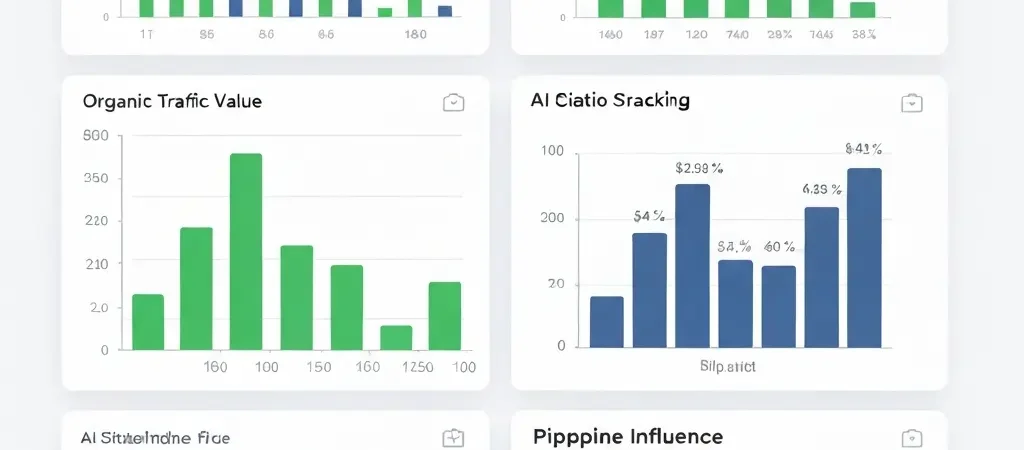
- Organic Traffic Value: The equivalent paid search cost to acquire the organic traffic your content generates. (Monthly organic visits × average CPC for your target keywords.)
- AI Citation Value: Estimated traffic and brand impression value from appearances in ChatGPT, Perplexity, and AI Overviews. Tracked via SE Ranking or manual SERP monitoring; valued using equivalent CPM rates.
- Brand Lift: Branded search volume increases attributable to content exposure. Tracked via Google Search Console impressions for branded queries.
- Cost Avoidance: The cost of producing the same content volume without AI — calculated as (articles produced × manual production cost per article) − (articles produced × AI-assisted production cost per article).
- Total Content Cost: AI platform subscriptions + editorial time at loaded hourly rate + image generation + distribution costs.
Content Velocity and Cost Metrics
Content velocity is the most immediate ROI signal from an AI content programme. It measures your output rate and is the clearest leading indicator of organic traffic growth — because more quality content published faster means more indexed pages, more keyword coverage, and a faster compound curve on domain authority.
Key Velocity Metrics
| Metric | What It Measures | 2026 AI Benchmark | Manual Benchmark |
|---|---|---|---|
| Articles per writer per month | Team output capacity | 30–50 | 8–15 |
| Time per article (hours) | Production efficiency | 0.5–3 hrs | 4–8 hrs |
| Cost per article (£/€/$) | Unit economics | £15–£40 | £100–£300 |
| Days from brief to live | Cycle time | 0.5–1 day | 5–14 days |
AI-powered content workflows deliver content 84% faster than traditional workflows. This velocity advantage is the most concrete ROI metric for early-stage AI content programmes where organic rankings have not yet compounded into measurable revenue.
Organic Traffic Value
Organic traffic value converts your SEO results into a currency finance understands: the equivalent paid media cost to acquire the same traffic. This metric bridges the gap between “content marketing is working” and “content marketing is worth £X per month.”
How to Calculate Organic Traffic Value
- Export organic clicks per article from Google Search Console
- Identify the primary keyword for each article
- Pull the average CPC for each keyword from your paid search account or Google Keyword Planner
- Multiply: (Monthly organic clicks × average CPC) = Monthly traffic value per article
- Sum across your article portfolio for total monthly organic traffic value
For a content programme with 200 published articles averaging 150 organic visits per month at an average CPC of £2.50, the total organic traffic value is £75,000 per month — or £900,000 per year. Against a content production cost of £3,000/month for a well-configured AI content programme, that represents a 2,500% ROI on a single metric alone.
The data on organic traffic growth strategies shows that content programmes that reach this scale typically took 12–18 months of consistent AI-assisted publishing to build. The compound nature of the growth is why early ROI tracking — before traffic numbers are impressive — matters so much.
AI Citation Value: The Emerging ROI Dimension
AI citation value is 2026’s most significant new ROI dimension for content marketing. When ChatGPT, Perplexity, Google AI Overviews, or Microsoft Copilot cite your content in a response, your brand gets exposure that is not captured in organic traffic metrics, paid media analytics, or traditional content attribution models. The exposure is real — millions of AI assistant queries generate responses citing specific web sources daily — but most content teams are not measuring it.
Measuring AI citation value requires:
- AI visibility monitoring: Tools like SE Ranking’s AI Overviews tracker, or manual spot-checking of queries in ChatGPT/Perplexity relevant to your content topics, to identify which articles are being cited.
- Citation frequency baseline: Track how often your domain is cited across a sample of 50–100 relevant queries. Repeat monthly to track trend direction.
- Estimated impression value: Multiply citation frequency by average monthly query volume for cited topics, then apply a CPM rate (typically £3–£8 for brand awareness) to estimate media value equivalent.
- Referral traffic attribution: Some AI assistants (Perplexity in particular) drive direct referral clicks. Track these separately in GA4 as the “ai-overview” and “perplexity” referral sources.
For the majority of content teams, AI citation value will be small in absolute terms in 2026 — but the trajectory is steep. Teams that build AI citation tracking infrastructure now will have years of historical data when this channel becomes a primary traffic source. The analogy to organic search data from 2008–2012 is apt.
Pipeline Influence and Revenue Attribution
Pipeline influence measures content’s role in deals, not just traffic. For B2B and SaaS companies, a blog post read during a sales cycle can be as valuable as a conversion event — it may be the specific piece of content that moved a prospect from consideration to decision.
Modern CRM and marketing automation platforms track content-assisted conversions. HubSpot’s “Content Influence” report, for example, shows which blog posts were read by contacts who eventually became customers. This data connects specific articles to pipeline value — and with AI-generated content publishing 20+ articles per month, the coverage of buyer intent keywords across the funnel increases substantially.
The AI content marketing strategy framework covers the full buyer journey content mapping approach. The key for ROI measurement is ensuring UTM parameters are consistently applied to all content links, so pipeline influence attribution data is clean and auditable.
2026 AI Content Marketing Benchmarks
These benchmarks from 2026 industry research provide calibration points for your own programme:
- AI content production is 84% faster than traditional workflows (Genesys Growth, 2026)
- AI-generated content reduces production costs by 65% versus manual writing
- Companies using AI for content marketing report 37% cost reduction and 39% revenue increase
- AI content workflows deliver a 55% boost in customer engagement metrics
- Only 19% of content marketers currently track AI-specific KPIs (Digital Applied, 2026)
- Teams producing 3–5x more content per writer maintain or improve engagement metrics when a human editorial review layer is present
- Payback period for AI content platforms: 60–90 days for teams publishing 5+ articles per week
Dashboard Setup for Continuous Tracking
Building the ROI measurement framework as a dashboard rather than a monthly manual exercise is essential for making AI content marketing metrics operationally visible. The minimum viable dashboard connects three data sources:
- Google Search Console API: Organic clicks, impressions, position by article. Use Looker Studio (free) with the native GSC connector to visualise weekly trends per article and by content cluster.
- Content platform data: Articles published, words generated, time saved. Authenova’s analytics dashboard surfaces this natively. For other platforms, export via API to a Google Sheet feeding Looker Studio.
- CRM pipeline data: Content-assisted conversions and pipeline value. HubSpot, Salesforce, and most modern CRMs have Looker Studio connectors. Filter for deals where a content page touchpoint occurred in the attribution window.
These three sources feed a single Looker Studio dashboard that answers the four essential questions: How much are we producing? What is it worth in organic traffic value? How much pipeline has it influenced? What is our cost per unit of output? Review it weekly, not monthly — content ROI is a fast-moving signal in AI-assisted programmes.
Presenting ROI to Leadership
Leadership conversations about AI content marketing ROI tend to break down in one of two ways: too much data presented without a narrative, or a single impressive traffic chart that does not connect to revenue. The 2026 framework structures the leadership presentation around four dimensions that resonate at the executive level:
- Revenue impact: Direct conversions + pipeline influence (the money number)
- Cost efficiency: Cost per article before and after AI implementation (the savings number)
- Strategic moat: Content portfolio size, topical coverage, and domain authority trend (the compounding asset number)
- Future-readiness: AI citation rate and trend (the forward-looking investment number)
Present one metric per dimension, backed by a single supporting data point. Then show the composite ROI calculation. A well-structured 10-minute leadership brief on this framework consistently results in AI content budget increases rather than cuts — because it makes the investment thesis concrete and multi-dimensional rather than relying on traffic metrics alone.
Frequently Asked Questions
What is the average ROI of AI content marketing in 2026?
Industry benchmarks show companies using AI for content marketing report a 37% reduction in marketing costs and a 39% increase in revenue, with a 55% boost in customer engagement. However, ROI varies significantly based on content quality, publishing velocity, keyword strategy, and measurement rigour. Teams tracking all ROI dimensions — including AI citation value and pipeline influence — consistently find higher ROI than those measuring organic traffic alone.
How do you measure the ROI of AI-generated content specifically?
Measure AI content ROI across six dimensions: direct revenue (conversions attributed to content), pipeline influence (deals where content was consumed), organic traffic value (equivalent paid search cost for your organic traffic), AI citation value (brand exposure from AI assistant citations), brand lift (branded search volume increase), and cost avoidance (savings versus manual production). Sum these and divide by your total content cost to get a percentage ROI figure comparable to other marketing channels.
How long does it take to see ROI from AI content marketing?
Cost efficiency ROI (production cost savings) is immediate — visible from the first month. Organic traffic ROI typically takes 3–6 months as new articles index, rank, and compound. Pipeline revenue ROI often appears at 4–9 months as content-assisted deals close. AI citation value ROI is building now but will compound over 12–24 months as AI assistant usage grows. Teams tracking early-stage metrics (velocity, cost per article) rather than waiting for traffic data maintain programme momentum through the pre-compound period.
What AI content marketing metrics should I report to the CEO?
Report four metrics to the CEO: (1) Revenue influenced — deals touched by content expressed in pipeline value. (2) Cost per article — before and after AI implementation as a percentage cost reduction. (3) Organic traffic value — monthly equivalent paid search cost for your organic traffic. (4) Content portfolio size — total published articles as a compounding strategic asset. Keep each metric to one number with a single trend indicator. Avoid traffic metrics without revenue context.
Does AI content marketing work for B2B companies?
Yes — B2B content marketing has some of the strongest ROI cases for AI-assisted content because B2B buying cycles are long and content-influenced. A B2B prospect reading 5–8 pieces of content during a 90-day evaluation period means a broad, deep content portfolio has outsized pipeline influence compared to B2C. AI content generation enables B2B teams to cover the full topical map of buyer intent queries — from awareness through to decision — without the headcount budget typically required to build that coverage manually.