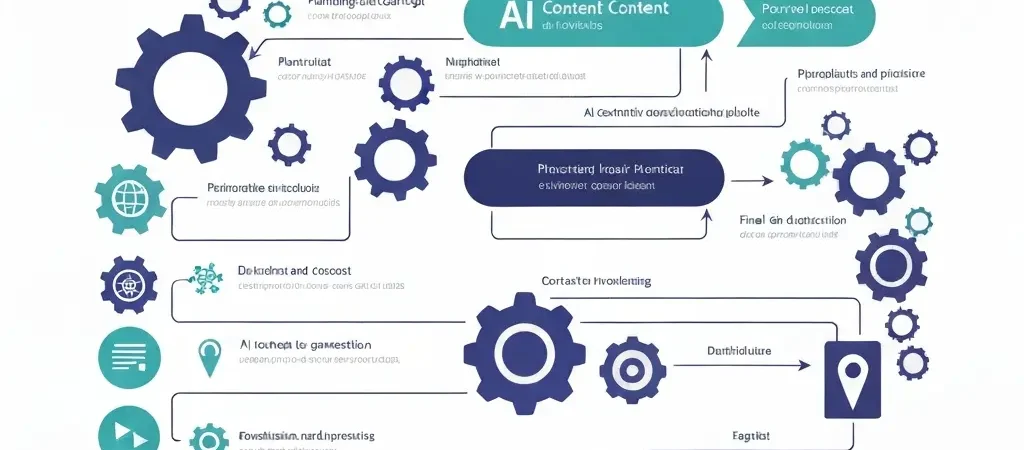
AI Content Strategy: Framework for Scaling Organic Traffic in 2026
A well-built AI content strategy is the most reliable path to compounding organic traffic in 2026. The organizations growing organic visibility fastest are not those with the biggest content budgets or the most experienced SEO teams — they are the ones that have built systematic, AI-powered content machines that publish consistently, maintain quality, and expand topical coverage month over month. This guide presents the complete framework for building that machine.
Whether you are starting from zero or overhauling a stalled content program, the principles here apply: choose the right topics, build the right cluster architecture, generate content at the right velocity, and measure what matters.
What Is an AI Content Strategy?
An AI content strategy is a systematic plan for using artificial intelligence to plan, produce, and distribute content at a scale that would be impossible with human production alone. It is not about replacing writers with AI — it is about building a content operation where AI handles the high-volume execution layer while humans focus on strategy, quality control, and brand differentiation.
The components of an AI content strategy:
- Topic authority plan: Which subject areas will the site own, and in what depth?
- Keyword cluster architecture: How keywords are grouped into pillar, cluster, and supporting article assignments
- AI production pipeline: The tools and workflow that generate, review, and publish content
- Publishing cadence: How many articles per week, in what order, on what schedule
- Performance loop: How content data feeds back into strategy refinement
The distinguishing feature of an AI content strategy versus a traditional one is velocity. Traditional content strategies are constrained by human writing speed — typically 5–20 articles per month for a small team. AI content strategies produce 20–100+ articles per month at comparable quality, enabling topical authority to be established in months rather than years.
Why AI Strategy Outperforms Traditional Content Programs
The performance gap between AI-driven and traditional content programs has widened significantly in 2026. Four structural advantages explain why:
1. Topic Coverage Speed
Google’s topical authority model rewards depth of coverage across a topic — not just individual article quality. A site with 200 articles covering every facet of “SEO” outranks a site with 30 carefully crafted articles on the same topic, all else being equal. AI production enables comprehensive topic coverage in months, not years.
2. Consistent Publishing Cadence
Humans publish inconsistently — productivity varies with workload, priorities shift, writers leave. AI content pipelines publish on schedule, every week, regardless of team capacity. This consistency accelerates crawl frequency and freshness signals, which compound ranking benefits over time.
3. Internal Link Density
Every new article creates internal linking opportunities. AI content platforms like Authenova manage internal links programmatically — ensuring each new article links to relevant existing content and existing content is updated to link back. This is impossible to maintain manually at high article counts.
4. Cost-Per-Article Economics
Human-written SEO articles cost $50–$500 each. AI-assisted articles cost $3–$30 each. At equal quality, the 10–50x cost reduction means AI-driven programs can cover 10–50x more topics for the same budget — which translates directly to 10–50x more ranking opportunities.
The 5-Phase AI Content Strategy Framework
The framework presented here has been validated across content programs in SaaS, e-commerce, and media — from sites with 50 articles to sites publishing 100+ per month. Adapt the specifics to your niche and audience, but maintain the phase sequence.
Phase 1: Topic Cluster Design
Start with business alignment: which topics are your target customers searching for before, during, and after they need your product? Map these to broad topic domains — your future pillar pages.
Each topic cluster needs:
- One head term (the pillar keyword) with 5,000+ monthly searches
- 8–15 mid-tail cluster keywords (1,000–5,000 monthly searches) directly related to the head term
- 5–10 long-tail supporting keywords (100–1,000 monthly searches) addressing specific questions within the topic
For a site just starting, build 2–3 clusters before publishing anything. This ensures your first articles have a hub to link back to and prevents the “island content” problem where new articles exist without internal link context.
Tools for cluster design: Ahrefs Keywords Explorer, Semrush Keyword Magic Tool, or Authenova’s built-in topic cluster generator. For detailed guidance, see our SEO pillar page guide which covers the full cluster architecture methodology.
Phase 2: Keyword Mapping and Content Planning
Once clusters are defined, map each keyword to a specific article type and target word count. This is your content calendar — the master plan that governs what gets produced and when.
Keyword-to-content mapping rules:
- Pillar keywords → PILLAR articles (2,500–4,000 words)
- Cluster keywords → CLUSTER articles (1,500–2,500 words)
- Supporting keywords → SUPPORTING articles (800–1,500 words)
- One focus keyword per article — no overlap between articles in the same cluster
- Publication order: pillar first, then cluster articles, then supporting articles
Content planning also includes deciding on tone, audience angle, and CTA for each article. Cluster articles on the same topic should have distinct angles — an educational article (“what is X”), a comparison article (“X vs Y”), and a how-to article (“how to do X”) can all target related keywords without cannibalizing each other.
Phase 3: AI Content Production at Scale
With keyword mapping complete, AI production begins. The production workflow for a well-configured AI content platform:
- Brief generation: SERP analysis pulls the questions, topics, and content structure that top-ranking pages cover
- AI drafting: LLM generates a full article structured around the brief — proper HTML, headers, lists, tables
- Internal link insertion: Existing articles in the cluster are automatically linked from the new piece
- Quality review: Human editor reviews for factual accuracy, brand voice, and uniqueness (for high-stakes content)
- Image generation: AI generates a featured image matching the article topic and brand style
Platforms like Authenova automate steps 1, 2, 3, and 5 entirely — reducing the human time investment per article to the quality review step only. At scale, this means one editor can manage the quality review of 20–50 articles per week rather than being the bottleneck at the writing stage.
Content production standards across all article types:
- Focus keyword in H1, first paragraph, at least one H2, and naturally distributed through body (1–2% density)
- Minimum word count met for content type
- FAQPage schema for all articles with FAQ sections
- 3–6 internal links to related articles in the same cluster
- 2–4 external links to authoritative sources
Phase 4: Publishing and Internal Linking
Publishing is where most content programs create technical debt. Manual publishing to WordPress introduces inconsistencies — missing meta data, incorrect categories, broken internal links, forgotten featured images. AI content platforms that publish directly to WordPress via API eliminate this debt entirely.
Publishing strategy principles:
- Publish pillar pages first: Cluster articles cannot link back to a hub that does not exist yet
- Batch-publish cluster articles over 2–4 weeks: Too many new pages at once can trigger crawl throttling on new sites
- Update pillar pages as cluster articles publish: Each new cluster article should be linked from the pillar
- Cross-link cluster articles: Adjacent cluster articles should link to each other where topics are related
- Submit updated sitemaps: After each publishing batch, submit an updated XML sitemap via Google Search Console
Phase 5: Measurement and Iteration
An AI content strategy is not a set-and-forget system. Performance data feeds back into strategy: which clusters are ranking, which keywords are driving impressions without clicks (optimization opportunity), and which articles need refreshing.
Monthly review checklist:
- Cluster traffic: Total organic sessions per cluster — is the hub-and-spoke model lifting all articles, or just the pillar?
- Impression growth: Are newly published articles appearing in impressions within 30 days? Slow indexation signals quality or crawl budget issues.
- Click-through rate by content type: PILLAR articles typically have lower CTR (competitive head terms) but high impressions; SUPPORTING articles should have higher CTR from long-tail queries.
- Top-performing articles: Identify articles ranking in positions 5–15 for their target keyword — these are candidates for optimization to push into top 3.
- Content gap identification: Are competitors ranking for cluster keywords you have not yet covered? Add them to the next production batch.
Tools for Building Your AI Content Strategy
The tool stack that supports this framework end-to-end:
| Phase | Tool | Function |
|---|---|---|
| Cluster Design | Ahrefs / Authenova | Keyword clustering, volume and difficulty data |
| Content Planning | Authenova Strategy | Keyword-to-article mapping, publishing calendar |
| Production | Authenova AI Generator | Full article generation, internal linking, images |
| Publishing | Authenova + WP Plugin | Scheduled WordPress publishing with meta data |
| Measurement | Google Search Console | Impressions, clicks, position tracking by page |
The AI content strategy framework scales across industries and languages. Tesify FR, Tesify App, and Tesify PT all run separate content strategies in their respective language markets — each following the same 5-phase framework with language-specific topic clusters and keyword targeting. CampaignOS applies the same framework to the campaign marketing niche. The framework is niche-agnostic.
Frequently Asked Questions
How do I start an AI content strategy from scratch?
Start by defining 2–3 topic clusters aligned with your core product or service. Each cluster needs a pillar keyword, 8–10 cluster keywords, and 5–8 supporting keywords. Set up an AI content platform (Authenova), configure your brand voice and publishing schedule, and begin with pillar pages. Once your pillar pages are live, publish cluster articles linking back to them over the following 2–4 weeks. This foundation takes approximately 3–4 weeks to establish and begins generating organic impressions within 30–60 days of first publication.
How many articles per month should an AI content strategy produce?
New sites (under 12 months old) benefit most from 15–30 articles per month — enough to establish topical coverage across 2–3 clusters quickly. Established sites (12+ months, DR 30+) can scale to 30–60+ articles per month across multiple clusters. The right number is the maximum you can produce while maintaining quality — measured by editorial review capacity, not AI generation capacity (AI can produce far more than humans can review at high quality).
What is the difference between an AI content strategy and just using an AI writer?
An AI writer generates individual articles on demand. An AI content strategy is a systematic plan — topic clusters defined, keywords mapped to specific articles, publishing scheduled in a deliberate sequence, internal links managed across the library, and performance data feeding back into strategy. Using an AI writer without a strategy produces a collection of disconnected articles that do not build topical authority. A strategy ensures every article contributes to a coherent semantic web that search engines recognize as expert coverage of a topic.
How long does it take for an AI content strategy to drive organic traffic?
Initial organic impressions typically appear within 2–4 weeks of first publication for long-tail supporting keywords. Meaningful traffic from cluster keywords begins at 2–4 months. Pillar page ranking for competitive head terms typically takes 4–9 months. The compounding nature of topical authority means traffic growth accelerates over time — months 6–12 typically see 3–5x the traffic of months 1–3, and the growth curve continues steepening as the content library expands and internal link density grows.
Build Your AI Content Strategy Today
Authenova gives you the complete platform to plan, generate, and publish your AI content strategy — from topic cluster design to scheduled WordPress publishing. No writing team required.