Is AI Generated Content Good for SEO? 5 Proven Tips to Rank
AI generated content is good for SEO — but only when it meets Google’s quality standards. The question isn’t whether AI wrote it. The question is whether it’s helpful, accurate, and authoritative. Most content fails because it skips the strategy, not because a machine drafted the first version.
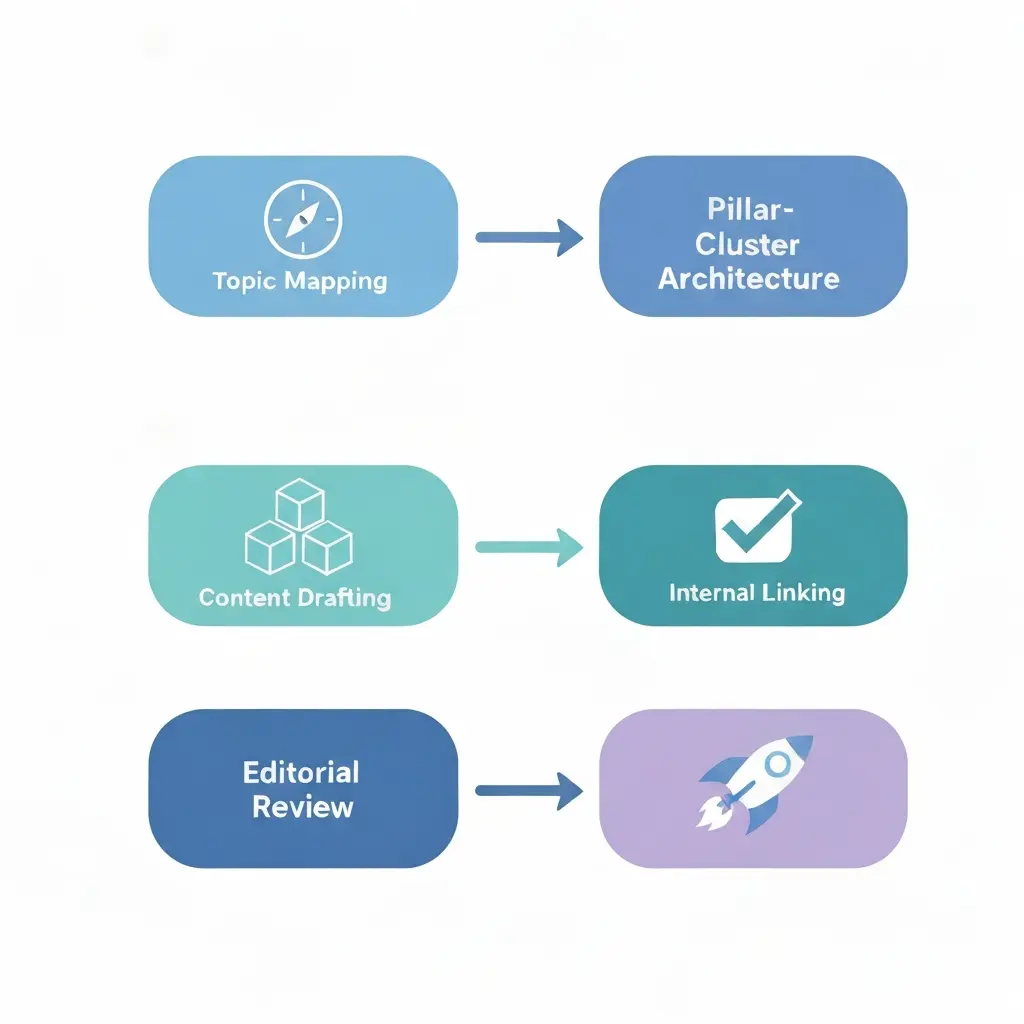
Here’s what most guides miss: the brands winning with AI content aren’t just generating articles faster. They’re building systems — pillar pages, cluster articles, internal linking structures, and AEO-ready passages that AI assistants and search engines extract as authoritative answers. That’s the real edge in AI SEO content generation and topical authority.

What Is AI Content Generation for SEO?
The distinction that actually matters is strategic AI content generation versus bulk AI content dumping. The first builds topical authority through structured pillar-cluster architecture. The second floods a domain with thin, repetitive articles that Google’s Helpful Content system rapidly devalues.
According to Search Engine Land’s guide on AI-generated content, the core risk isn’t the AI tool itself — it’s the absence of human editorial judgment. When marketers treat AI as a “publish and forget” button, quality collapses. When they treat it as a first-draft engine guided by a clear content strategy, rankings follow.
What most people miss is the scope of what “AI SEO content generation” actually covers. It’s not just blog posts. It includes meta descriptions, schema markup, FAQ sections, internal linking anchor text, and even topical map planning — all of which modern AI tools now handle with measurable accuracy.
Why AI Content Generation Has Crossed a Quality Threshold
Three years ago, AI content read like AI content. The syntax was off, the depth was shallow, and Google’s quality raters flagged it consistently. That changed significantly with GPT-4-class models. Semrush’s analysis of AI-generated content found that properly optimized AI articles can match human-written content in organic performance — with the critical caveat that they require strategic structure and expert review.
The threshold isn’t linguistic quality anymore. It’s informational depth, first-hand experience signals, and topical completeness. Those three factors determine whether your AI content ranks or disappears.
What Is Answer Engine Optimization (AEO)?
AEO is the single most important shift in search strategy since mobile-first indexing. Here’s why: Ahrefs’ study of 55.8 million AI Overviews across 590 million searches found that AI Overviews appear in roughly 8–14% of all queries depending on topic category — and they disproportionately pull from pages that already rank in the top 10 organically.
That creates a compounding advantage: strong traditional SEO feeds AEO visibility, and AEO visibility builds brand authority that further reinforces organic rankings. The two strategies aren’t competing — they’re multiplicative.
How AEO Differs from Traditional SEO
| Factor | Traditional SEO | Answer Engine Optimization (AEO) |
|---|---|---|
| Primary Goal | Rank in blue-link results | Get cited in AI-generated answers |
| Content Structure | Page-level optimization | Passage-level, standalone extraction |
| Key Signals | Backlinks, keyword density, CTR | Semantic clarity, schema markup, E-E-A-T |
| Format Preference | Long-form pillar pages | Concise definitions, numbered lists, FAQ blocks |
| Measurement | Ranking position, organic traffic | AI citation frequency, featured snippet captures |
The practical implication: every AI SEO content generation workflow should produce content that serves both goals simultaneously. That’s not a compromise — it’s a format upgrade. The same structured, well-defined content that wins featured snippets also gets extracted by ChatGPT and Perplexity.
Does Google Penalize AI Generated Content?
No — Google does not penalize content based on the method of production. This is one of the most misunderstood points in SEO right now, and it’s worth being direct about it.
Google’s official guidance on AI-generated content states: “Our focus is on the quality of content, rather than how content is produced.” The algorithmic signals Google evaluates — helpfulness, expertise, originality, user satisfaction — are content-quality signals, not authorship signals.
What Google does penalize is content designed to manipulate search rankings rather than serve users. That includes thin AI content published at scale without editorial review, AI content that recycles existing information without adding unique value, and AI-generated pages that exist purely to capture keyword traffic with no meaningful depth.
The data-backed answer: AI generated content is good for SEO when it clears Google’s quality bar. For a deep look at the evidence behind that claim, see Is AI Generated Content Good for SEO? Data-Backed Answer (2026) — which covers the specific ranking studies and case outcomes in detail.
Tip 1: How Do You Build Topical Authority with AI Content?
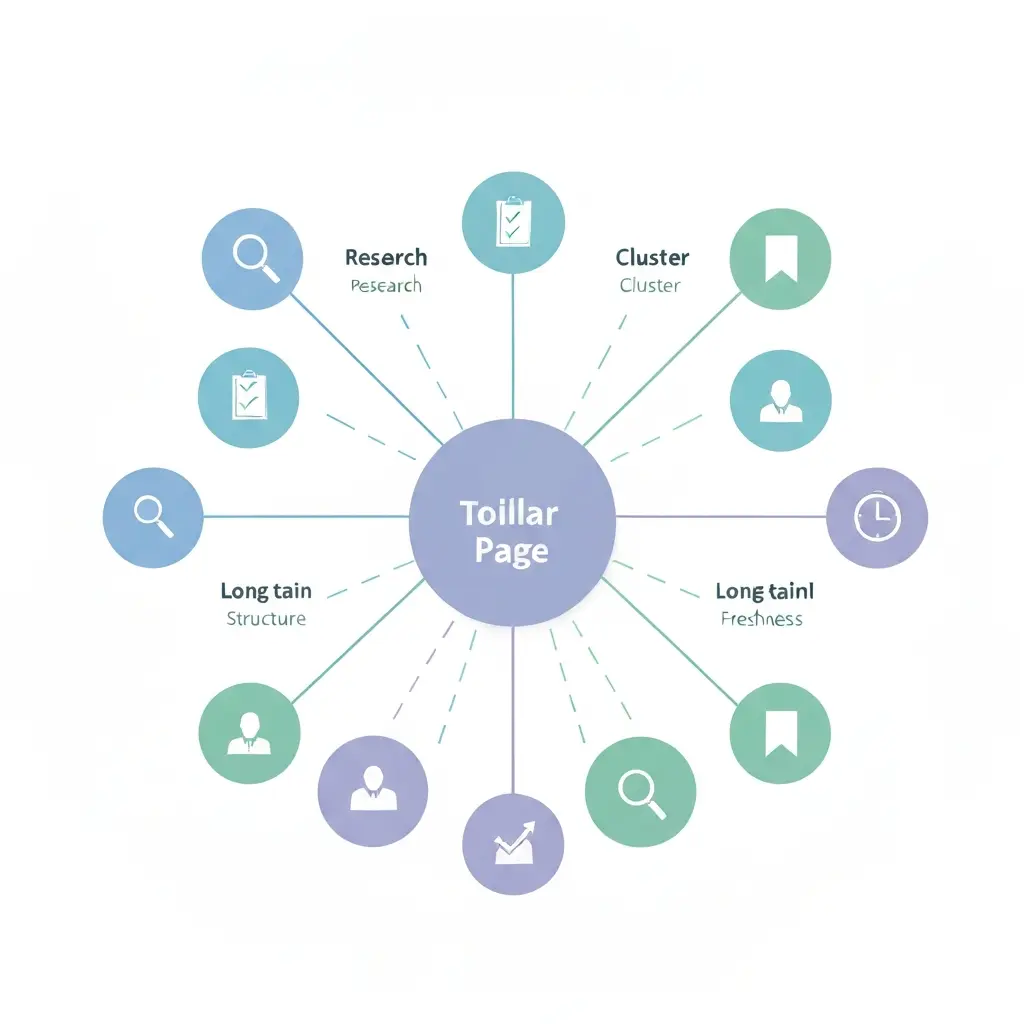
Topical authority is where AI content generation delivers its clearest competitive advantage. A human writer can produce 2–3 articles per week. An AI-assisted system with a defined topical map can produce 20–30 structurally coherent, interlinked articles in the same period. That’s not a marginal efficiency gain — it’s a fundamentally different coverage velocity.
The architecture that works is pillar-cluster-supporting. Pillar pages cover a broad topic comprehensively (2,500–4,000 words). Cluster articles dive deep into specific subtopics (1,500–2,500 words) and link back to the pillar. Supporting content captures long-tail queries (800–1,500 words) and feeds authority upward. HubSpot’s pillar page framework established this model, and it remains the most proven structure for topical authority building.
How to Map Topics Before You Generate a Single Piece of AI Content
- Choose a core topic domain — narrow enough that you can realistically cover it comprehensively (e.g., “AI SEO content generation” rather than “digital marketing”).
- Generate a topical map — identify every subtopic, question cluster, and long-tail variant your audience searches. Tools like Topical Map AI automate this for content marketing topics specifically.
- Classify each topic by content type — pillar, cluster, or supporting — based on search volume and informational depth required.
- Define internal link paths before publishing — every cluster article should have a pre-planned link to its pillar and 2–3 related cluster articles.
- Set a publishing cadence — consistency signals freshness to Google. A predictable cadence of 3–5 articles per week in one topic domain builds authority faster than sporadic high-volume bursts.
- Track topical coverage gaps — after 60 days, audit which subtopics are underrepresented and fill them before expanding to new domains.
For a step-by-step framework built specifically for AI-assisted execution, How to Build Topical Authority with AI Content: 6-Step Framework covers the exact process with architecture templates.
Tip 2: How Should You Structure AI Content for AEO and AI Extraction?
AEO-ready content has a specific structural fingerprint. AI answer engines — including Google’s AI Overviews, ChatGPT’s browse mode, and Perplexity — parse content in passages, not pages. If your content can’t be extracted as a standalone, coherent answer, it won’t be cited.
The structural requirements are precise and non-negotiable for competitive topics:
AEO Content Structure Checklist
- H1 as a question — mirrors how users actually query AI assistants and voice search.
- 40-60 word direct answer in the first paragraph — this is the featured snippet target and the AI extraction passage. It must stand alone and answer the question completely.
- Definition boxes at the start of each major section — AI engines are trained to extract structured definitions. Format them consistently.
- Numbered and bulleted lists for processes — list snippets are the most commonly triggered featured snippet format. Use bold labels on every item.
- FAQ sections with Schema.org FAQPage markup — structured data tells Google explicitly that this passage is a question-answer pair. It increases both featured snippet eligibility and AI Overview inclusion.
- Comparison tables with minimum 3 columns and 4 rows — table snippets capture high-commercial-intent queries. Every AI SEO article comparing tools or strategies should include one.
- Short paragraphs (2-4 sentences) — passage retrieval systems penalize dense blocks of text. White space isn’t just aesthetic — it’s algorithmic.
- Semantic keyword distribution — each section should naturally include LSI terms related to its H2 heading. This signals topical completeness at the passage level.
Here’s where it gets interesting: 76% of ChatGPT citations come from pages updated within the past 30 days (based on AEO research tracking citation freshness patterns). Structural optimization alone isn’t sufficient — freshness signals matter for AI engine citation frequency.
Tip 3: How Do You Add E-E-A-T Signals AI Can’t Generate on Its Own?
E-E-A-T — Experience, Expertise, Authoritativeness, and Trustworthiness — is Google’s quality framework for evaluating content reliability. AI can generate technically accurate content. It cannot generate genuine first-hand experience or real-world credibility signals. That gap is where human editorial input creates ranking differentiation.
What most people miss is that E-E-A-T isn’t just about author bios and credentials. It’s embedded in the texture of the writing itself — in the specificity of examples, the acknowledgment of edge cases, and the honest assessment of where advice doesn’t apply.
Practical E-E-A-T Injections for AI Generated Content
- Add specific, dated data points — “According to Ahrefs’ 2024 study of 55.8 million AI Overviews…” signals research depth that generic AI content omits.
- Include real scenario examples — “A B2B SaaS company publishing 15 cluster articles per month in a defined topic domain typically sees measurable ranking movement within 60–90 days” is more authoritative than “results vary.”
- Cite limitations explicitly — “This won’t work for brand-new domains without existing authority” builds trust because it acknowledges reality.
- Reference named experts and named tools — entities like Google, HubSpot, Ahrefs, Semrush, and recognized industry practitioners are NLP entities Google associates with topic authority. Use them accurately and contextually.
- Link to primary sources — outbound links to Google’s official documentation, peer-reviewed studies, or platform research signal that your content is grounded in verifiable evidence.
- Use an identifiable author with a public profile — author schema with a byline linked to an active professional presence (LinkedIn, industry publications) is a direct E-E-A-T signal for Google’s quality raters.
Tip 4: How Should You Automate Internal Linking for AI SEO Content?
Internal linking is the structural backbone of topical authority. It tells Google which pages are most important, how topics relate to each other, and how to distribute PageRank across your content cluster. Done manually at scale, it’s error-prone and inconsistent. Done with AI automation, it’s one of the highest-ROI SEO activities available.
The principle is simple: every piece of content you publish should receive links from topically related existing pages, and it should link outward to the pillar page it belongs under. In practice, most sites execute this poorly — publishing articles in isolation without connecting them to the broader topical architecture.
Internal Linking Rules for AI Content at Scale
- Every cluster article links to its parent pillar — this passes authority upward and signals topical relationship to Google’s crawlers.
- Anchor text matches the target page’s focus keyword — not “this article” or “learn more,” but the specific keyword phrase the target page is optimizing for.
- 5-8 internal links per pillar page — enough to distribute authority without diluting link equity across too many destinations.
- Avoid orphan pages — every supporting article should receive at least 2 inbound internal links from related cluster content within 30 days of publishing.
- Update existing articles when publishing new content — new cluster articles should trigger a review of existing related content to add contextually appropriate links.
The compounding effect of systematic internal linking is documented: sites that implement structured pillar-cluster linking consistently report 30–60% improvements in crawl coverage and measurable ranking lifts within 60–90 days. The mechanism is crawl efficiency — Google’s bots follow internal links to discover and prioritize content, and well-linked content gets crawled and indexed faster.
Tip 5: Why Do You Need to Audit and Update AI Content on a Rolling Schedule?
Content decay is real and measurable. Studies consistently show that the average blog post loses 30–50% of its organic traffic within 12–18 months if left unupdated. For AI-generated content specifically, this timeline can compress further — because AI models train on existing web data, AI-generated content on competitive topics can become semantically similar to dozens of competing pages over time.
A rolling audit schedule addresses three distinct problems: factual staleness, competitive displacement, and AEO citation freshness. Each requires a different remediation approach.
The 90-Day AI Content Audit Cycle
- Month 1 — Publish and index: Submit the sitemap update, monitor indexing speed, and confirm internal links are resolving correctly.
- Month 2 — Performance baseline: Record ranking positions, impressions, clicks, and average CTR. Flag any pages ranking in positions 11–20 as priority optimization targets.
- Month 3 — Content refresh: Update statistics, add new examples, expand any sections that received high impressions but low CTR (a signal that the meta description or heading isn’t matching user intent), and strengthen E-E-A-T signals. For a structured approach to this process, How to Audit and Improve AI-Generated Content for SEO in 2026 provides a step-by-step evaluation framework.
- Repeat quarterly: High-performing pages should be refreshed every 90 days. Medium-performing pages every 6 months. Low-performing pages should be evaluated for consolidation or redirection.
What Are the Key Differences Between AI SEO Content Strategies?
Not all AI content generation strategies produce the same results. The table below compares three common approaches — unstructured AI generation, AI with basic SEO, and strategic AI SEO content generation with topical authority — across the metrics that actually predict ranking performance.
| Factor | Unstructured AI Generation | AI + Basic On-Page SEO | Strategic AI SEO + Topical Authority |
|---|---|---|---|
| Content Architecture | Random topics, no structure | Individual pages optimized | Pillar-cluster-supporting hierarchy |
| E-E-A-T Compliance | Low — no editorial layer | Medium — author bio added | High — embedded throughout content |
| AEO Readiness | None | Partial — basic keyword targeting | Full — definition boxes, FAQ schema, passage structure |
| Internal Linking | Absent or inconsistent | Manual, inconsistent | Systematic, keyword-anchored |
| Ranking Timeline | Unpredictable, often negative | 3–6 months for isolated pages | 60–120 days for cluster-wide movement |
| Google Penalty Risk | High — Helpful Content system | Medium — quality variance | Low — quality-first, human-reviewed |
| Long-Term Authority | None | Limited to individual pages | Domain-wide topical authority |
How Does Authenova Automate AI SEO Content Generation at Scale?
Executing the 5-tip framework above manually — topical mapping, pillar-cluster architecture, AEO structuring, E-E-A-T injection, systematic internal linking, and rolling audits — requires coordinating multiple tools, workflows, and editorial processes simultaneously. Most marketing teams hit a capacity ceiling within the first 30 days.
Authenova is built specifically to automate this system. Connect your WordPress site, define your topical strategy, and the platform generates optimized, topically-structured content on autopilot — with pillar pages, cluster articles, and supporting content produced in the correct architectural relationship, with automatic internal linking, schema markup, meta descriptions, and scheduled publishing.
The workflow replaces the manual bottleneck at every stage:
- Topical mapping — Authenova’s AI identifies pillar topics, cluster subtopics, and long-tail supporting opportunities based on your domain and target keywords.
- Content generation — the Authenova AI Content Generator produces AEO-structured articles with definition boxes, FAQ schema, comparison tables, and passage-level extraction formatting built in.
- Internal linking — automatic anchor-text-optimized links between cluster articles and their parent pillars, executed at publish time.
- Multi-language support — for brands targeting US, GB, CA, AU, and IN markets simultaneously, Authenova generates market-specific content variants without duplicating the strategic setup.
- Scheduled publishing — consistent cadence without manual coordination.
Fair warning: Authenova handles the architecture and generation. The E-E-A-T layer — specific real-world examples, expert citations, honest assessments of limitations — still requires human editorial input for the highest-stakes content. The platform is a force multiplier, not a replacement for judgment.

Start Building Topical Authority with AI — Without the Manual Grind
Authenova connects to your WordPress site and builds your entire AI SEO content system automatically. Pillar pages, cluster articles, internal linking, schema markup — all on autopilot.
FAQ: AI Generated Content and SEO
What is AI content generation for SEO?
AI content generation for SEO is the use of large language models (LLMs) to create search-optimized articles, landing pages, FAQ sections, and supporting content at scale. The goal is to rank on Google and surface as cited answers in AI-powered search tools like ChatGPT, Perplexity, and Google AI Overviews. Effective AI SEO content generation combines automated drafting with human editorial review and a pillar-cluster architecture for topical authority.
What is Answer Engine Optimization (AEO)?
Answer Engine Optimization (AEO) is the practice of structuring web content so that AI-powered answer engines — including Google AI Overviews, ChatGPT, Perplexity, and Bing Copilot — extract and cite it as a direct response to user queries. AEO relies on structured content formats: 40-60 word direct answers, definition boxes, FAQ schema markup, numbered lists, and short paragraphs that can be extracted as standalone passages.
Does Google penalize AI generated content?
No. Google’s official guidance states it rewards high-quality content regardless of how it was produced. Google’s algorithms evaluate helpfulness, expertise, and user satisfaction — not authorship method. What Google does penalize is low-quality content designed to manipulate rankings: thin AI content published at scale without editorial review, or AI-generated pages with no unique value. The method of production is irrelevant; the content quality is not.
How does topical authority improve AI SEO content rankings?
Topical authority improves rankings because Google’s algorithms reward sites that demonstrate comprehensive, deep coverage of a subject domain. When a site publishes pillar pages, cluster articles, and supporting content in a structured, interlinked architecture, Google recognizes it as a reliable source on that topic — leading to faster indexing, broader keyword coverage, and higher average ranking positions across the entire content cluster.
How often should AI generated content be updated for SEO?
High-performing AI content should be refreshed every 90 days. Medium-performing content should be reviewed every 6 months. The update should include new statistics, expanded