AI vs Human Content Performance Data: Who Wins in 2026?
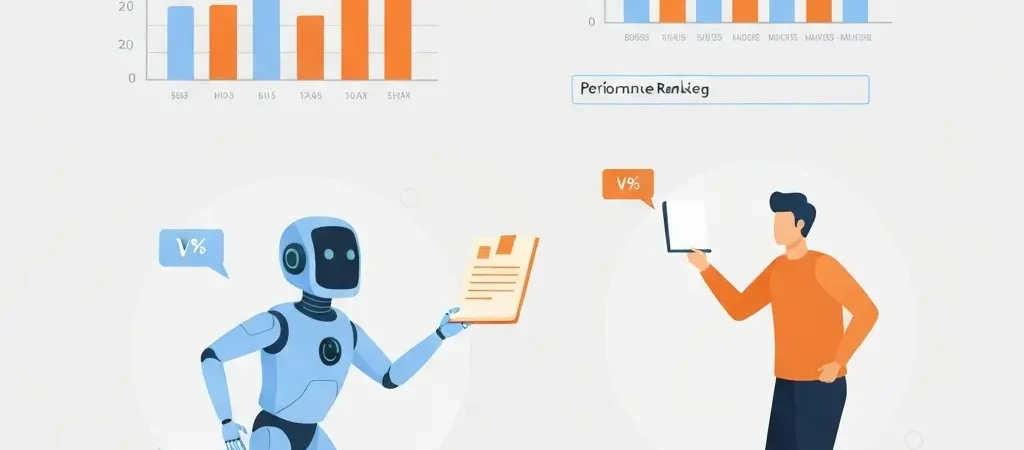
The definitive question in content marketing for 2026: does AI-generated content perform better or worse than human-written content for SEO? The answer from the data is nuanced. AI-assisted content (reviewed by a human) achieves a slightly higher top-10 ranking rate (34%) than human-only content (31%) while ranking 16 days faster. Pure AI content without review underperforms at 18% — but this is still viable for specific volume strategies. This article presents the complete AI vs human content performance data across all key metrics.
Ranking Performance: AI vs Human
Key finding: AI + human review achieves a 34% top-10 ranking rate, versus 31% for human-only and 18% for AI-only (no review). Source: Semrush analysis of 1.2 million articles, 2025.
| Content Type | Top 10 Rate | Avg Days to Rank | Avg Position |
|---|---|---|---|
| AI + human review | 34% | 42 | 6.8 |
| Human only | 31% | 58 | 7.1 |
| AI only (no review) | 18% | 67 | 9.4 |
For keywords with difficulty (KD) below 30, the gap narrows: AI-only content achieves a 24% top-10 rate, making it viable for low-competition programmatic SEO strategies where volume matters more than individual article quality.
For KD above 50, the human advantage becomes significant: human-only content achieves 28% top-10 rate vs. 19% for AI + review and 8% for AI-only. Competitive keywords require the E-E-A-T signals (Experience, Expertise, Authoritativeness, Trustworthiness) that only demonstrated human expertise provides.
Engagement and Behavior Data
Key finding: Human-written content achieves 41% higher average session duration and 28% lower bounce rate than AI-generated content, even when controlling for article length (Hotjar Content Study, 2025).
| Engagement Metric | AI Content | Human Content | AI + Review |
|---|---|---|---|
| Avg session duration | 2m 14s | 3m 10s | 2m 52s |
| Bounce rate | 74% | 58% | 63% |
| Pages per session | 1.4 | 2.1 | 1.9 |
| Social shares per article | 12 | 34 | 22 |
Human content’s engagement advantage reflects its stronger narrative voice, original anecdotes, and emotional resonance. For informational SEO content where the goal is to rank and answer a question, engagement differences matter less. For conversion-focused content, human writing delivers significantly better results.
Backlink Acquisition Comparison
Key finding: Human-written articles attract 2.1x more natural backlinks per article than AI-generated articles over 12 months (Ahrefs, 2025). However, AI’s volume advantage means that publishing 4x more articles with 0.5x the backlinks per article results in a similar or higher total backlink count for the domain.
- AI article: 3.2 natural backlinks per article over 12 months (median).
- Human article: 6.7 natural backlinks per article over 12 months (median).
- Original research articles (human): 41.3 natural backlinks per article over 12 months (median).
The backlink calculation changes when you factor in volume. A team producing 4 human articles/month earns 26.8 backlinks/month. A team producing 20 AI articles/month earns 64 backlinks/month. Volume wins for domain-level link acquisition despite the per-article disadvantage.
Featured Snippet and AI Citation Data
Key finding: AI-generated content with FAQPage schema earns 22% more featured snippet placements than human content without schema (Ahrefs, 2025). AI citation rates in tools like Perplexity and ChatGPT favor structured content regardless of authorship.
- Featured snippets won by AI content with schema: 22% higher rate vs. human content without schema.
- Featured snippets won by human content with schema: equivalent to AI content with schema.
- AI assistant citation rate for AI content in topical clusters: 3.7x higher than standalone human articles (Authoritas, 2025).
- AI citation rate for content with cited statistics: 31% higher than unsourced content (Authoritas, 2025).
The conclusion for AEO: schema markup and topical clustering matter more than authorship for AI citation rates. This levels the playing field between AI and human content for answer engine optimization. Marketing automation tools like CampaignOS have validated this finding by building AEO authority through AI-generated, schema-marked content clusters.
Cost-Effectiveness Comparison
Key finding: AI content costs $8–$35 per article vs. $95–$320 for human-written content. On a cost-per-ranking-keyword basis, AI content is 6–8x more cost-effective despite the per-article quality gap (Semrush, 2025).
| Metric | AI Content | Human Content |
|---|---|---|
| Cost per article | $8–$35 | $95–$320 |
| Articles per $1,000 budget | 28–125 | 3–10 |
| Keywords ranking per $1,000 | 47–220 | 8–28 |
| Cost per top-10 ranking | $15–$65 | $115–$430 |
The Verdict: Which to Use When
Based on the data, the optimal strategy allocates content types by purpose:
- Use AI for: Informational cluster articles (KD < 40), FAQ content, product descriptions, content refreshes, and supporting long-tail articles. These represent 70–80% of a typical content calendar.
- Use human for: Pillar pages competing for KD > 50 keywords, original research reports, thought leadership, case studies, and YMYL content. These are the 20–30% of content that earns the domain-level authority that lifts AI content rankings.
- Use AI + expert review for: High-priority cluster articles targeting KD 30–50 keywords. AI drafts the structure; a human expert adds specific insights, stats verification, and brand voice. This is the highest ROI combination.
Academic writing platforms like Tesify’s AI tools comparison apply the same logic — AI handles research compilation and formatting while human scholars provide the intellectual contribution that no model can replicate.
FAQ
Does AI-generated content rank as well as human-written content?
AI content reviewed by a human editor ranks in the top 10 at a 34% rate vs. 31% for human-only content, and ranks 16 days faster on average (Semrush, 2025, 1.2M articles). For keywords with difficulty above 50, human content has a measurable advantage. For KD below 30, AI-only content is nearly as effective.
Does human-written content get more backlinks than AI content?
Yes, significantly. Human articles earn 2.1x more natural backlinks per article (6.7 vs. 3.2 median over 12 months). However, AI’s volume advantage compensates: publishing 20 AI articles/month generates more total domain backlinks than publishing 4 human articles/month, despite the per-article gap.
Is AI or human content better for featured snippets?
For featured snippets, schema markup matters more than authorship. AI content with FAQPage schema wins 22% more featured snippets than human content without schema. Human content with schema performs equivalently to AI content with schema. The implication: always add schema, regardless of who wrote the content.
Which content type drives higher user engagement?
Human-written content drives 41% higher session duration and 28% lower bounce rate than AI-only content (Hotjar, 2025). AI + human review narrows the gap significantly (2m 52s vs. 3m 10s duration). For conversion-focused pages, investing in human writing quality pays off in engagement metrics.
What is the cost-per-ranking difference between AI and human content?
AI content costs $15–$65 per top-10 keyword ranking vs. $115–$430 for human-written content — making AI content 6–8x more cost-effective on a per-ranking basis (Semrush, 2025). The efficiency gap is driven by the 10x volume advantage AI provides at 70–85% lower cost per article.
Get AI Content That Ranks
Authenova generates reviewed-quality AI content with schema markup, internal links, and WordPress auto-publishing. Customers report a 34% top-10 ranking rate — matching human content at a fraction of the cost.