
AI Generated Blog Posts: The Complete 2026 ROI Guide
You’re publishing one blog post a month. Your competitor is publishing fifteen. They’re not working harder — they’re working smarter with automated blog writing. And while you’re staring at a blank Google Doc wondering where the next 90 minutes of your life went, their traffic compound is quietly growing.
Here’s the real question: is AI content automation actually worth it for a small business, a solopreneur, or a bootstrapped SaaS? Not in theory. In actual dollars, actual rankings, and actual hours saved?
This guide answers that question with the specificity it deserves — including the ROI math, the workflows, the mistakes that kill returns, and the tools that actually deliver. No vague promises. Just the real picture.
What Is Automated Blog Writing — and How Does It Actually Work?
The mechanics have changed dramatically since 2023. Early AI writing tools were essentially autocomplete on steroids — you’d get a draft that needed heavy rewriting before it was usable. What’s available now is different in kind, not just degree.
Modern AI content automation systems do several things at once. They research keyword clusters, generate content structured around topical authority, add internal links, assign schema markup, and push directly to your CMS. The human’s job shifts from writing to strategy and quality control — which is where skilled people actually add the most value anyway.
Here’s where it gets interesting: the best-performing automated content isn’t written in isolation. It’s built within a pillar-cluster content architecture that tells search engines you own a topic — not just that you’ve written about it once. That structural difference is what separates content that ranks from content that sits in the dark.
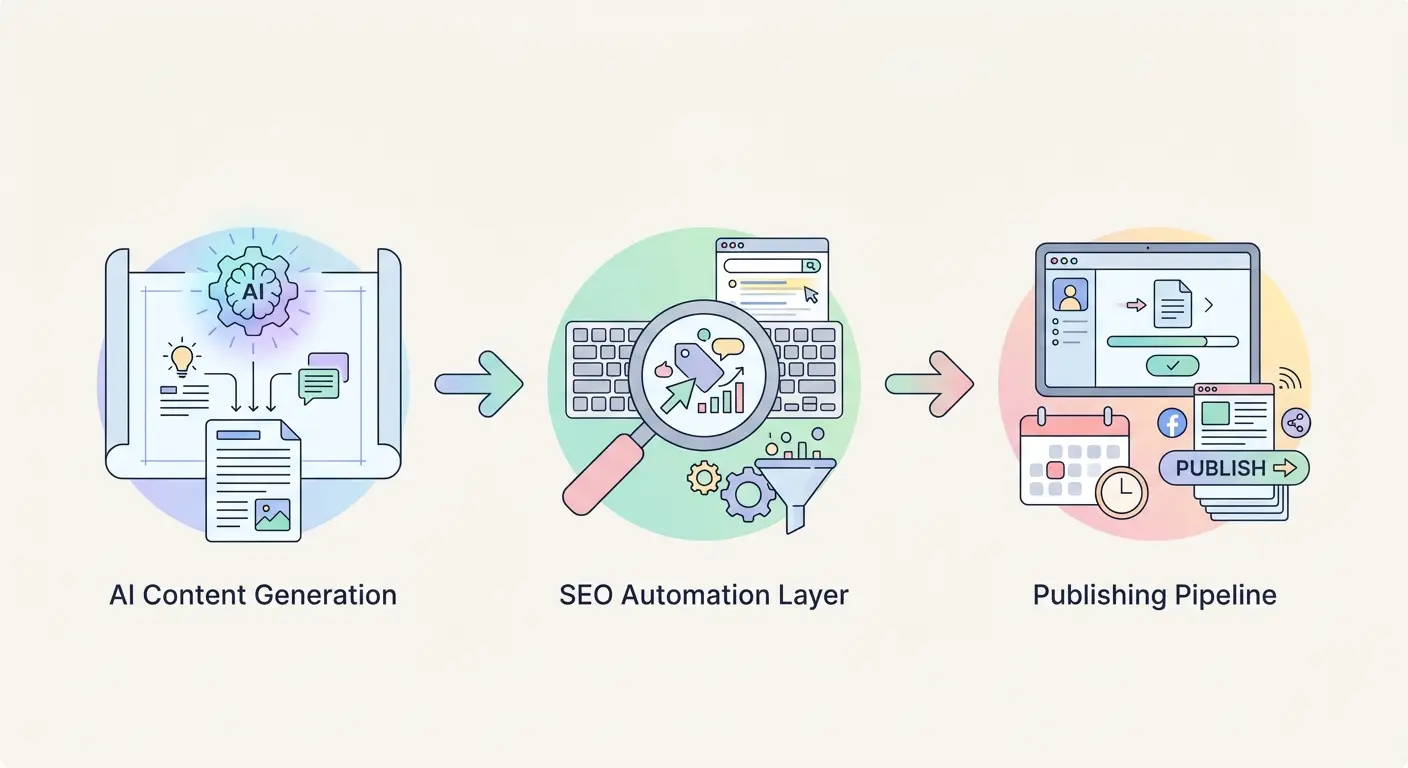
Three core components make automated blog writing work:
- AI content generation: LLM-powered drafting using GPT-4-class models, trained on SEO best practices and structured prompts
- SEO automation layer: Keyword placement, meta generation, schema markup, internal link insertion — all handled programmatically
- Publishing pipeline: CMS integration (usually WordPress), scheduled deployment, and sitemap updates without manual steps
What most people miss is that the ROI doesn’t come from AI writing faster than you can. It comes from removing the human bottleneck entirely for first drafts — freeing you to focus on strategy, differentiation, and the editorial layer that AI genuinely can’t replicate.
The Automated Blog Writing ROI Math You Need to See
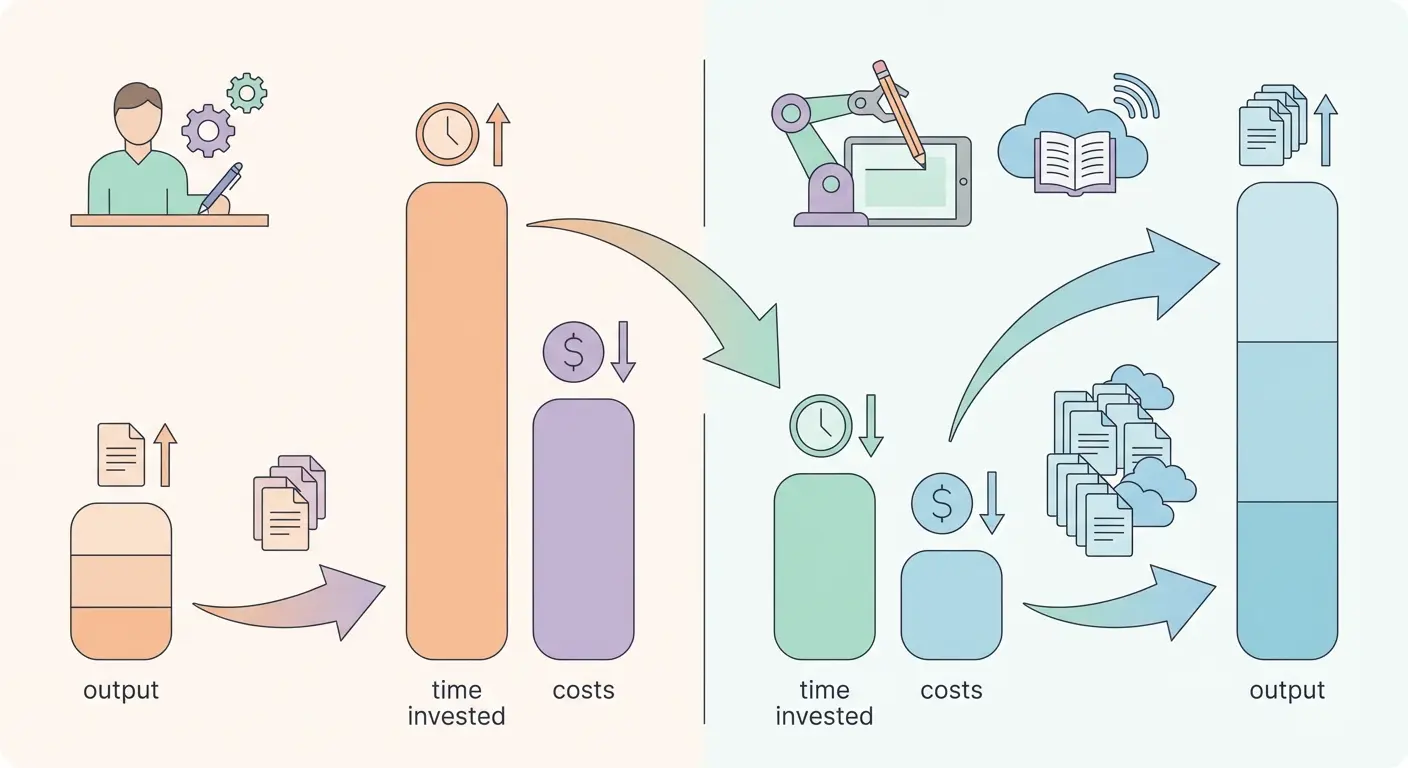
Let’s stop being vague about returns and run real numbers. This is the comparison that actually matters.
Traditional Content Production Cost
| Content Item | Traditional Cost | Time Required | Monthly Output |
|---|---|---|---|
| Freelance writer (1,500-word post) | $150–$400/article | 3–5 days | 4–6 posts |
| In-house writer (salary pro-rated) | $120–$200/article | 2–4 days | 8–10 posts |
| Content agency package | $2,000–$5,000/mo | 1–2 weeks | 8–12 posts |
| DIY (founder writing) | $0 cash, high opportunity cost | 4–6 hrs/post | 2–4 posts |
AI Content Automation Cost
| Setup | Monthly Cost | Monthly Output | Cost Per Post |
|---|---|---|---|
| AI platform (e.g., Authenova) | $49–$149/mo | 20–60 posts | $2–$7 |
| AI + editorial review (1 hr/post) | $49–$149 + $20–$40 editor time | 15–30 posts | $5–$15 |
| Full automation (no review) | $49–$149/mo | 30–60 posts | $1.50–$5 |
The math is stark. A solopreneur spending $300/month on AI content automation versus $300 on a single freelance article isn’t just saving money — they’re producing 20–40x more content at the same budget.
The Organic Traffic Value Calculation
Here’s how to calculate what that traffic is actually worth. According to Semrush data, the average cost-per-click for commercial keywords ranges from $1.50 to $8.00 in competitive niches. If your automated content drives 5,000 organic monthly visitors from keywords averaging $2.50 CPC, you’re generating $12,500/month in equivalent paid traffic value — from a $149/month tool.
That’s not a hypothetical. That’s the model that brands scaling from zero to 50,000 monthly organic visitors are actually running. Fair warning: it takes 3–6 months for content to rank — organic SEO isn’t instant. But the compounding effect after month six is where the real returns appear.
You can sharpen your broader strategy around this using our complete guide to AI-powered SEO content strategy in 2026 — it covers content velocity targets, keyword clustering, and how to structure your pipeline for maximum ranking velocity.
Before vs. After: Automated Blog Writing in Practice
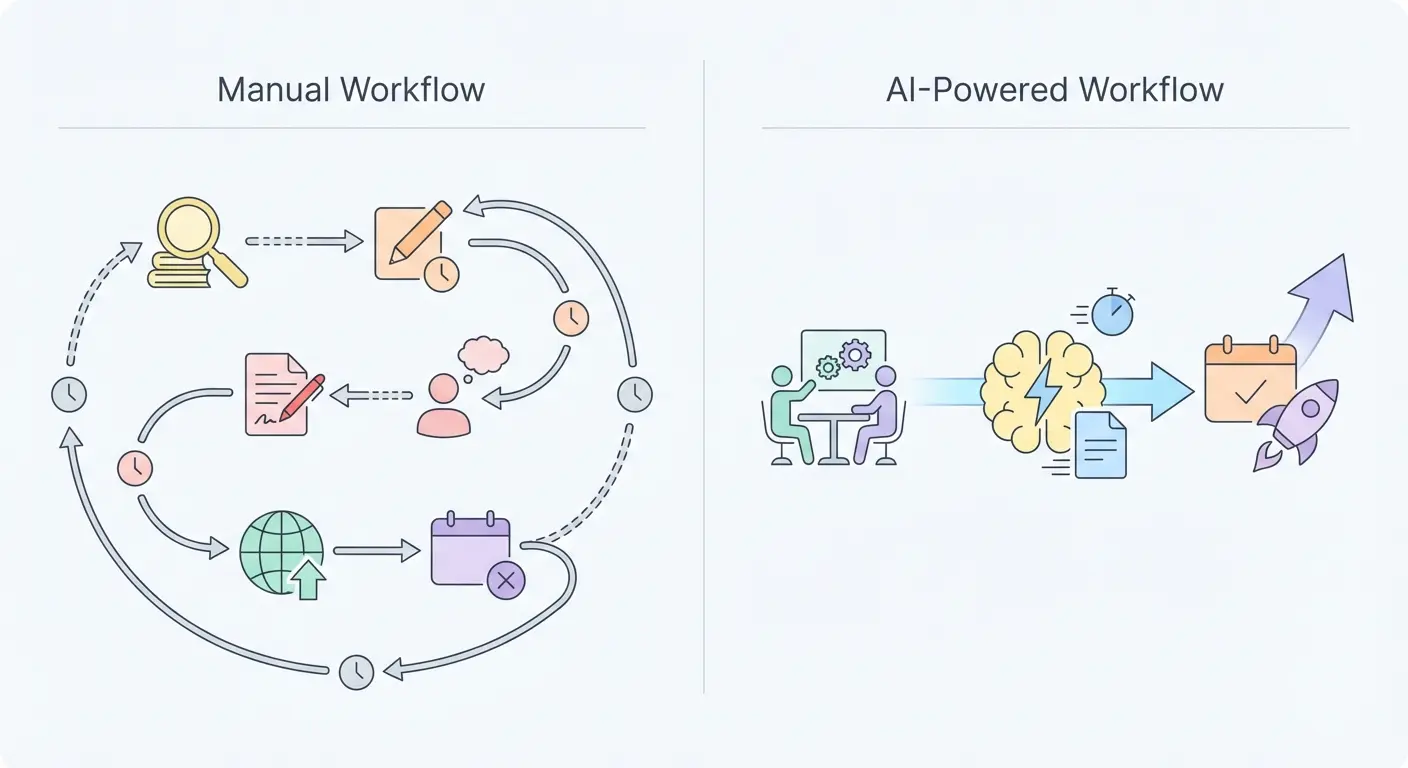
Numbers are one thing. Seeing the actual operational difference is another. Here’s what a realistic content workflow looks like on both sides.
Before AI Content Automation (Manual Workflow)
- Monday: Keyword research (2 hrs)
- Tuesday–Wednesday: Writing first draft (4–6 hrs)
- Thursday: Editing, SEO optimization, finding images (2 hrs)
- Friday: Formatting in WordPress, adding internal links, publishing (1.5 hrs)
- Total: 9.5–11.5 hours per post. Monthly output: 2–3 posts.
After AI Content Automation (Automated Workflow)
- Monday: Strategy session — define keyword clusters, set content velocity (1 hr)
- Automated: AI generates drafts, adds SEO elements, internal links, schema markup
- Wednesday: Editorial review of 5–10 posts, add personal insights, approve (2–3 hrs)
- Automated: Publishing scheduled across the month, sitemap updated
- Total: 3–4 hours of human time. Monthly output: 15–30 posts.
The counterintuitive thing here? The content produced at scale often outperforms hand-crafted posts — not because AI writes better, but because topical coverage depth is what actually drives rankings. Publishing 20 interconnected posts around a keyword cluster builds authority that a single “perfect” post can’t match.
Semrush’s own research (and their AI content training resources) confirm this: content velocity, when paired with quality signals, is one of the strongest predictors of organic growth for new and mid-authority domains.
Step-by-Step: Building a Profitable AI Blog Writing Workflow
Most people set up AI content tools the wrong way — they generate random posts on whatever topics seem interesting and wonder why nothing ranks. The profitable workflow is structured. Here’s the exact process.
Phase 1: Strategic Foundation (Week 1)
- Define your content goal: Traffic growth, product sales, or topical authority? Each goal changes your keyword selection and content type ratio.
- Keyword cluster mapping: Identify 3–5 broad pillar topics. Under each, map 8–15 supporting cluster keywords. Use tools like Semrush, Ahrefs, or Google Search Console for this.
- Competitive gap analysis: Find keywords where competitors have thin or outdated content. Those are your fastest wins.
- Set content velocity: Start with 8–12 posts/month. Scale to 20+ once you’ve validated quality and confirmed crawl/index rates are healthy.
Phase 2: Architecture Setup (Week 1–2)
- Build your pillar pages first: One comprehensive 2,500–4,000-word pillar per topic cluster. This is your hub.
- Plan cluster articles: Each pillar gets 6–12 supporting cluster posts targeting specific subtopics and long-tail variations.
- Configure internal linking rules: Every cluster post links back to its pillar. Pillars link to high-priority cluster articles. This creates a topical content architecture that Google’s information retrieval systems reward.
Phase 3: AI Content Generation (Ongoing)
- Input keyword brief into your AI tool: Include primary keyword, secondary terms, target length, content type (pillar/cluster/supporting), and tone.
- Generate draft: Modern platforms produce publish-ready drafts with meta descriptions, schema, and heading structure included.
- Editorial layer (critical): Add one personal insight, one specific data point, and one differentiated perspective per post. This is what separates content that ranks from content that gets filtered. Spend 15–20 minutes per post here, not 2 hours.
- Publish and track: Deploy on schedule, then track indexing within 72 hours using Google Search Console.
Phase 4: Measurement and Iteration (Monthly)
- Review which posts are impressions-positive (Google sees them) vs. ranking (positions 1–10)
- Identify posts stuck in positions 11–20 — those need a content refresh or more internal links pointing to them
- Double down on keyword clusters that are gaining traction
- Prune or consolidate posts with zero impressions after 90 days
For a deep walkthrough of automated AI pipelines, this n8n tutorial on building AI blog writing systems shows how developers build end-to-end automation — useful reference even if you’re not technical, since it illustrates what the best platforms are doing under the hood.
How Authenova Runs an Autonomous AI Content Engine

There’s a meaningful difference between using ChatGPT to write blog posts and running an actual content automation system. The former is a tool. The latter is infrastructure.
Authenova was built specifically for the use case this guide covers: growing businesses that need consistent, topically-structured, SEO-optimized content without a full writing team. Here’s what the actual workflow looks like on the platform.
Step 1: Connect Your WordPress Site
The Authenova WordPress Plugin installs in under 60 seconds. It syncs your existing site data — pages, categories, tags, metadata, products — so the AI understands your site structure before generating a single word. That context is what makes the output relevant to your specific business, not generic filler.
Step 2: Define Your Content Strategy
The Strategy Builder is where most of the ROI gets configured. You set your business goal (traffic, sales, authority), choose your workflow mode (draft only, auto-publish, or scheduled), define your keyword roles (primary, secondary, supporting), and assign your content velocity. Each strategy runs independently — so you can run separate campaigns for different product lines or audience segments simultaneously.
Step 3: Let the AI Content Generator Run
The AI Content Generator produces every content type you need: pillar pages, cluster articles, and supporting micro-content targeting long-tail keywords. Each piece is structured for topical authority from the start — with proper heading hierarchy, keyword placement, internal links to your pillar pages, schema markup, and meta descriptions. You’re not getting raw drafts that need formatting work. You’re getting publish-ready content.
Step 4: Review, Publish, Rank
Depending on your workflow mode, content either queues for your review or publishes on schedule automatically. The plugin handles sitemap updates, category assignment, and SEO tag injection — all the technical publishing work that usually eats 30–45 minutes per post.
What brands using Authenova consistently report is that the ROI shift becomes visible around month three, when enough topically-clustered content has accumulated to trigger what SEOs call a “trust cascade” — Google begins ranking multiple posts from the same domain on related queries simultaneously. That’s when organic traffic starts compounding instead of growing linearly.
🚀 No credit card required. Start your free Authenova trial and have your first AI-generated, SEO-structured post live on WordPress within the next two hours.
What Google Actually Says About AI-Generated Content
A lot of people are still operating on 2022-era assumptions about how Google treats AI content. The guidance has evolved — and getting this right is the difference between rankings and penalties.
Google’s official position, as stated in Google Search Central’s guidance on AI-generated content, is clear: “Google Search’s helpful content system and our core ranking systems aim to reward content that demonstrates E-E-A-T — expertise, experience, authoritativeness, and trustworthiness.” The method of production (human or AI) is explicitly secondary to the quality and usefulness of the output.
What Google does penalize:
- Mass-produced thin content that adds no value over existing search results
- AI content designed to manipulate rankings rather than help users
- Factual errors or hallucinations left unreviewed in published content
- Keyword stuffing or unnatural optimization signals
What Google doesn’t penalize:
- AI-assisted content that genuinely helps users
- Automated content with proper editorial oversight
- High-volume publishing from a single domain, when quality signals are maintained
The practical implication: an editorial review layer isn’t optional. It’s the mechanism that transforms AI output from “generated text” to “helpful content.” Even 15 minutes per post adding a specific data point, a personal perspective, or an accurate case reference dramatically shifts the quality signal.
Worth noting: even HubSpot — one of the most trafficked marketing blogs on the planet — uses AI in their content workflow. Their public breakdown of how their blog team uses AI shows AI handling research synthesis, outline generation, and first drafts, with editors adding the expertise layer. If HubSpot runs this model, it’s been validated at scale.
There’s also a growing body of research on risks when AI content goes unreviewed — specifically around factual drift and misinformation. Research published on arXiv has documented how unreviewed GenAI content can propagate inaccuracies. The solution isn’t to avoid AI — it’s to maintain editorial governance. And building that topical authority framework with proper oversight is what separates brands that win long-term from those that get hit by algorithm updates.
7 Mistakes That Kill Your Automated Blog Writing ROI
Most failed AI content strategies don’t fail because the AI is bad. They fail because of how the strategy is configured. These are the mistakes worth avoiding from the start.
Mistake 1: Publishing Without Topical Structure
Random posts on disconnected keywords don’t compound. Each post needs to belong to a cluster with a clear pillar. Without this, you’re building a pile of content instead of a content architecture. Google can’t establish what your site is about — so it doesn’t trust you on anything.
Mistake 2: Zero Editorial Review
Full automation with no human touch is a short-term gamble. AI models can hallucinate statistics, misattribute quotes, and produce subtly inaccurate claims. One credibility hit from a factually wrong article can cost you ranking momentum that took months to build. Spend 15 minutes per post. It’s worth it.
Mistake 3: Targeting Only High-Volume Keywords
New and mid-authority sites don’t rank for 10,000-search/month keywords. The ROI in automated blogging comes from owning long-tail clusters — keywords with 100–2,000 monthly searches where competition is low. AI lets you target 50 of these simultaneously, which is what makes the volume economics work.
Mistake 4: Ignoring Internal Linking
AI-generated content that doesn’t interlink is like a city with no roads. Each post needs to link to its pillar, to related cluster posts, and occasionally to supporting content. This isn’t just UX — it’s how PageRank flows through your site and signals topical depth to crawlers.
Mistake 5: Setting Velocity Too High, Too Fast
Publishing 60 posts in month one on a brand-new domain can trigger spam signals. Start at 8–12 posts/month, verify indexing health, then scale. Google’s crawl budget is real — if you flood a new site, posts stop getting indexed, which means zero ROI on all that generated content.
Mistake 6: Ignoring Content Freshness
AI is excellent at generating first drafts. It’s not great at staying current. Posts that reference outdated statistics or miss recent developments get filtered over time. Build a quarterly refresh cycle for your top-performing posts. Update one key statistic, add a recent example, change the publication date — these signals matter.
Mistake 7: No Conversion Layer
Traffic without conversion is a vanity metric. Every automated post needs a logical next step — a lead magnet, a product CTA, a related article link, a newsletter sign-up. If your content engine drives 10,000 visitors who bounce with no action, you’ve built reach without revenue. Match every content cluster to a conversion goal before you start publishing.
KPIs to Measure AI Content Performance
What gets measured gets improved. Here’s the metric stack that actually tells you whether your automated blog writing investment is working.
| KPI | What It Measures | Target Benchmark | Review Cadence |
|---|---|---|---|
| Index Rate | % of published posts Google has indexed | >85% within 2 weeks | Weekly |
| Impressions Growth | GSC impressions month-over-month | +20–40%/mo in months 3–6 | Monthly |
| Avg. Position Improvement | Keyword ranking movement | –2 to –5 positions/month for tracked KWs | Monthly |
| Organic Traffic Value | Equivalent paid traffic cost (from GSC + CPC data) | 3–8x monthly tool spend by month 6 | Monthly |
| Content ROI Ratio | Revenue attributed to organic / content spend | >3x by month 6, >8x by month 12 | Quarterly |
| Topical Coverage Score | % of planned cluster keywords with published content | >70% coverage per pillar cluster | Monthly |
The metric most small business owners overlook is Organic Traffic Value — the estimated dollar equivalent of your organic traffic based on what you’d pay for the same clicks via Google Ads. It’s the clearest single number for presenting content ROI to stakeholders or justifying tool spend to yourself.
For a deeper framework on how these metrics map to long-term authority building — and how to interpret signals that indicate you’re building genuine domain expertise vs. surface-level traffic — the topical authority SEO framework breaks this down with the specificity that vague “track your rankings” advice rarely delivers.
One more tool worth knowing for planning: Junia.ai’s free AI content calendar generator can help you map out publishing schedules aligned to keyword clusters — useful for visually sequencing your automated content pipeline before you start generating.
And if you want to see n8n-based automation pipelines that connect AI content generation to affiliate and blogging workflows, this n8n auto-blogging workflow template is a concrete reference for what full-stack automation looks like technically.
Frequently Asked Questions About Automated Blog Writing
Does Google penalize AI-generated blog posts?
Google does not penalize AI-generated content as a category. According to Google Search Central’s official guidance, what matters is whether content is helpful, accurate, and demonstrates E-E-A-T — not how it was produced. AI content that’s thin, inaccurate, or clearly designed to game rankings will be filtered, but high-quality AI-assisted content with editorial oversight performs as well as human-written content in search results.
How many AI blog posts should I publish per month?
For new sites, start with 8–12 posts/month and verify that Google is indexing them consistently before scaling. Mid-authority sites (6+ months old, DA 20+) can typically handle 20–40 posts/month without triggering spam signals. The key constraint isn’t the AI’s output capacity — it’s your site’s crawl budget and your editorial review capacity.
How long does it take for AI blog posts to rank on Google?
Most AI-generated blog posts targeting long-tail keywords begin appearing in search results within 2–6 weeks of indexing. Reaching the first page (positions 1–10) typically takes 3–6 months, depending on domain authority, keyword competition, and how well the content cluster is structured. Posts within strong pillar-cluster architectures tend to rank faster than isolated articles because the interconnected structure signals topical authority.
What’s the difference between AI content automation and just using ChatGPT?
ChatGPT is a writing tool that requires manual prompting, formatting, SEO optimization, and publishing for each individual piece. AI content automation platforms handle the entire pipeline: keyword strategy, structured content generation, internal linking, schema markup, meta descriptions, and direct WordPress publishing — all in a single automated workflow. The difference is between writing one post faster and running a fully autonomous content engine.
Can AI blog writing actually replace a content team?
AI content automation replaces the drafting and production functions of a content team, not the strategic and editorial functions. What you still need: a content strategist to define keyword clusters and business goals, and an editor to review AI output for accuracy, add differentiated insights, and maintain brand voice. The realistic outcome for most small businesses is that one person with AI tools can do the work that previously required a team of 3–5.
What is the typical ROI timeline for automated blog writing?
Most businesses see measurable organic traffic growth by month 3 and positive ROI (traffic value exceeding tool cost) by month 4–6. Full compounding returns — where a content library of 50–100+ posts generates significant inbound traffic daily — typically materialize by month 9–12. The ROI curve isn’t linear; it accelerates as topical authority compounds and more posts rank simultaneously.
Stop Trading Hours for Blog Posts — Build a Content Engine Instead
The gap between brands that dominate organic search and brands that don’t isn’t talent. It’s volume, structure, and consistency — and those three things are exactly what automated blog writing solves.
If you’ve read this far, you already know the math works. A single monthly freelance article at $300 versus 20–30 SEO-structured posts at the same budget isn’t a close call. The only real question is whether your workflow and tooling are set up to actually capture that ROI.
Authenova was built precisely for this moment. You connect your WordPress site, define your keyword strategy, set your publishing schedule, and the platform generates, optimizes, interlinks, and publishes your content automatically. Your job becomes editorial oversight and strategy — the 20% of content work that actually requires a human brain.
Here’s what you get when you start:
- ✅ AI-generated, SEO-optimized blog posts structured for topical authority
- ✅ Automatic internal linking with pillar-cluster architecture built in
- ✅ Schema markup, meta descriptions, and keyword optimization — all handled
- ✅ Direct WordPress publishing via the Authenova plugin (installs in 60 seconds)
- ✅ Strategy Builder to configure campaigns by goal, velocity, and keyword targeting
- ✅ Multi-language support for international SEO
- ✅ Free trial — no credit card required
Ready to 10x your content output without 10x-ing your workload?
Join growing brands using Authenova to build real organic traffic on autopilot.
The brands winning in organic search right now aren’t waiting for the “perfect” moment to start scaling content. They started months ago, and their content is compounding while you’re still deciding. The best time to start your automated blog writing engine was six months ago. The second best time is today.