SEO Content Strategy in 2026: How to Build a System That Grows on Its Own
A great SEO content strategy is not a publishing schedule. It is a system — a structured architecture of keyword clusters, content types, internal links, and publishing cadence that compounds in value over time. Sites that build this system correctly see organic traffic growth accelerate month over month, not plateau. Sites that treat SEO as a series of individual articles watch their efforts produce short-lived spikes and no lasting momentum.
In 2026, with Google’s AI Overviews appearing in 55% of all searches and AI-referred traffic converting at 14.2% compared to organic’s 2.8%, the strategic stakes are higher than ever. The difference between a content program that builds a defensible asset and one that generates forgettable content comes down to architecture. This guide walks you through it.
The Foundations of a Modern SEO Content Strategy
Modern SEO content strategy is built on topical authority — the principle that Google rewards sites that demonstrate comprehensive, expert coverage of a topic rather than individual high-ranking articles. This means your strategy must be designed not just to produce good articles, but to produce articles that collectively signal depth across your target topic space.
The three pillars of topical authority are:
- Breadth: You cover enough subtopics within your niche that Google recognizes you as a comprehensive resource
- Depth: Each subtopic you cover has multiple articles exploring different angles — FAQs, how-tos, comparisons, data — not just one surface-level post
- Architecture: Your internal linking structure makes the topical relationships between articles explicit and navigable
Our detailed breakdown in the Topical Authority SEO Framework covers the mechanics of each pillar in depth.
Step 1: Build Your Keyword Cluster Map
Your keyword cluster map is the blueprint for your entire content program. It starts with your primary topic (e.g., “email marketing”) and expands outward into subtopics (e.g., “email deliverability,” “A/B testing email campaigns,” “email marketing automation”) and then into specific questions and long-tail variations.
How to Build the Map
- Identify 5–10 primary topics. These are your pillar keywords — the core topics your brand wants to own. They typically have 5,000–50,000 monthly searches and moderate to high difficulty.
- Expand to secondary topics. Use keyword research tools to find subtopics with 500–5,000 monthly searches that cluster around each primary topic by intent and entity.
- Capture long-tail questions. People Also Ask data, Reddit threads, and forum discussions reveal the specific questions your audience is asking. These become supporting articles with low competition and high relevance to AI citation engines.
- Assign content types. Each keyword cluster gets a pillar article (the most important, comprehensive piece), several cluster articles (focused on specific subtopics), and supporting articles (answering specific questions or comparisons).
Step 2: Define Your Content Hierarchy
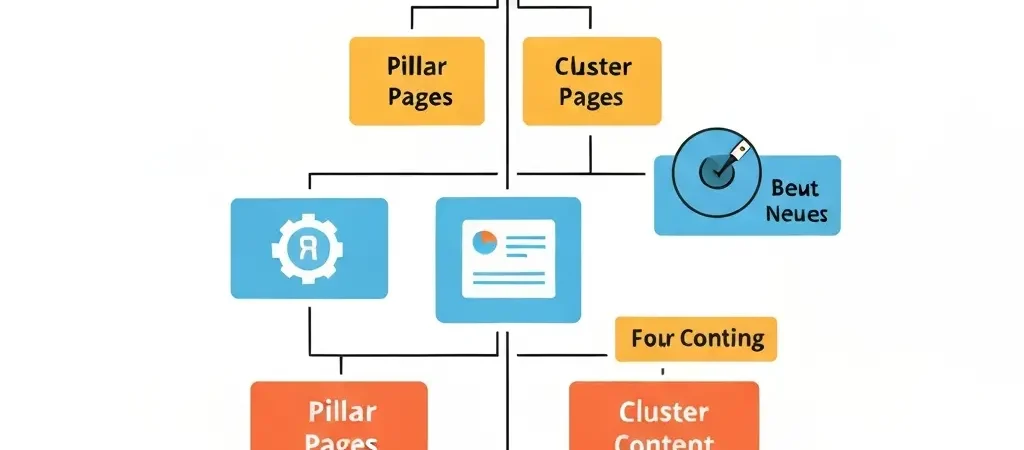
The pillar-cluster-supporting hierarchy is the structural backbone of topical authority. Here is how it works in practice:
| Content Type | Length | Purpose | Ratio |
|---|---|---|---|
| Pillar | 2,000–4,000 words | Comprehensive coverage of primary topic. Ranks for head keyword. | 10–15% |
| Cluster | 1,200–2,000 words | Focused on a specific subtopic. Links to pillar. | 55–60% |
| Supporting | 800–1,200 words | Specific questions, FAQs, and long-tail topics. | 25–30% |
This ratio ensures you’re building topical depth at scale while maintaining the anchor pillar pages that capture high-value head keywords. The pillar cluster content strategy implementation guide covers the setup in detail.
Step 3: Set a Sustainable Publishing Cadence
Content velocity — how consistently and frequently you publish — is a significant ranking signal in its own right. Sites publishing 5–10 quality articles per week see Google’s crawl rate increase as the algorithm recognizes active content production. The key word is “sustainable”: irregular bursts followed by months of silence harm more than they help.
AI content automation is the enabler here. Without it, maintaining a 5+ articles per week cadence requires a team of writers. With tools like Authenova, a single marketer can publish 20–40 articles per month from a pre-built keyword map. This cadence, sustained over 90 days, is where compounding begins.
For deeper analysis of velocity mechanics, see our content velocity SEO benchmarks article.
Step 4: Build the Internal Linking Architecture
Internal links do three things simultaneously: pass PageRank between pages, signal topical relationships between content to Google, and keep readers engaged by surfacing related content. All three have measurable impact on rankings.
Internal Linking Rules for a Content Strategy
- Every cluster article links to its parent pillar using the focus keyword as anchor text
- Pillar articles link to at least 5–8 cluster articles within their topic
- Supporting articles link to 2–3 cluster articles and 1 pillar
- No page on your site should be more than 3 clicks from the homepage
- Rotate anchor text — multiple links to the same page should use varied but topically relevant anchor text
This architecture is what transforms a collection of articles into a topical authority signal. Our comprehensive internal linking strategy guide covers the PageRank mechanics and link equity distribution models.
Step 5: Measure and Adjust
An SEO content strategy without measurement is just publishing. Track these metrics monthly:
- Topical cluster impressions: Are you appearing for more keywords within your target topic space?
- Pillar article rankings: Primary keyword position movement for your anchor pillar pages
- Content indexed: Are all your articles being indexed promptly after publication?
- CTR by article type: Pillar articles with schema markup should outperform average CTR
- Organic traffic growth rate: Month-over-month growth should accelerate as topical depth increases
At the 90-day mark, review which articles are ranking in positions 11–20. These are your highest-leverage refresh candidates — small improvements to content depth, internal links, or schema markup often push them to page 1.
Where AI Fits in Your Content Strategy
AI does not replace strategy — it executes strategy at a speed impossible for humans alone. Here is the division of labor in a high-performing content program:
- Human: Sets the topical keyword map, approves the content hierarchy, defines brand voice, reviews pillar articles
- AI: Generates cluster and supporting articles, creates meta tags and schema markup, suggests internal links, maintains publishing cadence
This division allows a 2–3 person team to maintain the content output of a 20-person editorial team. See our complete guide on AI content strategy from keyword research to publication for the exact workflow.
Frequently Asked Questions
What is an SEO content strategy?
An SEO content strategy is a structured plan for producing, organizing, and distributing content to rank in search engines. It includes keyword cluster mapping, content type hierarchies (pillar/cluster/supporting), internal linking architecture, publishing cadence, and performance measurement. The goal is to build topical authority — Google’s recognition that your site is a comprehensive expert source on your target topics.
How many articles do I need to build topical authority?
A minimum viable topical cluster typically requires 15–25 articles: 1–2 pillar articles, 8–12 cluster articles, and 5–10 supporting articles. This is enough to signal content depth to Google in most medium-competition niches. Highly competitive niches may require 50–100+ articles per topic cluster to achieve meaningful topical authority.
How long does it take for an SEO content strategy to work?
Most content programs see initial ranking movement in weeks 4–8, meaningful traffic growth by month 3, and compounding acceleration by month 4–6. The timeline depends on domain authority, content quality, publishing velocity, and competitive intensity. New sites in competitive niches can take 6–12 months to see significant organic traffic.
What is the pillar-cluster content model?
The pillar-cluster model is a content architecture where comprehensive “pillar” articles cover broad topics, and multiple “cluster” articles cover specific subtopics — all linked to the pillar. This structure signals topical depth and expertise to search engines, reinforces keyword rankings, and improves user navigation. Sites using this model see an average 40% higher organic traffic.
Build Your SEO Content Strategy on Autopilot
Authenova’s strategy builder maps your keyword universe into a pillar-cluster architecture, then executes the publishing cadence automatically. Set your strategy once and let the system compound.