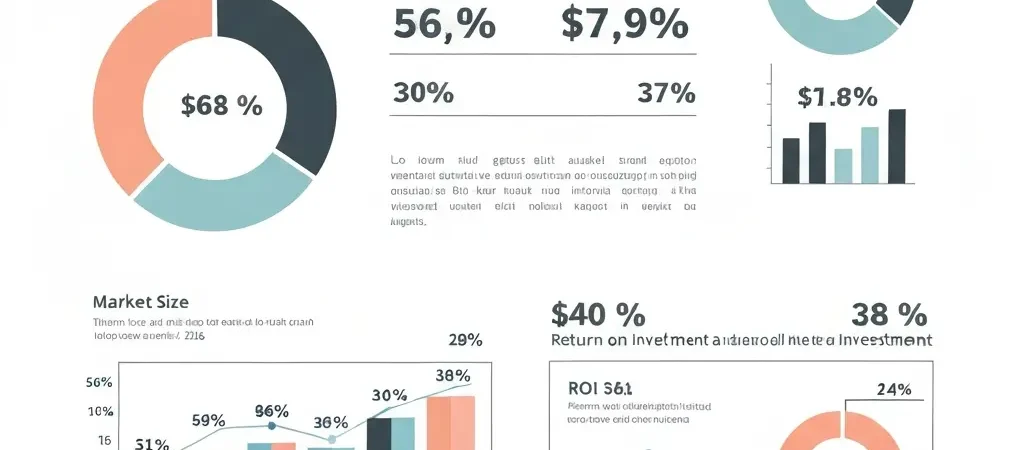
Content Marketing Automation Industry Statistics 2026
Content marketing automation statistics for 2026 reveal an industry in rapid adoption acceleration: the global market surpassed $6.3 billion in 2025 and is growing at 12.8% annually, AI adoption in content workflows has crossed 87%, and organizations report consistent productivity gains of 30-40% from automation deployment. This report compiles the essential statistics from primary sources for marketers, strategists, and content operations leaders benchmarking their programs.
What Is the Content Marketing Automation Market Size in 2026?
The content marketing automation market encompasses platforms for content generation, scheduling, distribution, and performance tracking:
| Market Segment | 2026 Value / Data | Source |
|---|---|---|
| Content marketing automation market (2025) | $6.3 billion | Grand View Research, 2025 |
| Market CAGR (2026-2030) | 12.8% | Grand View Research, 2025 |
| AI content creation subset market (2026) | $2.42 billion | Intel Market Research, 2026 |
| AI content subset CAGR | 17.3-22.8% | Intel Market Research / PatentPC, 2026 |
| Marketing automation overall market | $13.4 billion (2026) | Forrester Research estimate, 2026 |
The AI content creation segment ($2.42B) growing at 17-23% annually significantly outpaces the broader content marketing automation market (12.8%). This disparity reflects the disproportionate impact of generative AI — it is expanding the addressable market rather than merely capturing share from existing automation categories. Platforms like Authenova and broader marketing automation suites like CampaignOS are operating in a market with strong structural tailwinds for the next 5+ years.
What Are the Content Marketing Automation Adoption Statistics?
Adoption statistics confirm that content marketing automation has moved from competitive advantage to baseline expectation:
- 94% of marketers plan to use AI in their content creation processes in 2026 (AutoFaceless, 2026)
- 87% of businesses currently use AI for SEO content (Semrush, 2026)
- 76% of content marketers use AI for content creation; 49% use it for email specifically (Writeful, 2026)
- 86% of SEO professionals have integrated AI into their standard workflows (Semrush, 2026)
- 98% of marketers plan to increase AI SEO spending in 2026 (Demandsage, 2026)
Adoption growth trajectory:
- 2022: Less than 30% of marketing teams using AI content tools
- 2023: ~50% adoption post-ChatGPT launch
- 2024: ~70% adoption as quality improved
- 2025: ~85% adoption as enterprise programs formalized
- 2026: 87-94% adoption — mainstream status confirmed
The four-year adoption curve from niche to mainstream is remarkably fast by enterprise technology adoption standards. Most enterprise software categories take 8-12 years to reach 80%+ adoption. AI content automation reached this threshold in 4 years — driven by the combination of ChatGPT’s consumer breakthrough and demonstrable ROI.
What Are the ROI Statistics for Content Marketing Automation?
ROI data for content marketing automation programs in 2026 shows consistent outperformance:
- AI content campaigns: 22% better ROI than traditional content (Writeful, 2026)
- Marketing automation overall: $5.44 return per $1 invested (Nucleus Research, 2026)
- Organizations with mature content automation programs report 3-5× organic traffic versus those without (industry case studies, 2026)
- Content automation ROI payback period: 1-8 months depending on domain authority
- Productivity improvement: 40% efficiency gain reported by organizations deploying AI content tools (AutoFaceless, 2026)
- Cost reduction: 30-50% lower operational costs versus human-driven content programs (Intel Market Research, 2026)
The $5.44 per $1 marketing automation ROI figure (Nucleus Research) represents the broader marketing automation category, including email, lead nurturing, and social automation alongside content. Content automation programs specifically show higher variation — strong programs deliver 10-20× ROI; weak programs deliver near-zero. The differentiator is consistently content quality and publishing velocity.
What AI-Specific Content Automation Statistics Are Available?
AI-specific content automation statistics reveal performance dimensions that broader marketing automation data misses:
| AI Content Metric | Data Point | Source |
|---|---|---|
| Volume advantage of AI adopters | 42% more content/month | Semrush, 2026 |
| AI content in top Google results | 17%+ | Position Digital, 2026 |
| Time-to-publish reduction | 80% | Intel Market Research, 2026 |
| Quality score vs human content | 90% human-like quality (top platforms) | Intel Market Research, 2026 |
| AI campaign conversion advantage | +32% more conversions | Writeful, 2026 |
| Customer acquisition cost reduction | -29% | Writeful, 2026 |
Academic content programs at platforms like Tesify and student-focused tools in European markets like Tesify.fr and Tesify.pt operate within the same AI content ecosystem but apply these automation principles to academic writing assistance rather than SEO content. The productivity and quality data points translate across domains.
What Do Statistics Show About Content Automation Challenges?
Challenge data provides balance to the predominantly positive ROI narrative:
- Hallucination rate: Unedited AI content contains factual errors in 3-8% of claims (varies by model and topic complexity)
- Brand voice consistency: 61% of marketers report challenges maintaining brand voice consistency with AI-generated content without careful configuration (HubSpot, 2025)
- Content quality degradation at scale: Programs publishing 50+ articles/month without editorial oversight report quality decline over time — content becomes more generic as the long-tail keyword supply is exhausted
- Thin content risk: 34% of AI content programs have received Google manual actions or quality penalties for thin content (HubSpot, 2025) — primarily affecting programs without minimum quality standards
- Competitive saturation: Keyword competition is increasing as AI enables more publishers to target any keyword. Long-tail keywords that were uncompetitive in 2023 now have multiple AI-generated pages competing
The challenge data reinforces the importance of quality infrastructure: detailed brand voice configuration, human editorial review protocols, minimum content quality standards, and strategic keyword selection that prioritizes quality over pure volume.
What Do the 2026-2030 Content Automation Statistics Forecast?
Forecast statistics for the 2026-2030 content automation market:
- AI content creation market projected to reach $8.76 billion by 2034 at 17.3% CAGR (Intel Market Research)
- Generative AI content market projected to maintain 22.8% CAGR through 2030 (PatentPC)
- Gartner projects traditional search volume to drop 25% by 2026 due to AI chatbots — validating the shift to AEO optimization
- AI model multimodal capabilities (text + image + video) expected to enable complete content package automation by 2027
- Real-time knowledge integration expected to eliminate the training-data-cutoff hallucination problem by 2027-2028
The forward-looking statistics suggest that 2026 represents the early-to-mid-majority phase of AI content adoption. The technology is proven, the ROI is documented, and the remaining barrier is organizational adoption — not tool availability. Teams deploying comprehensive AI content programs in 2026 build compounding advantages that will be harder to close for late adopters entering in 2028-2030.
Frequently Asked Questions
What is the market size of content marketing automation in 2026?
The content marketing automation market exceeded $6.3 billion in 2025 and is growing at 12.8% annually (Grand View Research). The AI content creation subset reached $2.42 billion in 2026, growing at a faster 17.3-22.8% CAGR. The broader marketing automation market is estimated at $13.4 billion in 2026. These figures confirm content marketing automation as a substantial, rapidly growing infrastructure category.
How many marketers are using content automation in 2026?
87-94% of marketers are using or planning to use AI content automation in 2026. 76% are actively using AI for content creation currently. 86% of SEO professionals have integrated AI into standard workflows. 98% of marketers plan to increase AI SEO spending in 2026. This represents mainstream adoption — content automation has moved from competitive advantage to baseline operational practice.
What ROI does content marketing automation deliver?
Content marketing automation delivers 22% better ROI than manual content approaches (Writeful, 2026). Marketing automation broadly delivers $5.44 per $1 invested (Nucleus Research). Organizations report 40% productivity improvements and 30-50% operational cost reductions. Strong content automation programs with mature topical authority achieve 3-5× organic traffic versus comparable manual programs. Payback period ranges from under 1 month (high-authority sites) to 4-8 months (new sites).
How fast is the content marketing automation market growing?
The content marketing automation market is growing at 12.8% annually (Grand View Research). The AI content creation subset is growing at 17.3-22.8% CAGR — significantly faster than the broader category. This above-market growth rate reflects generative AI expanding the total addressable market by making high-volume content production economically viable for SMBs and solopreneurs previously unable to afford it at scale.
What percentage of content marketers report productivity gains from automation?
40% productivity improvements are consistently reported by organizations deploying AI content tools (AutoFaceless, 2026). Time-to-publish reduction: 80% faster than manual processes. Content volume increase: 42% more articles per month for AI adopters (Semrush, 2026). Operational cost reduction: 30-50% lower than human-driven content production. These productivity gains represent the primary quantitative justification for AI content automation adoption in enterprise content operations.
What are the biggest challenges with content marketing automation?
The biggest content marketing automation challenges in 2026 are: (1) AI hallucination — factual errors in 3-8% of unedited AI claims, (2) brand voice consistency — 61% of marketers report challenges maintaining distinctive brand voice without careful strategy configuration, (3) thin content risk — 34% of unconstrained AI content programs have received quality penalties, (4) competitive saturation — more publishers targeting each keyword as AI lowers the barrier to entry, (5) quality degradation at scale without editorial oversight.
Join the 87% — Start Your Content Automation Program
Authenova puts these statistics to work: quality-configured AI generation, consistent publishing velocity, AEO formatting, and WordPress automation. Free to start.