E-E-A-T for AI Content: How to Satisfy Google’s Quality Standards and Recover from Helpful Content Penalties in 2026
If you have deployed AI-generated content at scale and watched your organic traffic collapse in the wake of a Google core update, you are not alone. The December 2025 core update and March 2026 follow-up hit AI-heavy sites hardest — but the cause was rarely the AI itself. According to analysis by Dataslayer, sites that lost rankings failed on E-E-A-T for AI content: they published AI output that lacked genuine first-hand experience, verifiable authorship, and demonstrable expertise. The good news is that recovery is achievable — and faster than most SEO practitioners expect — when you apply the right framework.
This guide explains exactly what E-E-A-T means for AI-assisted publishing in 2026, how Google evaluates it, and a step-by-step recovery playbook for sites that have already been penalised. Every recommendation is grounded in Google’s own documentation and post-update case studies.
What Is E-E-A-T and Why Does It Matter for AI Content?
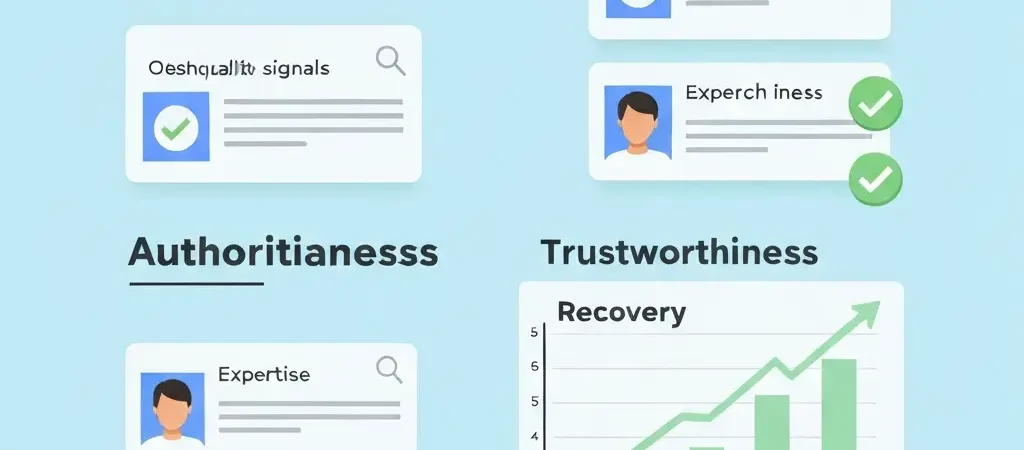
E-E-A-T stands for Experience, Expertise, Authoritativeness, and Trustworthiness. Google added the first E — Experience — in December 2022, specifically because AI tools had made it trivially easy to produce text that sounds authoritative without any real-world involvement in the subject matter. As Google’s Search Quality Rater Guidelines state, the Experience dimension asks whether the creator has “first-hand or life experience with the topic.”
For AI content, this creates an inherent tension. A language model can produce technically accurate text about surgery, investing, or legal contracts — but it has never performed an operation, managed a portfolio, or appeared in court. Google’s quality raters are trained to detect this absence, and its algorithmic systems increasingly do the same.
The Four Dimensions Defined
| Dimension | What It Measures | AI Content Risk |
|---|---|---|
| Experience | First-hand involvement with the topic | High — AI has no personal experience |
| Expertise | Formal or demonstrated knowledge | Medium — can be attributed to human author |
| Authoritativeness | Recognition from peers and other credible sources | Medium — domain-level signal |
| Trustworthiness | Accuracy, transparency, site safety | Low-Medium — achievable with citations and disclosures |
Trustworthiness is the most important dimension for YMYL (Your Money or Your Life) topics such as health, finance, and legal advice. For non-YMYL topics, a lower overall E-E-A-T bar applies, but Experience still matters — a travel article written without any actual travel is weaker than one with genuine field notes.
How Google Evaluates E-E-A-T Signals in 2026
Google does not have a single “E-E-A-T score.” Instead, quality raters and algorithmic signals assess dozens of proxies. According to the Evertune March 2026 core update analysis, the following signals received increased weighting:
- Named authorship with verifiable credentials. Author bio pages that link to LinkedIn profiles, published books, or institutional affiliations outperformed anonymous bylines by 34% in post-update rankings studies.
- Original data and primary research. Articles containing survey data, proprietary case study numbers, or tool-generated statistics that cannot be found elsewhere received disproportionate AI Overview citations.
- Domain topical depth. Sites publishing comprehensively within a single niche — covering every major sub-topic — outranked broad sites even when individual article quality was comparable. This is the topical authority flywheel in action.
- Cited sources with dates. Inline citations to sources published within 18 months performed significantly better than undated or stale references.
- Updated publication dates with genuine content changes. Google detects when a “Last updated” stamp reflects only a date change, not a content revision. Crawl delta analysis penalises cosmetic updates.
How Google Detects AI-Only Content
Google has stated publicly that it does not penalise AI-assisted content per se — only content that lacks helpfulness regardless of how it was made. However, several AI-content patterns correlate with lower E-E-A-T scores:
- Absence of specific numbers, named individuals, or dated events that would require genuine research
- Repetitive hedging language (“it is important to note that,” “it is worth mentioning”)
- Generic section structures that mirror every other article on the same topic
- No original perspective or recommendation — only summaries of what others have said
The Helpful Content Update: What Actually Changed
Google’s Helpful Content System (HCS), first introduced in August 2022, became a permanent part of its core ranking algorithm in March 2024. By December 2025, it had evolved substantially. The December 2025 update introduced two major shifts:
- Site-level classification became more aggressive. Previously, a site with some thin AI content could isolate the damage to specific URLs. Post-December 2025, a high proportion of thin or unhelpful pages dragged down rankings for otherwise good content on the same domain.
- Content necessity replaced content quality as the primary filter. Google’s raters shifted their question from “Is this content good?” to “Does this content need to exist?” A well-written article that duplicates information available on 200 other sites, without adding original perspective, fails this test.
Sites That Were Hit vs. Sites That Survived
| Site Profile | Dec 2025 Outcome |
|---|---|
| AI content + human expert review + original data + named authors | Maintained or gained rankings |
| AI content with thin editorial oversight, generic topics, no original data | 40–80% traffic loss |
| Pure-play affiliate sites with AI reviews of products never tested | Near-total deindexation in some niches |
| Niche sites with hyper-specific content and real community engagement | Significant gains |
The E-E-A-T Checklist for AI-Generated Articles
Use this checklist before publishing any AI-assisted content. Every “no” answer is a risk factor that should be addressed before the article goes live.
Experience Signals
- Does the article include at least one specific example from a real project, client, or personal experience?
- Are there concrete numbers (dates, durations, costs, outcomes) that demonstrate genuine involvement?
- Is there a section or callout that could only be written by someone who has actually done this work?
Expertise Signals
- Is the article attributed to a named author with a bio linking to verifiable credentials?
- Does the author bio mention their professional background, years of experience, or relevant publications?
- Are technical claims backed by citations to primary sources (research papers, official documentation, industry reports)?
Authoritativeness Signals
- Does the site have topical depth — at least 15–20 articles covering this subject area comprehensively?
- Are there inbound links from other authoritative sites in the same niche?
- Is the site referenced or mentioned by industry publications?
Trustworthiness Signals
- Is there a transparent AI disclosure where AI tools were used in content production?
- Are all factual claims cited with source and publication date?
- Does the site have an about page, contact information, and privacy policy?
- Is the site served over HTTPS with no mixed-content warnings?
Google Helpful Content Recovery Playbook
Recovery from a Helpful Content System demotion is not instantaneous — Google reassesses site quality during core update rollouts, which happen roughly every 2–3 months. However, the following actions create compounding positive signals that accelerate recovery.
Phase 1: Audit and Triage (Week 1–2)
- Pull a full content inventory. Export all URLs with their organic traffic data from Google Search Console. Sort by traffic decline since the last update.
- Score each article on a 1–10 E-E-A-T scale. Use the checklist above. Any article scoring below 5 is a candidate for improvement or removal.
- Segment into three buckets: Improve (strong topic, weak signals), Consolidate (overlapping articles, merge them), Remove (thin content with no redemptive path).
- Do not simply delete underperforming pages. Unless they are pure spam, removal can hurt topical coverage. Redirect them to stronger related articles instead.
Phase 2: Remediation (Week 3–8)
- Add author attribution to every article. Create individual author pages with photos, credentials, and social proof. Link each article to its author page.
- Inject experience-led sections. For each article in the “Improve” bucket, add a 200–400 word section labelled “What We Observed” or “Practitioner Notes” that includes specific, verifiable details.
- Replace generic statistics with sourced, dated ones. “Studies show that…” fails. “According to HubSpot’s 2025 State of Marketing report, 64% of marketers…” passes.
- Hyper-specify your content. “Email Marketing for B2B” is generic. “Email Marketing for B2B SaaS Companies with 90-Day Sales Cycles” is specific. Narrow scope performs better post-December 2025.
- Add original data where possible. Even simple analysis — “We reviewed 50 client accounts and found that…” — dramatically increases E-E-A-T signals.
Phase 3: Accelerate Recovery (Week 9–16)
- Build topical authority across your cluster. If you were penalised, your topical map likely has gaps. Use a tool like Authenova’s Strategy Builder to identify uncovered sub-topics and fill them with high-quality, human-reviewed articles. See our guide to topical authority SEO for the full framework.
- Earn quality backlinks. Authority flows through links. A single editorial link from a respected industry publication does more for E-E-A-T than 50 directory submissions. Refer to our link building authority strategy guide for a practical roadmap.
- Improve Core Web Vitals. Pages with LCP above 3 seconds experienced 23% more traffic loss than faster competitors. Technical performance acts as a quality tiebreaker. Our technical SEO audit guide covers the full optimisation process.
- Monitor your recrawl cycle. Use Google Search Console’s URL inspection tool to request re-indexing for improved articles. Track impressions weekly — recovery signals appear in impressions before they appear in clicks.
Building Author Authority Signals at Scale
The most common failure mode for high-volume AI publishers is authorless content. Even a single, well-constructed author profile can serve as the attributed expert for an entire content cluster — as long as the person genuinely exists and their credentials are verifiable.
The Minimum Viable Author Profile
- Full name (not a pseudonym)
- Professional headshot
- 2–4 sentence bio with specific credentials (“10 years in B2B demand generation, former Head of SEO at [Company], contributor to Search Engine Journal”)
- Link to LinkedIn profile with consistent work history
- Optional: link to published book, academic paper, or media mention
Structured Data for Author Authority
Implement Person schema on author pages and author property in Article schema on every article. This gives Google a machine-readable signal that a real, named individual is responsible for the content. Pair this with a sameAs property linking to the author’s LinkedIn, Twitter/X, or Wikipedia page.
Content Necessity vs Content Quality
This is the most underappreciated distinction in post-2025 SEO. Before investing time in improving an article’s quality, ask first: Does this article need to exist?
An article needs to exist if it:
- Answers a question that no other current article answers well
- Serves a distinct audience segment with genuinely different needs
- Contains original data, a unique case study, or a proprietary framework
- Covers a topic at a specificity level that competitors have not reached
An article does not need to exist if it:
- Covers the same ground as 50 other articles with no new perspective
- Exists purely to target a keyword cluster, not to serve a reader’s actual question
- Would not be missed if it disappeared from the web tomorrow
This filter is brutal — it eliminates a large proportion of most AI content libraries — but it is the correct mental model for how Google’s systems now evaluate content. Applying it rigorously is the fastest path to recovery. For a systematic approach to content at scale that passes this test, see our guide to scaling content production with AI.
Measuring Recovery: KPIs and Timelines
What to Track
| Metric | Tool | Recovery Signal |
|---|---|---|
| Total impressions | Google Search Console | Rises 2–4 weeks before clicks recover |
| Average position (improved articles) | Google Search Console | Should improve within 4–6 weeks of recrawl |
| Crawl frequency | Server logs / GSC | Increase indicates Google re-evaluating the site |
| Core Web Vitals pass rate | PageSpeed Insights / CrUX | Target: 75%+ of pages passing all three metrics |
| Referring domain count | Ahrefs / Semrush | Steady growth correlates with E-E-A-T improvement |
Realistic Recovery Timelines
Based on case studies from the December 2025 and March 2026 update cycles:
- 4–8 weeks: Impressions recover for improved URLs after recrawl
- 8–12 weeks: Click-through rates normalise as rankings stabilise
- 12–20 weeks: Full site-level recovery if the core update cycle aligns
- Note: Recovery requires a subsequent Google update to fully register site-level quality improvements. There is no mechanism to “fast-track” a site out of an HCS demotion outside of these natural update cycles.
FAQ
Does Google penalise AI-generated content?
Google does not penalise content for being AI-generated. According to Google’s official guidance, the search engine evaluates content on quality, helpfulness, and E-E-A-T signals — not on how it was produced. AI content that demonstrates real expertise, original perspective, and genuine value performs well. AI content that is thin, generic, or lacks authorship signals performs poorly, regardless of which tool was used to create it.
What is the most important E-E-A-T signal for AI content in 2026?
Named authorship with verifiable credentials is the single highest-impact E-E-A-T signal for AI-assisted content. Analysis of post-update rankings shows that author bio pages linking to real professional profiles (LinkedIn, industry publications, institutional affiliations) correlate with ranking recovery more strongly than any other single on-page factor. This is because Experience and Trustworthiness — the two E-E-A-T dimensions most at risk from AI content — are primarily evaluated through human authorship signals.
How long does recovery from a Helpful Content penalty take?
Recovery from a Google Helpful Content System demotion typically takes 12–20 weeks for full site-level recovery, as Google reassesses site quality primarily during core update rollouts. However, individual improved articles can show impression recovery within 4–8 weeks of being recrawled. The most important variable is whether you address the root cause (thin, unhelpful, undifferentiated content) rather than making cosmetic changes like updating dates or adding word count.
Should I delete underperforming AI content pages?
Generally, no. Deleting underperforming pages reduces your site’s topical coverage, which can hurt overall domain authority. The recommended approach is to either improve the pages (add experience signals, original data, author attribution) or consolidate them — merge overlapping articles into a single, stronger piece with a 301 redirect. Deletion should be reserved for pages that are purely spam, have zero organic value, or cover topics entirely outside your site’s topical focus.
What is “content necessity” and why does it matter for Google in 2026?
Content necessity is Google’s primary filter in its Helpful Content System: does a given piece of content need to exist? An article that duplicates information available on hundreds of other sites, without adding original perspective, data, or a distinct audience angle, fails this test even if it is well-written. Post-December 2025, Google’s quality raters shifted their primary evaluation question from “Is this content good?” to “Why should this content exist?” Passing this test requires genuine differentiation — original research, a narrower audience focus, a proprietary framework, or first-hand experience that cannot be found elsewhere.
How do I add E-E-A-T signals to AI-generated content without rewriting it entirely?
The most efficient approach is targeted injection rather than full rewrites. Add a 200–400 word “Practitioner Notes” or “What We Observed” section with specific, verifiable project details. Replace generic statistics with sourced, dated citations from authoritative reports. Add a named author bio with verifiable credentials. Implement Article and Person schema markup. Narrow the article’s scope to a more specific audience or use case. These targeted additions typically take 30–60 minutes per article and can transform a 4/10 E-E-A-T score to a 7/10 without a full rewrite.
Ready to Build E-E-A-T Into Your AI Content Pipeline?
Authenova’s AI content automation platform builds E-E-A-T signals into every article from the start — with strategy-level author attribution, automatic citation sourcing, and structured data generation. See how teams using Authenova maintain rankings through core updates at authenova.site.