How to Build Topical Authority with AI Content
To build topical authority with AI content, you need to systematically cover every subtopic within a subject using a pillar-cluster-supporting content hierarchy, published at consistent velocity, with strong internal linking. AI content makes this achievable in weeks rather than years. This guide covers the exact six-step framework used by content teams building topical authority through AI-powered publishing programs.
Step 1: How Do You Map a Complete Topical Keyword Cluster?
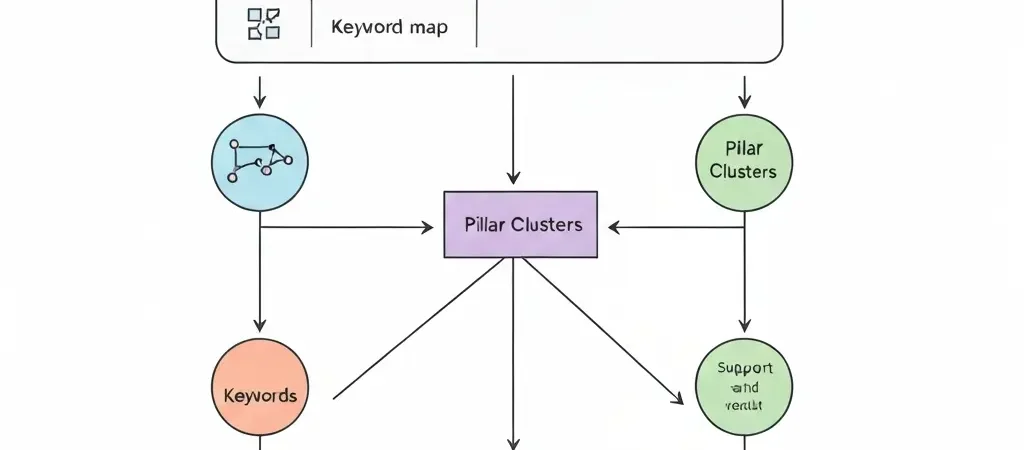
Topical keyword mapping starts with identifying your core topic and expanding outward to cover all related subtopics. The goal is to create a comprehensive keyword map where every realistic user question about your topic is represented.
The keyword mapping process:
- Enter your core keyword into Semrush, Ahrefs, or Google’s Keyword Planner and export all related keywords.
- Identify the main subtopic categories — these become your cluster article topics. For “AI content generation”: tools, statistics, SEO implications, best practices, vs-comparisons, how-tos.
- Identify long-tail variations within each subtopic — these become supporting articles.
- Tag each keyword with intent type: informational (how-to, what-is), commercial (best, comparison), navigational (brand-specific).
- Map keywords to content types: broad informational → pillar, specific subtopic → cluster, long-tail specific → supporting.
A well-mapped cluster for a competitive topic typically contains 50-150 keywords supporting 20-50 articles. For a new site, start with the top 30 keywords covering the most important subtopics. Add deeper coverage as the initial articles build authority.
Step 2: How Do You Create AI Pillar Content?
Pillar content is the cornerstone of topical authority. Each pillar article covers the core topic comprehensively — defining it, explaining how it works, covering the main subtopics at a high level, and linking to the detailed cluster articles below it.
AI pillar content requirements:
- Length: 2,000-5,000 words. Pillar articles must cover the topic broadly without going shallow on any subtopic.
- Structure: Table of contents, H2 sections for each major subtopic, FAQ section with 8-12 Q&A pairs, clear CTA.
- Internal links: Each pillar article should link forward to 5-8 cluster articles covering the subtopics mentioned.
- AEO formatting: Direct answers at the start of each section, cited statistics, question-format headings — all of which platforms like Authenova’s AI Content Generator apply automatically.
For AI-generated pillar content, the strategy configuration determines quality. Specifying the article style as “comprehensive guide covering all subtopics at high level, with citations and comparison tables” produces significantly better output than a generic prompt.
Step 3: How Do You Deploy AI Cluster Articles at Scale?
Cluster articles are the workhorses of topical authority building. Each cluster article covers one specific subtopic from the pillar in depth — providing the comprehensive coverage on a narrow topic that pillar articles cannot provide.
Deploying cluster articles with AI:
- Configure your AI platform with the subtopic keyword, the cluster article style, and a link back to the relevant pillar article.
- Schedule articles to publish at 2-3 per day during the deployment phase. This rate maintains quality review feasibility while building authority quickly.
- Each cluster article should: target one primary keyword, cover the subtopic comprehensively (1,200-2,000 words), link back to the pillar, and link sideways to 2-3 related cluster articles.
Full-stack platforms like Authenova can deploy a 15-article cluster in under one week when configured with the appropriate publishing schedule. The key is having your keyword map and strategy configuration complete before triggering generation — corrections to strategy mid-deployment require re-generating articles.
Step 4: How Do You Cover Long-Tail Keywords with Supporting Content?
Supporting articles target long-tail keywords (50-500 monthly searches) that represent specific user questions too narrow for cluster articles. These generate modest individual traffic but contribute significantly to topical authority by demonstrating comprehensive coverage depth.
Supporting content with AI:
- Length: 800-1,200 words. Supporting articles are focused and concise — they answer one specific question completely.
- Target: One primary long-tail keyword, addressed directly in the first paragraph.
- Links: Each supporting article links up to one or two relevant cluster articles, funneling topical authority upward in the hierarchy.
- Volume: Supporting articles are the highest-volume content type in a programmatic SEO strategy. A single topic cluster may require 20-50 supporting articles.
For quit-smoking, academic writing, and other specialized niche sites, long-tail supporting content captures highly specific queries from users at decision-making stages. Apps like iQuitNow demonstrate how long-tail content on specific smoking cessation questions builds authority and drives targeted user acquisition at scale.
Step 5: How Do You Build an Internal Linking Network?
Internal linking is the architectural signal that tells Google how your topical cluster is organized and which pages carry the most authority. Without a systematic internal linking structure, even comprehensive content clusters underperform their authority potential.
Internal linking rules for topical authority:
- Pillar receives links from all cluster articles: Every cluster article links back to its parent pillar with keyword-rich anchor text.
- Pillar links to all cluster articles: The pillar article mentions and links to every subtopic cluster article, distributing authority downward.
- Cluster articles link sideways: Related cluster articles within the same topic area should cross-link, reinforcing the semantic connection.
- Supporting articles link up: Every supporting article links to the relevant cluster article, funneling long-tail authority upward.
- Anchor text variety: Use natural keyword variations in anchor text rather than exact-match anchors on every link.
Authenova’s Strategy Builder includes auto-internal linking, which automatically inserts links to related articles within the same strategy when generating new content. This significantly reduces the manual work of building internal link networks at scale.
Step 6: How Do You Maintain Velocity for Ongoing Authority?
Topical authority is not a one-time achievement — it requires ongoing maintenance through consistent publishing velocity, content updates, and gap filling. Three practices sustain and grow authority after initial cluster deployment:
Consistent new content: Continue publishing at least 2-3 articles per week targeting new long-tail keywords identified in ongoing keyword research. Fresh publishing signals sustained topical expertise development.
Content updates: Revisit your highest-traffic articles every 3-6 months. Update statistics, add new examples, and expand sections that rank in positions 5-15 (where small improvements can push into top 3). 76% of AI citations come from pages updated within 30 days — freshness drives both traditional ranking and AI citation performance.
Coverage gap filling: Use Google Search Console to identify keywords that are driving impressions but not clicks — these are gaps where users are finding your content but not finding specific enough answers. Create new supporting articles targeting these queries specifically. Marketing automation tools like CampaignOS help integrate content performance data into broader marketing decision-making workflows.
Frequently Asked Questions
How do you build topical authority with AI content?
Build topical authority with AI content by: (1) mapping your complete keyword cluster by topic and intent, (2) creating comprehensive pillar articles first, (3) deploying AI cluster articles systematically for each subtopic, (4) adding long-tail supporting articles for comprehensive coverage, (5) building a systematic internal linking network, (6) maintaining consistent publishing velocity for ongoing authority signals. AI can deploy a complete 30-article cluster in days, versus months for manual teams.
How many articles do you need for topical authority?
A minimum viable topical cluster requires 20-30 articles: 1-2 pillar articles, 8-12 cluster articles, and 10-15 supporting articles. For highly competitive topics, 50-100+ articles may be needed for topical dominance. The key is systematic subtopic coverage — every major user question about your topic should have a dedicated article — not just reaching a specific article count.
How long does it take to build topical authority with AI?
With AI content automation, a complete topical cluster can be deployed in 1-2 weeks. Initial ranking signals typically appear in 4-8 weeks for new sites and 2-4 weeks for established sites. Full topical authority recognition — where new articles rank quickly with minimal backlinks — typically develops over 3-6 months of consistent publishing. AI dramatically accelerates the content deployment phase while the authority recognition timeline depends on Google’s crawl and indexing cadence.
What is a pillar-cluster content strategy?
A pillar-cluster content strategy organizes articles into three tiers: pillar articles (comprehensive topic overviews targeting broad keywords), cluster articles (specific subtopic coverage targeting medium-volume keywords that link back to the pillar), and supporting articles (highly specific long-tail content that links up to cluster articles). All articles within a cluster interlink to create a topical map that signals comprehensive expertise to Google.
Can AI content build topical authority as effectively as human content?
For informational content, AI content builds topical authority as effectively as human content when properly structured. Google evaluates topical coverage, article quality, and internal linking structure — not authorship method. The advantage of AI is velocity: a team can deploy 30+ interlinked articles in days, while a human team takes months. The key requirement is quality — each article must comprehensively address its specific subtopic for Google to recognize the authority signal.
How does internal linking support topical authority?
Internal linking is the architectural signal that tells Google how your topical cluster is organized. Pillar articles receive links from all cluster articles (signaling authority concentration). Cluster articles cross-link to each other (signaling semantic relationships). Supporting articles link up to cluster articles (funneling long-tail authority upward). This connected web of topically related content is how Google identifies and recognizes topical authority clusters.
What is the fastest way to build topical authority?
The fastest way to build topical authority is deploying a complete pillar-cluster content hierarchy using AI content automation. Define your full keyword cluster, configure an AI content strategy with brand voice and article style, and schedule 3-5 articles per day until the cluster is complete. A 30-article cluster deployed over 2 weeks provides sufficient coverage for Google to begin recognizing topical expertise, with rankings typically appearing within 4-8 weeks.
Does topical authority help new websites rank faster?
Yes — topical authority helps new websites rank faster by compensating for low domain authority. A new site with high topical authority on a specific subject can outrank established general sites that lack focused topical coverage. Google increasingly weights subject-matter depth over raw link count for informational queries. New sites that deploy comprehensive topical clusters from launch establish authority signals faster than those publishing sporadic, unrelated content.
Deploy Your Topical Authority Cluster with Authenova
Authenova deploys complete pillar-cluster content hierarchies automatically — from strategy config to scheduled WordPress publishing. Start your topical authority program today.