How to Create a Pillar Cluster Content Strategy
To create a pillar cluster content strategy, you define one core topic, build a comprehensive pillar article covering it broadly, and then produce cluster articles addressing each specific subtopic in depth — all interlinked to create a topical authority signal for search engines. This strategy builds ranking coverage across entire keyword families rather than chasing individual keywords in isolation. In 2026, it is the most effective SEO content architecture for both traditional rankings and AI engine citations.
What Is a Pillar Cluster Content Strategy?
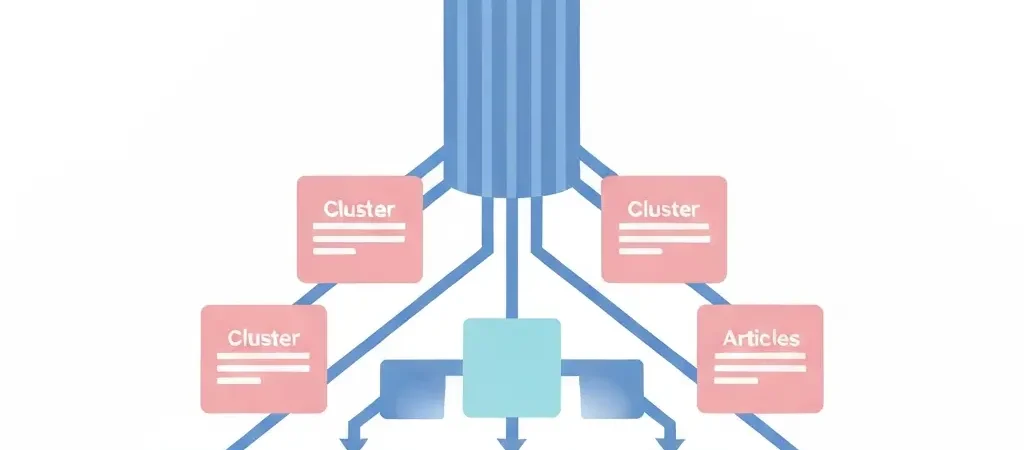
A pillar cluster content strategy is a content architecture model where articles are organized into interconnected topical groups rather than published as standalone pages. The model has three tiers:
- Pillar page: A comprehensive, long-form article covering the core topic broadly. Targets a high-volume, broad keyword. Links to all cluster articles.
- Cluster pages: Medium-depth articles each covering one specific subtopic of the pillar. Target medium-volume, specific keywords. Link back to the pillar and to related cluster articles.
- Supporting pages: Short, highly specific articles targeting long-tail queries. Link up to relevant cluster articles.
The strategic advantage is twofold: Google’s crawlers can map the semantic relationships between articles, recognizing topical depth; and users entering from any article in the cluster find clear navigation to related content, improving engagement signals.
How Do You Choose Your Core Topic and Pillar Keyword?
Your core topic is the subject area you want to own in search. The pillar keyword is the broad, high-volume keyword that defines that subject. Choosing correctly determines whether your entire content investment delivers ROI.
Criteria for a good pillar topic:
- Business alignment: The topic must connect to your products or services. Traffic that cannot convert into customers provides vanity metrics, not revenue.
- Search volume: Pillar keywords typically have 1,000-50,000+ monthly searches. Very high volume (100K+) targets are dominated by high-authority sites and take years to crack for new sites. Mid-range volume with strong subtopic coverage is often more achievable.
- Subtopic richness: The topic must have enough subtopics to support a full cluster (15-30+ articles). Narrow topics exhaust coverage quickly.
- Competition level: Evaluate SERP competition for the pillar keyword. New sites should target topics where top-10 results are achievable within 6-12 months of authority building.
How Do You Identify Cluster Article Topics?
Cluster article topics are the subtopics that users ask about within the context of your core topic. The goal is comprehensive coverage — every significant question about your topic should map to at least one article.
Methods for identifying cluster topics:
- Keyword research expansion: Export all keywords related to your pillar keyword from Semrush or Ahrefs. Group them by semantic similarity — each group becomes a cluster article topic.
- People Also Ask: Google’s PAA boxes reveal the actual questions users ask about your topic. These are high-value cluster article candidates because they map directly to Google’s own understanding of user intent.
- Competitor content analysis: Examine the top-ranking sites for your pillar keyword. What subtopics do they cover that you don’t? These gaps represent cluster opportunities.
- Google’s “searches related to”: The bottom of Google SERPs surfaces related search queries that reveal adjacent subtopics your cluster should cover.
A typical cluster for a competitive topic contains 8-15 cluster articles and 15-30 supporting articles. Organize your list before writing — the structure determines the internal linking architecture.
How Do You Write Pillar Content That Anchors the Cluster?
The pillar article must accomplish two tasks: comprehensively introduce the core topic for readers and link to every cluster article so Google can follow the full topical hierarchy.
Pillar article requirements:
- Length: 2,000-5,000 words. Cover all major subtopics at a high level — detailed coverage happens in cluster articles.
- Structure: Table of contents, H2 sections for each major subtopic, FAQ section (8-12 questions), CTA. Each H2 section introduces a subtopic and links to the dedicated cluster article.
- Links: Include one internal link per subtopic pointing to the corresponding cluster article. Use keyword-rich anchor text.
- AEO formatting: Direct answers at the start of each section. Question-format headings. FAQPage schema. This makes the pillar article citeable by AI answer engines as well as rankable in traditional search.
Platforms like Authenova apply AEO formatting automatically to pillar articles — producing content that satisfies both traditional search engines and AI answer engines from the first draft.
How Do You Build Cluster Articles That Reinforce Authority?
Cluster articles are the workhorses of topical authority. Each one covers a specific subtopic comprehensively — providing depth that the pillar cannot. They reinforce the pillar’s authority by linking back, and they link sideways to related cluster articles to strengthen semantic connections.
Cluster article structure:
- Length: 1,200-2,500 words. Enough for comprehensive subtopic coverage without padding.
- Focus: One primary keyword, addressed directly in the first paragraph and H1.
- Links: Link back to the pillar article (1 link). Link sideways to 2-3 related cluster articles. Link down to relevant supporting articles.
- FAQ section: 6-10 Q&A pairs covering common questions about the specific subtopic. FAQPage schema markup required.
Academic content follows analogous hierarchical structures — thesis-level work at Tesify or multi-part research series use the same principle of comprehensive core documents supported by detailed subtopic sections. The knowledge organization principles translate directly between academic and SEO content strategy.
How Do You Build Internal Links Across the Cluster?
Internal link architecture is the infrastructure layer that tells Google how your cluster is organized. Without systematic internal linking, even comprehensive topical coverage underperforms its potential. The linking rules:
| Article Type | Links To | Receives Links From |
|---|---|---|
| Pillar | All cluster articles | All cluster articles, some supporting |
| Cluster | Pillar, 2-3 related cluster, relevant supporting | Pillar, related cluster articles, supporting articles |
| Supporting | 1-2 relevant cluster articles | Relevant cluster articles |
Authenova’s auto-internal linking feature injects links to related articles within the same strategy automatically during generation — eliminating the manual link-building work that typically represents the most time-consuming part of post-publishing cluster maintenance.
How Do You Implement This Strategy with AI Content Tools?
Implementing a pillar cluster strategy with AI content tools follows a specific sequence that maximizes quality and minimizes rework:
- Configure your cluster map: Document all planned articles — titles, target keywords, article types, and planned internal links — before generating any content.
- Generate pillar articles first: Create 1-2 pillar articles. These set the topical framing that all cluster articles will reference.
- Generate cluster articles: Deploy cluster articles systematically, configuring each with its primary keyword and links back to the pillar. Schedule 2-3 per day for sustained publishing velocity.
- Generate supporting articles last: Supporting articles reference specific points made in cluster articles. Generate them after cluster articles are published so internal links can reference specific URLs.
- Conduct an internal link audit: After the full cluster is deployed, review internal linking using a crawl tool. Identify any articles with insufficient links and update them.
Using Authenova to implement this strategy means the entire workflow — from strategy configuration to scheduled WordPress publishing — runs from one dashboard. Marketing teams at companies using CampaignOS can integrate published cluster content with email marketing and social media automation for maximum content ROI.
Frequently Asked Questions
What is a pillar cluster content strategy?
A pillar cluster content strategy organizes articles into three tiers: a pillar article covering the core topic comprehensively, cluster articles covering each specific subtopic in depth, and supporting articles targeting long-tail queries. All articles interlink systematically. This architecture signals topical depth to Google, building authority that compounds across the entire keyword cluster rather than requiring individual optimization for each keyword.
How many articles do you need for a pillar cluster strategy?
A minimum viable pillar cluster requires 15-20 articles: 1-2 pillar articles, 6-10 cluster articles, and 8-10 supporting articles. For competitive topics, 50-100+ articles provide stronger topical dominance. The critical requirement is systematic coverage — every major subtopic must have a dedicated article — not just reaching a specific count. Use your keyword cluster map to determine the right number for your specific topic.
How long does it take to build a pillar cluster strategy?
Building a 20-article pillar cluster manually takes 4-8 weeks at professional writing rates. With AI content automation, the same cluster can be deployed in 5-10 days. Initial ranking signals typically appear 4-8 weeks after deployment. Full topical authority recognition develops over 3-6 months of consistent publishing. AI dramatically accelerates the content deployment phase, with the authority recognition timeline dependent on domain history and content quality.
What is the difference between a pillar page and a cluster article?
A pillar page covers the core topic broadly and comprehensively (2,000-5,000 words), targeting a high-volume broad keyword. A cluster article covers one specific subtopic of the pillar in depth (1,200-2,500 words), targeting a medium-volume specific keyword. Pillar pages link to all cluster articles. Cluster articles link back to the pillar and sideways to related cluster articles. The pillar is the hub; cluster articles are the spokes.
Can one website have multiple pillar clusters?
Yes — most websites benefit from multiple pillar clusters covering different core topics related to their business. Each cluster operates independently with its own pillar, cluster articles, and supporting articles. Clusters can also cross-link where topics overlap (example: “AI content generation” and “SEO automation” clusters would share relevant links). Authenova supports multiple strategies per website, enabling parallel cluster deployment programs.
Does the pillar cluster model work for all industries?
Yes — the pillar cluster model works for all industries with informational search demand. B2B SaaS, e-commerce, healthcare, finance, education, and consumer services all benefit from topical authority building through pillar cluster strategies. The model is most powerful for industries where users research extensively before purchasing and where there are many specific subtopic questions that can each support dedicated articles.
How do you maintain a pillar cluster strategy over time?
Maintain a pillar cluster strategy by: (1) continuing to publish new supporting articles for emerging long-tail queries, (2) updating high-performing articles with fresh statistics and examples every 3-6 months, (3) monitoring Google Search Console for impression opportunities that indicate coverage gaps, (4) expanding clusters when new subtopics emerge in your industry, and (5) building external backlinks to pillar articles to amplify topical authority with link authority.
Deploy Your Pillar Cluster Strategy Automatically
Authenova handles your entire pillar cluster deployment — from strategy configuration to scheduled WordPress publishing. Build 6 months of topical authority in weeks.