How to Create a Pillar Cluster Content Strategy: The 2026 Step-by-Step Playbook
A pillar cluster content strategy is the most effective structure for building topical authority in 2026. Sites using this model rank for 2.6x more keywords than unstructured sites (Semrush, 2025) and get cited by AI assistants at 3.7x the rate of single-article domains. This step-by-step playbook shows you exactly how to create one — from keyword research to internal linking architecture.
Prerequisites: Access to a keyword research tool (Semrush, Ahrefs, or Google Keyword Planner), a content publishing platform or WordPress site.
Time to complete: 3–5 hours to create the strategy. 3–6 months to fully execute it.
Step 1: Choose Your Topic Domain
Time: 30 minutes
Your topic domain must satisfy three criteria:
- Business relevance: The topic should attract your target customers, not just general web traffic.
- Adequate keyword depth: The topic should have at least 20–30 related keywords with meaningful search volume. Narrow topics don’t support full pillar-cluster architecture.
- Achievable competition level: Check average keyword difficulty for your topic. For new sites (DA < 20), focus on topics where most keywords have KD below 30. For established sites (DA 30+), you can target KD 40–50.
Topic domain selection examples:
- Good: “AI SEO content automation” (200+ keywords, multiple subtopics, clear business value)
- Good: “Email marketing automation for small business” (150+ keywords, clear audience)
- Too narrow: “Authenova vs Jasper” (20 keywords — not enough for full cluster)
- Too broad: “Digital marketing” (10,000+ keywords — impossible to dominate)
Step 2: Map Your Keyword Landscape
Time: 1–2 hours
- Enter your primary topic keyword into Semrush Keyword Magic Tool or Ahrefs Keywords Explorer.
- Filter results: volume above 100, KD below your site’s targeting threshold.
- Export all keywords (typically 100–500 for medium topics).
- In a spreadsheet, group keywords by semantic similarity and search intent:
- Informational (what is X, how does X work): Cluster or supporting articles
- Comparison (X vs Y, best X tools): Cluster articles
- How-to (how to X, guide to X): Cluster articles
- Primary topic (broad topic overview): Pillar article
- Identify your pillar keyword: highest volume, broadest intent.
- Select 8–12 cluster keywords (your best subtopics by volume and relevance).
- Select 10–20 supporting keywords (long-tail, question-format).
Output: A keyword map with 20–32 total keywords, each assigned to a content type.
Step 3: Build Your Pillar Page
Time: 4–8 hours for manual writing; 30 minutes for AI-assisted
The pillar page is the most important piece of content in your cluster. It must:
- Comprehensively cover the topic: 3,000–5,000 words. Address every major subtopic at a summary level (each gets expanded in cluster articles).
- Target the primary keyword: Include in H1, first paragraph, at least one H2, and meta description.
- Include a FAQ section: 6–10 Q&A pairs with FAQPage schema.
- Link to cluster articles: Mention each cluster topic with a link to the corresponding article (add placeholder links for articles not yet written).
- Include Article schema: JSON-LD Article markup with author, datePublished, and publisher.
Using Authenova’s AI generation for the pillar page saves 3–7 hours compared to manual writing while maintaining quality. The AI generates a properly structured draft with schema markup in under 10 minutes.
Step 4: Plan Your Cluster Articles
Time: 1 hour for planning; automated generation with Authenova
For each cluster keyword, create a brief that specifies:
| Field | Example |
|---|---|
| Target keyword | “how to automate SEO content creation” |
| Content type | CLUSTER (step-by-step) |
| Target word count | 1,500–2,000 |
| Links to pillar | Yes — anchor “AI SEO content strategy” |
| Related clusters to link | “how to build topical authority”, “best AI content tools” |
With Authenova, this planning is handled in the strategy configuration — you add keywords and the platform generates briefs and articles automatically. Marketing automation strategies use identical planning frameworks, as documented in CampaignOS’s definitive automation guide.
Step 5: Build the Internal Linking Architecture
Time: 30 minutes for initial setup; automated ongoing with Authenova
The internal linking architecture is what transforms your individual articles into a topical authority cluster:
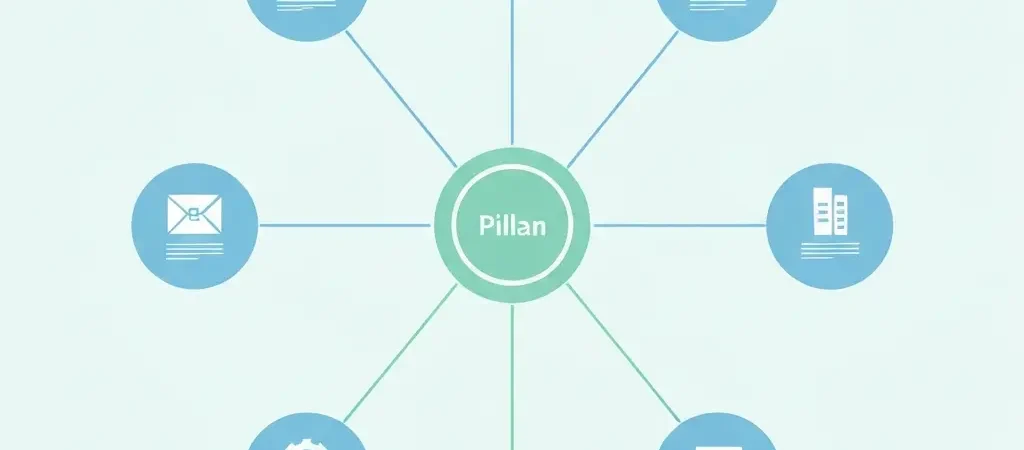
- Pillar → All clusters: Every cluster article gets a contextual link from the pillar page with a descriptive anchor text.
- All clusters → Pillar: Every cluster article links back to the pillar with a consistent anchor text (e.g., “our comprehensive AI SEO guide”).
- Clusters → Related clusters: Each cluster article links to 2–3 topically related clusters with natural, contextual anchor text.
- Supporting → Relevant clusters: Supporting articles link up to the most relevant cluster article (not necessarily the pillar).
Maintain this architecture by auditing internal links every 30 days using Screaming Frog or Ahrefs site audit.
Step 6: Create a Publishing Schedule
Time: 10 minutes
Effective pillar cluster execution requires consistent publishing velocity. The recommended schedule:
- Week 1: Publish the pillar article.
- Weeks 2–5: Publish 2–3 cluster articles per week (8–12 total).
- Weeks 6–12: Publish 1–2 supporting articles per week (8–14 total).
- Month 4+: Maintain 2–4 articles per month to expand coverage and update existing articles.
This schedule builds topical authority to the critical threshold (12–15 articles) by week 5–6, at which point new articles start ranking measurably faster.
Step 7: Measure and Expand
Time: 30 minutes per month
After 90 days, evaluate:
- Keyword rankings: How many cluster keywords rank in the top 10, 20, and 50?
- Time to rank: Are newer articles ranking faster than earlier ones? (Topical authority signal)
- Traffic by cluster: Which subtopics drive the most traffic? Expand those with more supporting articles.
- Coverage gaps: What questions in your topic domain do you not yet have articles for? Create a second batch.
Academic teams building topical authority around research topics use the same expansion model. Tools like Tesify’s thesis guide document how systematic coverage of a research topic — from broad overview to specific subtopics — mirrors the pillar-cluster architecture in content strategy.
FAQ
How long does it take to see results from a pillar cluster strategy?
Most pillar cluster strategies show measurable results (faster ranking speed, higher average positions) within 60–90 days of publishing the initial cluster (1 pillar + 8–10 clusters). Significant traffic increases typically appear in months 3–6. Full authority — where all cluster keywords rank in the top 10 — takes 6–12 months of consistent publishing.
How many cluster articles do I need per pillar?
A minimum viable cluster has 8–10 cluster articles per pillar page. Full topical authority typically requires 12–20 clusters per pillar, covering all significant subtopics. Additionally, 10–20 supporting articles targeting long-tail questions at the edges of the topic cluster maximize keyword coverage.
Should I write the pillar page or cluster articles first?
Always write the pillar page first. It establishes the topical frame and gives cluster articles a high-authority page to link back to from day one. Cluster articles published before the pillar exist as orphaned pages without a hub — they still rank individually but don’t benefit from the cluster’s link equity distribution.
Can I use AI to create a pillar cluster content strategy?
Yes. Platforms like Authenova automate the entire pillar cluster workflow: they map your topic cluster, assign content types, generate articles with proper structure and schema, inject internal links, and publish on a schedule. The human role is keyword research and strategy setup (2–4 hours) and weekly editorial review (30–60 min). Everything else is automated.
Execute Your Pillar Cluster Strategy Automatically
Authenova’s Strategy Builder maps your topic cluster, generates all pillar, cluster, and supporting articles, and publishes them on schedule — completing in 90 days what takes manual teams 12+ months. Start today.