How to Do Keyword Research for AI Content: A Step-by-Step System for 2026
Keyword research for AI content is not the same as keyword research for manually written content. When you are generating dozens or hundreds of articles per month, a flawed keyword selection process does not produce one bad article — it produces a hundred. Learning how to do keyword research for AI content pipelines requires a system that prioritises topical coverage, search intent alignment, and AEO potential from the start, before a single word is generated.
This guide walks you through a repeatable five-step keyword research framework built for teams running AI-powered content pipelines. You will leave with a process you can execute in under three hours per content cluster.
Why AI Content Needs a Different Keyword Research Approach
Traditional keyword research treats each article as independent. You pick a keyword, write an article, move to the next. For AI content pipelines, this approach fails in two ways:
- Topical gaps create authority holes. Google evaluates the depth of your coverage on a topic — not just individual page quality. If your AI generates 20 articles about “content marketing” but misses fundamental subtopics, your entire cluster underperforms. Research shows that sites with complete topical clusters rank 40% higher on average than sites with scattered keyword targeting.
- Internal linking becomes random. When keywords are selected article-by-article, internal linking is an afterthought. Pre-mapping your topical structure lets your AI (or your publishing platform) generate internal links that follow a deliberate architecture from day one.
AI content also targets two audiences simultaneously: Google’s crawlers and AI assistants like ChatGPT, Perplexity, and Google’s AI Overviews. This requires identifying keywords that are not just high-volume but high-AEO-potential — the question-formatted queries that AI systems pull answers from.
Step 1: Build a Topical Map, Not a Keyword List
Start with a single seed topic, not a keyword. Your seed topic is the broad subject your content cluster covers — for example, “content marketing automation” or “AI SEO tools”.
How to Build Your Topical Map
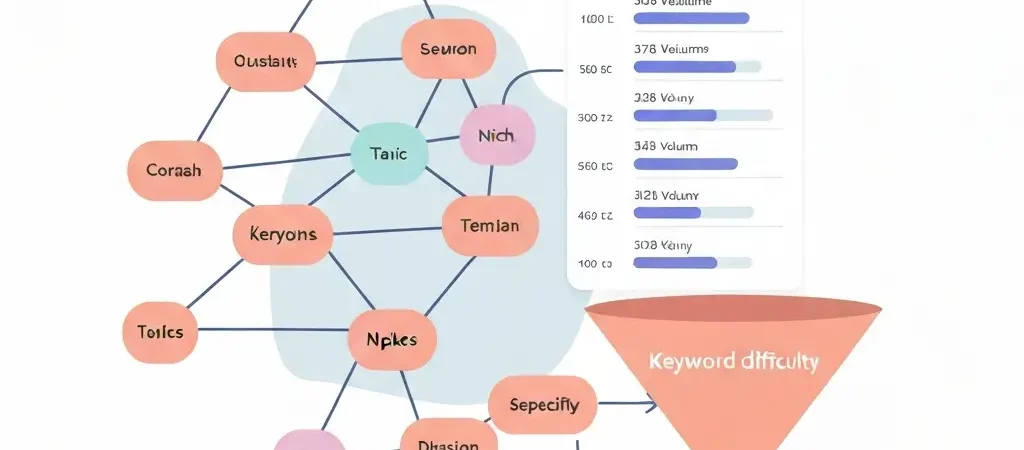
- Use a mind-map structure. Your seed topic is the center node. Branch out into 5-8 primary subtopics. Each primary subtopic branches into 3-5 secondary subtopics. Secondary subtopics branch into specific question-format queries.
- Use Google’s People Also Ask and autocomplete. Search your seed keyword and collect every PAA question. These represent the specific questions your audience asks AI assistants, making them high-AEO-value targets.
- Steal competitor structure. Find the top-ranking site for your seed keyword. Use a tool like Ahrefs Site Explorer or Semrush’s Site Audit to export their top-traffic pages. Their URL structure reveals the subtopics that actually drive traffic in your niche.
- Map to pillar, cluster, and supporting content. Your seed topic = pillar page. Primary subtopics = cluster articles. Secondary subtopics and question-format queries = supporting articles.
For an AI content pipeline, you need a minimum viable cluster: 1 pillar + 4-6 cluster articles + 3-5 supporting articles = 8-12 articles per seed topic. This is the minimum coverage required for topical authority signals to accumulate. Read more in our guide on how to create a pillar cluster content strategy.
Step 2: Classify Keywords by Intent and Content Type
Every keyword in your topical map needs two classifications before it enters your AI pipeline:
Search Intent Classification
| Intent Type | Signal Words | Content Type | Example |
|---|---|---|---|
| Informational | what is, how does, why | FAQ/Definition | “what is content automation” |
| How-To | how to, step by step, guide | Tutorial | “how to automate blog publishing” |
| Comparison | vs, best, compared, top | Listicle/Comparison | “surfer seo vs authenova” |
| Commercial | buy, pricing, cost, worth it | Review/Buying Guide | “authenova pricing 2026” |
Misaligning intent with content type is the leading reason AI-generated articles fail to rank. An AI that writes an opinion article for a “how to” query, or a listicle for a definitional query, produces content that Google demotes immediately regardless of quality.
AEO vs Traditional SEO Classification
For each keyword, ask: Would someone ask this to an AI chatbot? Question-format keywords (what, how, why, when, which) are high-AEO-potential. They should trigger content with a direct answer in the first 50 words, FAQ schema markup, and standalone-extractable sections. Learn how to optimize AI content for maximum search visibility.
Step 3: Score for AEO Potential
AEO potential is separate from search volume and difficulty. A keyword can have 50 searches/month but appear in thousands of AI assistant responses if structured correctly. Score each keyword on three AEO factors:
- Question format (1 point): Does the keyword read as a question? “How to automate blog posts” scores higher than “blog automation”.
- Definitive answer (1 point): Can you answer this keyword with a single definitive response? “What is topical authority” = yes. “Best content strategy” = subjective, scores lower.
- AI-cited topic area (1 point): Is this a topic where AI assistants regularly cite sources? Statistics, how-to guides, and comparison data are cited 3-5x more often than opinion pieces.
Keywords scoring 2-3 on this scale get AEO treatment in your AI content brief: direct answer box, FAQ schema, structured sections with standalone value. Keywords scoring 0-1 get standard SEO treatment.
Step 4: Assign Difficulty Tiers and Sequence Your Articles
AI content pipelines fail when teams launch with their hardest keywords first. A new site attacking KD 60+ keywords will rank for nothing and generate no internal link equity. The correct sequencing builds domain authority progressively.
Three-Tier Sequencing Model
- Tier 1 — Foundation (KD 0-25): Publish these first. These are your supporting articles — highly specific, low-competition, long-tail queries. They rank fastest and create the first link equity nodes in your topical cluster. Target: publish 60% of your total cluster volume here first.
- Tier 2 — Cluster (KD 25-45): Publish after Tier 1 articles have been indexed (typically 2-4 weeks). Cluster articles now receive internal links from Tier 1 pages, accelerating their ranking timeline.
- Tier 3 — Pillar (KD 45+): Publish last. By the time your pillar article goes live, it receives internal links from every cluster and supporting article in the group, giving it maximum internal PageRank concentration.
This sequencing is counter-intuitive — most teams start with the pillar page because it is the most important article. The data shows the opposite approach compounds faster. Read our full guide on building topical authority with AI content.
Step 5: Feed Keywords Into Your AI Content Strategy
Once your topical map is classified, tiered, and sequenced, the final step is converting it into a format your AI content platform can execute.
What Your AI Platform Needs Per Article
- Focus keyword — the primary term to optimise for
- Secondary keywords — 2-4 supporting terms to include naturally
- Search intent — informational, how-to, comparison, or commercial
- Content type — pillar, cluster, or supporting
- Target word count — based on competitor content length analysis
- Internal link targets — 3-6 other articles in the cluster to link to
- AEO flag — whether to include a direct answer box and FAQ schema
Authenova’s strategy builder accepts all seven of these parameters per keyword, then executes the article generation and publishing schedule automatically. This means you run this keyword research process once per cluster, set it in the platform, and the entire sequence publishes on schedule without further intervention.
Best Tools for AI Content Keyword Research
| Tool | Best For | Cost |
|---|---|---|
| Ahrefs Keywords Explorer | Topical map building, competitor gap analysis | From $129/mo |
| Semrush Keyword Magic Tool | Intent classification, volume data | From $139/mo |
| Google Search Console | Discovering existing ranking keywords to cluster | Free |
| AlsoAsked | PAA-based topical map expansion | From $15/mo |
| Authenova Strategy Builder | Converting keyword maps into AI content schedules | Included in platform |
Frequently Asked Questions
How is keyword research for AI content different from regular keyword research?
Keyword research for AI content must account for topical completeness, not just individual article optimization. Because AI pipelines generate many articles simultaneously, the research must map an entire topic cluster — pillar, cluster, and supporting articles — before any content is created. It also needs to classify keywords for AEO potential, since AI-generated content is increasingly optimized for AI assistant citations, not just Google rankings.
How many keywords do I need for an AI content cluster?
A minimum viable AI content cluster requires 8-12 keywords: 1 pillar keyword, 4-6 cluster keywords (primary subtopics), and 3-5 supporting keywords (specific long-tail questions). This structure provides enough topical coverage for topical authority signals to accumulate, which typically requires 8-12 weeks of content publication.
What keyword difficulty should I target with AI content?
Start with keywords at KD 0-25 (supporting articles), then KD 25-45 (cluster articles), and finally KD 45+ (pillar articles). This tiered approach builds internal link equity progressively. New sites or new topic clusters should avoid targeting KD 50+ keywords until they have 8+ supporting articles published and indexed in the same topical cluster.
Can I use AI to do keyword research?
AI can help build topical maps and identify subtopics, but it should not replace tools with live search volume data. Use AI (like ChatGPT or Claude) to expand your topical map and generate question variations, then validate each keyword using Ahrefs, Semrush, or Google Search Console for actual search volume and difficulty scores. AI without volume data produces keyword lists that sound logical but may have zero search traffic.
How long does keyword research for an AI content cluster take?
A complete keyword research session for a 10-12 article AI content cluster takes 2-4 hours. This includes topical map building (1 hour), intent classification (30 minutes), AEO scoring (30 minutes), difficulty tiering and sequencing (30 minutes), and inputting the keyword plan into your AI content platform (30 minutes). Once this research is complete, the actual content generation can run on autopilot.
Turn Your Keyword Research Into a Self-Running Content Engine
Authenova takes your keyword strategy and executes it automatically — from content generation to WordPress publishing. Set your cluster once, watch it publish on schedule.