Long-Tail Keyword Strategy: How to Dominate Low-Competition Search in 2026
A long-tail keyword strategy is the fastest path to ranking for a new site, the smartest approach for establishing topical authority, and — counterintuitively — often the highest-ROI keyword investment even for established sites with significant domain authority. In 2026, long-tail search represents 70%+ of all search queries, carries higher conversion intent than head keywords, and faces dramatically lower competition in every niche.
Yet most content strategies still over-index on short, high-volume keywords that take years to rank for. This guide makes the case for long-tail keyword strategy and gives you a systematic framework for finding, prioritizing, and publishing content that ranks.
Why Long-Tail Keywords Should Dominate Your Strategy
The economic case for long-tail keywords is compelling:
| Metric | Head Keywords | Long-Tail Keywords |
|---|---|---|
| Monthly volume | 10,000+ | 10–1,000 |
| Competition | Very high (KD 60–90) | Low (KD 5–30) |
| Time to rank (new site) | 12–24+ months | 30–90 days |
| Conversion rate | Low (informational intent) | High (specific intent) |
| % of all search queries | ~30% | ~70% |
The paradox: 100 long-tail rankings at 100 monthly searches each equals 10,000 monthly sessions — the same as one head keyword ranking at #1. But achieving 100 long-tail rankings in 6 months is realistic for most content operations. Achieving a #1 ranking for a 10,000-volume head keyword in 6 months is not.
Finding Long-Tail Keywords at Scale
Long-tail keyword discovery requires a multi-source approach. No single tool or method surfaces all the opportunities in a given niche.
Source 1: Google’s Own Data
Google Search Console: Filter your GSC data to show queries with 10–500 impressions and positions 5–30. These are long-tail queries your site is already appearing for but not yet ranking well on — they’re easy wins since Google already associates you with these queries.
Google Autocomplete and Related Searches: Type your head keywords and note all autocomplete suggestions, then check the related searches section at the bottom of results pages. These surfaces represent high-frequency long-tail queries Google has identified as related to your topic.
Source 2: Keyword Research Tools
Ahrefs, Semrush, and Moz’s keyword explorer can export thousands of long-tail keyword variations for any seed keyword. Use filters: volume 10–1,000, keyword difficulty 0–30, word count 4+. This typically surfaces hundreds of viable long-tail opportunities per seed keyword.
Source 3: Competitor Content Analysis
Use Ahrefs’ “Top Pages” report for competitor sites to identify which of their pages rank for long-tail clusters you haven’t covered. Sort by organic traffic to find the highest-value gaps in your content coverage.
Source 4: Community and Forum Research
Reddit, Quora, Facebook Groups, and niche forums surface the specific questions your target audience is actually asking — often in phrasing that doesn’t appear in keyword tools but represents real search behavior. These are gold mines for long-tail content opportunities.
Prioritizing Long-Tail Keywords
With potentially hundreds of long-tail opportunities identified, prioritization is critical. Use this scoring framework:
Business Value Score
Rate each keyword 1–5 based on its proximity to your conversion goal:
- 5 = Direct product/service comparison (“best tool for X”) or purchase intent (“X price,” “buy X”)
- 4 = Feature-specific or use case query (“X for e-commerce,” “X alternative to Y”)
- 3 = How-to query with natural product mention opportunity
- 2 = Informational query tangentially related to your product
- 1 = Pure informational with no obvious product connection
Topical Coverage Priority
Prioritize keywords that fill gaps in your topical map. A long-tail keyword that covers an unexplored sub-topic in your content cluster has higher strategic value than one targeting a sub-topic you’ve already covered extensively.
Quick Win Identification
Sort by: volume > 50, KD < 15, no existing content ranking in your competitor’s top 10. These are “blue water” opportunities where you can rank with minimal competition.
Content Structure for Long-Tail Rankings
Long-tail keywords are often question-format queries. Content that ranks for them tends to share structural characteristics:
- Direct answer in the first paragraph: Answer the question clearly in the opening. This is both UX-friendly and featured snippet-eligible
- Comprehensive coverage: Even for narrow long-tail queries, thorough answers outperform thin ones. Cover the question from multiple angles
- Related questions addressed: Include FAQ sections addressing questions semantically related to the primary long-tail keyword
- Structured data: FAQPage schema on long-tail articles improves featured snippet eligibility and AI answer engine visibility
Platforms like Authenova apply these structural principles automatically — every generated article includes a quick-answer box, comprehensive body coverage, FAQ section with schema markup, and proper heading hierarchy optimized for both search and AI answer engines.
Long-Tail Strategy and Topical Authority
The compounding effect of long-tail strategy on topical authority is one of the most powerful SEO dynamics available. Here’s how it works:
- Publish 30–50 long-tail articles around a topic cluster over 3–4 months
- Each article ranks for its specific long-tail query, building organic traffic individually
- The collective coverage signals deep topical expertise to Google
- Google begins showing your pillar articles — which target the highest-volume head keywords — in higher positions, because the long-tail coverage has established topical authority
- Higher rankings for head keywords generate more traffic, more backlinks, and even stronger authority signals
This is the compounding flywheel: long-tail → topical authority → pillar rankings → more authority → better long-tail rankings. Academic platforms like Tesify use this exact pattern across multiple language markets — using long-tail keyword coverage to build authority, which then supports rankings for higher-volume academic terms in French, German, Spanish, and English markets simultaneously.
Frequently Asked Questions
What qualifies as a long-tail keyword?
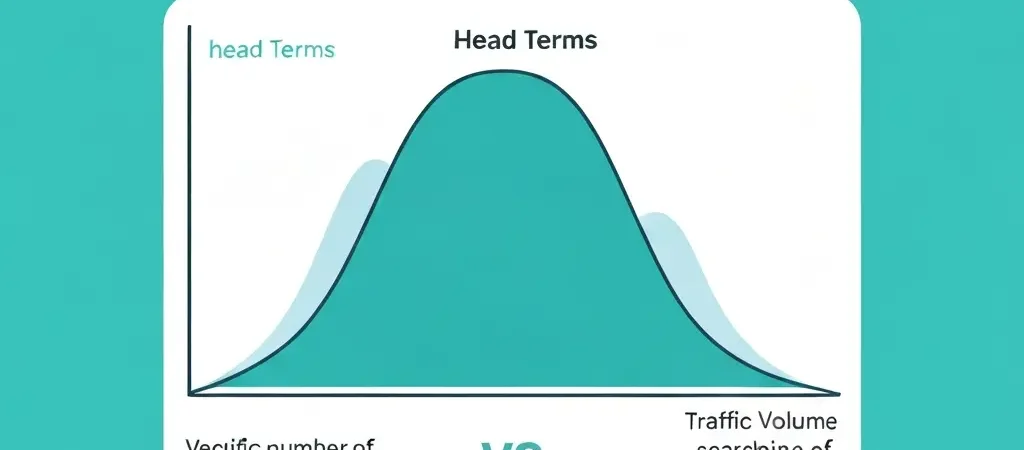
Long-tail keywords are typically 3–5+ words in length with monthly search volume under 1,000 (often under 200). They’re more specific than head keywords and reflect a more defined search intent. Examples: “best AI content generator for WordPress blogs” (long-tail) vs. “AI content generator” (head keyword). The “tail” refers to the long tail of the search demand curve, where thousands of specific queries each receive low individual volume but collectively represent the majority of all searches.
How many long-tail keywords should I target?
There’s no upper limit — every unique, relevant long-tail keyword can be its own article. For a focused niche strategy, targeting 50–200 long-tail keywords per topic cluster is achievable within 6–12 months. With AI content automation, targeting 200–500+ long-tail keywords in a niche is feasible. The practical limit is your topical map coverage — once you’ve addressed every meaningful long-tail query in your niche, you expand to adjacent topics.
Should I use one long-tail keyword per article?
Yes — one primary focus keyword per article, with semantic variations included naturally. Creating separate articles for each distinct long-tail keyword (vs. cramming multiple keywords into one article) produces better results: each article can be optimized specifically for its target query, and more articles means more ranked pages across more queries. The exception: keywords with identical intent can be targeted by one article (e.g., “AI content generator” and “AI content writing tool” are close enough to target in one article).
Do long-tail articles need backlinks to rank?
Often no — low-competition long-tail keywords can rank without external backlinks, especially on sites with some existing domain authority. Strong internal linking from related pillar and cluster articles can provide sufficient authority signal for long-tail articles targeting KD 0–20 keywords. As keyword difficulty increases above 20–30, some external link equity becomes increasingly important. This is one of the key advantages of long-tail strategy: many rankings achievable without link building investment.
How do I track long-tail keyword rankings effectively?
Google Search Console is the most accurate and free tool for tracking long-tail rankings. Filter by page to see all queries each article ranks for, including long-tail variations beyond your primary target keyword. For tracking across a large portfolio, Ahrefs and Semrush allow rank tracking for hundreds or thousands of keywords simultaneously. Focus on total impressions and position distribution by topic cluster rather than obsessing over individual keyword positions.
Scale Your Long-Tail Keyword Coverage
Authenova enables you to systematically cover your entire long-tail keyword landscape — generating one optimized article per keyword at publishing cadences of 20–60 articles per month. Build the comprehensive topical coverage that compounds into authority.