SEO Content Automation ROI Data: What the Numbers Actually Show
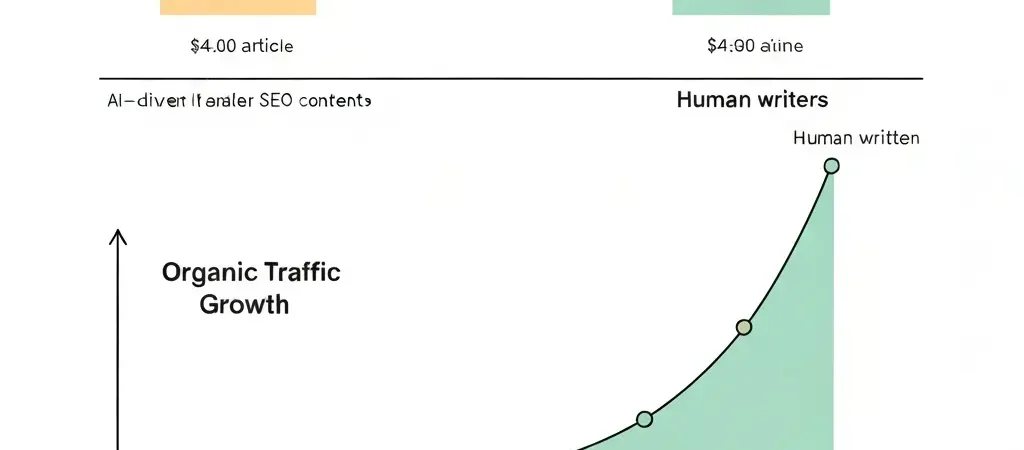
SEO content automation delivers measurable ROI through three mechanisms: direct cost reduction (10-100x lower per-article cost versus human writers), volume multiplier effect (42% more content from AI adopters), and compound organic traffic growth (each article building cumulative search equity). In 2026, the data on content automation ROI is robust enough to project returns across different program types and team sizes with reasonable confidence.
What Is the Cost Comparison Between AI and Human Content Production?
The cost comparison between AI and human content production is the most straightforward ROI calculation in content marketing. The differential is categorical, not marginal:
| Cost Factor | Human Writers | AI Content Automation | Difference |
|---|---|---|---|
| Cost per article (1,500 words) | $150-$500 | $2-$15 | 10-100× cheaper |
| Cost for 50 articles | $7,500-$25,000 | $100-$750 | $7,400-$24,250 saved |
| Production time (1 article) | 4-8 hours | 15-30 minutes | 80% time reduction |
| Operational cost reduction | Baseline | 30-50% lower | Intel Market Research, 2026 |
| Articles per month (same budget) | 8-12 articles at $2,000/month | 130-1,000 articles at $2,000/month | 10-83× more content |
The “same budget” row is the most operationally relevant comparison. A $2,000/month content budget that previously funded 8-12 human-written articles now funds 130-1,000 AI-generated articles — depending on the platform and plan. This volume differential is what drives the topical authority acceleration that produces compound organic traffic returns.
What Are the ROI Benchmarks for SEO Content Automation?
Aggregate ROI benchmarks from 2026 studies show consistent outperformance of AI content programs over traditional content approaches:
- Overall ROI: AI campaigns deliver 22% better ROI than traditional content marketing programs (Writeful, 2026)
- Conversion rate: AI-assisted campaigns produce 32% more conversions than human-only content programs (Writeful, 2026)
- Customer acquisition cost: AI content campaigns reduce customer acquisition costs by 29% (Writeful, 2026)
- Marketing productivity: Organizations report 40% productivity improvements with AI content tools (AutoFaceless, 2026)
- Time-to-market: AI content turnaround is 80% faster, enabling faster response to trending keywords and market opportunities
The 40% productivity improvement metric is particularly significant for teams. A 5-person content team using AI automation performs at the equivalent of a 7-person team without — with the cost savings from the eliminated 2 positions directly improving margin or funding other growth investments. Platforms like Authenova implement this productivity multiplier through full pipeline automation, not just writing assistance.
What Is the Typical Payback Period for Content Automation Investment?
The payback period for content automation investment depends on three variables: the platform cost, the baseline organic traffic value (CPC multiplied by keyword volume), and the domain’s existing authority level.
Payback period scenarios:
New site (DA 0-20): 4-8 months to payback. New sites take longer to build topical authority. Content begins ranking after 2-3 months; revenue-generating traffic typically materializes in months 4-6. Platform investment (often free or low-cost for entry tiers) is typically covered by the first month of meaningful organic traffic.
Established site (DA 20-50): 1-3 months to payback. Existing authority accelerates new content ranking. Cluster articles often reach positions 5-20 within weeks of publishing. Traffic from new content often generates revenue within the first billing cycle.
High-authority site (DA 50+): Under 1 month to payback. High-authority sites see new AI content ranking within days or weeks. Each article immediately contributes to revenue. The ROI calculation is simply: platform cost versus CPC value of new traffic × conversion rate.
Marketing automation platforms like CampaignOS can help track content ROI by connecting blog article publication events to downstream conversion tracking — providing precise attribution data for content automation payback calculations.
What Traffic Growth Data Is Associated with Content Automation?
Organic traffic growth data from content automation programs follows a predictable pattern: slow initial growth, inflection after topical authority establishment, then compound growth:
- Months 1-2: Indexing phase. Traffic growth minimal (10-30% month-over-month from a low base).
- Months 3-4: Initial ranking phase. Long-tail supporting articles begin ranking. 30-50% MoM traffic growth.
- Months 5-6: Authority recognition phase. Cluster articles reaching positions 5-20. 50-100% MoM traffic growth as multiple articles begin compounding.
- Months 7-12: Compound growth phase. 20-40% MoM growth becomes the baseline as an established content library continues accumulating traffic from new articles while existing articles continue building equity.
The key data point: companies using AI publish 42% more content monthly (Semrush, 2026). This velocity advantage means AI adopters are 6-8 months ahead on the authority-building curve compared to manual content operations at the same budget level. Academic and student-focused platforms like Tesify have used similar content velocity strategies to build substantial organic traffic bases in highly competitive academic niches.
What Conversion Data Exists for AI SEO Content?
Conversion data for AI-generated SEO content in 2026 shows performance advantages beyond traditional organic search:
| Traffic Source | Relative Conversion Rate | Source |
|---|---|---|
| Traditional organic search | 1× (baseline) | Industry baseline |
| AI Overview traffic (click-through) | 23× higher | SEOmator, 2026 |
| AI content campaigns overall | +32% more conversions | Writeful, 2026 |
| AI-powered PPC vs traditional | 30% better conversion rate | Robotic Marketer, 2026 |
The 23× conversion advantage of AI Overview traffic is one of the most consequential emerging findings in content marketing data. It reframes the zero-click search narrative: while AI Overviews reduce total click volume, the users who do click through convert at dramatically higher rates. This shifts the value proposition from traffic quantity to traffic quality — and makes AEO optimization high-priority for conversion-focused content programs.
What ROI Differences Exist Across Different Program Types?
ROI varies significantly across content automation program types based on competitive intensity and monetization model:
Informational content programs (educational, how-to, FAQ): Highest volume, lowest per-article cost, longest monetization timeline. Best suited for brand awareness and lead generation at the top of the funnel. ROI measured in organic traffic value and lead volume.
Comparison content programs (best-of, versus, reviews): Medium volume, higher conversion rate per visitor. Users searching comparison queries are further along the purchase journey. 32.5% of AI citations come from comparison content — strong AEO signal amplifying visibility. ROI measured in direct conversion rate from bottom-funnel visitors.
Long-tail programmatic programs: Very high volume at minimal cost. Thousands of specific queries each generating modest traffic. The compound effect of 500+ articles each capturing 50-200 monthly visits creates significant aggregate traffic. ROI measured in cumulative organic traffic value.
Topical authority building programs: Highest long-term ROI but longest payback period. The first 6 months invest in authority; subsequent years harvest compounding returns. Best for businesses with 12+ month growth horizons and content as a core acquisition channel.
Frequently Asked Questions
What is the ROI of SEO content automation in 2026?
SEO content automation delivers 22% better overall ROI than traditional content marketing, 32% more conversions, and 29% lower customer acquisition costs (Writeful, 2026). Cost efficiency: AI generates articles at $2-15 versus $150-500 for human writers. Output volume: AI adopters publish 42% more content monthly. Payback period: 1-3 months for established sites, 4-8 months for new sites. Long-term, each article compounds as an independent traffic source indefinitely.
How does content automation reduce costs?
Content automation reduces costs through three mechanisms: (1) per-article generation cost drops from $150-500 (human writer) to $2-15 (AI platform) — a 10-100x reduction, (2) operational overhead (project management, editorial coordination) drops 30-50% as manual handoffs are eliminated, (3) time-to-publish reduces 80%, enabling faster response to ranking opportunities. Total operational cost reductions of 30-50% are consistently reported in 2026 studies.
How long does it take for SEO content automation to generate positive ROI?
Payback period for SEO content automation depends on domain authority: under 1 month for high-authority sites (DA 50+), 1-3 months for established sites (DA 20-50), and 4-8 months for new sites (DA 0-20). The platform cost is typically low enough that even modest initial traffic generates positive ROI quickly. Long-term, content automation programs producing compound organic traffic deliver returns that accumulate without proportional cost increases.
Does AI content automation improve conversion rates?
Yes — AI content automation improves conversion rates through two mechanisms: (1) higher content volume increases topical coverage and captures more bottom-funnel queries where users are ready to convert, and (2) AI traffic from citations in AI Overviews and AI chatbots converts at 23× the rate of traditional organic traffic. AEO-optimized AI content that earns AI citations delivers significantly higher per-visitor conversion rates than traditional organic search traffic.
What is the cost of AI content versus human content in 2026?
AI content costs $2-15 per article on automation platforms in 2026. Human-written articles from professional freelancers cost $150-500 each. The cost differential is 10-100×. For a team publishing 50 articles per month: human writing costs $7,500-$25,000; AI automation costs $100-$750. This cost structure makes high-volume content programs economically viable for teams and budgets that could previously only afford 5-10 articles per month.
What metrics should I track to measure SEO content automation ROI?
The most important metrics for measuring SEO content automation ROI are: (1) organic traffic growth by month (tracks the compound effect), (2) keyword ranking improvements for target cluster keywords, (3) traffic value (organic traffic volume × average CPC for target keywords), (4) lead/conversion volume from organic traffic, (5) cost per article (AI platform cost / articles published), and (6) AI citation mentions (tracked via brand monitoring tools for AEO program ROI).
Start Your Content Automation ROI Clock Now
Every month without content automation is a month of compounding returns you are not capturing. Authenova starts free — your payback period begins the moment your first article goes live.