SEO Content Automation: The 2026 Playbook for Scaling Organic Traffic
SEO content automation is the systematic process of generating, optimizing, and publishing search-engine-optimized content without manual effort at the point of production. Done correctly, it’s the fastest way to build topical authority, grow organic traffic, and reduce your cost-per-visitor from search — all at the same time.
But the keyword “done correctly” matters enormously. SEO content automation that ignores content architecture, skips schema markup, or produces thin articles at high volume actually hurts rankings. This playbook shows you exactly how to implement SEO content automation the right way in 2026.
Why SEO Content Automation Is Now Non-Negotiable
The math of manual SEO content creation doesn’t work at scale. Consider: a comprehensive topical authority strategy for a mid-size niche requires 200-500 articles covering the full keyword landscape. At 3 articles per week, that’s 1-3 years to build out. Your competitors automating at 20 articles per week cover the same ground in 2-4 months.
In competitive niches, the window to establish topical authority through content is closing. Sites that built automated content flywheels in 2024-2025 now have authority moats — hundreds of indexed, ranking articles that accumulate backlinks and drive growing organic traffic. New entrants face a significant catch-up challenge. SEO content automation is how you catch up or maintain your lead.
The SEO Content Automation System
Component 1: Topical Authority Keyword Architecture
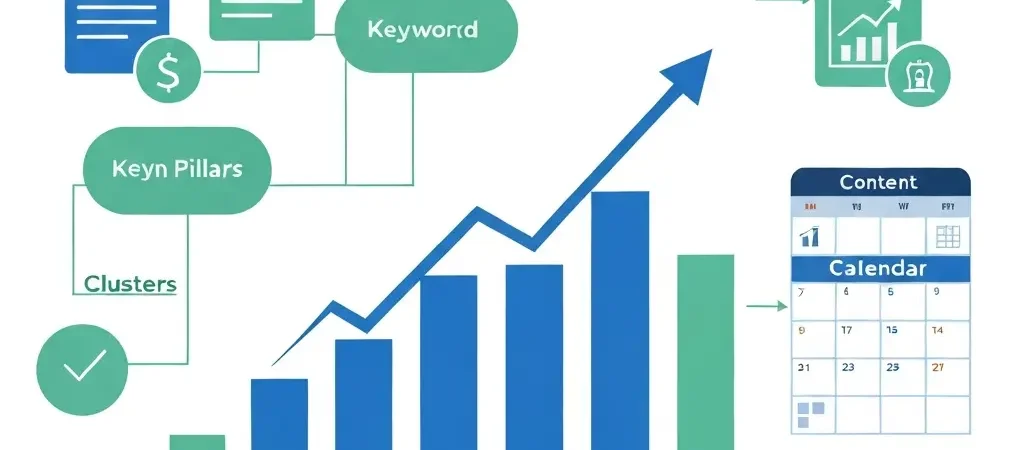
Random content generation doesn’t build topical authority. Your keyword architecture needs three tiers:
- PILLAR keywords: Broad, high-volume terms (1,000+ monthly searches, KD 30-60). These get your most comprehensive articles (2,000-3,000 words). Examples: “content marketing automation,” “AI SEO strategy.”
- CLUSTER keywords: Topic-specific, medium-volume terms (200-1,000 monthly searches, KD 20-40). 1,500-2,000 word articles. These link to their parent PILLAR.
- SUPPORTING keywords: Long-tail, low-competition terms (under 200 monthly searches, KD under 25). 800-1,200 word articles. These capture specific queries and link up to CLUSTER and PILLAR pages.
This architecture creates the topical depth signal that tells Google your site is a comprehensive resource. Authenova’s Strategy Builder enforces this architecture automatically — assign keywords to the correct tier, and the platform sequences content generation to build the architecture correctly (PILLARs first, then CLUSTERs, then SUPPORTING).
Component 2: AI Article Generation
Your AI content generator needs to produce articles with:
- Proper HTML structure (H1 → H2 → H3 hierarchy)
- Focus keyword in H1, first paragraph, and at least one H2
- 1-2% keyword density (natural, not forced)
- Semantic term coverage (related entities and topics)
- FAQ section with reader-relevant questions
- Internal link targets within the topical cluster
- External links to authoritative sources
Plain text AI output that requires manual HTML formatting is not SEO content automation — it’s AI-assisted manual content production. True automation requires complete HTML article output ready for immediate CMS publishing.
Component 3: SEO Metadata Automation
For every generated article, the following must be set automatically:
- Meta title (under 60 chars, keyword-first)
- Meta description (under 160 chars, compelling CTR hook)
- Focus keyword for your SEO plugin
- Open Graph title, description, and image
- Twitter Card metadata
- Article JSON-LD schema (datePublished, author, image)
- FAQPage JSON-LD schema (from FAQ sections)
Authenova generates all of this automatically. Other platforms require manual SEO plugin configuration for each article — undermining the “automation” claim.
Component 4: Scheduled WordPress Publishing
The final component is delivery. Complete SEO content automation pushes articles directly to WordPress on a predefined schedule — not a file export you upload manually, not a copy-paste workflow. Direct REST API integration with your WordPress site via the Authenova Plugin.
Implementation: Getting Your Automation Running
Week 1: Strategy and Keyword Setup
- Research 50-100 target keywords, organized by tier
- Write detailed brand voice guidelines
- Configure Authenova strategy with publishing schedule
- Install and connect the WordPress Plugin
Week 2-4: Launch and Monitor
- Enable your strategy (SCHEDULED mode recommended for first run)
- Review first 5-10 articles for quality and voice consistency
- Adjust brand voice guidelines based on output
- Monitor Google Search Console for initial indexing
Month 2-3: Optimize and Scale
- Identify first keyword rankings in GSC
- Double down on clusters generating early impressions
- Increase publishing velocity as indexing confirms crawl budget
- Add secondary keyword clusters to expand topical coverage
This implementation framework is how Tesify scaled their SEO content automation to five simultaneous language strategies — methodical launch, quick quality validation, then aggressive scale-up. Their French (tesify.fr) and Spanish (tesify.es) operations both reached significant organic traffic milestones within 90 days of launching automated content strategies. Marketing teams managing SEO automation for multiple clients use CampaignOS alongside Authenova to coordinate campaigns and track results across all client properties.
Measuring SEO Content Automation Results
Track these KPIs monthly:
- Articles indexed / articles published: Should be above 80%. Below this, reduce publishing velocity or improve internal linking.
- Keywords ranking positions 1-10: Should grow month-over-month as topical authority accumulates.
- Organic clicks: The ultimate metric. Should compound as indexed content grows.
- Cost per organic visitor: Should decrease as automated content volume grows without increasing spend.
Frequently Asked Questions
How long does SEO content automation take to show results?
Initial keyword rankings typically appear within 4-12 weeks depending on domain authority and keyword competition. Long-tail keywords (KD under 20) often rank within 2-4 weeks on established domains. The compounding effect — where each new article makes existing articles rank better — typically becomes visible at 3-4 months. Most sites see meaningful organic traffic growth by month 3-4 of consistent automated publishing.
Can SEO content automation work for affiliate marketing sites?
Yes. Affiliate sites benefit enormously from SEO content automation — the long-tail keyword landscape for product comparisons, reviews, and buyer guides is enormous and perfectly suited to automated production. Use Authenova to cover informational queries (how-to, what is) and comparison articles at scale. Reserve manual effort for high-stakes product review pages that require hands-on testing.
What’s the minimum publishing velocity for SEO content automation to be effective?
Even 3-5 articles per week is sufficient to see meaningful topical authority growth over 6-12 months. Higher velocity (10-20 articles per week) accelerates the timeline but requires higher domain authority for Google to index and rank new content quickly. For new domains, start at 3-5/week and increase as your crawl budget expands.
Does SEO content automation replace the need for link building?
Content automation and link building are complementary, not mutually exclusive. Automated content builds topical authority and drives organic clicks. Link building builds domain authority and helps individual pages rank for competitive keywords. High-volume automated content also creates more linkable assets — more articles means more opportunities for natural inbound links. The most effective SEO operations combine both.
Implement SEO Content Automation Today
Authenova gives you the complete SEO content automation stack — strategy, AI writing, metadata, schema, images, and WordPress publishing in one platform. Build your organic traffic flywheel starting today.