SEO Content Calendar Not Working? Here’s the Real Fix
You built the calendar. You assigned writers, set deadlines, tracked publish dates. Six months later, your organic traffic looks exactly the same — maybe worse. The frustrating part isn’t the lack of effort. It’s that the calendar itself is the problem, not your execution of it.
Most SEO content calendars are built around a dangerous assumption: that publishing consistently on loosely related topics eventually compounds into authority. It doesn’t. Google’s systems — particularly its understanding of topical authority SEO and how entity relationships signal domain expertise — penalize scattered coverage just as surely as thin content does.
The real fix isn’t a better spreadsheet or a smarter publishing cadence. It’s restructuring your entire content operation around a pillar-cluster content strategy that signals genuine expertise to search engines. Here’s exactly how to do it.
Why Most SEO Content Calendars Fail at Building Topical Authority
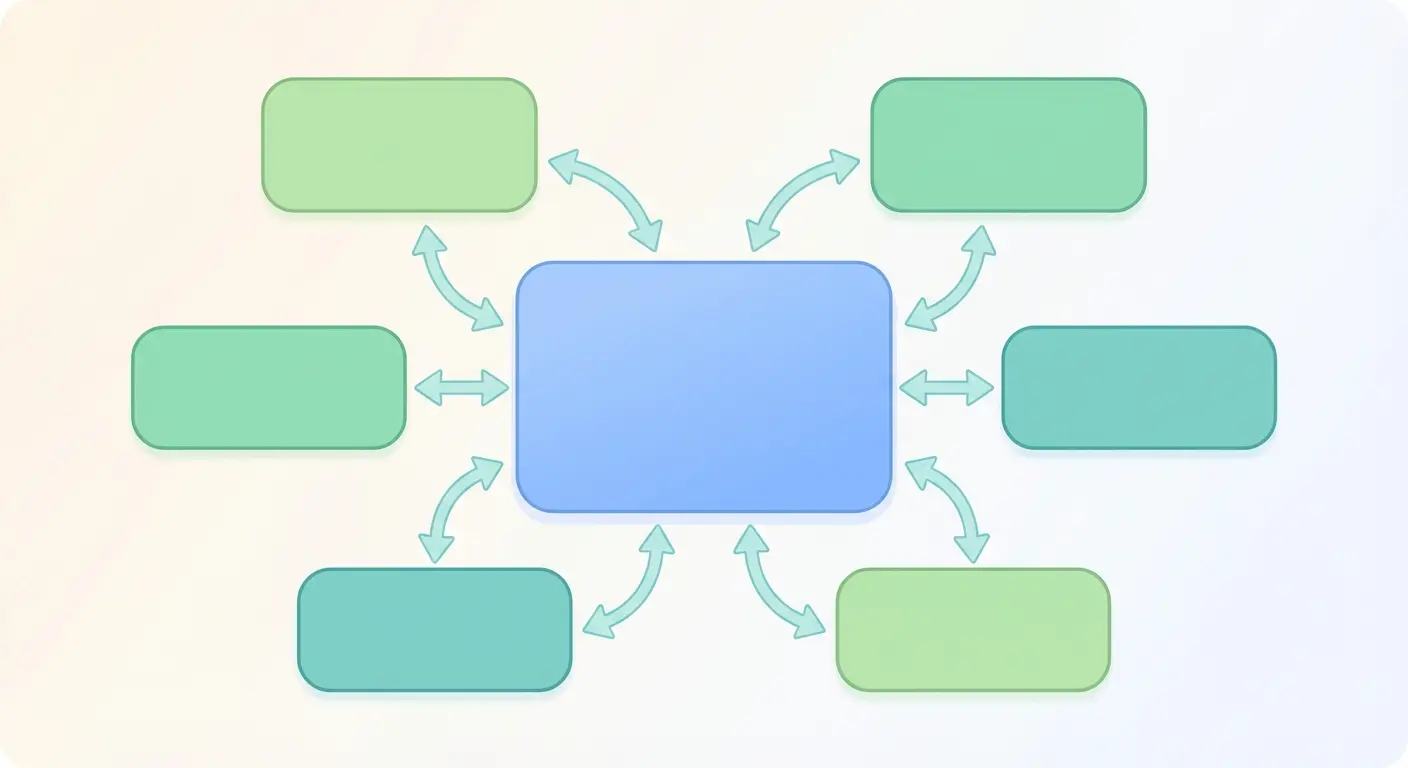
The core failure mode of a traditional content calendar is what I’d call topical scatter — publishing across a wide surface area without ever going deep enough for Google to recognize you as an authoritative source on anything specific.
Consider a SaaS marketing blog publishing one article per week. In a year, that’s 52 articles. If those articles span project management, email marketing, social media, SEO, and company culture, Google sees a generalist website — not an expert. The algorithm doesn’t reward effort. It rewards demonstrated expertise within a defined subject space.
According to Ahrefs’ research on topical authority, sites that comprehensively cover a topic’s semantic landscape — meaning they address the full range of questions and subtopics within a subject — rank significantly higher than sites that target individual high-volume keywords in isolation. This isn’t a soft signal. It’s a structural one baked into how Google’s entity-based indexing works.
What most people miss is that Google doesn’t just crawl pages. It builds a model of what your site collectively knows. A scattered calendar actively teaches Google the wrong lesson about your expertise.
The Three Symptoms of a Broken Content Calendar
- Keyword cannibalization: Multiple articles targeting the same intent, splitting authority instead of consolidating it.
- Orphaned content: Articles that aren’t internally linked to a parent topic page, making them nearly invisible to crawlers and readers alike.
- Zero topical clustering: No discernible relationship between consecutive posts — each one is a standalone bet rather than part of a coordinated coverage strategy.
If your analytics show individual pages ranking weakly for their target keywords despite solid on-page optimization, you’re almost certainly dealing with the third symptom. The issue isn’t the page. It’s the site architecture around it.
Topical Authority SEO: What Google Is Actually Measuring
Topical authority is Google’s assessment of how comprehensively and accurately a domain covers a specific subject area. It’s not just about backlinks anymore — it’s about whether your site’s collective content satisfies the full informational needs of users searching within a topic.
Google’s Natural Language Processing systems — including BERT, MUM, and the entity recognition frameworks underlying the Knowledge Graph — evaluate content at a semantic level. Semantic search, as Ahrefs explains, means Google is measuring the meaning and relationships within content, not just keyword frequency.
Here’s where it gets interesting. When Google indexes your site, it’s not just reading individual pages. It’s mapping the relationships between them. A tightly interconnected cluster of articles on, say, “email deliverability” tells Google something fundamentally different than five loosely related articles that each mention email deliverability once.
The practical implication for your content calendar: every article you publish either strengthens or dilutes your topical signal. There’s no neutral. A post about “team building activities” on an email marketing blog doesn’t just fail to build authority — it actively confuses Google’s model of what your site is about.
For a research-backed framework on building this type of authority systematically, the definitive topical authority framework outlines a four-phase approach that maps directly onto calendar restructuring.
Traditional Calendar vs. Topical Authority Calendar
| Dimension | Traditional Content Calendar | Topical Authority Calendar |
|---|---|---|
| Planning unit | Individual keyword | Topic cluster |
| Success metric | Page-level ranking | Cluster-wide organic visibility |
| Content relationship | Standalone articles | Interconnected pillar-cluster architecture |
| Internal linking | Ad hoc or absent | Systematic, bidirectional |
| Topic breadth | Wide, shallow | Narrow, deep |
| Google signal sent | Generalist site | Subject-matter expert |
The Pillar-Cluster Content Strategy Explained
The pillar-cluster model, popularized by HubSpot’s research team and validated by organic performance data across industries, is the structural solution to topical scatter. It’s not a new idea — but it’s still dramatically underused, mainly because it requires a level of editorial planning that most teams find uncomfortable.
HubSpot’s documented case study on implementing the pillar-cluster model showed a direct correlation between restructuring content around topic clusters and significant improvements in organic traffic — not just for cluster articles, but for the entire domain.
Here’s the architecture in plain terms:
- Pillar page: A comprehensive, authoritative resource that covers a broad topic at high altitude. It answers the primary question — “What is X?” — and links out to every cluster article on related subtopics. Typically 2,500–5,000 words.
- Cluster articles: Focused deep-dives that address specific questions or subtopics within the broader theme. Each one links back to the pillar page and, where relevant, to other cluster articles. Typically 1,000–2,500 words.
- Internal link mesh: The connective tissue. Bidirectional links between pillar and clusters create a crawlable, semantically coherent topic hub that Google can map and trust.
For an architectural breakdown of how pillar pages and cluster articles should be structured technically and editorially, the analysis of pillar-cluster content strategy architecture covers the mechanics in depth — including how to handle URL structure, crawl depth, and cluster sizing.
The counterintuitive insight here: publishing fewer, more strategically placed articles almost always outperforms publishing more articles without a cluster structure. Restraint in the service of depth is a competitive advantage most teams refuse to take.
How to Audit Your Existing SEO Content Calendar
Before rebuilding anything, you need an honest assessment of what your current calendar has actually produced. This isn’t a blame exercise — it’s a diagnostic one. Most content audits focus on page-level performance. What you need here is a cluster-level audit.
Pull your full content inventory into a spreadsheet. For each article, capture: target keyword, publishing date, organic sessions (last 90 days), number of internal links in, number of internal links out, and — critically — the primary topic it belongs to. Now group by topic.
What you’ll likely find: a handful of loose topic groupings with 2–3 articles each, no clear pillar page anchoring any of them, and minimal internal linking between related pieces. That’s the diagnostic picture of a scattered calendar.
Three Audit Questions That Expose the Real Problem
- Do you have a single, comprehensive resource for each core topic? If the answer is “no” or “kind of,” you don’t have a pillar page — you have a long article.
- Can a Googlebot crawl from any cluster article to your pillar page in one click? If not, your internal link structure is broken, and PageRank flow is leaking.
- Are you planning new content based on what’s missing from your clusters, or based on what’s trending? Trend-chasing produces topical scatter. Gap-filling produces authority.
According to Search Engine Land’s guide to topic clusters, the audit phase is where most teams identify that 30–50% of their existing content can be consolidated, redirected, or repurposed into cluster articles — without writing a single new word. That’s a significant efficiency gain hiding inside your existing content library.
A Practical 5-Step Framework for Rebuilding Your Content Calendar
Here’s the framework. Fair warning: this takes genuine editorial effort upfront. The payoff is a calendar that generates compounding organic returns instead of one-and-done ranking attempts.
Step 1: Define Your Core Topic Territories (Maximum 3–5)
Start by identifying the 3–5 subject areas your business has the right to own. Not topics you want to write about — topics where your product, team, and customer base give you genuine expertise. These become your pillar topics. Everything else goes on hold.
Step 2: Build a Semantic Subtopic Map for Each Pillar
For each pillar topic, map every question a searcher might ask at every stage of understanding — from definitional (“what is X”) to advanced (“how does X interact with Y in Z scenario”). Tools like Ahrefs’ Content Gap analysis, Google’s People Also Ask results, and Semrush’s Topic Research module accelerate this. You’re building the skeleton of your cluster before you write a word.
Step 3: Audit Existing Content Against the Semantic Map
Match every existing article to a node on your subtopic map. Articles that fit get earmarked for optimization and relinking. Articles that don’t fit get evaluated for consolidation or noindex. This step typically reveals both your content gaps and your hidden assets.
Step 4: Sequence New Content by Cluster Completion, Not by Trend
Rebuild your calendar so that each publishing period completes one cluster before starting another. Publish the pillar page first. Then release cluster articles in order of search volume — highest to lowest. This sequencing gives Google a complete picture of your expertise in phases, rather than a scattered impression over time.
For teams using AI tools to scale this process, the AI-powered SEO content strategy guide for 2026 covers how to automate subtopic discovery, brief generation, and cluster gap analysis without sacrificing content quality.
Step 5: Build Bidirectional Internal Links Into Every Brief
Internal linking can’t be an afterthought. Every content brief should specify: which pillar page this article links to, which other cluster articles it links to, and what anchor text to use. Make this non-negotiable in your editorial workflow. A cluster article published without these links is a node disconnected from the network — it generates almost no topical authority signal.
Frequently Asked Questions
How many cluster articles do I need per pillar page?
Most well-established clusters contain between 8 and 20 supporting articles, but the number matters less than completeness. Your cluster should cover every meaningful semantic subtopic within the pillar theme — use search volume data and People Also Ask results to identify gaps. A cluster of 6 highly focused, well-linked articles will outperform a cluster of 15 loosely related ones.
Should I delete content that doesn’t fit my cluster strategy?
Not always. Start by evaluating whether off-topic content generates meaningful organic traffic or backlinks. If it does neither, consolidating it into a relevant cluster article (via 301 redirect) is usually the right move. Content that earns links or traffic can sometimes be kept as a standalone asset, clearly separated from your core topic architecture.
How long does it take to see results after rebuilding a content calendar around topical authority?
Typically 3–6 months for measurable organic improvement, though sites with existing domain authority often see movement within 6–8 weeks of completing a cluster. The speed depends on your crawl frequency, the quality of your pillar page, and how efficiently Google can discover and process the new internal link structure.
Can a small site with limited resources implement a pillar-cluster content strategy?
Yes — and smaller sites often benefit more from it. Focusing on one tight cluster (1 pillar + 6–8 cluster articles) rather than spreading across 20 unrelated topics is both more achievable and more effective for building domain-level authority. Constraint forces the kind of strategic focus that larger teams frequently lack.
Does topical authority replace the need for backlinks?
No — backlinks remain a core ranking signal, but their relationship with topical authority is multiplicative, not additive. A site with high topical authority converts backlinks into ranking power more efficiently than a scattered site with the same link profile. Think of topical authority as improving the ROI of every link you earn, rather than replacing the need to earn them.
Go Deeper on Topical Authority SEO and Pillar-Cluster Architecture
If this diagnostic has clarified why your calendar isn’t working, the next step is understanding the full structural model that makes it work. These resources will take you from diagnosis to implementation:
- Pillar-Cluster Content Strategy: Architecture for Topical Authority — the technical and editorial mechanics of building topic hubs that rank.
- Topical Authority SEO: The Definitive Framework — a four-phase methodology grounded in how Google’s entity systems actually work.
- AI-Powered SEO Content Strategy in 2026 — how to operationalize cluster production at scale without sacrificing quality.
If this analysis changed how you think about content planning, share it with the SEO or content lead on your team. The frameworks here work — but they require buy-in from anyone who touches the editorial calendar.