Topical Authority SEO: The Complete 2026 Guide for SEOs
Topical authority SEO has quietly become the single most important ranking lever that most SEO teams are still underestimating. While everyone obsesses over backlink counts and technical audits, Google’s systems have been making a structural shift — rewarding sites that own a subject rather than sites that simply mention it. The 2024 Semrush Ranking Factors Study confirmed that content depth and topical coverage correlate more strongly with first-page visibility than domain authority alone for informational queries. That changes the game entirely.
Here’s the uncomfortable truth: you can have a technically perfect site with hundreds of backlinks and still lose ground to a smaller competitor who mapped their content around a topic cluster. This guide explains why — and exactly what to do about it in 2026.

What Is Topical Authority in SEO?
Topical authority in SEO refers to a search engine’s confidence that a specific website is a reliable, expert-level source on a defined subject area. It’s not a single score or a metric you can read directly in any tool — it’s a composite signal built from content coverage, entity relationships, link patterns, and user behavior that Google’s systems infer over time.
Topical authority SEO is the discipline of structuring a website’s content so that it demonstrates deep, consistent expertise across every meaningful dimension of a subject. When a site achieves topical authority, Google treats it as a trusted domain for that topic cluster — surfacing it more broadly, ranking it faster for new content, and protecting its positions during algorithm updates.
The concept draws from information retrieval theory, specifically the idea that relevance isn’t just keyword-matching — it’s about whether a document and its surrounding corpus answers the full scope of a user’s information need. Google’s systems, including the Helpful Content guidelines, explicitly evaluate whether content was created to serve people or to capture search traffic — and topical depth is one of the clearest proxies for genuine expertise.
What most people miss is that topical authority isn’t just about volume of content. A site publishing 500 shallow articles about “marketing” doesn’t build authority the same way a site publishing 80 deep, interconnected articles about email marketing strategy does. Specificity and structure matter as much as scale.
For a research-backed breakdown of the theoretical foundations and a phased roadmap, the Topical Authority in SEO: The Definitive Framework for Building Domain Expertise is the best companion piece to this guide.
Why Topical Authority Matters More in 2026
The shift started well before 2026, but this year it has become undeniable. Three concurrent forces have made topical authority SEO the central competitive differentiator for content-driven businesses.
The AI Overview Effect
Google’s AI Overviews (formerly SGE) pull answers primarily from sources that Google already trusts on a topic. Sites without established topical authority are being cited less frequently in these overviews — which means lower brand exposure even when they technically rank on page one. Being in position 4 with high topical authority now often outperforms being in position 1 without it, because AI Overviews pull from trusted sources first.
The “Content Glut” Problem
AI-assisted content tools have flooded the web with surface-level articles targeting every conceivable keyword. As of early 2025, estimates suggested content production volume had increased by over 300% since 2022. Google’s response has been to sharpen its signals for genuine expertise — and topical authority is one of the clearest ways to distinguish expert sites from commodity content farms.
E-E-A-T and Helpful Content Alignment
Google’s own documentation around Experience, Expertise, Authoritativeness, and Trustworthiness (E-E-A-T) maps almost perfectly onto topical authority signals. Sites that consistently demonstrate deep, accurate, and structured expertise on a subject are — by definition — building the signals Google uses to evaluate E-E-A-T at the domain level.
The practical implication? If you’re publishing content in 2026 without a topical authority strategy, you’re competing on luck. The sites winning long-term are those that have made a deliberate architectural decision about what they want to be known for — and built their content estate accordingly.

How Google Measures Topical Authority
Google has never published a “topical authority score” — but the signals it uses are well-documented across patent filings, algorithm update documentation, and third-party research. Here’s what the evidence actually supports.
Entity-Based Understanding
Google’s Knowledge Graph and semantic search infrastructure center on entities — people, places, concepts, and things — rather than keywords. When your content consistently covers the entities and relationships within a topic area, Google’s systems can map your site to that topical neighborhood. Research from the Allen Institute’s TOPICAL project demonstrates how automated topic classification works at scale — similar principles underpin how Google categorizes content.
Content Coverage and Gap Analysis
Google’s systems can detect whether a site covers a topic comprehensively or only surface-level. If your competitor covers 90% of the questions users ask about a topic and you cover 30%, their site will be treated as the more authoritative source — even if individual articles on your site are technically better written. Coverage breadth is a measurable signal.
Internal Link Architecture
How you connect content internally signals to Google which pages are conceptually related and which is the authoritative hub. A well-structured internal link graph mimics how experts reference each other’s work — it shows structural knowledge of a field, not just isolated facts.
Backlink Topical Relevance
Not all backlinks are equal for topical authority. A link from a highly relevant source in your niche carries more topical signal than a generic high-DA link from an unrelated domain. Ahrefs’ research on topical authority confirms that link relevance is increasingly weighted alongside raw authority metrics.
User Behavior Signals
When users consistently find complete, satisfying answers on your site — clicking through multiple related pages, returning, sharing — this behavioral data reinforces topical authority. It’s the difference between a site that answers one question and a site that genuinely serves an audience’s entire information journey.
Topical Authority Signals: Strength and Controllability
| Signal | Strength for Topical Authority | Controllability | Time to Impact |
|---|---|---|---|
| Content Coverage Breadth | Very High | Full Control | 3–6 months |
| Internal Link Architecture | High | Full Control | 1–3 months |
| Topically Relevant Backlinks | Very High | Partial Control | 3–9 months |
| Entity Mentions and Co-occurrence | High | Full Control | 2–4 months |
| User Engagement Patterns | Medium-High | Indirect Control | Ongoing |
| Content Update Frequency | Medium | Full Control | 1–2 months |
Topical Authority vs. Domain Authority: Key Differences
This comparison trips up even experienced SEOs. Domain Authority (DA) — Moz’s metric — and its equivalents (Ahrefs’ Domain Rating, Semrush’s Authority Score) measure the strength of a site’s overall backlink profile. Topical authority measures something fundamentally different: how deeply and comprehensively a site covers a specific subject area.
Here’s where it gets interesting. A DA 30 site with laser-focused topical authority in a niche like “B2B SaaS onboarding UX” can outrank a DA 70 generalist site for queries in that niche. This has been documented repeatedly in case studies from both Semrush’s topical authority research and practitioner SEO case studies across 2023–2025.
The two metrics work together but serve different functions. Domain authority is harder to build quickly — it depends on earning links over time. Topical authority is something a new site can build deliberately within 6–12 months through strategic content architecture. That asymmetry is why topical authority has become the preferred growth lever for emerging brands competing against established players.
The strategic implication: stop trying to “beat” competitors on DA. Instead, define a precise topical territory, map every question users ask within it, and build the most structurally complete resource in that space. That’s a winnable game — even from a standing start.

Building Topical Authority SEO: A Four-Phase Framework
Most topical authority failures come from jumping straight to content production without a strategic architecture phase. The framework below is designed to prevent that — and it’s sequenced deliberately.
Phase 1: Topical Territory Definition
Before writing a single word, define the exact topical territory you’re claiming. This isn’t “we write about marketing” — it’s “we are the definitive resource for performance marketing measurement for B2B SaaS companies.” The more specific the territory, the faster authority accumulates. Vague territory means diluted signals.
In practice, this means auditing your existing content to identify where you already have topical depth, analyzing competitor coverage gaps, and mapping your business’s genuine subject-matter expertise. The territory you choose should sit at the intersection of what you can genuinely claim expertise on, what your audience needs most, and where competitive coverage is thinnest.
Phase 2: Topical Map Construction
A topical map is a structured inventory of every subtopic, question, and entity within your territory — organized into a hierarchy that will eventually become your content architecture. Think of it as the outline for a textbook on your subject. The Ahrefs SEO Topic Map Template is a practical starting point for the mechanics of this process.
Phase 3: Content Architecture and Production
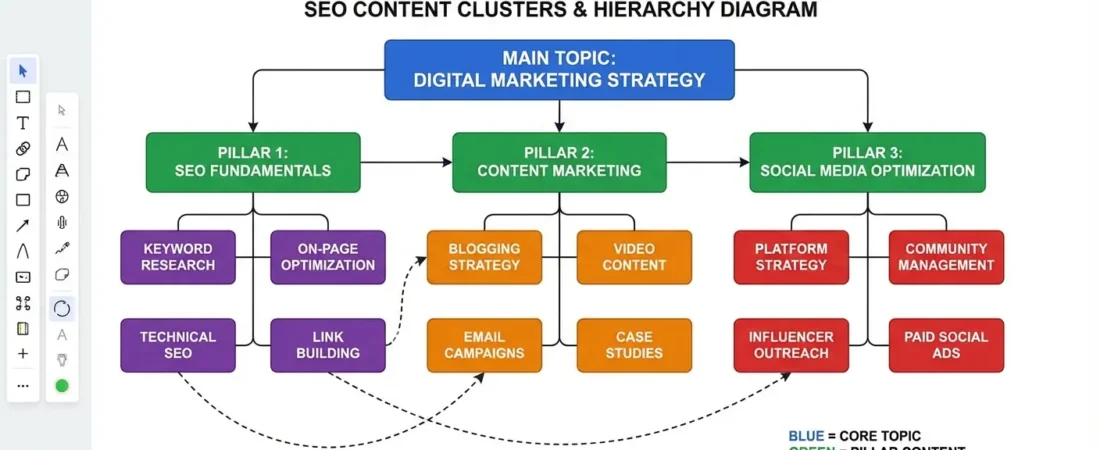
This is where the pillar-cluster model becomes essential. Pillar pages establish your authoritative position on broad subtopics. Cluster articles go deep on specific questions, angles, and use cases. The internal linking structure between them is what creates the topical signals Google reads. Skipping the architecture and just producing content is the most common mistake — and the most expensive one in terms of wasted effort.
Phase 4: Authority Amplification and Measurement
Once the content estate reaches critical mass, the focus shifts to amplifying the signals through targeted link acquisition, content updates, and measuring topical share of voice against competitors. Authority isn’t a destination — it requires ongoing maintenance as topics evolve and competitors respond.
Topical Map Creation: Step-by-Step Process
A topical map is the most underused strategic asset in SEO — and building one rigorously is what separates sites that build real topical authority from those that publish content and hope.
- Define your core entity: Identify the central concept or subject your site will own. Everything else branches from here. Be specific — “project management software for construction firms” not “project management.”
- Extract subtopics using multiple sources: Pull from Google’s People Also Ask, related searches, Ahrefs’ content gap tool, Semrush’s Keyword Magic Tool, and Reddit/Quora discussions in your niche. The goal is exhaustive coverage — every question a curious person might ask about your topic.
- Classify by intent and hierarchy: Sort subtopics into awareness-level (what is X?), consideration-level (how does X work?), decision-level (X vs. Y), and operational-level (how to do X step-by-step). This classification determines content type and placement in your architecture.
- Identify entity relationships: Map which subtopics connect to each other and which entities (tools, people, processes, organizations) are naturally associated with each cluster. These become your internal linking opportunities and your semantic vocabulary for each page.
- Prioritize by coverage gap and search volume: Score each subtopic by search volume, current ranking position (if any), and competitor coverage. Start with high-volume subtopics where competitors have weak, shallow coverage — these are your fastest wins.
- Assign content formats: Not every subtopic needs a 3,000-word article. Some need comparison tables, some need how-to guides, some need definition pages. Matching format to intent is both a UX and SEO decision.
- Build the internal link graph in advance: Before writing, map which pages will link to which. This prevents the common problem of retroactively trying to create internal links in content that wasn’t designed for them.

Pillar-Cluster Architecture and Topical Authority SEO
The pillar-cluster model is the structural backbone of topical authority SEO — and it’s not just a content organization method. It’s the mechanism by which internal link equity flows, entity associations are formed, and topical signals are concentrated in the pages that matter most.
A pillar page is a broad, authoritative resource on a core subtopic — detailed enough to be genuinely useful, but deliberately designed to link out to deeper cluster articles that cover specific dimensions of that subtopic. Cluster articles address specific questions with depth, then link back to the pillar. The result is a hub-and-spoke structure that Google’s crawlers can navigate in a way that directly mirrors how expertise is organized in academic and professional knowledge systems.
What most people get wrong is treating pillar pages as long keyword-stuffed content aggregators. The best pillar pages are genuinely useful standalone resources — not just a table of contents with thin introductions to each subtopic. They need to answer the core question fully while contextualizing the deeper cluster content as extensions of the conversation.
For a detailed technical blueprint — including information retrieval theory, implementation phases, and the specific metrics to track — the Pillar-Cluster Content Strategy: Architecture for Topical Authority guide covers the mechanics in granular detail.
The Three-Tier Model
The most effective pillar-cluster architectures use three tiers: the topical pillar (broadest), category clusters (mid-level), and supporting articles (most specific). This isn’t just organizational preference — it reflects how search query intent breaks down from broad informational to specific transactional, and Google’s systems respond to that hierarchy when it’s reflected in your content architecture.
Content Depth Signals Google Actually Uses
Depth isn’t word count. That distinction matters enormously — and conflating the two leads to exactly the kind of padded, repetitive content that the Helpful Content System is designed to filter out.
Real content depth, as far as Google’s systems are concerned, comes from these measurable dimensions:
Question Coverage Completeness
Does a page answer not just the primary query but the natural follow-up questions a reader would have? Google’s NLP systems can evaluate whether a piece of content follows the natural progression of an informational journey — or stops abruptly, leaving users to search again elsewhere. High abandonment and “pogo-sticking” are signals that a page answered the headline but not the full question.
Entity Co-occurrence and Semantic Richness
Pages with genuine expertise naturally mention related entities — tools, techniques, people, organizations, and concepts — that belong in a conversation about that topic. An article about “email marketing automation” written by an expert will naturally reference segmentation, ESP platforms, drip sequences, and A/B testing. One written by someone without subject knowledge won’t — and Google’s entity-extraction systems can tell the difference.
Source Credibility and Citation Patterns
Expert content references external authoritative sources. Internal citation patterns (how your content cites and cross-references your own material) signal to Google that your site has a coherent knowledge base — not just a collection of isolated articles. This is one of the most underappreciated internal SEO signals for topical authority.
Content Freshness and Update Signals
Topics evolve. Sites that consistently update content to reflect new research, changed best practices, or emerging tools signal ongoing expertise. Sites that let content stagnate signal abandonment — which is a slow but real erosion of topical authority over time. The Semrush 2024 Ranking Factors Study found content freshness to be a statistically significant correlate of rankings across competitive informational queries.
AI Content and Topical Authority in 2026
This is where the conversation gets genuinely complicated — and where a lot of bad advice is circulating. The question isn’t whether to use AI in content production. The question is how to use it without sacrificing the topical authority signals that make content rank.
Here’s the reality: AI-generated content at scale can actually hurt topical authority if it’s deployed without a strategic architecture. When AI tools produce thin variations of the same subtopic across dozens of pages, they dilute topical signals rather than concentrate them. Google’s systems detect content that covers the same entity cluster repetitively without adding new information — and they treat it as a coverage pattern consistent with low-quality sites.
The right model for 2026 is what many practitioners are calling “AI-assisted, expert-directed” content production. AI handles research aggregation, first-draft generation, and formatting. Human subject-matter experts — or deeply experienced content strategists — handle the insight layer, the entity enrichment, the real-world examples, and the editorial decisions about what a page actually claims. That combination can produce content at scale without sacrificing the depth signals that drive topical authority.
For a detailed operational playbook on this workflow — including quality control frameworks and content velocity models — the Complete Guide to AI-Powered SEO Content Strategy in 2026 covers the full production system.
The counterintuitive insight here: in a world where AI makes it easy to produce more content faster, quality signals become more differentiating — not less. Topical authority built on genuine depth is harder to replicate at scale than topical authority built on volume alone. That’s a competitive moat, not a constraint.
Measuring Topical Authority SEO: Metrics and Models
You can’t manage what you can’t measure — but topical authority doesn’t have a clean single metric. Here’s the measurement framework that actually captures meaningful progress.
Topical Share of Voice (TSOV)
Identify the full set of target keywords within your topical territory (your topical map is the foundation for this). Calculate what percentage of those keywords your site currently ranks for in positions 1–10. Track this monthly against your top two or three competitors. A growing TSOV in your target territory is the clearest leading indicator of topical authority momentum.
Topical Coverage Rate
Compare your published content inventory against your complete topical map. What percentage of your identified subtopics have published content? A coverage rate below 40% means your topical authority signals are scattered. Sites at 70%+ coverage within a defined territory start to show the “authority compounding” effect — where new pages rank faster than earlier pages did.
Semantic Cluster Rankings Distribution
Pull your rankings data segmented by topical cluster. Are you ranking for terms across the full spectrum of a cluster (awareness, consideration, decision, operational)? Or are your rankings concentrated in just one or two intent categories? Uneven distribution indicates structural gaps in your topical coverage.
Organic Impression Breadth
Track Google Search Console impressions for queries you’ve never explicitly targeted. As topical authority builds, you’ll start appearing for long-tail and adjacent queries you didn’t write specific content for. This “passive impression growth” is one of the clearest real-world signals that Google is treating your site as an authority in a topical space.
Return Visitor Rate and Session Depth
Users who trust a site as an authority come back. They also navigate deeper — reading multiple related articles in a single session. Tracking return visitor rates and pages-per-session for topically-related content clusters gives you a behavioral proxy for perceived authority.
Common Topical Authority SEO Mistakes (and Fixes)
After analyzing dozens of content estates across industries, the failure patterns are remarkably consistent. These are the mistakes that cost the most time and the most opportunity.
Mistake 1: Defining the Topical Territory Too Broadly
“Digital marketing” is not a topical territory. It’s an industry. A new or mid-sized site claiming authority over “digital marketing” is competing with sites that have been publishing in that space for 10+ years with thousands of indexed pages. The fix: narrow ruthlessly until you find a territory you can realistically dominate within 12 months. Expand from there once authority compounds.
Mistake 2: Building Content Without Architecture
Publishing content without a topical map and a defined internal linking plan is like building a library without a cataloging system. Individually, the books might be excellent. As a system, it’s inaccessible to both users and crawlers. The fix: build the map and the architecture before writing a single new piece. Audit and restructure existing content against that architecture before scaling production.
Mistake 3: Prioritizing Volume Over Coverage Quality
Publishing 200 articles that each cover 30% of a subtopic adequately is worse for topical authority than publishing 80 articles that each cover their subtopic thoroughly. The fix: set a minimum content depth standard — not in word count, but in entity coverage, question completeness, and genuine utility. Enforce it before publication.
Mistake 4: Ignoring Existing Content Gaps in Favor of New Production
Many sites have significant topical coverage in certain clusters but critical gaps in others. They keep producing new content without fixing the gaps that prevent the existing content from building authority. The fix: conduct a topical gap analysis quarterly. Prioritize gap-filling over net-new production when your coverage rate in a target cluster falls below 60%.
Mistake 5: Treating Internal Linking as an Afterthought
Internal links are not UX decoration. They’re the mechanism by which topical authority signals flow through a site’s content graph. Sites that link internally without strategy — random contextual links, excessive footer links, no hub-and-spoke structure — fail to concentrate the topical signals in their most important pages. The fix: treat internal linking as a structural SEO decision, not an editorial suggestion.
FAQ: Topical Authority SEO
How long does it take to build topical authority in SEO?
Most sites begin seeing measurable topical authority signals — faster rankings, broader impression coverage, reduced link dependency — within 6 to 12 months of systematic implementation. The timeline depends on the competitiveness of the target territory, the depth of existing content, and the consistency of production. Narrower topical territories build authority faster than broad ones.
Is topical authority more important than backlinks for SEO in 2026?
Topical authority and backlinks are complementary signals — neither fully replaces the other. That said, in informational and mid-funnel query categories, topical authority is increasingly outperforming raw backlink counts as a ranking driver, particularly since Google’s 2024–2025 algorithm updates placed heavier weight on content quality and coverage. For competitive commercial queries, both remain important.
What is a topical map and why do you need one?
A topical map is a structured inventory of every subtopic, question, and entity within a defined subject area — organized into a content architecture hierarchy. You need one because building topical authority without it results in uneven coverage, poor internal linking, and scattered signals. It’s the blueprint that ensures your content estate operates as a coherent, authority-building system rather than a collection of individual articles.
Can a new website build topical authority fast?
Yes — and this is one of topical authority’s most underappreciated strategic advantages. New sites can build topical authority within a specific, well-defined niche faster than they can build competitive domain authority through link acquisition. By narrowing the topical territory, creating a thorough content map, and publishing systematically, new sites have consistently outranked older, higher-DA competitors within 9–15 months in dozens of documented case studies.
How do you measure topical authority progress?
The most reliable metrics for tracking topical authority progress are: topical share of voice (percentage of target keywords ranking in top 10), content coverage rate against your topical map, organic impression breadth for untargeted queries in Google Search Console, and session depth metrics for topically-related content clusters. No single tool provides a direct topical authority score, so tracking multiple signals in combination gives the clearest picture.
Does AI-generated content hurt topical authority?
AI-generated content hurts topical authority when it produces thin, repetitive, or shallow coverage at scale — which dilutes topical signals rather than strengthening them. AI-assisted content directed by genuine subject-matter expertise can build topical authority effectively, provided it meets real depth standards: entity coverage, question completeness, and original insight. The determining factor is quality and strategic architecture, not whether AI was involved in production.
Apply This Topical Authority SEO Framework to Your Content Strategy
Topical authority SEO isn’t a tactic — it’s a strategic decision about what your site will be known for, executed through architecture and consistent content investment. The sites that will dominate search through 2026 and beyond are the ones building that architecture now.
If this guide gave you a clear framework, share it with your team and link to it from your own content planning resources. The more practitioners apply these principles rigorously, the better the search ecosystem becomes for everyone.
Ready to go deeper? Explore the full implementation blueprint in the Pillar-Cluster Content Strategy: Architecture for Topical Authority — covering the technical architecture patterns, information retrieval theory, and measurement approaches that make this framework work in practice.
For the theoretical foundations and the four-phase research-backed framework, the Topical Authority in SEO: The Definitive Framework for Building Domain Expertise is the essential companion to this guide.