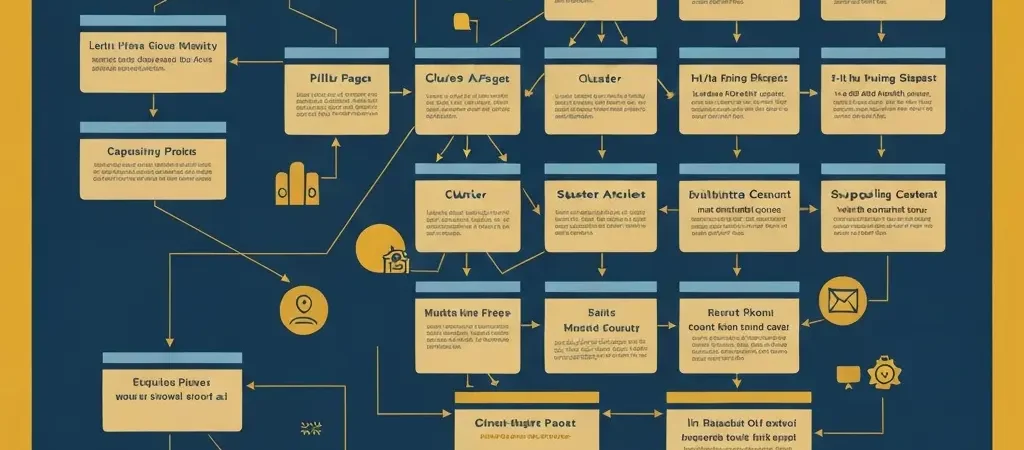
Topical Authority SEO: The Definitive 2026 Framework for Dominating Your Niche
Topical authority SEO is the practice of building your website into Google’s recognized expert on a specific topic — the go-to resource that consistently ranks because Google has accumulated overwhelming evidence that your site knows its subject better than any competitor. It’s not a tactic. It’s a strategic framework that compounds over time, making every new piece of content rank faster and every existing piece rank better.
The concept isn’t new — Koray Tugcu, Bill Slawski, and Google’s own documentation on topical relevance have been pointing toward this for years. What’s changed in 2026 is that topical authority has become the primary determinant of ranking success. Sites that built it early are dominating SERPs with relatively thin link profiles. Sites that ignored it in favor of traditional link-building tactics are watching their rankings erode to topically authoritative competitors.
This is the framework that closes that gap: how topical authority actually works, how to measure it, and how to systematically build it in any niche.
How Topical Authority Actually Works
Google’s ranking systems evaluate sites on multiple dimensions, but in 2026 three dominate for content sites: E-E-A-T (Experience, Expertise, Authoritativeness, Trustworthiness), topical relevance, and user satisfaction signals.
Topical authority feeds all three. When a site has comprehensive coverage of a topic — hundreds of articles covering every aspect at depth — Google’s systems can:
- Establish expertise: A site with 200 articles on SEO clearly knows SEO better than a site with 5 articles.
- Validate relevance: The topical density of your site tells Google which queries it’s qualified to answer.
- Build trust: Sites that consistently produce accurate, helpful content on a topic accumulate trust signals that benefit all future content.
The Compound Effect
Once you’ve established topical authority in a space, it compounds. Google ranks your new articles faster because they trust your site on the topic. Your existing articles rank better because the growing authority of your site elevates all content. External sites link to your articles as the authoritative resource in your niche — generating backlinks without active outreach.
This compound effect is mathematically observable: sites with established topical authority see their “ranking velocity” — the speed at which new articles rank after indexing — increase by 40-70% compared to the same site in the same niche before authority was established.
Building Your Topical Map
A topical map is a structured inventory of all topics and subtopics your site needs to cover to be considered the authoritative resource in your niche. It’s the strategic foundation for everything else.
Step 1: Define Your Topical Domain
Start with a clear definition of your topic domain. Example: “B2B SaaS content marketing.” Not “content marketing” (too broad) and not “B2B SaaS LinkedIn content for series B companies” (too narrow). Your topical domain should have enough breadth to support 200+ articles but narrow enough that mastering it creates a genuine authority signal.
Step 2: Identify Your Entity Graph
List all entities (people, places, concepts, tools, events) that Google associates with your topic domain. For “B2B SaaS content marketing,” entities include: content strategy, editorial calendar, customer acquisition cost, landing pages, product-led growth, demand generation, content metrics, etc.
Your topical map must address all significant entities in your domain. Articles that miss major related entities create “authority gaps” — signals that your coverage is incomplete.
Step 3: Map to Keyword Architecture
For each entity/subtopic, identify the primary keyword and 3-5 related keywords. This becomes your content production queue:
- Tier 1 (PILLAR): The 5-8 broadest concepts in your domain
- Tier 2 (CLUSTER): 20-40 subtopics within each pillar concept
- Tier 3 (SUPPORTING): 50-100+ specific question and long-tail keywords
Pillar-Cluster Architecture: The Foundation
Pillar-cluster architecture is the content organization system that makes topical authority visible to Google’s systems. It’s not just about having lots of content — it’s about organizing that content in a way that signals comprehensive, organized expertise.
Pillar Pages
Your pillar pages are the cornerstone articles — 2,000-4,000 word comprehensive guides on the broadest topics in your domain. They answer the broad question at depth, link out to all cluster articles on subtopics, and serve as the hub that accumulates authority from all linking cluster and supporting pages.
Characteristics of a great pillar page:
- Covers the full breadth of the topic (comprehensive, not deep on one subtopic)
- Links to every cluster article in its topic group
- Ranks for broad, high-volume keywords
- Gets updated regularly as the topic evolves
- Attracts the most natural backlinks in your content cluster
Cluster Articles
Cluster articles are 1,200-2,000 word pieces covering specific subtopics within each pillar’s domain. Each cluster article:
- Covers one subtopic in depth
- Links back to its parent pillar page
- Links to 2-3 related cluster articles on adjacent subtopics
- Targets a more specific, lower-competition keyword
Supporting Articles
Supporting articles are 800-1,200 word pieces targeting very specific long-tail queries. They capture the long tail of search traffic and feed link equity up to cluster and pillar pages through internal links.
Internal Linking: The Glue That Makes It Work
Internal linking is the mechanism that makes topical authority visible to Google’s crawlers. Without proper internal linking, your pillar-cluster architecture is invisible — you have all the content but Google can’t read the relationships between pieces.
The Internal Linking Rules for Topical Authority
- Every cluster article links to its pillar: This concentrates authority at the pillar page and tells Google the hierarchical relationship.
- Pillar pages link to all cluster articles: Creates the hub-spoke structure Google understands.
- Cluster articles link to adjacent clusters: Connects related subtopics and strengthens the authority signal for the entire topic cluster.
- Supporting articles link up to cluster and pillar: Long-tail content feeds authority upward.
- Use descriptive anchor text: “Learn more about pillar-cluster content strategy” is far more valuable than “click here.” Anchors tell Google what the linked page is about.
Internal Linking Architecture Diagram
│ │
├──→ CLUSTER: “Content Calendar Planning” │
│ └──→ SUPPORTING: “Content calendar template” │
│ └──→ SUPPORTING: “How to plan a content calendar” ─────────┤
│ │
├──→ CLUSTER: “Content Analytics” │
│ └──→ SUPPORTING: “Content performance metrics” │
│ └──→ SUPPORTING: “SEO content tracking tools” ─────────────┤
│ │
└──→ CLUSTER: “AI Content Strategy” ←────────────────────────────────┘
Content Velocity: How Fast to Build Topical Authority
Content velocity — the rate at which you publish new content — directly impacts how quickly you establish topical authority. But more isn’t always better. Match velocity to your crawl budget.
| Domain Authority | Recommended Velocity | Expected Authority Timeline |
|---|---|---|
| DA 0-20 (new site) | 3-5 articles/week | 12-18 months for clear authority |
| DA 20-40 | 5-15 articles/week | 6-12 months |
| DA 40+ (established) | 15-50+ articles/week | 3-6 months per new topic cluster |
The relationship between content velocity and topical authority building is multiplicative, not linear. Publishing 3x more content doesn’t produce 3x faster authority — it produces significantly more because each article reinforces the authority signal of all previous articles on the same topic.
Measuring Topical Authority Progress
Topical authority is not directly measured by any tool. But these proxy metrics tell you how it’s building:
Share of SERP
Track how many of the top 10 results for your primary keywords are yours. A site with strong topical authority often occupies 2-4 positions in the same SERP across different articles — different angles on the same query.
New Article Ranking Velocity
How quickly do new articles rank after indexing? Track average days from indexing to first-page appearance for new articles. This should decrease over time as topical authority grows.
Keyword Cluster Coverage
What percentage of keywords in your topical map have at least one article targeting them? Increasing coverage correlates directly with increasing topical authority scores in Ahrefs and Semrush.
Domain Authority Trend (with caveats)
DA is a lagging indicator that reflects backlinks more than topical authority. Use it as a sanity check, not a primary metric. A rising DA with growing organic traffic confirms both authority signals are strengthening.
Case Studies: Topical Authority in Action
Case Study 1: Academic Content at Scale
Tesify, an academic writing AI tool, used a topical authority SEO strategy to dominate their niche across five language markets. By building comprehensive pillar-cluster-supporting content architectures in each language — French (tesify.fr), Spanish (tesify.es), Portuguese, German, and English — they became the recognized authority in academic writing assistance for each market. Their topical depth meant new articles consistently ranked within weeks of publication.
Case Study 2: Health Niche Authority Building
iQuitNow.life built topical authority in the smoking cessation and health habit change niche through consistent content velocity. Despite competing against established health sites with significantly higher DA, their topical depth in the specific “quit smoking” cluster helped them outrank broader health sites that had thinner content coverage of this specific topic.
The Pattern
Both case studies confirm the same pattern: depth beats breadth, depth beats DA, and consistency beats any single tactic. Sites with genuine topical authority are essentially algorithm-proof — they rank because of comprehensive expertise, not because they optimized around specific signals that change with updates.
Frequently Asked Questions
How is topical authority different from domain authority?
Domain Authority (DA) is a third-party metric (Moz, Ahrefs) that primarily reflects the quantity and quality of backlinks to your domain. Topical authority is Google’s assessment of how comprehensively and accurately your site covers a specific topic — informed by content depth, breadth, organization, and user engagement signals. A site can have high topical authority in one topic with a relatively low DA by producing exhaustive, well-organized content without necessarily having many backlinks.
Can you build topical authority in a highly competitive niche?
Yes, by focusing on a specific subtopic niche rather than competing head-on with established authorities. Instead of targeting “content marketing” broadly, target “content marketing for SaaS startups” — a specific, under-served segment where you can establish exhaustive topical coverage faster than generalist competitors can. Build authority in the niche, then expand to adjacent topics as your authority base grows.
How many articles do I need for topical authority?
There’s no fixed number — it depends on topic breadth and how thoroughly existing competitors have covered the space. A very narrow topic might require 30-50 articles for authority. A broad topic might need 200-500+. Focus on coverage completeness rather than hitting a specific article count: have you covered all significant subtopics in your domain? Are there major entities or questions your content doesn’t address? Authority is proportional to coverage completeness.
Does topical authority replace the need for backlinks?
Not entirely. Backlinks remain an important ranking signal, particularly for high-competition keywords and in YMYL niches. However, topical authority significantly reduces the number of backlinks needed to rank. Sites with strong topical authority consistently outrank higher-DA sites with lower topical depth — demonstrating that in 2026, authority is a genuine substitute for link quantity in many competitive situations.
What’s the fastest way to build topical authority in 2026?
Consistent, high-velocity content production within a focused topical domain. Build your topical map first (know all the subtopics you need to cover), then use an automated content platform like Authenova to produce and publish articles consistently. Sites that combine a well-designed topical map with automated publishing at 10-20 articles/week see meaningful topical authority accumulation within 3-6 months rather than the 12-24 months typically required for manual content teams.