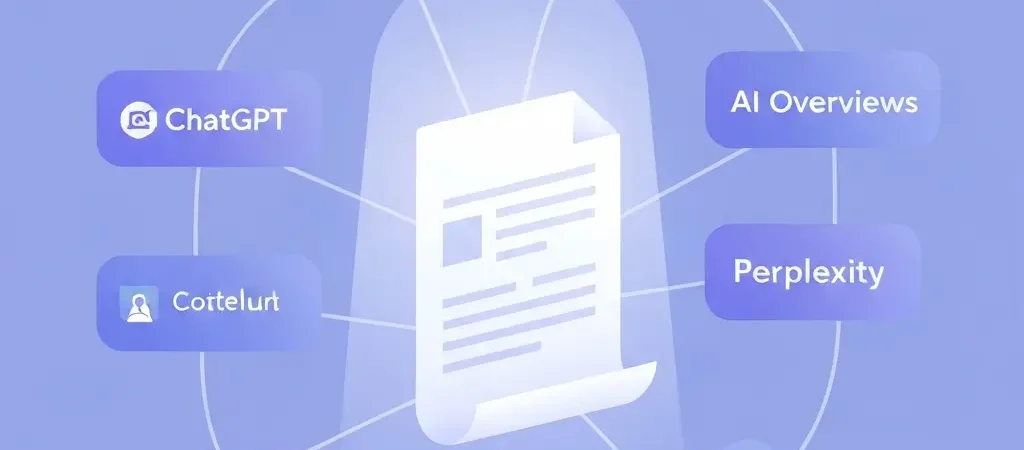
What is Answer Engine Optimization (AEO)? The Complete 2026 Guide
Answer Engine Optimization (AEO) is the discipline of structuring, formatting, and publishing content so that AI-powered answer engines — including ChatGPT, Google AI Overviews, Perplexity, and Microsoft Copilot — select your content as the cited, authoritative response to user queries. Unlike traditional SEO, which targets a position on a search results page, AEO targets the answer itself. In 2026, 69% of Google searches end without a single click, up from 56% in 2024, and ChatGPT processes 2.5 billion daily prompts. If your content is not optimized to be cited by AI, it is effectively invisible to a growing share of your audience.
This guide explains exactly what answer engine optimization is, why it matters more in 2026 than ever before, and how to implement every AEO tactic — from schema markup and FAQ structure to content freshness and cross-source consistency. Whether you are a marketer, SEO professional, or business owner, this is the complete playbook.
Answer Engine Optimization (AEO) is the practice of optimizing web content so AI systems — ChatGPT, Google AI Overviews, Perplexity, and voice assistants — understand, extract, and cite it as the definitive answer to user queries. It extends traditional SEO with structured data, direct-answer formatting, E-E-A-T signals, and cross-source brand consistency.
AEO vs SEO: What Is the Difference?
Search Engine Optimization (SEO) optimizes content to rank for keywords on a search results page (SERP). Answer Engine Optimization (AEO) optimizes content to be cited inside AI-generated responses before or instead of a SERP ever appearing. The two disciplines share a foundation — technical health, E-E-A-T, and quality content — but diverge sharply on formatting, structure, and measurement.
| Dimension | Traditional SEO | AEO |
|---|---|---|
| Primary goal | Rank on SERP page 1 | Be cited in AI answer |
| Key signal | Backlinks, keyword density | Structured data, direct answers |
| Content format | Long-form prose | Extractable passage blocks |
| Freshness window | Months to years | 30 days for peak citation rate |
| Measurement | Rankings, CTR | AI citation frequency, brand mentions |
The strategic implication: AEO does not replace SEO but extends it. Pages that rank in position 1 on Google are 161% more likely to appear in AI Overviews, according to 2025 Ahrefs data. Automating your SEO foundation is therefore the prerequisite to any AEO strategy.
Why AEO Matters More Than Ever in 2026
The numbers are unambiguous. According to Ahrefs’ study of 17 million citations, AI-surfaced URLs average 1,064 days old compared to 1,432 days for traditional search — a 25.7% freshness advantage for AI. Google AI Overviews now reduce organic CTR by 15–46% depending on query type, with Pew Research Center documenting a 46.7% relative decline in click rates across 68,000 queries. Meanwhile, the AI content marketing market is projected to grow from $5 billion in 2026 to over $17.6 billion by 2033.
For brands that fail to adapt, the risk is compounding invisibility. For those who master AEO, the reward is citation-level authority — your brand name read aloud by voice assistants, displayed as the answer in AI Overviews, and recommended by ChatGPT to millions of users every day. The AI-optimized content market is generating real competitive moats right now. Our analysis of how topical authority compounds with AI content shows exactly why early movers win disproportionately.
The Citation Economy: How AI Picks Its Sources
AI models are not choosing sources randomly. According to research published in 2025, brands with consistent cross-source information received 3.2× more AI citations than brands with detectable inconsistencies across their top five indexed pages. Content with explicit data attribution — “According to Ahrefs’ 2025 study” — is cited by AI models at 4.2× the rate of equivalent content with no source references. And pages that answer both primary queries and related fan-out queries are 161% more likely to appear in AI Overviews.
How AI Answer Engines Select and Cite Content
Understanding the mechanics of AI citation is the foundation of effective AEO. Each major AI answer engine uses a different retrieval and citation model, but several signals are universal.
Retrieval-Augmented Generation (RAG)
Most AI answer engines use Retrieval-Augmented Generation (RAG): they first retrieve candidate documents from an index (often a real-time web index), then generate a response grounded in those documents, citing the sources used. This means your page must be crawlable, indexable, and contain the precise answer to the query in an extractable passage — not buried in a wall of text.
Passage-Level Extraction
Google’s passage ranking system and the passage-extraction models used by Perplexity and ChatGPT both evaluate content at the paragraph level, not the page level. A single well-structured paragraph that directly answers a question can trigger a citation even if the surrounding article is unfocused. This is why AEO content must be written so every section is a standalone, citation-worthy block.
Platform-Specific Citation Patterns (2025 Data)
- ChatGPT: 47.9% of citations come from Wikipedia; long-form authoritative pages dominate non-Wikipedia citations
- Google AI Overviews: 21% of citations from Reddit; 13% from LinkedIn; strong bias toward freshness and E-E-A-T
- Perplexity AI: 13.9% of citations from YouTube; strong preference for structured data and numbered lists
The 7 Core AEO Tactics for 2026
1. Answer First, Explain Later
Every heading (H2/H3) should be immediately followed by a 40–60 word direct answer in the first paragraph. AI models extract this opening passage as the citation-worthy response. Supporting context, examples, and nuance come after. This structure doubles as a featured snippet optimization technique for traditional search.
2. Implement FAQPage and HowTo Schema
Structured data is the explicit signal AI crawlers use to understand content type and extract Q&A pairs. FAQPage schema increases the probability that your questions and answers appear directly in AI responses. HowTo schema signals step-by-step instructional content, which AI engines heavily favor for process-oriented queries.
3. Maintain Cross-Source Consistency
AI models aggregate information across sources. If your NAP data, product descriptions, or factual claims differ between your website, LinkedIn, and third-party directories, your brand’s citation rate drops by up to 68%. Audit every indexed property for consistency quarterly.
4. Cite Statistics with Sources
Adding statistics with named sources improves AI citation likelihood by 30–41%, according to 2025 research. Use the format: “According to [Source]’s [Year] [report/study], [specific finding].” Never present data without attribution. Our guide on best AI SEO content generators covers how modern tools automate source citation at scale.
5. Publish Fresh Content Every 30 Days
76% of ChatGPT citations come from pages updated within the past 30 days. Building a publishing cadence that keeps your core AEO pages fresh is non-negotiable. This does not mean rewriting from scratch — adding new data, updating statistics, and expanding FAQ sections on existing pages qualifies as meaningful freshness. An SEO content calendar framework makes 30-day refresh cycles operationally sustainable.
6. Target Conversational Long-Tail Queries
AI answer engines process natural language queries, not keyword-stuffed searches. AEO content should target full-sentence questions: “What is the best way to automate SEO content creation?” rather than “automate SEO content.” Map every content piece to a specific conversational query drawn from forums, Reddit, Quora, and “People Also Ask” boxes.
7. Build Topical Depth, Not Just Breadth
AI models assess topical authority holistically. A site with 50 deeply interlinked articles on content automation is vastly more likely to be cited on that topic than a site with one article. The pillar-cluster model — which we break down in our AI blog writer guide — is the structural backbone of AEO-ready topical authority.
Schema Markup for AEO: FAQPage, HowTo, and Article
Schema markup is machine-readable metadata that tells AI crawlers exactly what type of content a page contains. For AEO purposes, three schema types are critical:
FAQPage Schema
FAQPage schema marks up question-and-answer content so AI systems can extract individual Q&A pairs as discrete citations. Each question should mirror a real search query. Each answer should be 40–100 words — long enough to be complete, short enough to be extracted as a passage.
HowTo Schema
HowTo schema marks up step-by-step processes with individual step names, descriptions, and optionally images and duration. This schema type is strongly correlated with AI Overview citations for “how to” queries, which represent approximately 8% of all searches.
Article Schema with Author and DateModified
Article schema with author, datePublished, and dateModified fields signals E-E-A-T (Experience, Expertise, Authoritativeness, Trustworthiness) to both Google and AI citation models. The dateModified field is especially important for the freshness signals that drive ChatGPT citation rates.
AEO Citation Factor Infographic: What Drives AI Citations in 2026
| Citation Factor | Citation Lift | Implementation |
|---|---|---|
| Cited statistics with named source | +4.2× | “According to [Source] [Year]…” |
| Cross-source brand consistency | +3.2× | Consistent info across all indexed properties |
| FAQPage schema markup | +41% | Implement on every Q&A section |
| Content freshness (≤30 days) | 76% of ChatGPT citations | Update core pages monthly |
| Ranks for primary + fan-out queries | +161% in AI Overviews | Pillar-cluster topical architecture |
Sources: Ahrefs 2025 citation study, SparkToro 2025, Search Engine Land 2026
Content Structure That AI Engines Extract
The single most impactful AEO technique is structural: write every content block so it can be extracted and read aloud without context from the rest of the article. This is sometimes called “passage independence.” Here is the exact structural template that maximizes AI citation probability:
- H2 heading as a question: “What is [topic]?” or “How does [process] work?”
- Direct answer paragraph (40–60 words): Answers the heading question completely in the opening sentences.
- Supporting detail (100–200 words): Context, examples, and nuance that human readers need but AI can skip.
- Data point with attribution: At least one sourced statistic per section.
- Transition to the next section: One sentence bridging to the next H2.
This structure works across all content types — tutorials, comparisons, definitions, and data roundups. It is also the format that generates the highest organic traffic compounding effect, as we demonstrate in our research on organic traffic growth strategies for 2026.
Measuring AEO Performance in 2026
AEO lacks the mature measurement ecosystem of traditional SEO, but several metrics proxy for citation health effectively:
- AI brand mention frequency: Tools like Semrush AI Visibility Toolkit and Profound track how often AI engines mention your brand in relevant responses.
- Featured snippet capture rate: AI Overviews draw heavily from featured snippet winners. Track this in Google Search Console.
- Zero-click impression share: Google Search Console shows queries where your page appeared but received no clicks — a proxy for AI Overview displacement.
- Direct/branded search volume growth: When AI engines recommend your brand, branded search volume rises. Track this monthly in Ahrefs or Semrush.
- Content freshness score: Audit
dateModifiedacross your AEO content library. Any page with a modification date older than 60 days is at heightened citation risk.
Best Tools for AEO in 2026
The AEO tooling landscape has matured rapidly in the past 18 months. Here are the category leaders as of April 2026:
| Tool | Primary AEO Use Case | Starting Price |
|---|---|---|
| Semrush AI Visibility Toolkit | AI citation tracking across 100M+ prompts | $139/mo |
| Ahrefs Brand Radar | AI response brand mention monitoring | $129/mo |
| Profound | Dedicated AEO tracking platform | Custom |
| Authenova | AEO-optimized content generation at scale | Free to start |
| Google Search Console | AI Overview impression tracking | Free |
Video: AEO in Practice
The following video from Ahrefs provides a foundational walkthrough of how search optimization intersects with AI engine citation mechanics — directly applicable to the AEO framework covered in this guide.
Frequently Asked Questions About Answer Engine Optimization
What is the difference between AEO and GEO?
AEO (Answer Engine Optimization) focuses on optimizing content for AI-powered answer engines like ChatGPT and Google AI Overviews. GEO (Generative Engine Optimization) is a broader term that encompasses all strategies for appearing in generative AI outputs, including AI-written articles and image captions. In practice, most practitioners use the terms interchangeably, though GEO tends to emphasize brand presence in non-search AI contexts.
Does AEO replace traditional SEO?
No. AEO extends traditional SEO rather than replacing it. Pages that rank in Google position 1 are 161% more likely to appear in AI Overviews. A strong SEO foundation — technical health, backlinks, E-E-A-T — is the prerequisite for AEO success. AEO adds structured formatting, conversational query targeting, and freshness discipline on top of that foundation.
How long does it take to see results from AEO?
Initial AI citation improvements can appear within 2–4 weeks of implementing AEO tactics, especially for freshness-sensitive platforms like ChatGPT where 76% of citations come from pages updated within 30 days. Sustained, measurable brand mention growth typically takes 3–6 months, as it depends on topical authority depth and cross-source consistency building.
Which AI engines are most important to optimize for?
In 2026, the priority order for most brands is: (1) Google AI Overviews — highest search volume, (2) ChatGPT — 2.5 billion daily prompts, (3) Perplexity AI — fastest-growing AI search engine, (4) Microsoft Copilot — strong enterprise penetration. Voice assistants (Siri, Alexa) remain relevant for local and consumer queries.
Is AEO only relevant for B2B companies?
No. AEO is relevant for any brand whose customers use AI assistants. B2C brands benefit enormously from AEO for product recommendations (“What is the best [product category]?”), local queries, and health/finance queries where AI Overviews dominate. B2B companies benefit from AEO for comparison queries and vendor research, which are heavily AI-mediated in 2026.
What schema markup is most important for AEO?
The three most important schema types for AEO are: (1) FAQPage — marks up Q&A content for direct AI extraction, (2) HowTo — signals step-by-step instructional content preferred by AI engines for process queries, and (3) Article with author, datePublished, and dateModified — signals E-E-A-T and content freshness. All three should be implemented as JSON-LD in the page’s head section.
Start Publishing AEO-Optimized Content at Scale
Authenova is the AI SEO platform built specifically for AEO compliance — every article generated follows answer-first structure, includes FAQPage schema, and is updated on a configurable freshness schedule to maintain the 30-day citation window.