What Is a Pillar Cluster Content Strategy? (The 2026 Complete Answer)
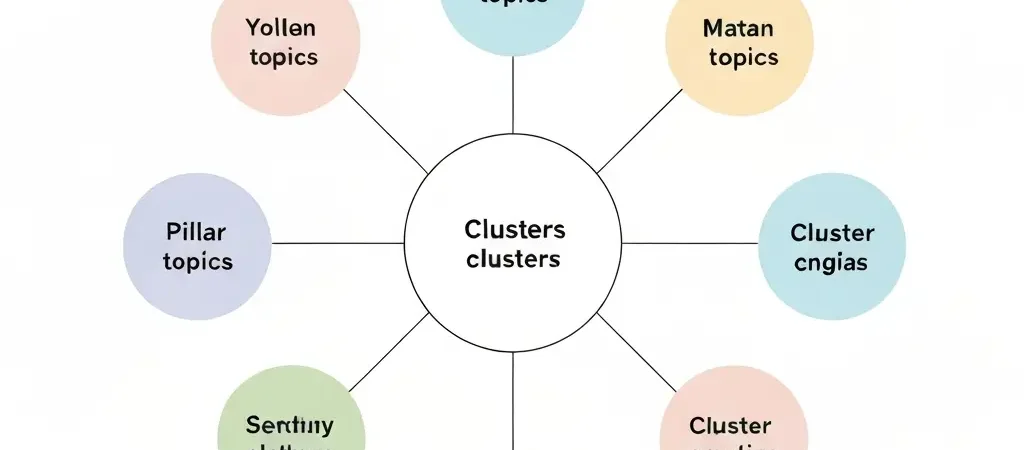
A pillar cluster content strategy is an SEO architecture where one comprehensive pillar page on a broad topic connects through internal links to a set of focused cluster articles — each covering a specific sub-topic in depth. Together, the pillar and its cluster form a topic authority network: Google recognises the site as an expert on the entire subject, and the domain ranks across hundreds of related queries simultaneously. Without this architecture, sites competing in content-heavy niches struggle to achieve consistent first-page rankings regardless of individual article quality.
How a Pillar Cluster Strategy Works
Imagine you run a marketing automation SaaS. Your pillar page covers “marketing automation” comprehensively — explaining what it is, why businesses use it, and what features to look for. That page targets 5,000+ monthly search volume head terms. Surrounding it are cluster articles, each going deep on one aspect: “email automation for ecommerce,” “lead scoring models,” “marketing automation ROI.” Each cluster article links back to the pillar. The pillar links out to each cluster.
This creates a self-reinforcing authority loop. Backlinks earned by the pillar flow to cluster articles through internal links. Backlinks earned by individual cluster articles on niche topics flow back to the pillar. Google’s algorithm reads this network as evidence that the domain has genuine depth of expertise on the subject — not just a few well-written articles, but comprehensive, interconnected coverage.
For teams managing both content and marketing operations, this strategy connects naturally to automation workflows. Omnichannel marketing automation platforms can trigger email notifications when new cluster articles are published, automatically distributing each piece to the appropriate subscriber segment based on their interest history.
Why Google Rewards Cluster Architecture
Google has evolved from keyword matching to semantic understanding. Its algorithms now assess topical coverage — not just whether individual pages contain a keyword, but whether the site as a whole demonstrates genuine expertise in a subject area. The pillar cluster model directly addresses this evaluation:
- Semantic density: The cluster covers a topic from every relevant angle, creating a dense network of semantically related pages that Google’s Knowledge Graph can map
- Internal link signals: The structured linking pattern within the cluster tells Google’s crawlers exactly which page is the authority on the broad topic and which pages cover sub-topics
- Crawl efficiency: Tightly-linked clusters are crawled more thoroughly, ensuring all pages get indexed faster
- AI Overviews eligibility: Google’s AI Overviews in 2026 preferentially pull from comprehensive cluster architectures that can answer multi-part queries in a single knowledge domain
Pillar Page vs Cluster Article: Key Differences
| Dimension | Pillar Page | Cluster Article |
|---|---|---|
| Topic scope | Broad (the whole topic) | Specific (one sub-topic) |
| Word count | 3,000–5,000 words | 1,200–2,000 words |
| Keywords targeted | High-volume head terms | Mid-tail sub-topic terms |
| Internal links | Links OUT to all clusters | Links BACK to pillar + siblings |
| Primary goal | Rank for broad head term | Rank for specific intent queries |
5 Steps to Implement a Pillar Cluster Strategy
- Choose your cluster topics: Each cluster should represent a topic area large enough to support 8–15 articles but specific enough to have a clear semantic boundary. “Email marketing” works; “marketing” is too broad.
- Research the keyword universe: Use Ahrefs or Semrush to pull all keywords in your cluster topic. Classify by intent and group by sub-topic. Each distinct sub-topic becomes one cluster article.
- Write the pillar first: The pillar page establishes the architecture. Write it as the definitive guide to the topic — comprehensive but not exhaustive on any single sub-topic (clusters handle the depth).
- Produce clusters systematically: Publish 2–3 cluster articles per week. Each one must link to the pillar with descriptive anchor text and receive a corresponding link from the pillar.
- Update internal links continuously: As you publish new cluster articles, go back to earlier articles and add contextual links where topics intersect. The cluster linking web should grow denser over time.
Academic writing platforms face a structurally identical challenge when building their content libraries. Tesify.app’s thesis writing hub uses exactly this architecture: a comprehensive “how to write a thesis” pillar linking to cluster articles on literature reviews, methodology chapters, APA citation, and defence preparation. Each layer of the cluster attracts its own search audience while contributing authority back to the central hub.
How AI Accelerates Cluster Execution
The practical constraint on pillar cluster strategy is production capacity. A complete cluster of 15 articles (1 pillar + 10 clusters + 4 supporting) requires 25,000–40,000 words of high-quality content. At manual writing speed, this takes 4–8 weeks of dedicated writing time. Competitors who are also building clusters during this window gain ground daily.
AI automation reduces this to a matter of days. A platform like Authenova can generate an entire keyword-mapped cluster from a topic seed, produce all articles with correct internal linking, and publish them to WordPress on a staggered schedule — delivering the full cluster to Google’s index within 2–3 weeks rather than 2 months.
The speed advantage is not cosmetic. Clusters that reach the ranking threshold (enough articles indexed and linked) before a competitor’s cluster do tend to hold position even after the competitor publishes. Early topical authority has a compounding moat effect in competitive niches.
Frequently Asked Questions
How many cluster articles should a pillar page have?
The optimal cluster size is 8–15 cluster articles per pillar page, depending on the topic’s keyword universe. Fewer than 8 leaves significant keyword coverage gaps; more than 20 can cause diminishing returns unless the topic is exceptionally broad. Start with 8–10 and expand based on keyword gaps identified after the initial cluster ranks.
Does every cluster article need to link to the pillar?
Yes. Every cluster article must link to the pillar page at least once using descriptive anchor text that includes the pillar’s target keyword. This is the fundamental structural requirement of the hub-and-spoke model. Missing this link breaks the authority flow and weakens both the cluster article’s ranking potential and the pillar’s ability to rank for broad head terms.
Can you have multiple pillar pages on one website?
Yes, and most authority sites have 3–8 active pillar clusters covering different topic areas. Each cluster operates independently with its own pillar and spoke articles. Where topics genuinely intersect (e.g., “email automation” and “lead scoring”), cross-cluster internal linking is appropriate and beneficial for both clusters.
What is the difference between a pillar cluster strategy and a topical map?
A topical map is the planning document — the visual or spreadsheet representation of all the content needed to achieve topical authority in a niche. A pillar cluster strategy is the implementation architecture — the actual content hierarchy and linking structure used to execute the topical map. A topical map tells you what to write; the pillar cluster strategy tells you how to structure and link it.
How long does a pillar cluster strategy take to show results?
Cluster articles targeting long-tail keywords typically rank within 30–60 days of indexing. The pillar page targeting competitive head terms takes 90–180 days to reach top-10 positions. The compounding effect — where cluster rankings lift pillar rankings and vice versa — becomes measurable around the 90-day mark for most domains. Sites with existing authority see results faster; brand new domains may take 6–9 months for pillar head terms to rank.
Build Your Pillar Cluster Strategy Automatically
Authenova maps your topic cluster from a single keyword, generates your pillar page and all cluster articles with correct internal linking, and auto-publishes them to WordPress. Build the architecture that ranks in weeks, not months.