What Is Topical Authority and Why Does It Matter?
Topical authority is Google’s measure of how comprehensively a website covers a specific subject area. A site with high topical authority on “AI content generation” has published extensive, interlinked content covering every sub-topic — definitions, tools, strategies, comparisons, and case studies. Google uses topical authority as a trust signal that predicts whether a site will consistently provide accurate, expert-level answers on a given topic.
How Does Google Measure Topical Authority?
Google measures topical authority through several interconnected signals. The primary signals are content coverage depth (how many subtopics within a subject a site addresses), content quality (whether individual articles comprehensively answer specific questions), internal linking structure (whether related content is systematically interconnected), and external authority signals (backlinks from other topically relevant sites).
Google’s 2022 Helpful Content Update and subsequent Quality Rater Guidelines explicitly emphasized “content that demonstrates first-hand expertise and a depth of knowledge.” This is topical authority in practice — a signal that the site has invested in genuine subject-matter coverage, not just keyword targeting.
The semantic relationship between articles also matters. A site with 50 interlinked articles on “AI content generation” that reference and reinforce each other signals deeper topical coverage than 50 isolated articles that don’t cross-reference. Google’s Knowledge Graph and entity-based understanding connect these semantic relationships into a coherent topical map.
How Is Topical Authority Different from Domain Authority?
Domain authority (DA) is a broad metric reflecting a site’s overall link profile and age. Topical authority is a narrower, topic-specific signal reflecting expertise depth within a particular subject area.
| Dimension | Domain Authority | Topical Authority |
|---|---|---|
| Scope | Entire domain | Specific topic area |
| Primary signals | Backlinks, age, spam score | Content coverage, depth, internal links |
| Build time | Years | Months (with AI content) |
| Actionability | Requires link acquisition | Built through publishing strategy |
| New site advantage | Low — needs time to accumulate | High — can be built quickly |
A critical insight: a new site can outrank an established high-DA site on topical keywords if the new site has stronger topical authority for that specific subject. This is why focused niche sites frequently beat general-purpose publications on specialized topics — their coverage depth signals greater expertise to Google’s topical relevance systems.
Why Does Topical Authority Matter for SEO Rankings?
Topical authority creates compounding SEO advantages. Once Google recognizes a site as authoritative on a topic, three things happen:
- Faster indexing: New articles on the established topic get crawled and indexed within hours rather than days or weeks.
- Lower competition threshold: New pages on the topic earn rankings with fewer or no backlinks, because Google’s trust in the site extends to new content within the same topical area.
- Broader keyword capture: High topical authority allows ranking for semantically related terms not explicitly targeted. A site with authority on “AI SEO” will naturally rank for related queries about content automation, keyword research, and ranking strategies.
For AI content automation platforms like Authenova, topical authority is the core value proposition. Automated content systems build topical coverage at the scale and speed required to establish Google recognition in months rather than years.
Teams using marketing automation platforms like CampaignOS to coordinate content distribution and social signals amplify the authority-building effects of high-volume content publishing.
How Do You Build Topical Authority in 2026?
Building topical authority in 2026 requires four systematic actions:
1. Define your topic cluster. Identify the core topic and map every semantically related subtopic using keyword research tools. This creates your content roadmap. A topic like “AI content generation” has dozens of subtopics: what it is, how it works, tools available, SEO implications, cost comparisons, case studies, and more.
2. Build pillar content first. Create one or two comprehensive pillar articles (2,000-5,000 words) that define and explain the core topic. These act as the topical hub and internal linking destination for all cluster articles.
3. Publish cluster and supporting articles systematically. Deploy 10-30 cluster articles targeting specific subtopics within the topic cluster. Each article addresses one specific question or subtopic in depth and links back to the pillar article. Supporting articles address even more specific long-tail queries.
4. Maintain publishing velocity. Consistency matters. 76% of AI citations come from pages updated within 30 days. Maintaining a regular publishing cadence — not just publishing a large batch and stopping — signals ongoing expertise development to Google.
What Is the Pillar-Cluster Model for Topical Authority?
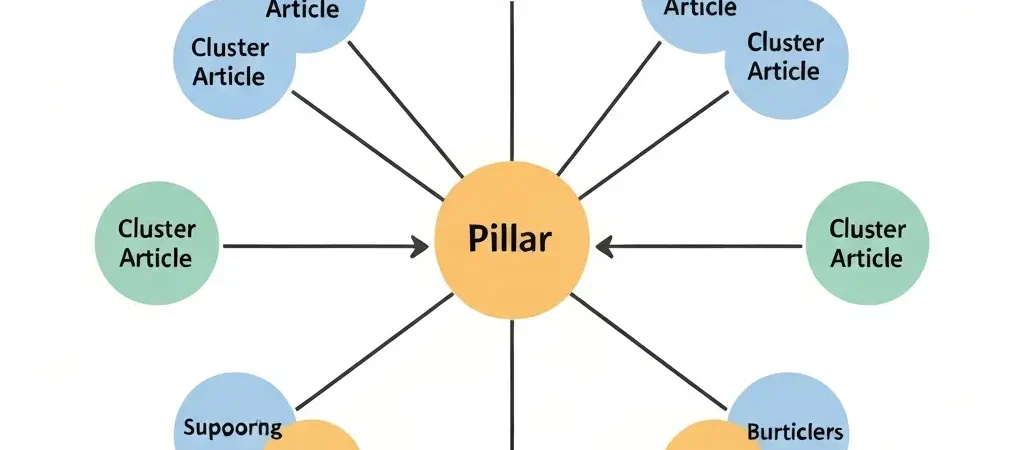
The pillar-cluster model is the dominant content architecture for building topical authority. It organizes content into three tiers:
- Pillar articles: Comprehensive overview articles covering the entire topic at a high level (example: “Complete Guide to AI Content Generation”). These target high-volume, broad keywords.
- Cluster articles: Medium-depth articles covering specific subtopics of the pillar (example: “How AI Content Generation Works”). These target medium-volume, specific keywords and link to the pillar.
- Supporting articles: Short, highly specific articles targeting long-tail queries (example: “What Is the Best AI Content Generator for E-commerce?”). These link to relevant cluster articles.
All articles in the cluster interlink, creating a semantic web of authority around the core topic. Google’s crawlers follow these links and build a topical map of the site, recognizing the subject-matter depth.
Academic knowledge organization follows similar principles — platforms like Tesify for thesis writing use hierarchical knowledge structures that mirror the pillar-cluster SEO architecture in how they organize research and citations.
What Role Does AI Play in Building Topical Authority?
AI content generation is the most practical mechanism for building topical authority at the scale required. A complete topical cluster — pillar, 10 cluster articles, 20 supporting articles — requires 31 articles minimum. At $300 per human-written article, that’s $9,300 before any keyword research, editing, or publishing costs.
AI content platforms reduce the cost to $150-$600 for the entire cluster and the time from months to weeks. Authenova automates the full process: keyword research, content hierarchy planning, scheduled article generation, internal link injection, and WordPress publishing. The platform is specifically designed to build topical authority through systematic cluster deployment.
The key advantage of AI for topical authority is not just cost — it is the ability to maintain publishing velocity consistently. Human teams exhaust capacity or shift priorities. AI-driven platforms execute the content calendar regardless of team size or competing demands.
Frequently Asked Questions
What is topical authority in SEO?
Topical authority in SEO is Google’s recognition that a website is a comprehensive, expert-level resource on a specific subject. It is built through publishing interlinked, high-quality content covering all aspects of a topic. Sites with high topical authority rank faster for new content, require fewer backlinks to rank, and capture a broader range of semantically related keywords.
Why does topical authority matter more than domain authority?
Topical authority can be built in months through content strategy alone, while domain authority requires years of link acquisition. For new sites and niche publishers, topical authority is the faster path to first-page rankings. A focused niche site with high topical authority consistently outranks general-purpose sites with high domain authority on specialized topics.
How long does it take to build topical authority?
Building topical authority typically takes 3-6 months with consistent content publishing. The timeline depends on content quality, publication frequency, and competition level. AI content automation platforms can deploy complete pillar-cluster content hierarchies in weeks rather than months, significantly accelerating the authority-building timeline compared to manual publishing.
How many articles do I need for topical authority?
A minimum viable topical cluster requires 20-30 articles: 1-2 pillar articles, 8-12 cluster articles, and 10-15 supporting articles. Highly competitive topics may require 50-100+ articles to achieve topical dominance. The key is systematic coverage of all subtopics within the cluster, not just raw article count.
What is the pillar-cluster content model?
The pillar-cluster model organizes content into three tiers: pillar articles (comprehensive topic overviews targeting broad keywords), cluster articles (specific subtopic coverage targeting medium-volume keywords), and supporting articles (highly specific long-tail content). All articles within a cluster interlink systematically, creating a topical map that signals subject-matter depth to Google’s crawlers.
Can AI content build topical authority?
Yes — AI content is the most practical tool for building topical authority at scale. AI platforms can deploy complete pillar-cluster hierarchies (30+ articles) in days at a fraction of the cost of human writing. The critical requirement is quality: each AI article must comprehensively address its specific subtopic. Google evaluates coverage depth, not production method.
Is topical authority a confirmed Google ranking factor?
Google has not explicitly confirmed “topical authority” as a named ranking factor, but its Quality Rater Guidelines, Helpful Content Update, and patent filings consistently describe semantic topical relevance as a core ranking signal. The guidelines reward sites demonstrating “comprehensive expertise” and “depth of knowledge” — which is topical authority operationally defined.
How does internal linking support topical authority?
Internal linking is the architectural signal of topical authority. When cluster articles link to the pillar, the pillar links to cluster articles, and supporting articles link to relevant cluster pieces, Google’s crawlers follow these connections and map the semantic relationships. This connected web of topically related content is how Google identifies topical clusters and assigns authority within subject areas.
What is the difference between topical authority and E-E-A-T?
E-E-A-T (Experience, Expertise, Authoritativeness, Trustworthiness) is Google’s quality framework for evaluating content credibility. Topical authority is one component of the Authoritativeness dimension — it reflects how comprehensively the site covers a subject. E-E-A-T also includes author credentials, factual accuracy, and site trustworthiness. Strong topical authority contributes to but does not fully satisfy E-E-A-T requirements.
Build Your Topical Authority with Automated Content
Authenova builds complete pillar-cluster content hierarchies automatically. Define your topic, set your keywords, and let the platform deploy your topical authority strategy — from content planning to WordPress publishing.