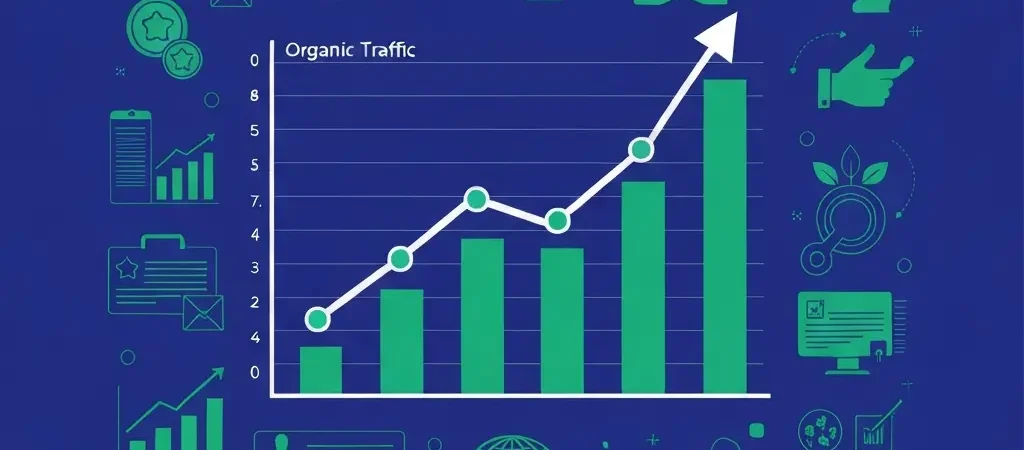
Organic Traffic Growth: Data-Driven Strategies for 2026
Organic traffic growth in 2026 is simultaneously more challenging and more achievable than at any previous point in SEO history. More challenging because AI Overviews appear in roughly 50% of US searches, zero-click searches have crossed the 60% threshold, and answer engines like ChatGPT and Perplexity are redirecting queries that previously sent users to websites. More achievable because the teams that adapt — building topical authority, optimizing for AI citation, and publishing at scale — are compounding rankings faster than competitors who are still operating with 2023-era strategies.
This guide covers the data-backed strategies that drive organic traffic growth in 2026, the metrics that matter in the new search landscape, and the tools that make these strategies executable without a 10-person SEO team.
The 2026 Organic Search Landscape
Understanding the current landscape is prerequisite to choosing the right growth strategies. Key data points that shape 2026 SEO:
- Organic search still drives 53% of all website traffic and delivers approximately 700% ROI as a long-term channel
- US organic search traffic is down approximately 2.5% year-over-year — a more modest decline than feared given AI Overview expansion
- Google AI Overviews appear in 13% of all queries, reducing CTR for featured results by up to 58%
- Zero-click searches have crossed 60% of all searches — meaning most searches end without a click to any website
- AI search engines (ChatGPT, Perplexity, Gemini) now influence 12–18% of total web referral traffic globally, up from 5–8% in late 2024
- Websites with original research saw an average 42.2% growth in backlinks; original charts earned 2.1× more referring domains than standard posts
The picture this data paints: organic traffic is not dead, but the strategies that drive it have shifted. Individual articles targeting isolated keywords are less competitive than content clusters that build topical authority. And visibility in AI answers has become a parallel channel to traditional organic rankings — one that requires deliberate optimization.
Strategy 1: Build Topical Authority Through Content Clusters
The single highest-leverage organic traffic growth strategy in 2026 is building topical authority through the pillar-cluster content model. Sites with 200+ articles organized into coherent topic clusters consistently outrank competitors with 50 high-quality individual articles targeting the same keywords.
Why topical authority outperforms individual article quality:
- Google’s Helpful Content System evaluates site-level topic expertise, not just individual page quality
- E-E-A-T signals are portfolio-level — many articles demonstrating expertise outweigh one exceptional article
- Internal link density within clusters distributes link equity efficiently, lifting all articles in the group
- AI Overviews and answer engines pull from sites with comprehensive topic coverage, not just the best individual page
Implementation: See our complete guide on SEO Pillar Pages and content clusters for the full architecture methodology. And our AI Content Strategy Framework for the production workflow.
Strategy 2: Optimize for AI Answer Engines
AI answer engine optimization (AEO) is the 2026 addendum to traditional SEO. As ChatGPT, Perplexity, and Google AI Overviews take an increasing share of queries, appearing in their answers delivers brand impressions that increasingly drive traffic — even when users do not click through to the website.
AEO optimization tactics:
- Direct answer structure: Open each article section with a 40–60 word direct answer to the implied question — this is the format AI extractors prefer
- FAQ schema markup: Every article’s FAQ section should use FAQPage schema — AI Overviews pull structured FAQ content preferentially
- Definitive statements: State conclusions clearly (“The best approach is X because Y”) rather than hedging (it depends, there are many factors). AI extractors prefer definitive, citable statements.
- Entity optimization: Mention relevant entities (brands, tools, locations, people) with context — AI systems build knowledge graphs from entity co-occurrences
- Original data: Original statistics and research earn AI citations at a higher rate than derivative content
Strategy 3: Publish at Strategic Velocity
Content velocity — publishing frequency — directly impacts topical authority accumulation rate. Sites that publish 15–30 articles per month in a defined topic cluster reach competitive ranking positions in 3–6 months. Sites publishing 2–4 articles per month on the same topics take 12–18 months to reach comparable authority.
Strategic velocity means matching publication rate to your site’s current authority level and cluster coverage gaps. For the full velocity framework, see our guide on Content Velocity SEO.
Key velocity principle: consistency outperforms bursts. Publishing 4 articles per week consistently beats publishing 20 articles in one week and then nothing for three weeks — Googlebot learns your update rhythm and crawls accordingly.
Strategy 4: Strengthen E-E-A-T Signals
Google’s E-E-A-T framework (Experience, Expertise, Authoritativeness, Trustworthiness) has become more influential as AI-generated content has proliferated. Sites that demonstrate genuine expertise and experience outrank those that produce only technically optimized content.
Practical E-E-A-T strengthening tactics:
- Author credentials: Named authors with expertise credentials on each article. An “About the Author” section linking to a detailed author page signals expertise.
- Original research and data: Publish original surveys, case studies, or industry reports. Sites with original data earn 2.1× more backlinks than those citing existing sources.
- Cite authoritative sources: External links to .gov, .edu, and recognized industry publications signal that your content is grounded in authoritative sources.
- Content freshness: Update articles when underlying data changes. Stale statistics on important pages are a trust signal failure.
- Technical accuracy: For technical topics, accuracy reviews by subject matter experts add a layer of quality assurance that distinguishes expert sites from AI-generated content farms.
Strategy 5: Data-Driven Link Building
Backlinks remain a top-3 ranking factor. The data-driven approach to link building prioritizes tactics by ROI:
- Digital PR (48.6% of SEOs rate as most effective): Create linkable assets — original research, industry surveys, data visualizations — and pitch them to journalists and publications as story sources.
- Resource page link building: Identify resource pages in your niche and pitch your pillar pages as additions. Pillar pages structured as comprehensive guides earn resource page links more reliably than individual blog posts.
- Broken link building: Find broken links on authoritative sites pointing to defunct resources in your niche. Offer your equivalent content as the replacement.
- HARO/journalist sourcing: Answer journalist queries in your area of expertise. Consistent participation generates high-authority citations that compound domain authority.
- Content partnerships: Guest content and data partnerships with non-competing sites in adjacent niches create mutual link relationships at scale.
Strategy 6: Technical SEO Foundation
Technical SEO is the foundation that all content strategies depend on. Without it, even excellent content underperforms. Critical technical factors for organic traffic growth in 2026:
- Core Web Vitals: LCP under 2.5 seconds, INP under 200ms, CLS under 0.1. Pages failing these thresholds see a ranking disadvantage for competitive queries.
- Crawl budget management: Sites over 500 pages should monitor crawl stats in Google Search Console. Crawl budget waste (parameter duplicates, thin pages, staging content accidentally indexed) reduces the frequency and quality of crawling for important content.
- Schema markup: Article, FAQPage, BreadcrumbList, and Organization schema implemented correctly. AI Overviews pull from structured data more reliably than unstructured prose.
- Mobile-first optimization: Google’s ranking index is mobile-first. Pages not optimized for mobile viewports carry a ranking penalty for all queries.
Measuring Organic Traffic Growth in 2026
Traditional organic traffic measurement (sessions from Google Analytics) is increasingly incomplete. A comprehensive 2026 measurement framework:
| Metric | Tool | What It Tells You |
|---|---|---|
| Organic sessions | GA4 | Traditional click traffic — still primary revenue driver |
| Total impressions | Google Search Console | Brand visibility — impressions growing even if clicks decline (zero-click) is positive |
| AI Overview citations | Ahrefs Brand Radar / Conductor | Emerging visibility channel — citations drive brand awareness even without clicks |
| Organic conversion rate | GA4 + CRM | Revenue signal — lower traffic from better-intent queries can deliver more revenue |
| Indexed page count growth | Search Console Pages report | Content velocity effectiveness — are new pages being indexed? |
Tools That Accelerate Organic Growth
The tools that provide the highest leverage for organic traffic growth in 2026:
- Authenova: End-to-end content automation — topical cluster planning, AI writing, WordPress publishing. Removes the content production bottleneck that caps most organic growth programs.
- Ahrefs: Keyword research, backlink analysis, AI Overview tracking via Brand Radar.
- Google Search Console: Impressions, clicks, position data, crawl stats — free and authoritative.
- GA4: Session, conversion, and revenue attribution for organic traffic.
- Semrush: Competitive gap analysis, technical auditing, position tracking.
The same growth principles apply across industries. Tesify FR and Tesify ES use topical authority clusters to dominate academic writing queries in French and Spanish markets. iQuitNow builds organic authority in the behavioral health space with the same content velocity approach. CampaignOS applies it to campaign marketing. The growth strategies are niche-agnostic.
Frequently Asked Questions
Is organic traffic still worth investing in with AI Overviews taking over?
Yes — organic search still drives 53% of all website traffic and delivers approximately 700% ROI as a long-term channel. While AI Overviews reduce click-through rates for some queries, they have not replaced organic traffic — they have changed its composition. Informational queries see more zero-click behavior, while commercial and transactional queries still deliver high-value click traffic. The strategy shift is to optimize for both: earn the AI Overview citation (impressions and brand awareness) while also ranking organically for the click traffic that follows.
How long does it take to grow organic traffic significantly?
Meaningful organic traffic growth (50%+ increase) typically requires 3–6 months for long-tail keyword rankings and 6–12 months for competitive head terms. Sites publishing at high content velocity (15–30 articles/month) see traction faster — initial impressions appear within 2–4 weeks of publication, with click traffic materializing at 2–3 months. The compound nature of topical authority means months 6–12 typically deliver 3–5x the traffic of months 1–3, even at the same publishing cadence.
What is the fastest way to grow organic traffic in 2026?
The fastest path to organic traffic growth is: 1) identify 2–3 topic clusters with a competitive gap (competitors ranking but with low-quality coverage), 2) publish a pillar page and 8–10 cluster articles targeting that gap within 4–6 weeks, 3) build internal links between all articles, 4) submit an XML sitemap. This cluster-launch approach produces ranking signals within 30–60 days for long-tail targets and positions the pillar for competitive rankings within 3–4 months.
How do I grow organic traffic without backlinks?
Growing organic traffic without backlinks is possible for long-tail and low-competition keywords — these can be won on content quality and topical authority alone. For competitive head terms (above difficulty 30 in Ahrefs), backlinks become increasingly necessary to outrank established sites. The practical answer: focus initial SEO on long-tail supporting articles (which rank without backlinks), use the traffic and authority they generate to support cluster and pillar pages, and invest in link building for your highest-priority pillar pages once the cluster foundation is built.
Put Your Organic Traffic Growth on Autopilot
Authenova plans your topic clusters, generates SEO content at scale, and publishes to WordPress automatically — delivering the content velocity that compounds organic traffic month over month.