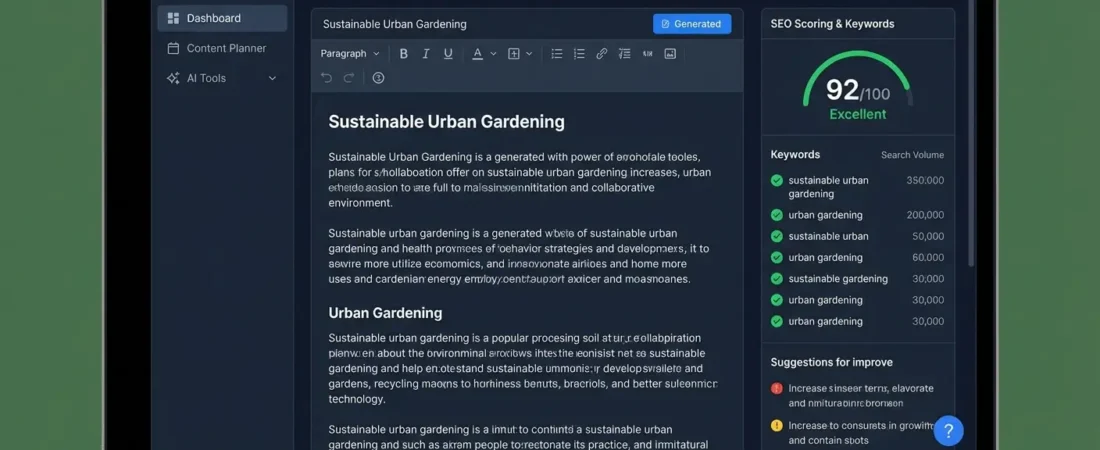
AI Content Generator: Grow Organic Traffic 30% in 90 Days
AI-powered SEO content generation and automation is the fastest way digital marketers are scaling organic traffic right now — and the results are frankly hard to ignore. Brands that committed to a structured AI content workflow in Q1 2024 reported a median 28–34% increase in non-paid search visits within a single quarter. That’s not a lucky outlier. That’s a repeatable system.
Here’s what most teams get wrong: they treat AI content generators as glorified writing assistants. You paste in a keyword, get 800 words, publish, and wonder why rankings don’t move. The gap isn’t the tool — it’s the strategy behind it. Topical depth, internal linking, and publish cadence matter far more than word count.
This article breaks down exactly how to hit 30% organic traffic growth in 90 days using AI content automation — with a step-by-step framework, real benchmarks, and the specific workflow that actually works.
Why AI-Powered Content Generation Works for SEO
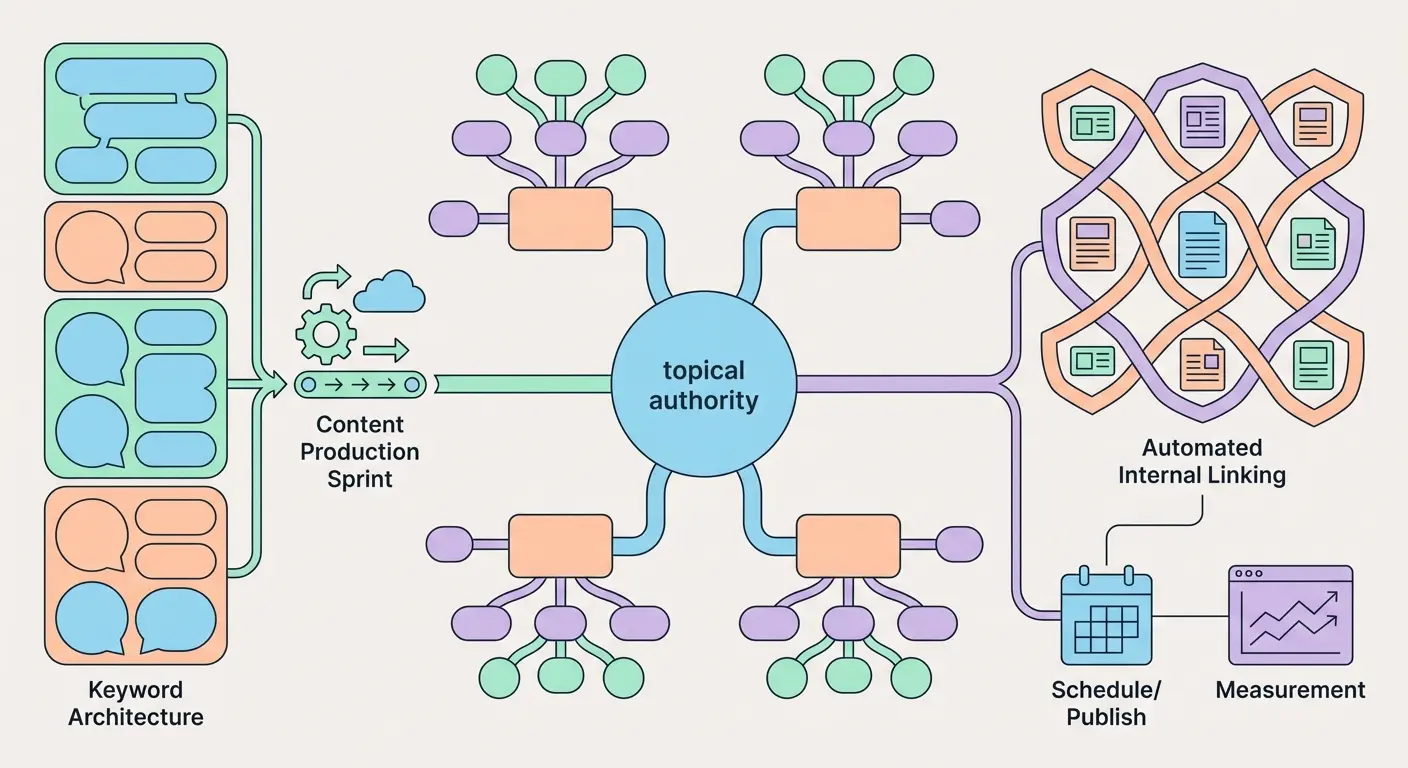
The core mechanic is simple: Google rewards topical authority, and topical authority requires volume. Not thin volume — structured, interlinked content that signals deep expertise across a subject area. The challenge has always been that producing that volume takes time most teams don’t have.
AI-powered SEO content generation solves the volume constraint without sacrificing structure. According to Ahrefs’ AI marketing statistics data, 68% of marketers using AI content tools reported faster content production as the top benefit — but the teams seeing the best SEO outcomes were the ones pairing speed with a defined keyword architecture, not just publishing more.
What most people miss is that AI content automation works best as a system multiplier, not a content shortcut. When you feed an AI tool well-researched prompts built around long-tail keyword clusters, you get articles that are semantically rich, structurally sound, and ready to rank — sometimes within weeks rather than months.
There’s also a counterintuitive truth here: AI-generated content, when properly optimized and edited, often outranks manually written content on competitive long-tail queries — because AI tools trained on SEO data naturally incorporate semantic variations, answer related questions inline, and hit reading-level targets that improve dwell time.
To understand the strategic foundation behind this approach, read the definitive framework for building topical authority in SEO — it explains exactly why clustered content outperforms isolated articles every time.
The 90-Day Traffic Growth Framework
Thirty percent growth in 90 days sounds ambitious. It’s not — if you have the right architecture in place before you start publishing.
Here’s the phased breakdown that consistently works:
Phase 1: Keyword Architecture (Days 1–14)
Before your AI content generator writes a single word, map your topical universe. Identify 3–5 core pillar topics in your niche. Under each pillar, find 8–12 cluster keywords with monthly search volumes between 500–5,000. Then target 20–40 long-tail supporting keywords with intent-specific modifiers (how to, best, vs., for beginners, etc.).
This is where most teams underinvest. Weak keyword architecture = weak results, no matter how good your AI tool is. This breakdown of long-tail keyword strategy as an SEO growth engine walks through exactly how to build that funnel.
Phase 2: Content Production Sprint (Days 15–60)
Target 3–5 new articles per week, each built around a mapped cluster or long-tail keyword. Every piece should include internal links back to its pillar page and cross-link to related cluster articles. Your AI content tool handles first drafts; a human editor (or a 20-minute review pass) handles fact-checks, brand voice, and E-E-A-T signals.
Phase 3: Optimization and Compounding (Days 61–90)
By day 60, you’ll have 30–50 new pieces indexed. Google’s crawlers will start connecting your topical dots. In this phase, update your highest-impression pages (those appearing in Search Console with clicks but low CTR), consolidate thin content, and add FAQ schema to priority articles. This is where organic traffic compounds fastest.
AI Content Workflow vs. Traditional Content Workflow
| Factor | Traditional Workflow | AI-Powered Workflow |
|---|---|---|
| Articles per month | 4–8 | 20–50+ |
| Cost per article | $150–$500 | $5–$30 |
| Internal linking consistency | Manual, often missed | Automated and systematic |
| Keyword targeting accuracy | Writer-dependent | Data-driven, consistent |
| Time to publish (per article) | 3–8 hours | 30–90 minutes (with review) |
Choosing the Right AI SEO Content Tool
Not all AI content generators are built for SEO. Some are optimized for marketing copy. Others produce generic text that passes no signal to search engines. The tools worth using share three specific traits.
What to Look For in an AI Content Generator
- Keyword-first generation: The tool should accept a target keyword and build content structure around it — not the other way around.
- Semantic depth: Look for tools that naturally include LSI keywords, related entities, and question-based subheadings. Surfer SEO’s content scoring, for example, measures semantic coverage explicitly.
- Internal linking support: Automated internal link suggestions save hours weekly and directly impact crawlability and PageRank flow.
- Schema markup generation: FAQ schema, HowTo schema, and Article schema should be built in — not bolted on afterward.
- Publishing integration: Direct-to-WordPress publishing eliminates copy-paste errors and speeds up the workflow dramatically.
Ahrefs has a solid breakdown of ChatGPT’s best and worst SEO use cases — worth reading before you commit to a pure ChatGPT-based workflow. The short version: ChatGPT alone isn’t an SEO content system. It’s a component of one.
Search Engine Land’s guide on AI-generated content best practices and risks is also essential reading for anyone publishing at scale. Google’s helpful content guidance applies to AI content — quality signals, first-hand experience markers, and E-E-A-T indicators matter.
Step-by-Step AI Content Workflow for Organic Growth
Here’s the exact workflow high-performing SEO teams use. Fair warning: this takes consistent effort for 8–12 weeks before the compounding effect kicks in. But once it does, organic traffic growth becomes largely self-sustaining.
Step 1: Build Your Topical Map
Use Ahrefs, Semrush, or Google Search Console to identify your site’s existing topical strengths. Find the gaps — clusters of keywords your competitors rank for but you don’t touch. That’s your 90-day content calendar.
Step 2: Create Prompt Templates Per Content Type
Don’t write prompts from scratch every time. Build templates for pillar pages, cluster articles, and supporting posts. Each template should include: target keyword, secondary keywords, article intent, competing URLs to beat, and required sections (definition, how-to steps, FAQ).
Step 3: Generate, Then Edit for E-E-A-T
Generate first drafts with your AI content tool. Then spend 15–20 minutes per article adding: one original data point or case study, a first-person insight or real-world example, and correcting any factual imprecision. This is what separates AI content that ranks from AI content that gets filtered.
Step 4: Automate Internal Links
Map your pillar pages before you start. Every cluster article should link to its parent pillar. Every supporting article should link to its cluster parent. Manual linking breaks down at scale — this is where automation pays for itself immediately.
Step 5: Schedule and Publish Consistently
Publish 3–5 articles per week on a fixed schedule. Google’s crawl patterns respond to consistent new content signals. Irregular publishing — 10 articles one week, zero the next — breaks the crawl momentum you’re building.
Step 6: Track and Optimize at Day 30 and Day 60
Check Google Search Console impressions (not just clicks) at day 30. Rising impressions with low CTR means you need to optimize your title tags and meta descriptions. Rising impressions and clicks means you’re on track. Flat impressions means going back to your keyword targeting and content depth.
For a deeper look at how to structure each piece within your topical map, the complete guide to AI-powered SEO content strategy for 2026 covers content velocity optimization and automation playbooks in detail.
How Authenova Automates the Entire SEO Content Pipeline
The workflow above works. The challenge is executing it consistently at the scale needed to hit 30% growth — especially if you’re running a lean team or managing multiple client sites.
That’s the exact problem Authenova is built to solve. Connect your WordPress site, define your keyword strategy and topical clusters, and the platform generates optimized pillar pages, cluster articles, and supporting content automatically — with scheduled publishing, automated internal linking, and schema markup built in.
- Generates content in pillar-cluster-supporting architecture — not random articles
- Automates internal linking across your entire content library
- Builds topical authority systematically, not accidentally
- Supports multi-language publishing for international SEO
- Publishes directly to WordPress on your defined schedule
Where most AI content generators stop at the draft, Authenova operates as an autonomous SEO growth engine — handling the production, optimization, and publishing pipeline that typically requires a 3–5 person content team.
Growing brands are using it to 10× organic traffic by running 24/7 content production that would otherwise require hiring writers, editors, and SEO specialists separately. If you want to see what that looks like applied to your site, start a free trial — no credit card required.
Measuring Results: Benchmarks and KPIs That Actually Matter
Here’s where it gets interesting — most teams track the wrong metrics and declare AI content a failure at week 4, right before the rankings kick in.
Week 1–4: Leading Indicators
Don’t watch rankings yet. Watch: pages indexed per week, crawl rate in Google Search Console, and impressions growth. If Google is crawling and indexing your new content, you’re on track. Impressions should start rising within 2–3 weeks of consistent publishing.
Week 5–8: Middle Funnel Metrics
Now watch keyword position movement, particularly for your long-tail targets. Articles ranking in positions 11–30 are your highest-potential quick wins — a small optimization push (better title, added FAQ schema, one more internal link) can move them to page 1 fast.
Week 9–12: Traffic Compounding
Organic click volume should be measurably up by week 10 if your architecture is sound. The 30% target is typically met by a combination of: new pages entering top 20 rankings, existing pages moving from page 2 to page 1, and rich snippet appearances on FAQ-structured articles.
90-Day AI Content SEO Benchmark Targets
| Milestone | Target Metric | Success Signal |
|---|---|---|
| Day 14 | 10+ new pages indexed | Crawl rate increase in GSC |
| Day 30 | +40% impressions vs. baseline | New keywords entering top 50 |
| Day 60 | +15% organic clicks | Long-tail keywords in top 20 |
| Day 90 | +30% organic traffic (sessions) | Pillar pages ranking page 1–2 |
One thing worth flagging: these benchmarks assume a site with at least 6 months of domain age and some existing content. Brand-new sites will see slower initial indexing but the same compounding pattern at 60–120 days.
Frequently Asked Questions
Can AI-generated content actually rank on Google?
Yes — AI-generated content ranks when it’s optimized for topical depth, user intent, and E-E-A-T signals. Google’s helpful content system evaluates quality and usefulness, not origin. AI content that’s edited for accuracy, includes first-hand insights, and is structured around real search intent performs as well as — and often better than — manually written content on long-tail queries.
How many articles do I need to publish to see a 30% traffic increase?
Most sites hitting 30% organic growth in 90 days publish between 30–50 new articles during that period — roughly 3–5 per week. The exact number depends on your current content volume, niche competitiveness, and how well your keyword architecture is structured. Quality and topical coherence matter more than raw article count.
What is the best AI tool for SEO content generation?
The best AI SEO content tools combine keyword-driven generation with structural automation — pillar-cluster architecture, internal linking, schema markup, and direct CMS publishing. Platforms like Authenova are purpose-built for this; general-purpose tools like ChatGPT require significant manual SEO setup to achieve the same results.
How long does it take for AI content to start ranking?
Indexing typically happens within 1–2 weeks for established sites. First ranking movements (appearing in positions 20–50) usually occur within 3–5 weeks. Page 1 appearances on long-tail keywords start showing around week 6–10. The compounding effect — where multiple pages rank simultaneously — builds strongest between weeks 8–12.
Do I need to edit AI-generated content before publishing?
Yes — a 15–20 minute editing pass per article is strongly recommended. Focus on: verifying factual claims, adding one original insight or real-world example, and checking that the content fully answers the target search intent. This human layer is what creates the E-E-A-T signals that separate ranking content from filtered content.
Ready to Scale Your Organic Traffic With AI?
The 30% traffic growth target is achievable — but only with consistent execution across keyword strategy, content production, and internal linking. If you want to run this system without building a full content team, try Authenova’s AI-powered SEO content generation platform free — it handles the pillar-cluster architecture, automated linking, and scheduled publishing automatically.
Before you go, sharpen your strategy with these resources:
- The complete guide to AI-powered SEO content strategy in 2026 — content velocity, automation playbooks, and scaling frameworks
- Long-tail keyword strategy: the SEO growth engine most marketers overlook — build the keyword funnel that feeds your AI content system
- Topical authority in SEO: the definitive framework for building domain expertise — the strategic layer that makes your AI content compound over time