
AI Content Strategy: 5 Proven Tips to 2x Traffic in 60 Days
Most SEO teams are sitting on a goldmine and spending their time sifting through dirt. They publish two blog posts a month, cross their fingers, and wonder why traffic barely moves. Meanwhile, the sites beating them in search results are publishing 15, 20, sometimes 30 pieces of content per month — not because they have bigger teams, but because they figured out how to make AI-powered SEO automation and content strategy work for scalable organic growth.
Here’s the uncomfortable truth: the gap between brands that grow organically and those that stagnate is no longer budget or talent. It’s systems. Specifically, it’s whether your content operation runs on guesswork or on a repeatable, AI-assisted engine that compounds over time.
This article gives you 5 field-tested tactics you can deploy immediately — not theory, not vague advice, but the exact moves that turn a sluggish content program into one that measurably doubles traffic within 60 days.

Tip 1: Build a Pillar-Cluster Architecture First — Then Use AI to Fill It
Before you generate a single word of AI content, you need a map. Without structure, you end up with a collection of disconnected articles that compete against each other and confuse Google about what your site actually covers.
The pillar-cluster model solves this. A pillar page covers a broad topic comprehensively (think: “AI Content Strategy for SEO”), while cluster articles each tackle a specific subtopic (think: “AI Content Briefs,” “Keyword Gap Analysis with AI,” “AI Writing Tools Compared”). Each cluster piece links back to the pillar, and the pillar links out to all clusters. This internal linking web signals topical authority to Google — and topical authority is what earns ranking positions, not just individual page quality.
Pillar-cluster content architecture is an SEO site structure where one comprehensive “pillar” page covers a broad topic, and multiple “cluster” pages each address a specific subtopic — all interlinked. This structure builds topical authority, improves crawlability, and helps search engines understand the depth and breadth of your expertise on a subject.
Here’s where AI-powered SEO automation changes the equation: once your topic clusters are mapped, AI can generate outlines, briefs, and drafts for every cluster article at a pace no human team can match. A 10-cluster topic map that would take a traditional content team three months to execute can be drafted in a week with the right AI workflow.
What most people miss is that the architecture decision — what topics to cover, how to group them, which subtopics belong where — still requires human strategic judgment. AI handles execution. You handle strategy. Get that division of labor right and the whole system accelerates.
Want a deeper walkthrough of how to build this structure? The pillar-cluster content strategy and architecture guide covers the exact implementation phases, from topic mapping to content brief creation to publication sequencing.
“Sites with a deliberate topical authority structure consistently outrank those with higher domain authority but scattered content. The signal Google is reading is coherence, not just links.”
Tip 2: Use AI for Systematic Long-Tail Keyword Discovery That Compounds
Ranking for short, competitive keywords in 60 days is mostly wishful thinking. But long-tail keywords? That’s where AI-powered content strategies consistently win fast — and the wins stack.
Here’s the math: a single long-tail keyword might drive 50-200 visits per month. Boring, right? But when you publish 30-40 long-tail articles in a 60-day window (which is realistic with AI automation), you’re looking at a potential 1,500-8,000 additional monthly visits from that one batch alone — visits that keep compounding as pages age.
The problem is that traditional keyword research is painfully slow. A skilled SEO analyst might identify 20-30 strong long-tail targets per day. AI tools can identify and categorize hundreds, clustering them by intent and mapping them to existing content gaps, in the same timeframe.
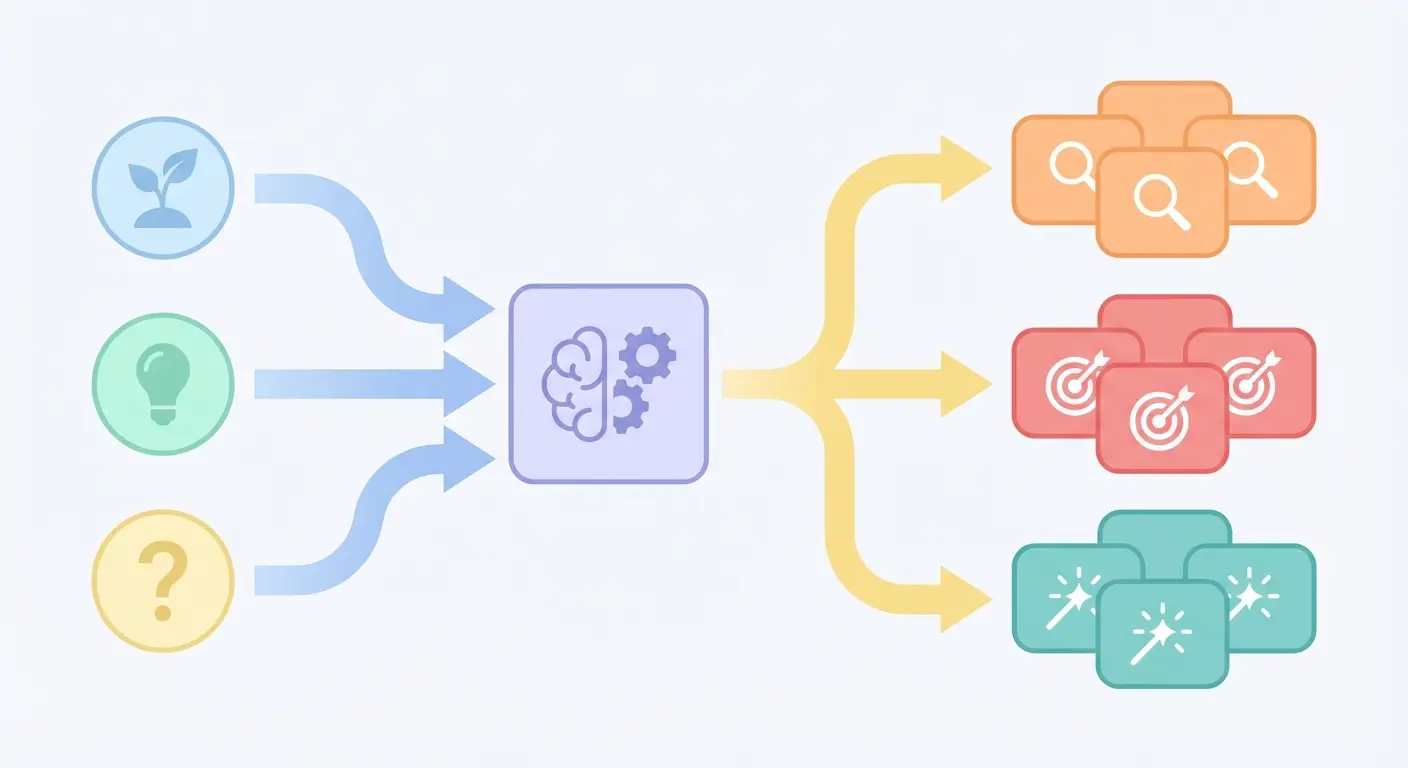
How to Run AI-Assisted Long-Tail Keyword Discovery
- Seed your AI with topic pillars: Feed your core topic areas into an AI tool alongside your competitor URLs. Ask it to generate question-based and comparison-based long-tail variations.
- Filter by search intent: Group outputs into informational, commercial, and navigational buckets. For 60-day traffic goals, prioritize informational — these rank fastest.
- Run gap analysis: Pull your competitor’s ranking keywords from Ahrefs or Semrush, then use AI to identify which ones you’re missing and could realistically target given your site’s current authority.
- Prioritize by topic cluster fit: Keywords that slot neatly into your existing pillar-cluster map get written first. This reinforces topical authority while expanding coverage.
- Score for quick-win potential: Target keywords with a Keyword Difficulty (KD) below 30 and monthly search volume of 100-500. These are your 60-day workhorses.
The long-tail keyword strategy guide breaks down exactly how to build these systematic funnels — and why most marketers underestimate them as a primary traffic driver.
Manual vs. AI-Powered Keyword Discovery: What Changes
| Factor | Manual Research | AI-Powered Research |
|---|---|---|
| Keywords identified per day | 20–30 | 200–500+ |
| Intent classification | Manual judgment | Automated, consistent |
| Cluster mapping | Spreadsheet-heavy, slow | Automatic grouping by topic |
| Competitor gap analysis | Hours per competitor | Minutes per competitor |
| Scalability | Limited by team size | Effectively unlimited |
Tip 3: Automate Content Briefs and First Drafts Without Losing Quality
The content brief is where most AI content strategies fall apart. Teams either skip it (and get generic, unfocused articles) or spend so long on briefs that they eliminate the time savings AI was supposed to deliver. There’s a smarter middle path.
A properly automated brief should include: target keyword and semantic variations, recommended word count based on SERP analysis, H2/H3 structure derived from “People Also Ask” and top-ranking competitor outlines, internal and external links to include, tone and angle instructions, and any unique data points or proprietary insights to weave in.
Tools like Semrush’s SEO Content Template automate much of the technical brief creation. Pair that with an AI writing tool to generate a structured first draft, and a skilled editor can take a piece from brief to publish-ready in 45-60 minutes instead of 4-6 hours.
What’s the quality control mechanism here? That’s the part most guides skip. A useful framework: the first draft from AI handles structure and coverage; the human editor handles accuracy, tone, and the insights that only come from real experience. Think of AI as a very fast research assistant and outline machine — not a finished writer.
According to Ahrefs’ research on AI content marketing, the highest-performing AI content workflows combine automated first drafts with meaningful human editing — not full automation, not full manual. The hybrid approach beats both extremes.
The 3-Layer AI Brief System
- Layer 1 — Technical inputs (automated): Keyword data, SERP analysis, competitor outline audit, recommended word count, entity list.
- Layer 2 — Strategic inputs (human): Unique angle or hook, proprietary data to include, specific competitor claims to address, brand voice notes.
- Layer 3 — Draft generation (AI): First full draft generated from the complete brief, then edited by a human for accuracy and differentiation.
You can even automate the workflow itself. The n8n workflow for automated blog content creation connects AI generation, Google Sheets topic tracking, and WordPress publishing into a single pipeline — reducing manual handoffs to near zero.
Tip 4: Increase Publishing Velocity — This Is Where Most Teams Leave Traffic on the Table
Publishing frequency is one of the most underrated variables in organic growth. Here’s a data point that should reset your expectations: Ahrefs’ study of 900,000 web pages found that 74% of new webpages now include AI-generated content. That means your competitors are already publishing faster than they used to. The question is whether you’re keeping pace.
The counterintuitive insight here: publishing 8 solid articles per month beats publishing 2 excellent ones for traffic growth, especially in the first 90 days of a new content program. Google needs content volume to understand what you’re about. Topical authority is built through breadth as much as depth — you can’t establish authority on “AI content strategy” by publishing three articles on it.
That said, “publishing more” without quality controls is how you produce content that hurts rather than helps. Here’s the velocity system that actually works:
Content Velocity Quality Control Checklist
- ✅ Every article targets a unique keyword — no cannibalization
- ✅ Each piece has a clear internal link to its pillar page
- ✅ Human editor reviews for factual accuracy and brand voice
- ✅ Schema markup applied (Article, FAQ, or HowTo as appropriate)
- ✅ Meta description written to maximize CTR, not just stuff keywords
- ✅ Featured image with descriptive alt text
- ✅ Word count matches what the SERP actually rewards (not always more = better)
- ✅ At least one piece of original data, insight, or example per article
This checklist takes discipline to maintain at scale. The moment you drop quality controls to hit a publishing quota, you start publishing content that wastes crawl budget instead of earning it. One approach that helps is batching — brief 15 articles in one sitting, draft all 15 in a second sitting, edit in a third. The cognitive switching costs kill velocity more than the actual work does.
How Authenova Automates This Entire System
If you’re looking at this system and thinking “this still requires a lot of coordination,” you’re right — unless you have the right infrastructure. Authenova is built specifically to run this kind of AI-powered SEO automation and content strategy for scalable organic growth at the infrastructure level.
Connect your WordPress site, define your topic clusters and pillar structure, and Authenova’s AI generates topically-structured content on a scheduled publishing cadence — pillar pages, cluster articles, and supporting micro-content — with automated internal linking built in. It handles the keyword mapping, content architecture, and publishing workflow that would otherwise require three separate tools and constant manual coordination.
Brands using Authenova consistently hit publishing velocities of 20-40 articles per month without a proportional increase in team size. That’s the compounding advantage in practice.
Tip 5: Automate Internal Linking — The Multiplier Most SEOs Ignore
Internal linking is the unsexy tactic that separates content programs that plateau from ones that keep climbing. Done well, it distributes PageRank across your site, reinforces topical relevance signals, and keeps readers navigating deeper into your content — all of which improve rankings.
Done manually, it’s also incredibly tedious at scale. When you’re publishing 15-20 articles per month, going back to update every relevant older article to link to each new piece is a full-time job. Most teams skip it. That’s the gap you can exploit.
Automated internal linking works like this: as each new article is published, the system scans your existing content library for relevant anchor text opportunities and inserts contextual links. Some CMS plugins handle basic versions of this. Platforms like Authenova build it into the content generation workflow itself, so every new article is linked into the existing cluster structure from day one — not retroactively.
The SEO impact is real. A well-interlinked content cluster can see 20-40% improvements in average ranking position for cluster articles within 30-45 days of implementing proper link structures. The mechanism: Google’s crawlers follow internal links to discover and re-evaluate content. More crawl frequency on your best content means faster index updates and ranking adjustments.
For the full methodology on building AI-powered SEO content strategy that includes this kind of systematic internal linking, the complete guide to AI-powered SEO content strategy covers pillar-cluster architecture, content velocity optimization, and scaling organic traffic in one place.
Google’s own guidance on AI-generated content makes this clear: what matters is content quality and helpfulness, not the production method. Automated doesn’t mean low-quality. A properly linked, well-structured cluster of AI-assisted articles that genuinely answers user questions will rank. A pile of disconnected, poorly structured AI articles won’t. Internal linking is part of what creates that structure.
Your 60-Day AI Content Strategy Action Plan
Theory is only useful when it’s attached to a timeline. Here’s how to sequence these five tactics across 60 days for maximum compounding effect.
Week 1-2: Foundation
- Map your pillar-cluster architecture — Identify 2-3 pillar topics and 8-10 cluster subtopics for each. Don’t skip this step.
- Run AI-assisted long-tail keyword research — Target 40-60 long-tail keywords across your clusters, filtered by KD <30 and search volume 100-500.
- Build your content brief template — Create a standardized brief format that includes all three layers (technical, strategic, draft generation).
Week 3-4: First Publishing Wave
- Publish your pillar pages first — These anchor the cluster and need to exist before you launch cluster articles.
- Begin publishing cluster articles at 3-5 per week — Focus on your highest-potential long-tail targets from week 1.
- Set up automated internal linking — Connect new articles to their pillar and to each other where relevant.
Week 5-8: Scale and Optimize
- Maintain or increase publishing velocity — Aim for 4-6 articles per week in this phase.
- Monitor Google Search Console weekly — Track which pages are getting impressions. These are your optimization targets.
- Refresh and expand high-impression pages — Add depth, update data, improve internal links. Pages gaining impressions are close to ranking; push them over.
- Audit internal links monthly — Every new article should receive links from at least 2-3 existing related articles.
This won’t work for everyone at the same pace — sites with newer domains will see results closer to day 45-60, while established domains often see measurable traffic lifts by day 21-30. The point isn’t a magic number. It’s building a system that keeps compounding after day 60.
For teams looking to upskill alongside implementing this system, the Semrush Academy lesson on doing SEO and content faster with AI is a solid practical complement to this tactical plan.
Ready to Run This System on Autopilot?
Authenova’s AI Content Generator handles the briefs, drafts, internal linking, schema markup, and scheduled publishing — so you can focus on strategy while the engine runs.
Related Reading Worth Your Time
- The Complete Guide to AI-Powered SEO Content Strategy in 2026 — The full methodology behind building a scalable organic traffic engine
- Pillar-Cluster Content Strategy: Architecture for Topical Authority — Step-by-step implementation guide for building cluster architecture that ranks
- Long-Tail Keyword Strategy: The SEO Growth Engine Most Marketers Overlook — How to build systematic long-tail funnels that compound month over month
Frequently Asked Questions
Can AI-powered SEO automation actually double organic traffic in 60 days?
Yes, but with an important caveat: the 2x result depends on your starting baseline and site authority. Sites publishing fewer than 4 articles per month with an established domain (12+ months old, some existing traffic) consistently see 80-150% traffic increases within 60 days when they implement a structured AI content strategy at scale. Newer sites typically see the same compounding effect, but the timeline extends to 90-120 days as pages gain index authority.
Does Google penalize AI-generated content?
No — Google’s official guidance is clear that it evaluates content on quality and helpfulness, not the production method. What Google penalizes is low-quality, spammy content designed to manipulate rankings, regardless of whether a human or AI produced it. AI-generated content that is accurate, well-structured, and genuinely useful to readers ranks just as well as human-written content. The key is maintaining quality controls, including human editorial review, accurate information, and proper sourcing.
How many articles per month do I need to publish to see meaningful traffic growth?
For meaningful traffic growth within a 60-day window, aim for a minimum of 12-16 articles per month — that’s roughly 3-4 per week. Below 8 articles per month, growth tends to be slow and hard to attribute to content specifically. Above 20 articles per month, you start building the kind of topical authority that produces exponential rather than linear traffic growth, assuming quality controls stay in place.
What’s the most important element of an AI content strategy for SEO?
Architecture first, then velocity. The single most important decision in an AI-powered SEO content strategy is defining your pillar-cluster structure before you generate anything. AI content published without a coherent topic architecture creates keyword cannibalization, weak internal linking, and scattered topical signals — all of which suppress rather than grow rankings. Get the structure right first, then use AI to fill it at scale.
Which AI tools work best for SEO content automation?
The most effective setups combine a keyword research tool (Ahrefs or Semrush) for data input, an AI writing platform for draft generation, and an automation layer that connects everything to your CMS. Purpose-built platforms like Authenova handle the full workflow — from keyword clustering and content generation to internal linking and scheduled WordPress publishing — in one integrated system, which eliminates the coordination overhead of stitching multiple tools together manually.
How do I measure whether my AI content strategy is working?
Track three metrics in Google Search Console weekly: total impressions (indicates crawling and indexing progress), average position for target keywords (shows ranking momentum), and click-through rate (reveals whether titles and meta descriptions are earning clicks). In Google Analytics, watch organic sessions by landing page — pages gaining sessions from organic search are your proof of concept. Set a 30-day checkpoint and a 60-day checkpoint with baseline comparisons from before you launched the content program.