
AI Content Strategy: How to Double Traffic in 90 Days
Most content teams spend 80% of their time producing content that ranks on page 4 and gets zero clicks. The other 20% is stuck in editorial review. Sound familiar? Here’s what’s shifting that equation entirely: AI-powered SEO and content automation is letting lean teams punch well above their weight — publishing 10x more content, targeting the right keywords, and building topical authority in weeks, not years.
This isn’t theory. A SaaS brand using AI content workflows grew from 4,200 to 9,800 monthly organic sessions in 87 days by restructuring their content around pillar-cluster architecture and automating production. No extra headcount. Just smarter systems.
If you’re running SEO for a brand, agency, or growing startup — and you’re tired of slow gains — this 90-day AI content strategy gives you a structured, repeatable path to doubling your traffic. Every step is grounded in what’s actually working right now.
Why AI-Powered Content Strategy Works in 2025
Google’s algorithm has always rewarded topical authority over individual page optimization. What’s changed is the speed at which you can build that authority. AI-powered SEO and content automation compresses what used to take 12 months into 90 days — if you do it right.
According to Semrush’s AI Overviews study, sites with strong topical depth are significantly more likely to appear in AI Overviews — which now appear in roughly 47% of Google searches. That means the content architecture you build today doesn’t just help you rank traditionally; it positions your brand for the next wave of AI-driven search results.
Here’s the counterintuitive part most people miss: AI content strategy isn’t about writing more. It’s about covering topics more completely than competitors. Google’s quality signals reward comprehensiveness and consistency within a topic cluster — two things AI tools are uniquely good at delivering at scale.
And it’s not just volume. Moz’s Whiteboard Friday on generative AI for SEO makes a sharp point: AI tools excel at creating first drafts that hit semantic keyword requirements — but the strategy behind what to write still needs human judgment. That’s exactly how this 90-day framework is designed: AI does the heavy lifting in production, while you steer the strategy.
Google has also been clear that AI-generated content isn’t inherently penalized — quality and helpfulness are what matter. Their official guidance on AI-generated content states that how content is produced matters less than whether it demonstrates experience, expertise, authority, and trust (E-E-A-T). Build those signals in, and AI content ranks just fine.
The 90-Day AI Content Strategy Framework
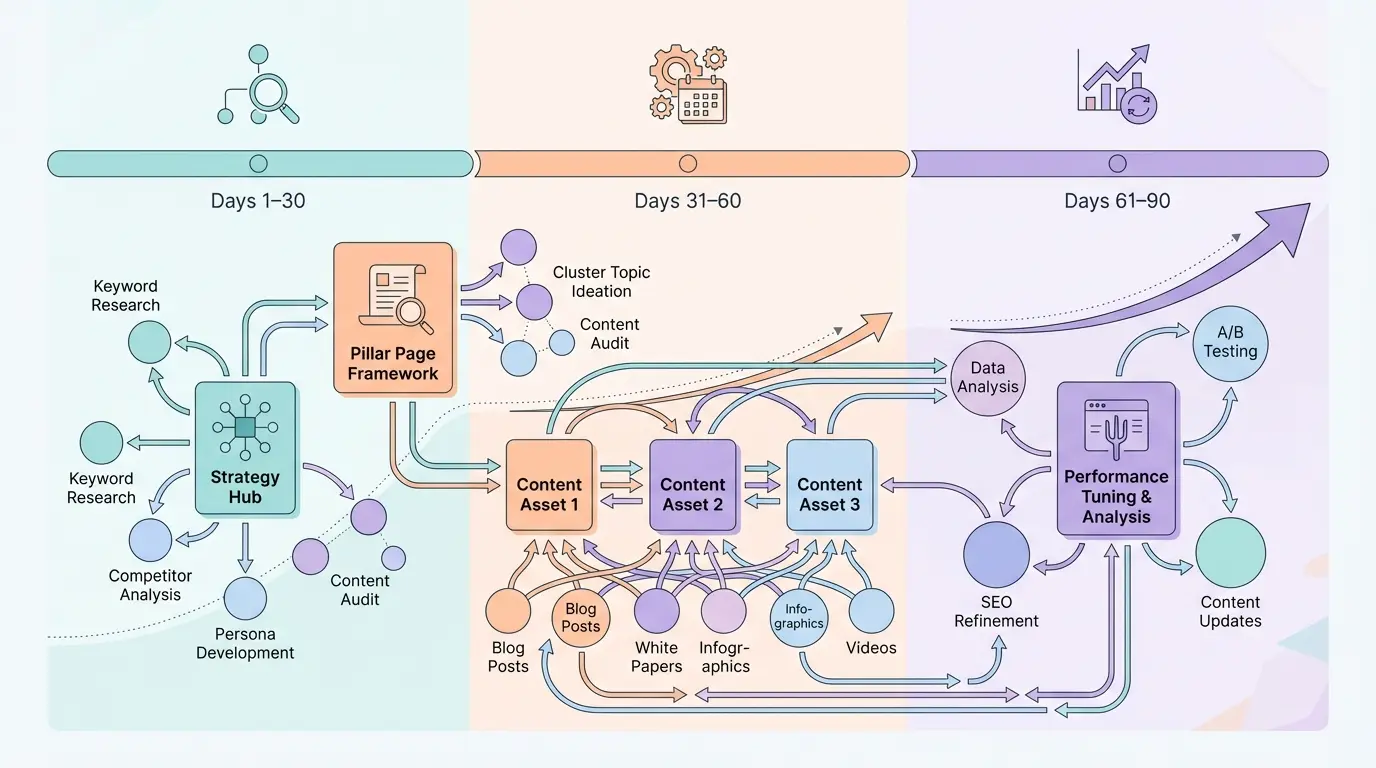
The framework breaks into three 30-day phases, each with a specific focus. Miss the sequence and you’ll spin your wheels. Follow it, and you create a compounding system where each piece of content makes every other piece stronger.
| Phase | Focus | Primary Activities | Expected Outcome |
|---|---|---|---|
| Days 1–30 | Foundation | Keyword clustering, topic selection, content architecture | Content map, 5 pillar pages live |
| Days 31–60 | Production | AI content generation, cluster articles, internal linking | 20–40 articles published, crawl index growing |
| Days 61–90 | Optimization | Performance analysis, refresh cycles, backlink outreach | Traffic doubling, featured snippet captures |
The logic here mirrors how topical authority actually works. You’re not trying to rank one article — you’re building a web of content that signals to Google: this site is the authority on this topic. For a deeper look at the architecture behind this approach, the pillar-cluster content strategy for topical authority breaks down the structural principles in detail.
Days 1–30: Foundation — Keyword Research & Content Architecture
Get this phase wrong and the next 60 days are wasted effort. The foundation isn’t about creating content — it’s about identifying exactly which topics you can win and building the map before a single word is written.
Step 1: Identify Your Core Topic Clusters
Start with 3–5 topics where your site has existing relevance or where competition is manageable. Use Ahrefs or Semrush to find topics with a Keyword Difficulty (KD) under 40 and monthly search volume above 500. These are your pillar themes.
For each pillar theme, identify 15–25 supporting keywords — the subtopics, questions, and variations that orbit the main topic. These become your cluster articles. Tools like Semrush’s SEO Content Template can accelerate this research significantly.
Step 2: Prioritize Long-Tail Keywords for Fast Wins
Here’s what most marketers overlook: long-tail keywords convert faster and rank faster. A keyword like “AI content strategy for B2B SaaS” is exponentially easier to rank for than “content strategy” — and the person searching it is far more likely to take action. Understanding how to build a long-tail keyword strategy as an SEO growth engine gives you the targeting precision that drives compounding traffic gains in 90 days.
Step 3: Map Your Pillar-Cluster Architecture
Create a content map — even a simple spreadsheet works — that shows:
- Pillar page: Broad topic, targets head keyword, 2,500–4,000 words
- Cluster articles: Subtopics, each targets a specific supporting keyword, 1,200–2,000 words
- Supporting content: Long-tail, question-based articles, 800–1,200 words
- Internal link plan: Every cluster links back to its pillar; supporting pages link to relevant clusters
By Day 30, you want 5 pillar pages live and indexed, with your cluster content map finalized and ready for production.

Days 31–60: Production — AI Content Generation at Scale
This is where AI-powered SEO and content automation earns its name. With your architecture mapped, you’re now generating 20–40 articles in 30 days — a pace that would take a traditional team 3–4 months. Done right, this content isn’t filler; it’s structured, semantically optimized, and built to rank.
How to Use AI Content Tools Without Tanking Quality
The biggest mistake teams make is treating AI as a “publish and forget” tool. The right workflow is: AI generates the draft → human reviews for accuracy and brand voice → publish with proper on-page optimization. This hybrid approach takes roughly 45–60 minutes per article instead of 4–6 hours.
Ahrefs’ deep-dive on ChatGPT for SEO identifies the best use cases clearly: keyword clustering, outline generation, meta description writing, and FAQ generation are where AI tools genuinely accelerate output. First-draft generation for informational content is also strong. Where you want human oversight: anything requiring unique data, personal experience stories, or brand-specific positioning.
The AI Content Production Workflow
- Pull the brief: Target keyword, search intent, competitor top-ranking URLs, semantic keywords from your research tool
- Generate outline: Use AI to draft a heading structure that covers the topic comprehensively
- Generate draft: Produce the full article with your AI tool of choice
- Human edit pass: Add specific examples, fix any factual claims, inject brand voice
- On-page optimization: Confirm keyword placement, add internal links, write meta description
- Publish and ping: Submit URL to Google Search Console for indexing
Internal Linking During Production
Don’t save internal linking for later. As each article is published, immediately add links from existing relevant pages to the new piece, and from the new piece back to its pillar page. Every internal link passes authority and helps Googlebot discover your new content faster. Aim for 3–5 internal links per article, using descriptive, keyword-rich anchor text.
Days 61–90: Optimization — Authority Building & Traffic Compounding
By Day 60, your site should have 20–40 new pieces of content live. Google has started crawling and indexing them. Some are already surfacing in position 8–15. Now is when you shift from production mode to optimization mode — and this phase is what separates sites that get a temporary traffic bump from those that see permanent compounding growth.
Identify Your Quick-Win Content
Pull your Google Search Console data. Filter for pages ranking in positions 8–20 for their target keywords. These are your quick wins — they’re close to page one and need a targeted push. For each, do the following:
- Expand thin sections: Add 200–300 words to any section that’s underdeveloped compared to top-ranking competitors
- Add a featured snippet target: Include a concise 40–60 word definition or answer box near the top of the page
- Improve internal link equity: Add links from your highest-traffic pages to these quick-win articles
- Refresh the publish date: Only if you’ve made substantial updates — Google notices meaningful content improvements
Build E-E-A-T Signals Into Existing Content
Content quality signals matter more than ever, especially with AI Overviews becoming a major traffic source. According to Forbes, companies are now shifting from SEO to GEO (Generative Engine Optimization) as AI answers begin capturing clicks that previously went to organic results. To appear in AI summaries, your content needs to be clearly authoritative: cite sources, include author bylines with credentials, and structure content so it can be extracted and quoted.
Track What’s Actually Driving Traffic Growth
Vanity metrics will mislead you. Focus on these three performance indicators during Days 61–90:
- Organic clicks (GSC): Weekly trend — are clicks increasing across your cluster topics?
- Keyword position movements: Track your target keywords weekly in Ahrefs or Semrush
- Pages indexed vs. pages ranking: If indexing lags, submit sitemaps and check crawl budget
The AI Tools Stack That Powers This Strategy
You don’t need a dozen tools. You need the right four or five, configured correctly. Here’s what a production-grade AI SEO stack looks like in 2025:
| Tool Category | Purpose | Example Tools | Phase Used |
|---|---|---|---|
| Keyword Research | Identify target keywords, cluster topics | Ahrefs, Semrush | Days 1–30 |
| Content Architecture | Pillar-cluster mapping, content briefs | Authenova, Surfer SEO | Days 1–30 |
| AI Content Generation | Draft articles at scale | Authenova, ChatGPT | Days 31–60 |
| Performance Tracking | Monitor rankings, clicks, indexing | Google Search Console, Ahrefs | Days 61–90 |
| AI Search Visibility | Check brand presence in AI answers | HubSpot AI Search Grader | Days 61–90 |
The complete methodology, including which tools to use at each stage and how to configure them for maximum SEO impact, is laid out in the complete guide to AI-powered SEO content strategy for 2026 — worth reading before you scale production in phase two.
How Authenova Automates the Entire System
The 90-day framework above works. But executing it manually — even with AI writing tools — still requires significant coordination: briefing writers, managing publishing schedules, building internal links, tracking what’s live vs. what’s in draft. That’s where most teams stall out around Day 45.
Authenova is built specifically to run this system on autopilot. Connect your WordPress site, define your topic clusters and target keywords, and the platform generates SEO-optimized pillar pages, cluster articles, and supporting content — structured for topical authority from the start.
What makes it different from a generic AI writer:
- Pillar-cluster architecture built in: Content is generated in the right structural hierarchy, not as disconnected articles
- Automated internal linking: Every article gets contextually relevant internal links added automatically — no manual spreadsheet required
- Scheduled publishing: Set your cadence and the platform handles the queue, keeping your publishing velocity consistent
- Schema markup and meta optimization: Every piece includes proper schema, meta descriptions, and keyword placement out of the box
- Multi-language support: Targeting US, GB, CA, AU, and IE markets? You can publish optimized content across all of them without duplicating your workflow
The result is a content operation that doesn’t require you to choose between quality and scale. Brands using Authenova have reported 10x organic traffic growth by running exactly the kind of AI-powered SEO and content automation strategy outlined in this guide.
Start Your 90-Day AI Content Strategy — Free
Authenova’s AI Content Generator structures every article for topical authority: pillar pages, cluster deep-dives, and long-tail supporting content — all with automatic schema markup and internal linking.
90-Day AI Content Strategy Checklist
Use this as your implementation roadmap. Check each item off before moving to the next phase.
Days 1–30: Foundation Checklist
- ☐ Identify 3–5 core topic clusters with KD <40
- ☐ Research 15–25 cluster keywords per pillar topic
- ☐ Map content architecture (pillar → clusters → supporting)
- ☐ Write and publish 5 pillar pages (2,500–4,000 words each)
- ☐ Submit sitemap to Google Search Console
- ☐ Set up keyword tracking for all target terms
Days 31–60: Production Checklist
- ☐ Generate 20–40 cluster and supporting articles using AI workflow
- ☐ Add internal links on every publish (3–5 per article)
- ☐ Ensure every cluster article links back to its pillar page
- ☐ Add schema markup to all published pages
- ☐ Monitor indexing weekly in Search Console
- ☐ Track keyword position movements bi-weekly
Days 61–90: Optimization Checklist
- ☐ Identify pages ranking positions 8–20 for quick-win optimization
- ☐ Expand thin sections on quick-win pages (+200–300 words)
- ☐ Add featured snippet targets (40–60 word answer boxes)
- ☐ Audit internal link equity — push links to underperforming pages
- ☐ Begin backlink outreach for top 5 pillar pages
- ☐ Check AI search visibility using HubSpot AI Search Grader
- ☐ Review total organic traffic vs. Day 1 baseline — are you on track for 2x?
Frequently Asked Questions
Can AI-generated content actually rank on Google?
Yes — Google’s own guidance confirms that AI-generated content isn’t penalized as long as it’s helpful, accurate, and demonstrates E-E-A-T signals. The key is human oversight: review AI drafts for factual accuracy, add original insights, and ensure proper on-page optimization. AI content that follows these principles consistently ranks alongside — and often above — manually written content.
How many articles do I need to publish to double traffic in 90 days?
The target is 25–40 articles across 3–5 topic clusters, plus 5 pillar pages. This volume is enough to build meaningful topical authority in most niches within 90 days. Sites in competitive niches may need more; sites in less competitive verticals often see results faster. The key variable is internal linking and keyword targeting precision, not just raw volume.
What’s the difference between AI-powered SEO and traditional SEO?
AI-powered SEO automates the most time-intensive parts of the process — keyword clustering, content drafting, internal link building, and meta optimization — so teams can operate at 5–10x the output of manual workflows. Traditional SEO relies on human writers and editors for every piece. The strategy and quality standards remain the same; AI just eliminates the production bottleneck.
How do I know if my AI content strategy is working?
Track three metrics weekly: organic clicks in Google Search Console, keyword position movements in Ahrefs or Semrush, and pages indexed vs. pages published. By Day 30, you should see indexing momentum. By Day 60, early ranking signals on cluster articles. By Day 90, measurable traffic growth against your baseline — with specific pages showing position improvements that directly map to your content cluster topics.
Does AI content automation work for small websites with low domain authority?
It works especially well for lower-authority sites because the strategy targets long-tail keywords and builds topical authority from scratch — both of which favor newer domains. High-DA sites have a ranking advantage on competitive head terms, but a focused cluster strategy targeting low-KD long-tail keywords levels the playing field. Many new sites with DA under 20 see significant traffic growth within 90 days using this approach.
What is AI-powered content automation?
AI-powered content automation is the use of artificial intelligence tools to generate, optimize, publish, and internally link SEO content at scale — replacing or accelerating manual writing and optimization tasks. It includes AI content generation, automated keyword targeting, internal link building, schema markup, and scheduled publishing, allowing marketing teams to produce significantly more SEO-optimized content in less time.
Your 90-Day AI Content Roadmap Starts Now
Doubling your organic traffic in 90 days isn’t a marketing promise — it’s an engineering problem with a clear solution. Map your topic clusters, generate content at scale using AI-powered SEO and content automation, build your internal link architecture, and optimize aggressively in the final 30 days. The framework is proven. The tools exist. The only variable is whether you actually execute it.
If you want the full methodology behind choosing the right content clusters and scaling production without quality loss, read the complete guide to AI-powered SEO content strategy next — it covers the tool configurations and measurement frameworks that make this 90-day plan repeatable beyond the first quarter.
Ready to run this system on autopilot? Start your free trial of Authenova — connect your WordPress site, set your topic clusters, and let the AI content engine handle the rest.