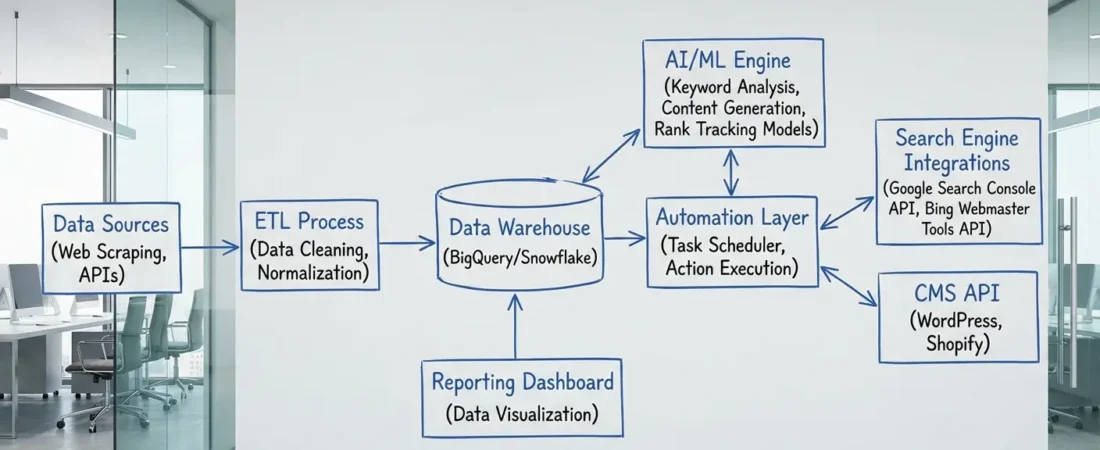
How to Automate SEO: Best 5-Step Autopilot System for Growth
Most SEO teams are stuck in a loop: research keywords, write content, publish, wait, repeat. It’s exhausting — and it doesn’t scale. The brands quietly compounding their organic traffic month after month aren’t working harder. They’ve built an AI-powered SEO automation and content strategy that runs while they sleep.
Here’s the uncomfortable truth: if you’re still doing keyword research manually for every article, writing briefs from scratch, and publishing content piece by piece, you’re already behind. According to Ahrefs research, marketers using AI publish 42% more content than those who don’t — and that content velocity gap is only widening.
This guide breaks down a concrete, 5-step autopilot system for automating your SEO from keyword discovery to published, ranking content.
Why Automate SEO (And What You Risk By Not Doing It)
The math is simple — and brutal. If your team can produce 4 articles a month manually, and a competitor using AI-powered SEO automation is publishing 20 to 30 targeted pieces, they’ll own your keyword space within six months. Topical authority compounds. Gaps close slowly, not quickly.
What makes AI-driven SEO automation genuinely different from earlier “content farms” is precision. Modern systems don’t just produce volume — they map content to search intent, structure pieces for featured snippets, embed semantic keywords, and handle internal linking automatically. That’s the combination that earns rankings, not just traffic.
BrightEdge’s 2025 research found that AI search visits are surging — but organic search remains the cornerstone of digital growth. That means the window to build durable SEO authority is still wide open. The brands winning are those automating the process, not the strategy.
The risks of staying manual? You’re slower to respond to keyword opportunities. Your content gaps stay open. Your team burns hours on tasks that software handles in minutes. And you leave compounding organic growth on the table every single month.
Step 1: Automate Keyword Research and Intent Clustering
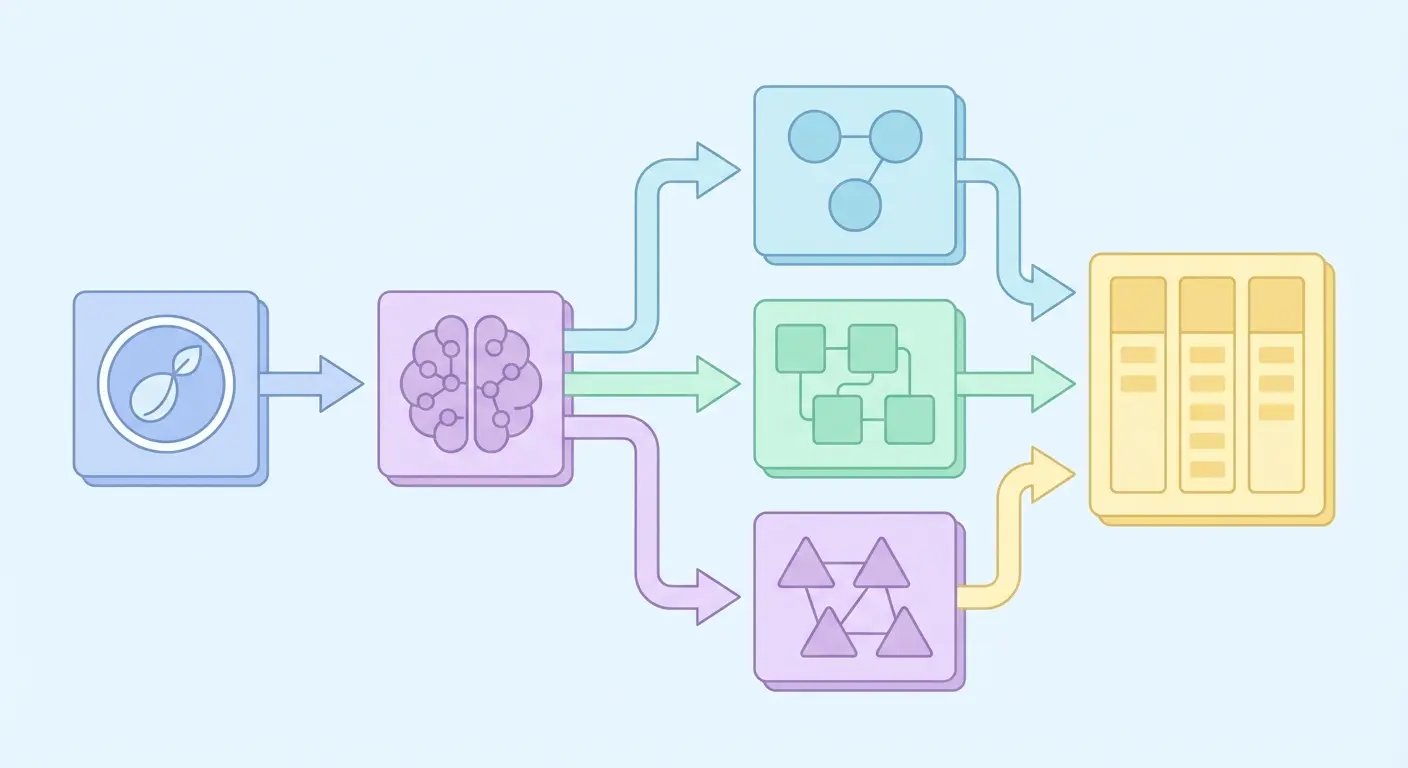
Manual keyword research is where most SEO time gets buried — and it doesn’t have to be. The first step in any working AI-powered SEO automation and content strategy is building a repeatable, automated pipeline for discovering and organizing keywords by intent.
What Automated Keyword Research Actually Looks Like
Tools like Ahrefs, Semrush, and Google Search Console can export keyword data in bulk. The real automation happens in what you do with that data — clustering keywords by intent, grouping them into topic families, and prioritizing by traffic potential versus difficulty ratio.
Here’s a practical workflow:
- Seed keyword export: Pull 500–1,000 keyword variations from your primary topic using Ahrefs’ Keywords Explorer or Semrush’s Keyword Magic Tool.
- Intent classification: Use AI (GPT-based tools or built-in platform features) to classify each keyword as informational, commercial, or transactional.
- Cluster by topic family: Group semantically related keywords together — these become your content clusters.
- Prioritize by opportunity score: Score each cluster by search volume, keyword difficulty, and topical relevance to your site’s existing authority.
- Map to content type: Assign pillar, cluster, or supporting content type to each group based on volume and depth required.
If you’re building out a long-tail strategy alongside this — and you should be — the long-tail keyword strategy that most marketers overlook is one of the fastest ways to find low-competition ranking opportunities that feed your automated content pipeline.
The key metric at this stage: time-to-cluster. Manual clustering takes 3–6 hours per topic. Automated clustering with AI takes under 20 minutes. That’s not an incremental improvement — it’s a different category of speed.
Step 2: Build AI-Powered Pillar-Cluster Content Architecture
Here’s where most “automate your SEO” advice falls apart — it skips the architecture. Publishing AI content without a topical structure is like building a house without a blueprint. You get walls, but no rooms.
Pillar-Cluster Architecture: The Foundation of Scalable SEO
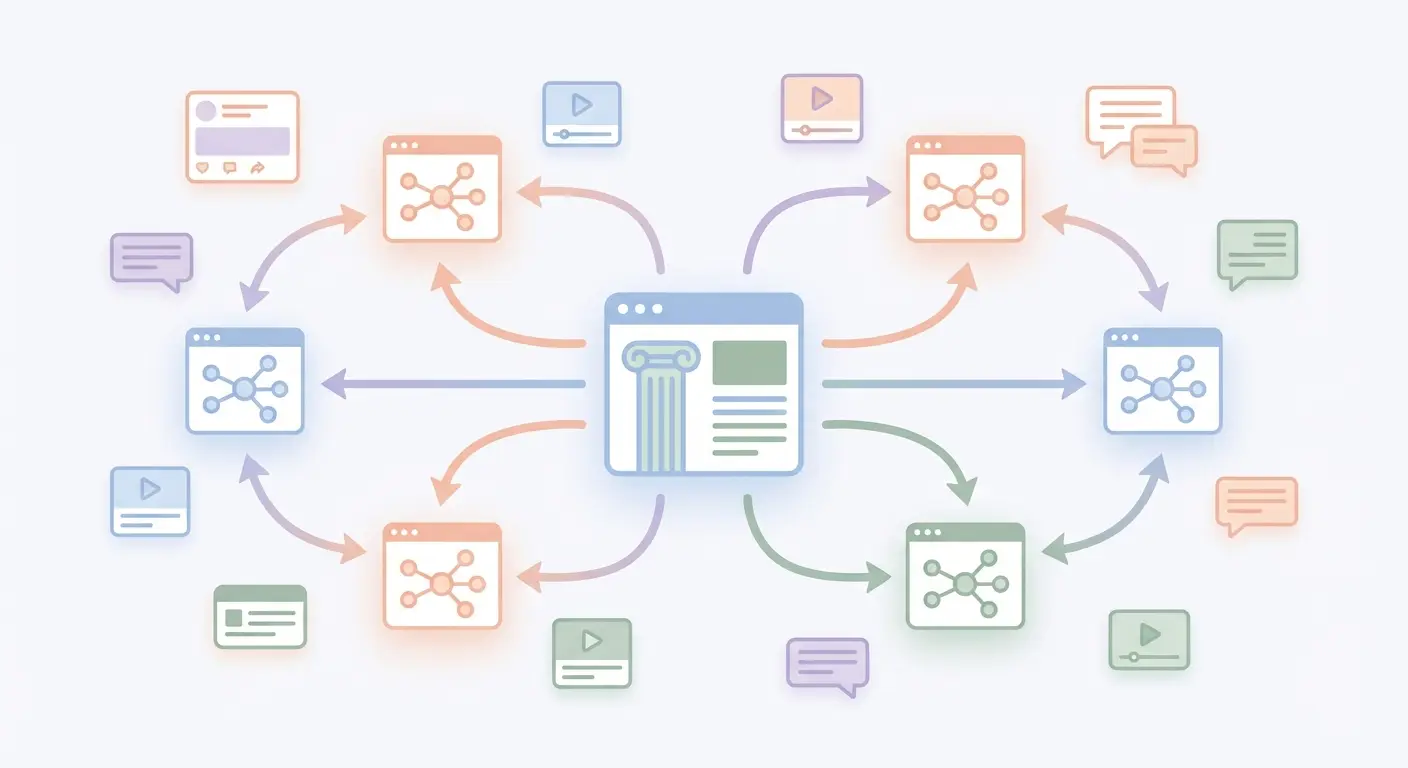
When you automate this architecture, you’re not just publishing content — you’re building a topical authority map that Google can crawl, understand, and reward. The internal link structure tells Google exactly how your content relates to each other.
A strong automated pillar-cluster system works like this:
- Define 3–5 core topic pillars for your site (broad, high-volume topics you want to own).
- Generate 8–15 cluster article topics per pillar using AI keyword clustering.
- Identify 3–5 supporting micro-content pieces per cluster to capture long-tail queries.
- Map internal linking: every cluster links to the pillar; every supporting piece links to its cluster.
- Automate production in order: pillar first, then clusters, then supporting content.
The pillar-cluster content strategy architecture for topical authority covers this structure in detail — including implementation phases, measurement approaches, and how to prioritize which clusters to build first based on your site’s current authority.
What most people miss: the order of publication matters. Publishing cluster content before the pillar exists means your internal links have nowhere to point, weakening the entire structure. Build top-down.
Step 3: Automate Content Brief and Draft Production
Content briefs are the bridge between keyword research and published content. They’re also the step that eats the most time in a manual workflow — and the one most ripe for automation.
What Goes Into an Automated Content Brief
A strong automated brief pulls together:
- Primary and secondary keywords with target density
- SERP analysis: what the top 10 results cover (headings, word count, content structure)
- Questions from People Also Ask for FAQ targeting
- Competitor content gaps — what they’re missing that you should cover
- Internal link opportunities from existing site content
- Schema markup recommendations (FAQ, HowTo, Article)
- Target reading level and tone
Ahrefs has a solid deep-dive on how to create content briefs with templates — worth bookmarking for the manual process. The automated version compresses this 2–3 hour task into minutes using AI that analyzes SERPs in real time.
Once the brief exists, AI-powered draft generation takes over. The output isn’t a final article — it’s a structured first draft that human editors (or AI review layers) refine for accuracy, brand voice, and E-E-A-T signals. The goal isn’t to remove humans entirely. It’s to remove the repetitive, scalable parts that don’t require human judgment.
For editorial calendar management at scale, HubSpot’s editorial calendar templates give you a solid starting framework before you move to automated scheduling.
Real-world benchmark: teams using automated brief + draft generation report reducing per-article production time from 4–6 hours to 45–90 minutes. That’s a 5x throughput increase without hiring.
AI Content Generation Best Practices
Fair warning: AI drafts require quality control. The best-performing AI-generated content goes through at least one human pass for:
- Fact-checking statistics and claims
- Adding first-person experience signals (E-E-A-T)
- Tightening brand voice
- Verifying internal link anchor text relevance
Ahrefs’ AI content marketing guide is one of the more honest takes on what AI content can and can’t do well — required reading if you’re scaling a content operation.
Step 4: Set Up Scheduled Publishing with Automated Internal Linking
Publishing is the step that kills momentum. You have 20 articles ready, but manually formatting, uploading, tagging, adding meta data, and setting internal links for each one takes days. Automated publishing pipelines compress that to near-zero human time.
Building an Automated Publishing Workflow
A proper automated publishing setup handles:
- CMS integration: Direct connection to WordPress (or your CMS) so content publishes without manual upload.
- Meta data generation: Auto-generated title tags, meta descriptions, and URL slugs based on target keywords.
- Schema markup injection: Article, FAQ, and HowTo schema added automatically before publish.
- Scheduled release: Content publishes at optimal times (typically Tuesday–Thursday, 9–11am in target timezone) without manual intervention.
- Automated internal linking: New articles automatically link to relevant existing content, and existing articles get updated with links to new content where relevant.
That last point — automated internal linking — is the one most teams get wrong. Internal links built manually are inconsistent and incomplete. An automated system scans your entire content library, identifies contextual linking opportunities, and inserts them with appropriate anchor text based on keyword relevance. This is a direct topical authority signal to Google.
The complete guide to AI-powered SEO content strategy in 2026 covers content velocity optimization and the technical implementation details for automated publishing pipelines — including tool-specific setup guides and pillar-cluster sequencing.
Step 5: Automate Performance Tracking and Content Refresh
Publishing is not the finish line. The brands that sustain compound organic growth treat their content library as a living asset — and they automate the monitoring and refreshing of that asset continuously.
What Automated SEO Performance Tracking Looks Like
A functional automated tracking system monitors:
- Ranking position changes: Weekly rank tracking for all target keywords, flagging drops of 3+ positions.
- Impressions vs. clicks (CTR): Articles with high impressions and low CTR are prime candidates for title tag optimization.
- Traffic decay signals: Pages losing 15%+ traffic month-over-month trigger automatic refresh alerts.
- Content gap detection: New keyword opportunities in your cluster topics that you haven’t covered yet.
- Cannibalization flags: Multiple pages competing for the same keyword — a silent ranking killer.
The content refresh loop is where automated SEO pays the biggest dividend long-term. A 2024 study found that refreshing high-potential content increased organic traffic by an average of 106% within 60 days. That’s not an anomaly — it’s a repeatable pattern when you have automated monitoring catching decay early.
Most teams never refresh content because they don’t know which pages need it until traffic has already collapsed. Automation flips that — you catch the signal early and refresh proactively, before rankings drop.
The Tool That Runs This Entire System
You can stitch together this 5-step system with five different tools — or you can run it from one place. That’s exactly what Authenova was built to do.
Authenova is an autonomous SEO growth engine that connects directly to your WordPress site, takes your topic strategy as input, and handles the rest: AI-powered keyword clustering, pillar-cluster architecture generation, content brief production, draft generation, automated internal linking, and scheduled publishing — all from a single dashboard.
What makes it different from generic AI writing tools is the structural intelligence. Every piece Authenova produces is mapped to a topical authority architecture — pillar pages cover broad topics with authority, cluster articles build depth on subtopics, and supporting content captures long-tail queries. The internal link network builds automatically as new content publishes.
For teams and agencies managing multiple sites or scaling organic traffic without scaling headcount, this is the system that makes it possible. No credit card required to start — you can see the content structure in action before committing.
🚀 Ready to see AI-powered SEO automation in action?
Authenova generates optimized, topically-structured content on autopilot — pillar pages, cluster articles, and long-tail supporting content that builds authority and ranks.
SEO Automation: Manual vs. AI-Powered Comparison
Here’s a concrete breakdown of where the time (and results) actually differ between a manual SEO workflow and an AI-powered SEO automation and content strategy system:
| Task | Manual Workflow | AI-Powered Automation | Time Saved |
|---|---|---|---|
| Keyword research + clustering | 4–6 hours per topic | 15–20 minutes | ~5 hours |
| Content architecture mapping | 2–3 hours | Automated | 2–3 hours |
| Content brief creation | 1–2 hours per brief | 5–10 minutes | ~1.5 hours each |
| First draft production | 3–5 hours per article | 10–15 minutes | ~4 hours each |
| Internal linking | 30–60 min per article | Automated at publish | 45 min each |
| Publishing + meta setup | 30–45 min per article | Automated scheduled | 30–40 min each |
| Performance monitoring | Weekly manual audit | Continuous automated alerts | 2–4 hours/week |
Total time savings per article: roughly 10–15 hours. At a conservative 10 articles per month, that’s 100–150 hours reclaimed — without sacrificing content quality when the workflow is set up correctly.
5-Step SEO Automation System: Implementation Checklist
Before you start building, run through this checklist to make sure your automation foundation is solid:
Pre-Launch Checklist
- ☐ Define 3–5 core topic pillars based on your business goals and existing authority
- ☐ Connect Ahrefs or Semrush for keyword data export
- ☐ Set up Google Search Console integration for ranking data
- ☐ Choose your AI content platform (with CMS integration support)
- ☐ Build or import your pillar-cluster topic map before generating content
- ☐ Configure internal linking rules (max links per page, anchor text variety)
- ☐ Set up publishing schedule (frequency, timing, categories)
- ☐ Define human review checkpoints (especially for YMYL topics)
- ☐ Configure performance alert thresholds (rank drop, CTR drop, traffic decay)
- ☐ Schedule monthly architecture reviews to add new clusters as topics evolve
FAQ: Automating SEO
Can you fully automate SEO without human involvement?
Not entirely — and you shouldn’t try. The most effective AI-powered SEO automation systems automate the repeatable, scalable tasks (keyword clustering, brief generation, drafting, publishing, internal linking) while keeping human judgment in the strategy and quality control layers. For YMYL topics (health, finance, legal), human review is non-negotiable for E-E-A-T compliance.
How long does it take to see results from an automated SEO content strategy?
Most sites see measurable ranking improvements within 60–90 days of publishing a structured pillar-cluster content system. Compounding growth — where organic traffic accelerates month over month — typically kicks in at the 4–6 month mark as Google recognizes topical authority signals. Long-tail cluster content often ranks faster (2–4 weeks) than competitive pillar pages.
Will Google penalize AI-generated content?
Google’s official position is that it rewards high-quality, helpful content regardless of how it was produced — AI or human. The risk comes from low-quality, thin, or deceptive AI content. AI-powered content that’s accurate, well-structured, internally linked, and genuinely useful to readers performs well in search — often better than manually written content that lacks SEO structure.
What’s the best tool for AI-powered SEO automation?
The best tool depends on your workflow, but look for platforms that handle the full pipeline: keyword clustering, pillar-cluster architecture generation, AI draft production, automated internal linking, and scheduled CMS publishing. Point solutions (one tool per task) work but create integration overhead. All-in-one platforms like Authenova are built specifically for this end-to-end automated SEO workflow.
How many articles should I publish per month with an automated SEO system?
Quality over raw volume — but automated systems make both achievable. A typical starting cadence is 12–20 articles per month: 1 pillar page, 6–10 cluster articles, and 4–8 supporting pieces. Sites with strong existing authority can scale to 30–50 pieces monthly. The key constraint shifts from production capacity to editorial quality control.
How does automated internal linking affect SEO rankings?
Automated internal linking directly improves topical authority signals, crawl efficiency, and link equity distribution across your site. When done correctly — with relevant anchor text, logical content relationships, and appropriate link density — it can significantly improve rankings for both pillar and cluster pages. Poorly configured automated linking (keyword-stuffed anchors, excessive links per page) can trigger quality issues.
Start Building Your SEO Autopilot System
The 5-step AI-powered SEO automation and content strategy above isn’t theoretical — it’s the operational model that growing brands are using right now to outpace competitors who are still doing this manually. The gap between automated and manual SEO teams is widening every month.
Your next move: pick one step and automate it this week. Start with keyword clustering — it’s the highest-leverage, lowest-risk entry point. Once that pipeline runs reliably, add automated brief generation. Build the system one step at a time, and within 60 days you’ll have a content engine that runs largely on autopilot.
If you want to skip the stitching-together phase and run all five steps from one platform, Authenova’s AI Content Generator is built exactly for this — pillar-cluster architecture, automated internal linking, and scheduled WordPress publishing included. Free trial, no credit card required.
Want to go deeper on the strategy layer first? The complete guide to AI-powered SEO content strategy in 2026 covers the full strategic framework — tool recommendations, content velocity benchmarks, and pillar-cluster implementation phases that work alongside any automation system you build.