
AI SEO Tool: How to 3x Organic Traffic in 90 Days
Most SEO teams are stuck publishing 4 articles a month, watching their competitors pull ahead with 40. The gap isn’t talent — it’s throughput. AI-powered SEO automation and content generation has changed the math entirely, and the brands catching on early are already seeing 3x organic traffic gains in a single quarter.
Here’s what’s surprising: tripling traffic in 90 days isn’t a vanity metric reserved for well-funded teams. It’s a repeatable process when you combine the right AI SEO tool with a structured content architecture. This guide breaks down exactly how to do it — with real benchmarks, a week-by-week playbook, and zero fluff.

Why AI-Powered SEO Automation Changes the Traffic Equation
Content velocity is the variable most SEO teams underestimate. Google’s internal quality rater guidelines reward topical authority — and topical authority is built through volume, depth, and structure. The problem is that humans can’t produce that volume fast enough without sacrificing quality. That’s the bottleneck AI breaks.
According to the Stanford AI Index Report 2024, AI model capabilities in language generation have advanced to the point where AI-written text is frequently indistinguishable from human writing — and in structured tasks like SEO content, AI consistently produces output that meets or exceeds baseline quality standards.
What does this mean practically? A team that previously published 8 articles per month can now operate at 80 — with consistent on-page optimization, keyword placement, and internal linking built in automatically. That’s not a 10x in effort. It’s a 10x in output from the same effort, directed by an AI SEO tool that handles the mechanical work.
The other variable people miss is structural. Random articles don’t compound. Articles built within a pillar-cluster content architecture signal topical authority to Google’s algorithms, which means each new piece of content makes your existing content rank better too. It’s a flywheel — and AI is what makes it spin fast enough to matter in 90 days.
According to Ahrefs’ breakdown of 14 ways to use AI for better SEO, the highest-impact applications are content research, brief generation, and first-draft creation — all three of which can be fully automated when using the right platform.
What an AI SEO Tool Actually Does (And What It Doesn’t)
There’s a lot of noise around AI SEO tools, so let’s be precise about what you’re actually buying when you invest in one.
Here’s a clear breakdown of what these tools handle versus what still needs human judgment:
| Task | AI Handles | Human Still Needed |
|---|---|---|
| Keyword research & clustering | ✅ Automated grouping, intent mapping | Strategy validation, niche context |
| Content brief creation | ✅ SERP analysis, outline generation | Tone approval, brand alignment |
| Article drafting (pillar + cluster) | ✅ Full drafts at scale | Expert quotes, proprietary data |
| On-page SEO optimization | ✅ H-tags, meta, schema, density | Final review pass |
| Internal link mapping | ✅ Anchor text + placement automation | Structural oversight |
| Publishing & scheduling | ✅ WordPress integration, calendar | Campaign timing decisions |
| Performance analysis | ✅ Traffic trend identification | Strategic pivots based on business goals |
| Original research & interviews | ❌ Not applicable | 100% human (and worth it) |
What most people miss is that the ROI of an AI SEO tool isn’t just time saved — it’s the compounding return on publishing 10x more content that’s structurally linked and keyword-optimized from day one. That’s a fundamentally different asset base than what you’d build manually in the same timeframe.
It’s also worth being honest: AI content isn’t magic. Google’s official guidance on AI-generated content makes clear that quality and helpfulness matter far more than how content was produced. AI gets you speed and structure; your strategy and expertise give it the edge to rank.
The 90-Day Traffic Growth Framework: Week-by-Week Breakdown
Ninety days sounds aggressive until you see the math laid out. Here’s the exact framework that’s producing 3x traffic results for teams using AI-powered SEO automation at scale.
Phase 1: Foundation (Days 1-21)
This phase is about architecture, not articles. Rushing content without structure is the #1 mistake teams make — and it’s why so many “content sprints” produce zero ranking movement.
- Topical map creation: Identify 3-5 core topic pillars relevant to your audience. Each pillar should represent a broad keyword with 1,000+ monthly searches and strong commercial intent.
- Keyword clustering: Use your AI SEO tool to group related keywords into cluster topics under each pillar. Aim for 8-12 cluster articles per pillar.
- Content calendar build: Map out every article — title, target keyword, word count, internal linking plan — before writing a single word.
- Pillar pages first: Publish your pillar pages in week 3. These are your authority anchors. Everything else links back to them.
- Technical audit: Run a site crawl. Fix any critical issues — broken links, crawlability problems, Core Web Vitals failures — before the content flood begins.
Phase 2: Content Velocity (Days 22-60)
This is where AI-powered content generation earns its keep. You’re publishing 5-10 cluster articles per week, all structured to feed authority back to your pillar pages.
- AI brief generation: For each cluster article, generate a content brief that includes target keyword, secondary keywords, H2 structure, and competitor gap analysis.
- First-draft automation: Run each brief through your AI content generator. Review, fact-check, and add any brand-specific insights before publishing.
- Internal link injection: Every cluster article should link to its pillar page and to 2-3 related cluster articles.
- Indexing push: Submit each published URL to Google Search Console immediately. Don’t wait for passive crawling.
Phase 3: Optimization and Amplification (Days 61-90)
- Performance triage: Identify which articles hit page 2-3 of Google. These are your “quick win” candidates — they already have some authority and need targeted optimization to break into page 1.
- On-page tuning: Update meta titles, add FAQ schema, improve internal linking to underperforming pages.
- Content refresh loop: For any article that’s 60+ days old and not ranking, run it through your AI SEO tool for a structured refresh — new stats, updated headings, expanded sections.
- Traffic analysis: Compare month-3 organic sessions against baseline. A 3x result means you’re on the right track. If you’re at 2x, double down on cluster content in your highest-performing pillar.

Pillar-Cluster AI Content Architecture: The Engine Behind Fast Rankings
The pillar-cluster model isn’t new — HubSpot popularized it back in 2017. What’s new is that AI makes it achievable at a scale that previously required a 10-person content team.
Here’s the thing that makes pillar-cluster work so well with AI: the architecture is formulaic by design. Pillar pages follow a predictable structure (broad topic, comprehensive coverage, links to clusters). Cluster articles follow a predictable structure (specific subtopic, deep coverage, links back to pillar). AI is extraordinarily good at following formulas while varying the execution — which is exactly what you need when publishing at volume.
For a detailed breakdown of how to build this architecture from scratch, the guide on pillar-cluster content strategy and topical authority architecture walks through every component — from topical map creation to internal linking logic.
How Topical Authority Amplifies Your AI Content Output
Google’s systems evaluate topical authority by looking at how thoroughly a site covers a subject. If you have a pillar page about “email marketing” and 12 cluster articles covering deliverability, A/B testing, segmentation, automation, and list growth — you’re demonstrating depth. That depth signals authority. That authority lifts all your related pages.
The counterintuitive truth? A site with 60 well-structured, topically clustered articles will outrank a site with 200 disconnected articles almost every time. Structure beats volume — but AI lets you have both.
AI Content Generation at Scale: Quality Controls That Matter
Scale without quality is just spam. Google’s helpful content system has gotten exceptionally good at identifying low-value, AI-generated content — and it penalizes it accordingly. The goal isn’t to produce content; it’s to produce content that actually serves search intent better than what’s already ranking.
Here’s the quality control framework that keeps AI content generation genuinely useful at scale:
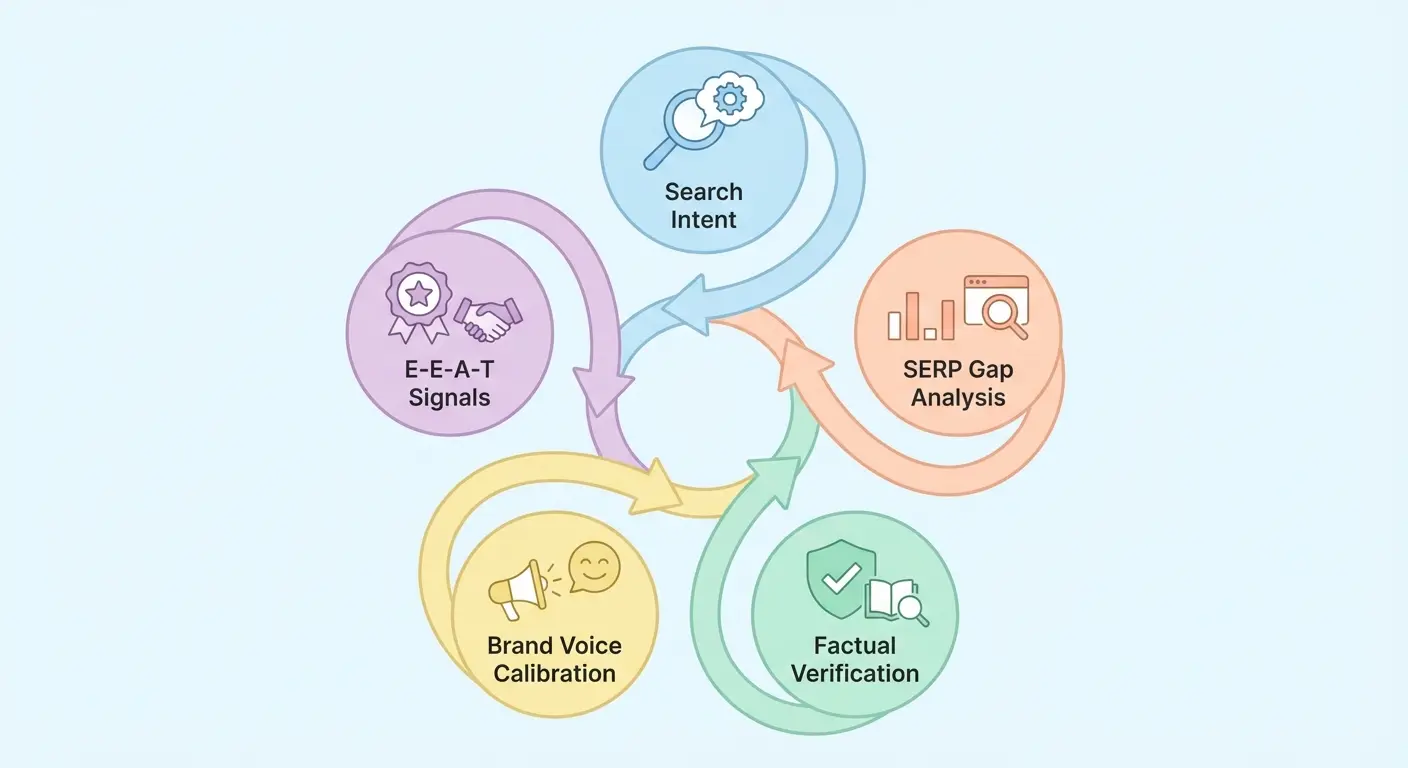
The 5-Layer Quality Check
- Search intent alignment: Before your AI generates anything, confirm the target keyword’s intent (informational, navigational, commercial, transactional). Your content type and structure must match.
- SERP gap analysis: What are the top 3 ranking pages missing? Your AI brief should explicitly include gaps to cover — statistics they don’t have, subtopics they skip, questions they don’t answer.
- Factual verification pass: AI hallucinates. Every statistic, study reference, and named example needs a human check before publishing. Build this into your editorial workflow as a non-negotiable step.
- Brand voice calibration: The best AI SEO platforms let you feed in voice guidelines, sample content, and tone parameters. Use them. Generic-sounding AI content is detectable and forgettable.
- E-E-A-T signal injection: Add first-person insights, expert quotes, real case studies, or proprietary data to any article that targets competitive keywords. AI gives you the scaffold; human expertise gives it the weight that ranks.
Semrush’s guidance on using AI for SEO and content makes the same point: AI works best as an acceleration tool, not a replacement for strategic thinking. The teams seeing the biggest wins are those using AI to handle structure and scale while humans inject expertise and brand authority.
For content repurposing specifically — turning one strong pillar page into a dozen cluster articles, social snippets, or email sequences — Moz’s Whiteboard Friday on repurposing content with AI is a practical resource worth bookmarking.
Automated Internal Linking: How AI Builds Your Site’s Authority Flow
Internal linking is arguably the most underestimated technical SEO lever — and it’s one that AI handles better than humans do at scale, because it requires consistency, pattern recognition, and volume that humans naturally can’t maintain across hundreds of articles.
Here’s where it gets interesting: manual internal linking typically results in 1-2 links per article, often to homepage or top navigation pages. AI-powered internal linking maps every new article to its topically relevant cluster, pillar page, and supporting content — creating a web of authority signals that Google’s crawlers follow efficiently.
Internal Linking Rules for AI Content Workflows
- Every cluster article links to its pillar page — always, without exception, using keyword-rich anchor text.
- Pillar pages link to 8-12 cluster articles — with descriptive anchor text that matches each cluster’s primary keyword.
- Cluster articles link to 2-3 sibling cluster articles — building horizontal authority within a topic group.
- Supporting pages link upward — long-tail supporting content links to the relevant cluster article, not directly to the pillar.
- Anchor text variety matters: Don’t repeat the exact same anchor text more than twice across the site for any given target page.
This architecture creates what SEO professionals call a “PageRank flow” — authority earned by any page in the cluster distributes upward to the pillar and sideways to sibling pages. The result is that your newest articles benefit from the domain authority your older articles have accumulated, even on day one of publishing.
Long-Tail Keyword Targeting with AI: The Compounding Traffic Play
Long-tail keywords are the unsung engine of the 90-day traffic growth strategy. They’re lower competition, higher intent, and faster to rank — which means your AI content starts generating traffic while you’re still building authority for the bigger head terms.
The math is compelling: a single head keyword with 10,000 monthly searches might take 12-18 months to crack with a new site. But 100 long-tail keywords averaging 100 monthly searches each? That’s the same traffic ceiling — with achievable rankings in 60-90 days and significantly lower content investment per article.
The deeper dive on long-tail keyword strategy as an SEO growth engine covers the full targeting framework — including how to identify the highest-converting long-tail clusters and map them to your AI content calendar.
How AI Finds and Groups Long-Tail Opportunities
The best AI SEO tools don’t just suggest keywords — they identify semantic clusters of related long-tail terms that can be addressed by a single piece of content. Instead of writing 20 separate articles for 20 slightly different questions, you write one cluster article that ranks for all 20 variations. That’s the content efficiency multiplier that makes the 90-day timeline realistic.
Measuring Results: KPIs That Actually Predict 3x Traffic Growth
Vanity metrics will get you fired. Here are the leading indicators that tell you whether your AI-powered SEO automation strategy is on track for 3x organic traffic — measured at the 30, 60, and 90-day marks.
| KPI | 30-Day Target | 60-Day Target | 90-Day Target |
|---|---|---|---|
| Indexed pages | +25% increase | +100% increase | +200% increase |
| Organic impressions (GSC) | +15% | +60% | +150%+ |
| Keywords ranking (positions 1-20) | +30% | +80% | +200%+ |
| Organic sessions | +10% | +50% | +200%+ (3x goal) |
| Average position (tracked keywords) | Stable or improving | -3 to -5 positions | -8 to -12 positions |
| Pages with featured snippets | 2-5 new snippets | 10-20 snippets | 30+ snippets |
The most reliable leading indicator of 90-day traffic growth is the 30-day impression curve. If your Google Search Console impressions are growing week-over-week in the first 30 days, the traffic follows. If impressions are flat, your indexing or keyword targeting needs attention before you publish more content.
For the full technical and strategic playbook behind this measurement framework, the Complete Guide to AI-Powered SEO Content Strategy goes deep on tool-driven workflows, tracking setups, and the metrics that matter at each growth stage.

How Authenova Automates the Entire AI SEO Workflow
Every strategy in this guide requires three things to work at 90-day speed: a content generation engine, a structural architecture system, and an automated publishing pipeline. Doing this manually across multiple tools is slow, error-prone, and expensive. That’s the problem Authenova was built to solve.
Authenova is an autonomous AI SEO content platform that connects directly to your WordPress site and handles the full content workflow — from topical map creation to scheduled, optimized publishing — without requiring manual intervention at each step.
What Authenova Does in Practice
- Topical authority engine: Define your core topic pillars, and Authenova maps out an entire pillar-cluster-supporting architecture automatically — complete with keyword assignments, word count targets, and internal linking logic.
- AI content generation: Each article is generated with proper H-tag hierarchy, keyword density, meta descriptions, schema markup, and readability optimization built in. No extra prompting or reformatting required.
- Automated internal linking: Authenova identifies and injects internal links across your content library as new articles are published — keeping your authority flow intact as your site scales.
- Multi-language support: Targeting US, UK, Canadian, Australian, or Irish audiences (or all five) is handled natively, with localized content generation for each market.
- Scheduled publishing: Set your content cadence once — Authenova handles the queue, publishes on schedule, and keeps your editorial calendar moving without daily check-ins.
This isn’t a “write one article at a time” AI content tool. It’s a content operations system designed for teams that want to execute the 90-day traffic growth framework without hiring 5 additional writers.
Ready to run this strategy on autopilot?
Authenova’s AI Content Generator creates pillar pages, cluster articles, and supporting content — fully optimized, internally linked, and published on schedule. Free trial, no credit card required.
The 90-Day AI SEO Execution Checklist
Use this as your go-to reference throughout the campaign. Each item maps to a specific phase of the framework above.
Phase 1: Foundation (Days 1-21) ✅
- ☐ Define 3-5 core topic pillars with search volume validation
- ☐ Build topical map with 8-12 cluster keywords per pillar
- ☐ Run technical audit — fix crawl errors, Core Web Vitals, broken links
- ☐ Set up Google Search Console and confirm indexing is working
- ☐ Configure AI SEO tool with brand voice, tone, and site architecture
- ☐ Publish pillar pages (one per core topic) by day 21
Phase 2: Content Velocity (Days 22-60) ✅
- ☐ Generate and publish 5-10 cluster articles per week
- ☐ Verify internal links on every published article
- ☐ Submit all new URLs to Google Search Console
- ☐ Check indexing weekly — flag any URLs not indexed within 7 days
- ☐ Monitor GSC impressions weekly for upward trend confirmation
- ☐ Add FAQ schema to every article covering question-based keywords
Phase 3: Optimization (Days 61-90) ✅
- ☐ Identify page 2-3 articles and prioritize for optimization
- ☐ Refresh underperforming content (updated stats, expanded sections)
- ☐ Audit internal link distribution — ensure pillar pages have the most inbound internal links
- ☐ Begin long-tail keyword cluster targeting for supporting articles
- ☐ Pull 90-day GSC report — compare sessions, impressions, and keyword rankings to baseline
- ☐ Plan Phase 2 pillar expansion based on highest-performing topic clusters
Frequently Asked Questions
Can AI-powered SEO automation really triple organic traffic in 90 days?
Yes — but with an important qualifier. The 3x target assumes you’re starting from a baseline with some existing domain authority, clean technical SEO, and a proper pillar-cluster architecture. For sites with near-zero organic presence, the growth trajectory is the same but may take 120-150 days to fully materialize. Sites with an established baseline (500-2,000 monthly sessions) consistently achieve 2-4x traffic growth in 90 days using structured AI content generation at scale.
Does Google penalize AI-generated SEO content?
Google doesn’t penalize content for being AI-generated — it penalizes content that’s low-quality, unhelpful, or produced primarily to manipulate search rankings. Google’s own guidance (published February 2023) confirms that helpful, accurate, people-first content is rewarded regardless of how it was created. The risk comes from publishing unreviewed AI content with factual errors, thin coverage, or no expertise signal — not from using AI to write well-structured, genuinely useful articles.
How many articles do you need to publish to see a 3x traffic increase?
The target is 40-60 new pieces of content across 90 days, organized into pillar-cluster groupings. For a site targeting 3-5 core topics, that means 1 pillar page per topic and 8-12 cluster articles per pillar, plus supporting long-tail content. The exact volume depends on your baseline — sites with lower existing content libraries see faster relative gains from the same publishing volume.
What’s the difference between an AI SEO tool and a regular AI writing tool?
A regular AI writing tool (like a general-purpose LLM) generates text — it doesn’t understand keyword strategy, SERP intent, internal linking architecture, or topical authority. An AI SEO tool is specifically trained and configured for search optimization: it conducts keyword research, builds content briefs from SERP analysis, structures articles according to SEO best practices, and integrates with publishing workflows. The output isn’t just readable — it’s built to rank.
How long does it take for AI-generated SEO content to rank on Google?
Most AI-generated content targeting low-to-medium competition keywords (KD under 40) starts ranking in positions 10-30 within 30-45 days of publishing, assuming proper indexing. First-page rankings for those same keywords typically follow within 60-90 days when supported by a strong internal linking structure and topical cluster. Head terms with higher competition take longer — which is why the 90-day strategy front-loads long-tail keyword targeting for early traffic wins.
What tools do I need alongside an AI SEO platform to run this strategy?
The core stack is: an AI SEO platform (for content generation and internal linking), Google Search Console (for indexing and performance data), and a keyword research tool like Ahrefs or Semrush (for validating keyword volumes and competition). If your AI SEO platform handles topical mapping and publishing natively — as Authenova does — you can run the full 90-day strategy without adding additional tools to the workflow.
The Bottom Line: AI SEO Is a Speed Advantage, Not a Shortcut
The 3x traffic goal is real and achievable — but it requires treating AI-powered SEO automation and content generation as an operational strategy, not a magic button. The teams winning with it right now are the ones who got the architecture right first, used AI to execute at volume, and applied human expertise where it counts: strategy, quality control, and E-E-A-T signals that algorithms can’t fake.
Ninety days is a short window. The structure you build in the first three weeks determines everything that follows. Start with your topical pillars, map your clusters, configure your AI content pipeline — and then execute with consistency.
The compounding nature of this strategy means your results at day 90 are just the beginning. Sites that maintain this content velocity for 6-12 months don’t just 3x their traffic — they build the kind of topical authority that’s genuinely difficult for competitors to displace.
Start Your 90-Day Traffic Sprint with Authenova
Authenova is the AI SEO content platform built specifically for this strategy. Connect your WordPress site, define your topic pillars, and let the platform generate, optimize, and publish your entire pillar-cluster content architecture — on autopilot.
- ✅ AI-generated pillar pages, cluster articles, and supporting content
- ✅ Automated internal linking across your entire content library
- ✅ Schema markup, meta optimization, and keyword placement — built in
- ✅ Scheduled publishing directly to WordPress
- ✅ Multi-language support for US, UK, CA, AU, and IE markets
Free trial. No credit card required.
Want to go deeper on the technical side of this strategy? Read the <a href="https://authenova.site/complete-guide-ai-powered-seo-content-strategy-2026/"