
AI Blog Writer: How to Gain 10K Organic Visitors in 90 Days
Most content teams spend 6–8 hours writing a single blog post — and it still doesn’t rank. Meanwhile, a growing number of digital marketers are hitting 10,000 organic visitors within 90 days using an AI blog writer paired with a deliberate AI SEO & content automation strategy. The gap between those two outcomes isn’t talent or budget. It’s system.
Here’s what actually separates the teams who scale fast from those spinning their wheels: they stopped treating AI as a writing assistant and started treating it as an autonomous content engine with a clear architectural plan behind it.
Why AI Blog Writing Actually Works for SEO
Skeptics still ask whether AI-generated content can rank. The short answer: yes — when it’s structured correctly. Google’s own guidance on generative AI content is clear: they reward content that demonstrates experience, expertise, authority, and trust (E-E-A-T), regardless of how it was produced.
The real question isn’t “can AI write content that ranks?” It’s “can you produce enough quality content, fast enough, to build topical authority before your competitors do?” AI changes the math entirely.
What makes AI blog writing effective for SEO isn’t speed alone. It’s the ability to cover an entire topic cluster — say, 40 articles on “email marketing automation” — in the time it used to take to write three. Google’s algorithms reward topical depth. The site that answers 40 questions about a topic consistently beats the one with 5 longer posts, all else equal.
The thing most people miss is that AI writing fails when it’s used reactively — one article at a time, no strategy. It wins when you build a content system around it.
The 90-Day Traffic Plan: Phases and Milestones
Hitting 10K organic visitors in 90 days isn’t magic — it’s math applied to the right variables. Here’s how the timeline actually breaks down for teams doing this successfully.
Phase 1: Foundation (Days 1–14)
This phase is all about strategy before a single article goes live. You’re building the keyword map, identifying your pillar topics, and setting up your content architecture. Skip this phase and your AI-generated content becomes a pile of unrelated posts that dilutes topical authority instead of building it.
- Audit existing content and identify topic gaps
- Select 2–3 core pillar topics with clear search demand
- Research 40–60 long-tail keywords per pillar (more on this below)
- Configure your AI blog writer with brand voice, target audience, and content templates
Phase 2: Content Sprint (Days 15–60)
This is where volume meets velocity. With your keyword map in hand, you publish 3–5 articles per week minimum. AI SEO & content automation tools make this achievable without burning out your team. Each article targets a specific keyword and links back to its pillar page.
Realistic publishing benchmarks for this phase:
| Team Size | Articles/Week (AI-Assisted) | Articles/Week (Manual) | 90-Day Total |
|---|---|---|---|
| Solo marketer | 8–12 | 1–2 | 50–75 |
| 2-person team | 15–20 | 3–5 | 90–120 |
| Agency (5+ people) | 30–50 | 8–12 | 180–250 |
| Fully automated | 50–100+ | N/A | 300+ |
Phase 3: Optimization & Compounding (Days 61–90)
By week 9, you’ll start seeing Google index your content and initial rankings emerge. Now you audit what’s working, strengthen internal links on content that’s ranking on page 2, and double down on the clusters getting traction. This compounding effect is where the 10K number becomes real.
Keyword Strategy That Fuels 10K Visitors Fast
Here’s a counterintuitive truth: you won’t reach 10,000 visitors by targeting high-volume keywords. You’ll get there by owning dozens of low-competition, high-intent long-tail keywords that each send 50–300 visitors per month. Add up 60 of those and the math works itself out.
The formula that works consistently:
- Start with seed keywords: Identify 2–3 broad topics your site should own (e.g., “AI SEO & content automation”)
- Expand with question-based queries: Use tools like Ahrefs or Semrush to extract “how to,” “what is,” and “best way to” variants
- Filter by KD (Keyword Difficulty) under 30: These are winnable within 90 days for a new or growing site
- Group by intent: Informational, commercial, and navigational queries need different content formats
- Map to content type: Pillar (broad, KD 20–40), cluster (specific, KD 10–25), supporting (very specific, KD 0–15)
For a deeper look at how this keyword funnel works end-to-end, the long-tail keyword strategy guide on Authenova breaks down the exact filtering process with real examples.
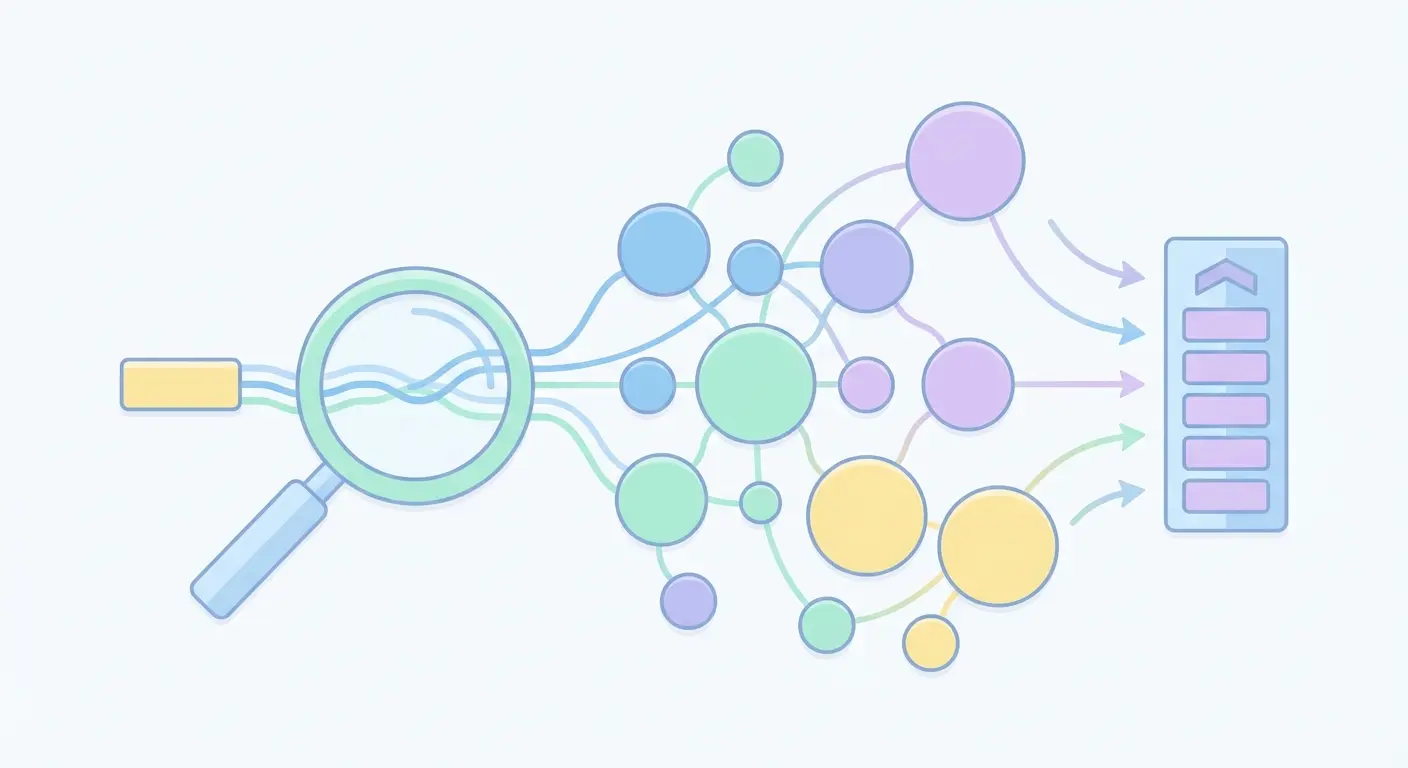
Content Architecture: Pillar-Cluster-Supporting Structure
Content architecture is the secret weapon most AI blog writers ignore — and it’s exactly why some sites explode in traffic while others plateau. Google doesn’t just rank individual pages; it ranks sites that demonstrate authority over a topic.
Here’s why this matters for your 90-day plan: when you publish 40 articles all internally linking to one pillar page on “AI SEO & content automation,” that pillar page accumulates internal link equity from 40 sources. Google sees a network of topically-related content and ranks the entire cluster higher — including articles that might otherwise be too new to compete.
The practical structure looks like this:
- 1 Pillar page (2,500–4,000 words): Covers the broad topic with all major subtopics
- 8–12 Cluster articles (1,500–2,500 words each): Deep dives on each subtopic, linked to the pillar
- 20–30 Supporting articles (800–1,500 words each): Specific questions, long-tail targets, linked to clusters
This is exactly the model described in the pillar-cluster architecture guide — if you’re building this from scratch, that’s the resource to follow before you write a single word.
AI SEO & Content Automation Tools That Do the Heavy Lifting
The toolstack you choose determines whether this plan is “possible with effort” or “runs while you sleep.” There’s a meaningful difference between AI writing assistants (you still do most of the work) and true AI SEO & content automation platforms (the system does the work).
Semrush’s own research on doing SEO and content faster with AI notes that teams using integrated AI workflows reduce content production time by up to 70% while maintaining quality benchmarks.
Ahrefs published a detailed breakdown of their complete AI content process — worth reading for how a data-heavy SEO company approaches quality control at scale.
The Authenova Automation Stack
For teams that want the full autonomous experience — where the content system runs with minimal manual input — Authenova is built specifically for this use case. Connect your WordPress site, define your pillar topics and keyword strategy, and the platform generates topically-structured content on a publishing schedule you control.
What makes it different from a standalone AI writer: Authenova builds the entire pillar-cluster architecture automatically, handles internal linking between articles, applies schema markup, and optimizes meta descriptions — all without requiring you to manage each piece individually. For agencies and growing brands running the 90-day sprint, that automation layer is the difference between publishing 20 articles and publishing 100.
Quality Control: Making AI Content Google-Proof
Fair warning: this is where most people cut corners — and where the 90-day plan either works or falls apart. AI SEO & content automation doesn’t mean publishing raw AI output. It means AI handles the structure, research synthesis, and first draft, while your editorial process ensures accuracy, originality, and genuine usefulness.
Semrush’s guide to AI content optimization identifies three recurring failure points in AI content: generic claims without specifics, missing E-E-A-T signals, and thin coverage of the search intent. All three are fixable with a lightweight editorial layer.
Your quality checklist for every AI-generated article:
- ✅ Does it directly answer the target keyword’s search intent in the first 100 words?
- ✅ Are there specific data points, examples, or case references — not just vague claims?
- ✅ Has a human added at least one original insight or first-hand angle?
- ✅ Are internal links in place and pointing to the correct pillar/cluster pages?
- ✅ Is the reading level appropriate for the target audience (aim for Flesch-Kincaid 60–70)?
- ✅ Does the content structure match what’s ranking (compare top 3 SERP results)?
Google’s official guidance on AI content confirms they’re not penalizing AI writing — they’re penalizing low-quality, unhelpful content regardless of how it was produced. The bar is usefulness, not authorship method.
For a structured foundation on how to build this into every piece, the complete guide to AI-powered SEO content strategy covers the editorial workflow in full — including how to build brand voice into AI outputs so they don’t sound generic.
Step-by-Step 90-Day Execution Checklist
Here’s the actual execution plan — no theory, no padding. Work through this in sequence and you’ll have the infrastructure for 10K+ monthly organic visitors by day 90.
- Week 1 — Audit & Strategy: Run a site audit, identify your 2–3 core topic pillars, and pull 50+ keyword targets per pillar using Ahrefs or Semrush. Filter to KD under 30.
- Week 2 — Architecture Setup: Map your pillar-cluster-supporting structure. Assign keywords to each content tier. Set up your AI blog writer with tone guidelines and target audience profile.
- Weeks 3–4 — Pillar Pages First: Publish your 2–3 pillar pages. These become the internal link destinations for everything that follows. Don’t skip this step.
- Weeks 5–8 — Cluster Sprint: Publish 3–5 cluster and supporting articles per week. Every article links back to its pillar. Use AI SEO & content automation to maintain velocity without sacrificing structure.
- Week 9 — First Ranking Review: Check Google Search Console for impressions and early rankings. Identify articles appearing in positions 11–20 — these get priority optimization (update, expand, strengthen internal links).
- Weeks 10–12 — Double Down & Compound: Increase publishing frequency on clusters that are gaining traction. Add FAQ schema to high-impression pages. Build out supporting content for keywords driving clicks.
- Day 90 — Traffic Audit: Measure organic sessions, keyword rankings, and indexed pages. Most sites following this system see 5,000–15,000 monthly organic visitors by this point, depending on domain authority and niche competitiveness.
Ready to Run This on Autopilot?
If manually managing 50+ articles across a pillar-cluster system sounds like a lot — it is. That’s why Authenova’s AI Content Generator was built to handle the entire system: keyword-to-article architecture, automatic internal linking, schema markup, and scheduled publishing to WordPress. No credit card required to start.
Frequently Asked Questions
Can an AI blog writer really generate 10,000 organic visitors in 90 days?
Yes — for sites targeting low-competition niches with a structured pillar-cluster publishing strategy, 10,000 organic visitors in 90 days is achievable. Results depend on domain authority, niche competitiveness, and publishing volume. New sites in high-competition niches may take 120–180 days, while established domains with existing authority often hit the milestone faster.
Does Google penalize AI-generated content?
No. Google’s official guidance states they evaluate content on quality, helpfulness, and E-E-A-T signals — not on whether it was written by a human or AI. AI-generated content that is accurate, useful, and well-structured ranks normally. The penalty risk comes from publishing thin, repetitive, or factually incorrect content regardless of how it was produced.
How many articles do I need to publish to reach 10K monthly organic visitors?
Typically 40–80 well-targeted articles across a pillar-cluster structure is enough to generate 10,000 monthly organic visitors in a low-to-medium competition niche. Each article averages 100–300 monthly visitors from long-tail keywords. The total compounds as more articles index and internal link equity accumulates across the cluster.
What’s the best AI SEO content automation tool for scaling a blog?
The best tool depends on how much automation you need. For teams wanting full-stack automation — content generation, internal linking, schema markup, and WordPress publishing in one platform — Authenova is purpose-built for this use case. For manual workflows with AI assistance, tools like Surfer SEO with ChatGPT or Jasper work well but require more hands-on management.
How do I maintain content quality when publishing at high volume with AI?
Implement a lightweight editorial checklist for every article: verify factual claims, add at least one original insight per piece, confirm the content directly answers the target keyword’s search intent, and ensure all internal links are correctly placed. A 15–20 minute human review per article is enough to bring AI drafts up to a publishable quality standard that satisfies Google’s E-E-A-T criteria.
Go Deeper on AI-Powered SEO
These resources will help you build out every layer of the strategy covered here:
- 📖 The Complete Guide to AI-Powered SEO Content Strategy in 2026 — full methodology, workflows, and scaling frameworks
- 🔑 Long-Tail Keyword Strategy: The SEO Growth Engine Most Marketers Overlook — find 50+ winnable keywords in any niche
- 🏗️ Pillar-Cluster Content Strategy: Architecture for Topical Authority — build the content structure that compounds over time