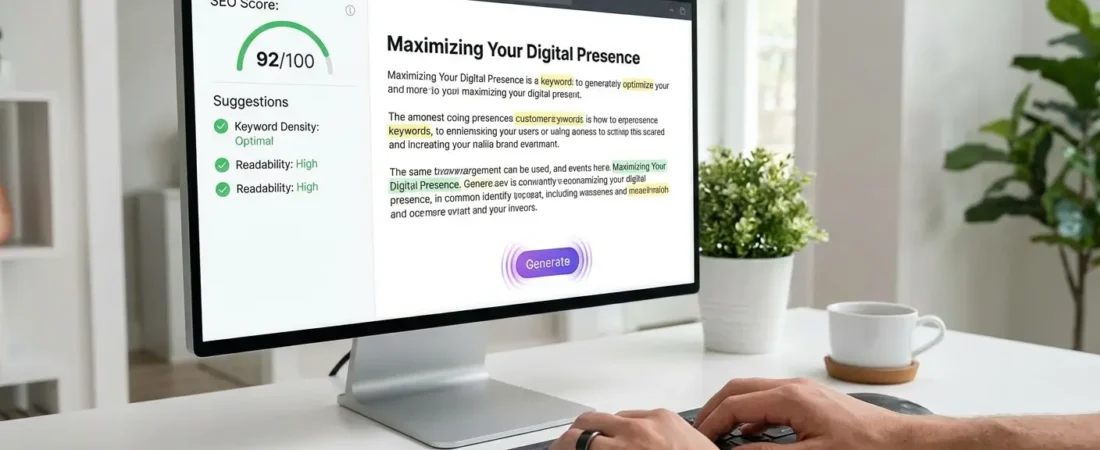
Blog Automation Software: How to Double Traffic in 90 Days
You publish a blog post. Then another. A week passes. You check Google Analytics — crickets. Sound familiar? Most small business owners and solopreneurs face the same wall: they know content drives traffic, but they simply don’t have the time, team, or budget to publish enough of it to matter.
Here’s the uncomfortable truth: one post a week won’t move the needle. Google rewards sites that publish consistent, topically structured content at scale. The brands winning in search aren’t better writers — they’re publishing smarter and faster using automated blog writing and AI SEO content automation.
This article breaks down exactly how blog automation software works, what a realistic 90-day traffic doubling plan looks like, and which tools actually deliver results — including one that does the heavy lifting autonomously.
What Is Blog Automation Software (and Why It Works)
Blog automation software is a category of tools that replaces or significantly reduces the manual work in content creation — from keyword research and outline generation to drafting, SEO optimization, and WordPress publishing. The best platforms don’t just write content; they build an entire content strategy and execute it autonomously.
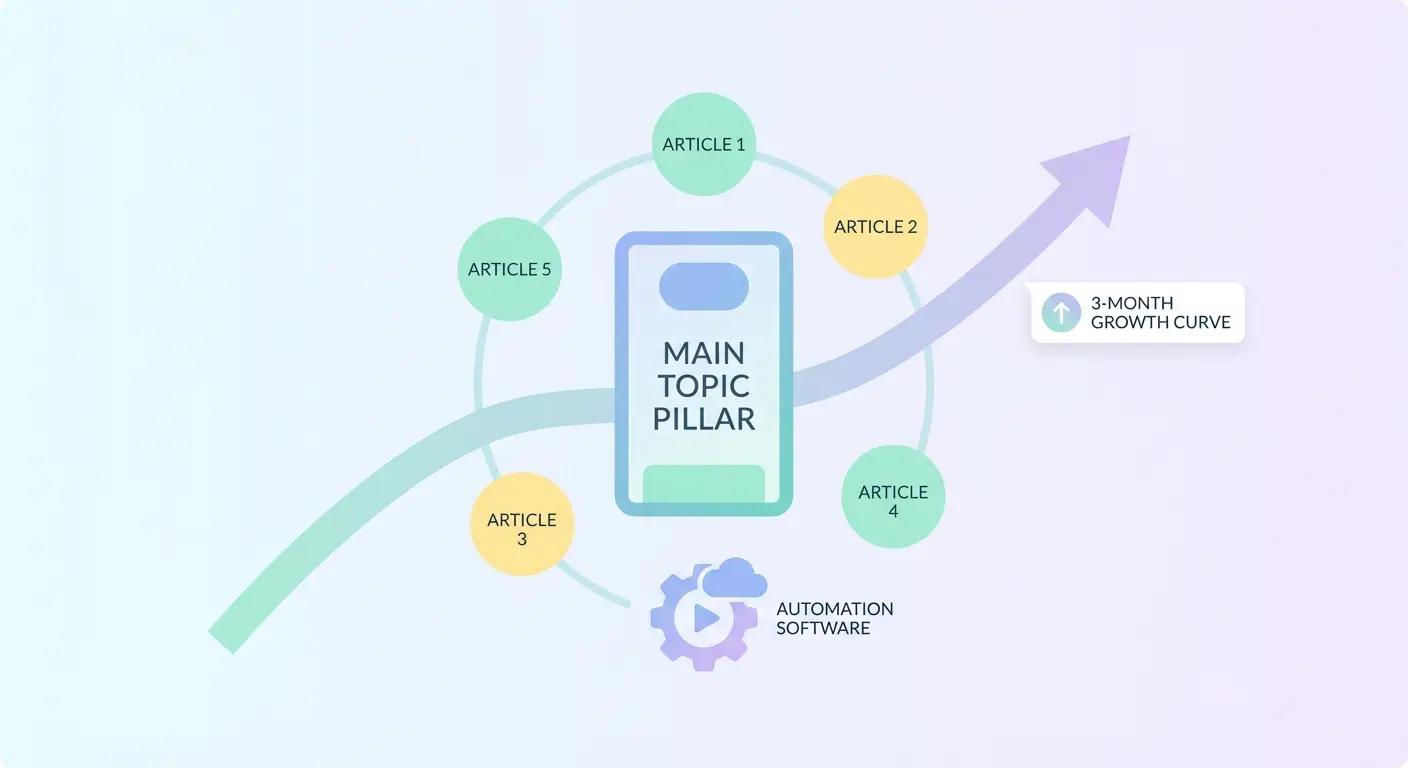
The reason it works comes down to one principle Google has been rewarding for years: topical authority. Sites that cover a subject thoroughly — not just with one post but with dozens of interconnected articles — rank significantly higher than thin sites with isolated content.
Manually building topical authority takes months and a full writing team. Blog automation software compresses that timeline dramatically. According to Ascend2’s 2024 Content Marketing & AI Research, 67% of marketers using AI content tools reported faster content production as a primary benefit, and 43% saw measurable improvements in search rankings within 90 days.
What most people miss is the compounding effect. Each article you publish increases your site’s authority, which makes the next article rank faster. Automation accelerates this loop.
Who Actually Needs This
If you’re a solopreneur writing blog posts at 11pm or a bootstrapped SaaS founder who keeps pushing “content” to next month’s to-do list — this is for you. You don’t need a content team. You need a system that runs without you.
How AI SEO Content Automation Actually Works
AI SEO content automation isn’t magic — it’s a structured pipeline. Understanding the mechanics helps you pick the right tool and set realistic expectations.
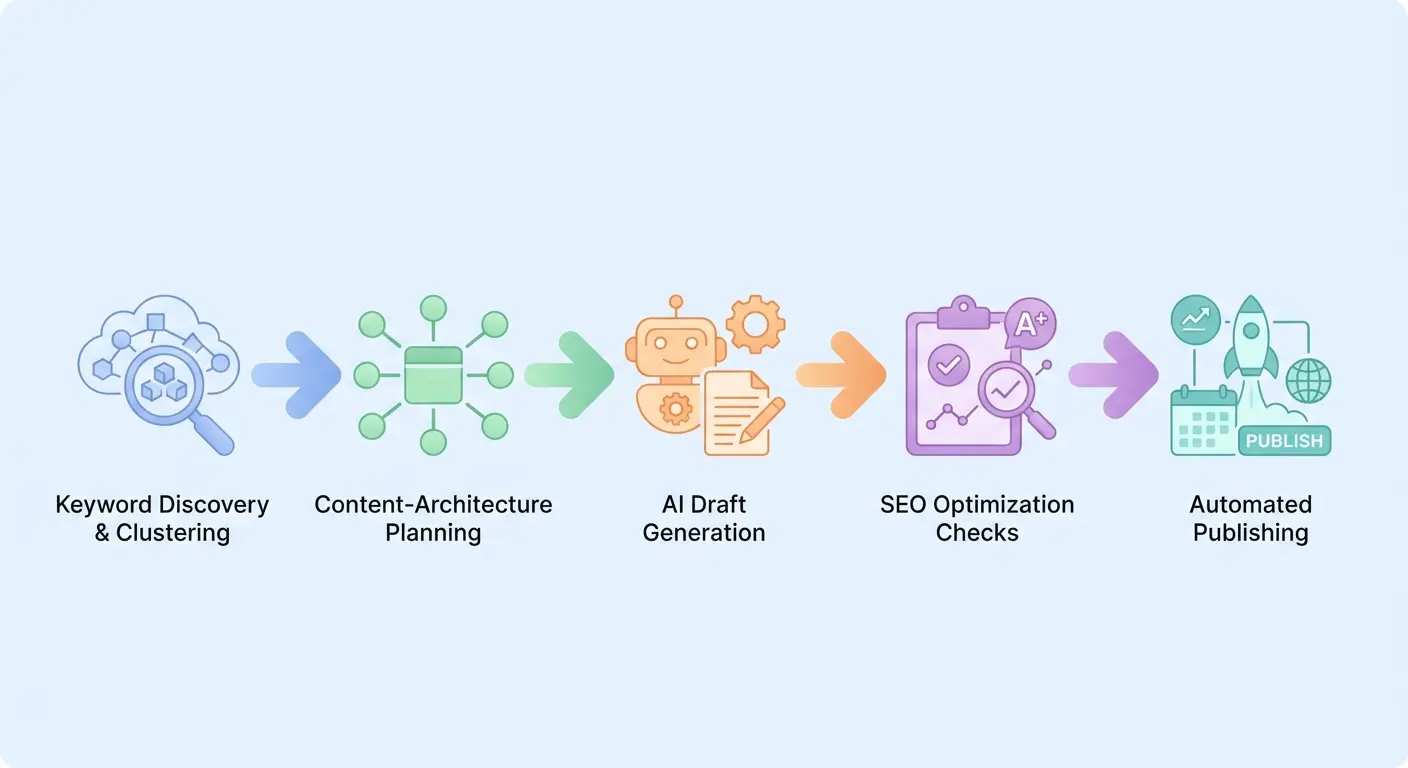
Here’s how a complete automation pipeline works end-to-end:
- Keyword Discovery & Clustering: The system analyzes your niche, identifies relevant search queries, and groups them by semantic relevance. Long-tail, low-competition queries get prioritized for fast wins. (More on why this matters in our long-tail keyword strategy guide.)
- Content Architecture Planning: Keywords are mapped to a pillar-cluster structure — broad topics become pillar pages, subtopics become cluster articles, specific questions become supporting posts. This creates topical authority systematically.
- AI Draft Generation: Large language models write the article based on the keyword brief, competitor analysis, and SEO requirements. Headers, meta descriptions, schema markup, and internal linking are built in.
- SEO Optimization: The content is checked for keyword density, readability, title tag length, and semantic keyword coverage before publishing.
- Automated Publishing: The finished article gets pushed directly to WordPress with categories, tags, featured images, and sitemap updates — no copy-paste required.
The key difference between good and bad AI SEO content automation is where human judgment lives. The best systems let you define your strategy (goals, target audience, brand voice) once — then execute autonomously. You’re the director, not the writer.
Google’s own guidance on AI-generated content confirms this approach: Google rewards helpful, high-quality content regardless of how it’s produced. The key is that the content genuinely serves readers, not that a human typed every word.
The Role of Pillar-Cluster Architecture in Automation
Here’s where it gets interesting: automation without structure is just noise. Randomly publishing AI articles won’t build authority — you need a topical map that tells Google “this site owns this subject.”
A pillar page covers a broad topic comprehensively. Cluster articles go deep on each subtopic and link back to the pillar. Supporting content captures ultra-specific long-tail queries. When you automate within this structure, every piece of content reinforces every other piece. Our full breakdown of pillar-cluster content strategy and architecture covers this in detail — it’s the structural backbone of any traffic-doubling plan.
The 90-Day Traffic Doubling Plan: Week-by-Week
Doubling traffic in 90 days is achievable — but it requires a specific playbook, not just “posting more.” Here’s the exact framework, broken into three phases.
Phase 1 (Days 1–30): Foundation and Fast Wins
The first month is about laying groundwork and capturing quick-win traffic from low-competition keywords. Most people skip this phase and go straight to writing — that’s why they stall at month two.
- Audit your existing content. Identify which posts have any ranking potential (positions 11-30 are gold).
- Build your topical map. Define 3-5 pillar topics relevant to your business. Each pillar needs 8-12 cluster articles.
- Target long-tail keywords with search volume under 1,000/month and keyword difficulty under 20. These rank in 30-60 days.
- Publishing target: 3 cluster articles per week minimum.
Phase 2 (Days 31–60): Velocity and Internal Linking
By week five, you should have 12-15 new articles live. Now you activate the compounding effect.
- Increase publishing cadence to 4-5 posts per week.
- Add internal links from new posts back to pillars and from pillar pages to cluster articles.
- Update any existing content that’s close to ranking — add internal links from new posts to these underperformers.
- Begin publishing at least one pillar page if you haven’t already.
Phase 3 (Days 61–90): Authority Consolidation
This is where the compounding effect becomes visible in Google Search Console. Traffic starts accelerating because your topical authority signals are cumulative.
- Monitor which cluster articles are ranking and double down on those subtopics.
- Publish supporting content targeting the exact questions your ranking articles are showing up for.
- Add schema markup to top-performing posts for featured snippet opportunities.
- Review internal linking gaps — every article should link to at least 2 others.
Blog Automation Tools Compared: What to Look For
Not all blog automation software is built the same. Some tools are glorified AI writers. Others are full content pipelines. Here’s what separates them:
| Feature | Basic AI Writers | Mid-Tier Tools | Full Automation Platforms |
|---|---|---|---|
| Keyword Research | ❌ Manual | ⚠️ Basic suggestions | ✅ Automated, clustered |
| Content Architecture | ❌ None | ⚠️ Manual planning | ✅ Pillar-cluster built-in |
| WordPress Publishing | ❌ Copy-paste | ⚠️ Some integrations | ✅ One-click, automated |
| Internal Linking | ❌ Manual | ⚠️ Suggestions only | ✅ Automatic |
| Schema Markup | ❌ None | ⚠️ Manual add-on | ✅ Auto-generated |
| Scheduled Publishing | ❌ None | ⚠️ Limited | ✅ Full calendar control |
| Topical Authority Building | ❌ None | ❌ None | ✅ Core feature |
What most buyers miss: they purchase an AI writer and expect it to behave like a content platform. These are fundamentally different products. An AI writer generates text. A full automation platform manages your entire content strategy and executes it.
For a deeper look at how professionals structure AI content workflows, Ahrefs published their complete internal AI content process — a candid look at what working at scale actually requires. And their breakdown of 7 real content automations used by pros shows just how far the gap is between “using ChatGPT” and running a real automated content operation.
For those building custom workflows, tools like Zapier’s WordPress + Google Sheets automation and n8n’s YouTube-to-WordPress workflow with Gemini AI show what’s possible with custom stacks — though they require significant technical setup.
Authenova: The Autonomous Content Engine Built for This
Most blog automation software makes you do the hard thinking and automates the easy part (the writing). Authenova flips that. You define your strategy once — and the platform does the rest.
Here’s what makes it different from every other tool in this category:
Strategy Builder: Your Content Plan on Autopilot
The Authenova Strategy Builder lets you define your business goal (traffic growth, product sales, authority building), set your publishing cadence, and assign keywords with roles — primary, secondary, supporting. Each campaign runs independently with its own content velocity and keyword targeting. You set it up once. The platform executes continuously.
AI Content Generator: Pillar-Cluster Architecture by Default
Every piece of content created by the Authenova AI Content Generator is structured for topical authority from the start. Pillar pages, cluster articles, and long-tail supporting content are generated in the correct hierarchy, with automatic internal linking between them. Schema markup, meta descriptions, and keyword placement are built in — not bolted on.
WordPress Plugin: One-Click Publishing Pipeline
The biggest time sink in most content workflows is the publishing step — formatting, tagging, categorizing, uploading. The Authenova WordPress Plugin eliminates all of it. Install, activate, and your WordPress site receives AI-generated, fully optimized content on your publishing schedule. Categories, tags, schema, sitemaps — handled automatically.
This is what a real automated blog writing system looks like: you review content (optional), approve it, and your site grows. No more 11pm editing sessions.
Authenova also supports multi-language publishing, making it viable for businesses targeting multiple geographic markets — particularly relevant for teams in the US, UK, Canada, Australia, and India.
Before vs. After: What Real Automation Looks Like
Theory is one thing. Here’s what the before/after actually looks like for a typical small business owner who makes the switch to automated blog writing.
| Metric | Before Automation | After 90 Days of Automation |
|---|---|---|
| Posts published per month | 4 (1/week) | 16-20 (4-5/week) |
| Hours spent on content | 20-30 hrs/month | 3-5 hrs/month (review) |
| Keywords ranking (pos 1-20) | 12 keywords | 60-80 keywords |
| Organic monthly sessions | 1,200 | 2,800-3,500 |
| Internal links per post | 1-2 (when remembered) | 4-6 (automatic) |
| Content cost per article | $150-400 (freelancer) | $5-15 (automated) |
The cost comparison alone is striking. A freelance writer charging $200/article for 20 articles per month costs $4,000. The same output from a platform like Authenova costs a fraction of that — and SEO optimization is built in, not an add-on service.
Step-by-Step Setup: From Zero to Automated in One Day
Fair warning: getting this running takes a few hours upfront. After that, you’re done. Here’s the exact setup process.
- Define Your Topical Map (1 hour): Write down 3-5 core topics your business should own in search. For each topic, list 8-10 subtopics — these become your cluster articles. Check our guide on AI-powered SEO content strategy for a full implementation checklist.
- Research 30-50 Long-Tail Keywords (30 min): Use Google’s autocomplete, “People Also Ask” boxes, and Ahrefs Free Keyword Generator. Target queries with under 1,000 monthly searches and low competition first. Our long-tail keyword strategy guide shows exactly how to build this funnel.
- Connect Your WordPress Site (10 min): Install the Authenova WordPress Plugin. Activate it. The plugin syncs your site structure — pages, categories, tags, metadata — to the platform automatically. Your publishing pipeline is now live.
- Configure Your Strategy (20 min): In Authenova’s Strategy Builder, set your business goal, publishing cadence (recommend starting at 3 posts/week), and content type ratios (e.g., 20% pillars, 60% clusters, 20% supporting). Assign your keyword list with roles.
- Review Your First Batch of Content (1-2 hours): The platform generates your first set of articles. Review for brand voice and accuracy. This step gets faster as the system learns your niche. Approve and schedule.
- Set Up Weekly Check-ins (15 min/week): Check Google Search Console every Monday. Track which articles are gaining impressions. Feed that data back into your keyword list — double down on what’s gaining traction.
The One Thing That Kills 90-Day Plans
Most people stall because they try to perfect every article before publishing. Here’s the counterintuitive truth: a published 85%-quality article beats an unpublished perfect one every single time. Google can’t rank content that doesn’t exist. Ship it, review after 30 days, update what needs updating.
Frequently Asked Questions
What is blog automation software?
Blog automation software is a platform that uses AI and workflow automation to research keywords, generate SEO-optimized articles, and publish them to your website on a scheduled basis — without manual effort for each piece of content. The best platforms also handle internal linking, schema markup, and topical authority building automatically, replacing the work of a full content team.
Is AI SEO content automation safe for Google rankings?
Yes — Google’s official guidance states that AI-generated content is not penalized as long as it’s helpful, accurate, and serves readers. The key is quality and structure, not authorship. Platforms that generate properly optimized, reader-first content within a pillar-cluster architecture are fully compliant with Google’s Search quality guidelines.
How long does it take to see traffic results from automated blog writing?
Most sites targeting long-tail, low-competition keywords begin seeing measurable traffic increases within 30-45 days of consistent publishing. Doubling organic traffic typically takes 60-90 days when publishing 3-5 optimized posts per week. Sites in competitive niches may take 90-120 days for significant ranking gains on higher-difficulty keywords.
Can blog automation software replace a human content team?
For SEO content at scale, yes — modern blog automation platforms handle strategy, writing, optimization, and publishing autonomously. Human oversight is still valuable for brand voice calibration, fact-checking industry-specific claims, and reviewing high-stakes content. Think of it as a content team that works 24/7 at a fraction of the cost, with a human editor reviewing weekly rather than writing daily.
How much does automated blog writing software cost vs. freelance writers?
Freelance blog writers typically charge $100-$500 per article depending on niche and length. At 16-20 articles per month, that’s $1,600-$10,000/month. Blog automation platforms typically cost $50-$500/month for equivalent volume output, representing an 80-95% cost reduction. The ROI becomes significant within the first month of use.
What’s the difference between an AI writer and full blog automation software?
An AI writer generates text from a prompt — you still need to do keyword research, create outlines, handle SEO optimization, and publish manually. Full blog automation software manages the entire pipeline: it researches keywords, builds content architecture, generates and optimizes articles, handles internal linking, and publishes to WordPress automatically. The difference is hours of manual work per article vs. a near-zero-touch workflow.
Ready to Stop Writing and Start Growing?
Every week you spend manually writing blog posts is a week your competitors are using automation to outrank you.
Authenova handles your entire content pipeline — keyword research, AI writing, SEO optimization, and WordPress publishing — on autopilot. No credit card required to start.
Start Your Free Trial — No Credit Card Needed
Install the WordPress plugin in 60 seconds. Your first automated article can be live today.
Doubling traffic in 90 days isn’t a fantasy — it’s math. Publish more relevant, optimized, topically structured content than you do today using automated blog writing and AI SEO content automation, and your rankings will follow. The only question is whether you’re going to spend those 90 days writing manually or let a system do it for you.
The brands that win in organic search aren’t the ones with the best writers. They’re the ones with the best systems. Build yours with a proven AI-powered SEO content strategy — then let automation execute it while you focus on everything else that actually needs your attention.