
Automated Blog Writing & AI SEO Content Automation: 5-Step Secret to 3x ROI
You’re publishing one blog post a month. Your competitor just pushed out twelve. And somehow, they’re ranking above you for keywords you’ve been chasing for a year. That’s the cold reality of organic search right now — and it’s exactly why automated blog writing and AI SEO content automation have stopped being “nice to have” and become a survival strategy for small businesses, solopreneurs, and bootstrapped SaaS founders.
Here’s the thing most content gurus won’t tell you: you don’t need to write more. You need a system that writes for you — one that’s structured, keyword-aware, and built to compound traffic over time. That’s what this guide covers, step by step.
What Is AI SEO Content Automation (And Why It Works Now)
Let’s set the foundation before we get into the system, because this term gets muddied constantly.
AI SEO content automation is the process of using artificial intelligence to research, generate, optimize, and publish SEO-targeted blog content at scale — without manual writing for each piece. It combines NLP-driven keyword targeting, structured content architecture (pillar-cluster models), and automated CMS publishing to produce consistent organic search results.

Three things changed in 2024–2025 that made this viable at the small business level. First, large language models got dramatically better at following structured SEO briefs — not just writing fluent prose, but placing keywords at the right density, using proper heading hierarchies, and generating schema-ready content. Second, WordPress plugin ecosystems matured enough that AI platforms can now push fully optimized posts directly to your site without touching a text editor. Third — and this is the one most people miss — Google’s Helpful Content guidelines shifted to reward topical depth and consistency, not just individual article quality. That change made high-velocity, structured content the single best organic growth lever available.
According to the 2024 State of Marketing AI Report by Marketing AI Institute & Drift, 68% of marketing teams said AI-assisted content creation was their highest-ROI AI use case. That’s not a small signal.
Fair warning though: automated blog writing isn’t a “set it and forget it” button. It’s a system that needs proper setup — which is exactly what the 5 steps below will walk you through.
Automated Blog Writing vs. Manual: The Real ROI Comparison
Before you commit to any workflow, you deserve a straight-up numbers comparison — not marketing spin.
| Factor | Manual Content Writing | AI SEO Content Automation | Winner |
|---|---|---|---|
| Cost per article | $150–$500 (freelancer) or 4–8 hrs (in-house) | $2–$15 per piece at platform scale | ✅ Automation |
| Content velocity | 2–6 articles/month realistic | 20–100+ articles/month | ✅ Automation |
| On-page SEO consistency | Varies by writer — often incomplete | 100% consistent schema, meta, heading structure | ✅ Automation |
| Brand voice & nuance | High — experienced writer nails it | Good with proper prompting; improves over time | ⚖️ Manual (slight edge) |
| Internal linking | Inconsistent — often forgotten | Automated, architecture-aware | ✅ Automation |
| Topical authority building | Slow — depends on team capacity | Fast — systematic cluster coverage | ✅ Automation |
| Scalability | Linear — need more writers to scale | Exponential — same setup, more output | ✅ Automation |
The counterintuitive insight here: manual content has a quality ceiling that automation eventually reaches, but automation has a volume floor that manual writing can never meet. For organic SEO — where topical coverage and consistent publishing frequency matter enormously — volume wins the long game.
Ahrefs documented this exact dynamic in their own operations. Their post on AI content processes at scale shows how systematic AI-assisted content production consistently outperforms sporadic high-effort manual publishing for search traffic growth.
The 5-Step Autonomous Content Creation System for Automated Blog Writing
This is where most guides hand you a generic “use AI tools” checklist and call it a day. Not here. Each step below is actionable, sequenced, and built for the solo operator or lean team who needs results without a dedicated content department.
Step 1 — Keyword Research & Intent Mapping for Automated Blog Writing
Most people start with keywords. The smart ones start with intent clusters.
Here’s where it gets interesting: a keyword like “content automation” has four different intents hiding inside it — informational (what is it?), commercial (what tools exist?), transactional (I’m ready to buy), and navigational (find a specific platform). If your automated blog writing system generates content without distinguishing between these, you’ll publish 30 articles that cannibalize each other and confuse Google’s crawlers.
The intent-mapping process:
- Seed keyword export: Pull 50–100 seed keywords from your niche using tools like Semrush or Ahrefs. Focus on terms with 100–10,000 monthly searches — the sweet spot for AI-generated content to rank.
- Intent classification: Tag each keyword as informational, commercial, transactional, or navigational. This determines the content type you’ll assign.
- Long-tail expansion: For every seed keyword, generate 5–10 long-tail variants. These are your cluster article targets. (The long-tail keyword strategy that most marketers overlook explains why these lower-competition terms compound traffic faster than head terms.)
- Competitive gap analysis: Identify keywords your competitors rank for but you don’t. These become your first automation targets.
- Volume-to-difficulty scoring: Score each keyword by (monthly search volume ÷ keyword difficulty). Prioritize the top 20% — high ratio scores mean faster ranking wins.
What most people miss at this stage: don’t just collect keywords — assign each one a role in your content architecture. Is it a pillar topic (broad, high-volume), a cluster article (medium-volume subtopic), or a supporting piece (long-tail, single question)? That role determines everything about how the AI generates the content in Step 3.
Step 2 — Pillar-Cluster Brief Generation for AI Content Architecture
The brief is where 90% of AI content failures happen. Vague input = mediocre output. Structured, SEO-aware input = content that ranks.
A proper brief for automated blog writing includes six non-negotiable elements:
- Primary keyword + density target: E.g., “automated blog writing” at 1.5% density across 2,000 words
- Secondary & LSI keywords: Related terms like “AI content generation,” “content marketing automation,” “WordPress automation,” “SEO content tools”
- Content type & word count: Pillar (2,500–4,000 words), cluster (1,500–2,500 words), or supporting (800–1,500 words)
- Heading hierarchy blueprint: Pre-mapped H2 and H3 structure so the AI follows a logical outline rather than improvising
- Internal linking targets: Which existing pages should be linked, with suggested anchor text
- Audience & intent signal: Who’s reading this? What do they need to know to take action?
The pillar-cluster model is the architecture that makes this work at scale. You produce one comprehensive pillar page on a broad topic, then generate 8–15 cluster articles targeting related subtopics — all internally linked back to the pillar. The pillar-cluster content strategy for topical authority building breaks down the exact architecture in detail, including how to map clusters so they reinforce each other’s ranking signals rather than competing.

Step 3 — AI Content Generation with On-Page SEO Baked In
Here’s the step where people either succeed or completely waste money on AI tools. Content generation without SEO optimization built into the process produces articles that read well but rank nowhere.
What “SEO baked in” actually means:
- Primary keyword in H1, first 100 words, and at least 2 H2s — not stuffed, placed naturally
- Schema markup auto-generated — Article schema, FAQ schema, HowTo schema depending on content type
- Meta description written to maximize CTR — action-oriented, 150–160 characters, includes keyword
- Readability targets met — Flesch-Kincaid 60–70, paragraphs under 4 sentences, subheadings every 250–300 words
- Featured snippet formatting — definition boxes, numbered lists, comparison tables positioned within the first 300 words where applicable
- Internal links auto-placed with keyword-rich anchor text, not generic phrases
One important caveat: not all AI SEO tools are created equal. A 2025 benchmark study reported by Search Engine Land found that newer versions of Claude, Gemini, and ChatGPT-5.1 actually showed accuracy drops in SEO tasks compared to earlier models. The lesson: use platforms purpose-built for SEO content automation, not general-purpose chatbots repurposed for content creation.
Semrush’s own research on content automation best practices echoes this — the quality gap between generic AI writing and SEO-specialized AI content tools is substantial, particularly for structured, keyword-targeted blog content.
Step 4 — WordPress Automation & Scheduled Publishing
Generating content is only half the system. Publishing it — consistently, at scale, without manual uploading — is where the time savings compound.
The WordPress automation layer needs to handle:
- Content ingestion: The AI platform pushes the article to WordPress via API or plugin — no copy-paste
- Metadata injection: Title tag, meta description, focus keyword, Open Graph tags — all pre-populated
- Category & tag assignment: Based on content type and topic cluster — keeps your site architecture clean
- Internal link insertion: Links placed contextually within content, not added as an afterthought
- Schema markup addition: Proper structured data markup added to the post template automatically
- Sitemap update: New URL submitted to Google Search Console as part of the publish workflow
- Publishing schedule: Articles queued by content type — pillar pages first, then clusters, then supporting content
Publishing frequency matters more than most people realize. Google’s crawl budget allocation responds to consistent publishing patterns. Sites that publish 4–5 posts per week for 3+ months consistently see crawl frequency increase — meaning new content indexes faster. This is the compounding effect that makes automated blog writing financially superior to sporadic manual publishing.
For a practical look at how AI content pipelines connect to WordPress at the technical level, n8n’s workflow tutorial for converting content into SEO blog posts shows the automation architecture in a concrete, visual format — worth reading if you’re building custom pipelines.
Step 5 — Performance Tracking & ROI Compounding for AI SEO Content
This step is where most small businesses drop the ball — they set up the automation, watch traffic climb slowly, get impatient at month two, and turn it off just before the compounding kicks in.
The tracking framework that makes ROI visible:
- Week 1–2 post-publish: Check indexing in Google Search Console. Every article should index within 7 days if your sitemap automation is working.
- Month 1: Track impressions by article. Early ranking signals (position 30–50) on target keywords confirm Google understands the content’s intent.
- Month 2–3: Watch for position climbing (30 → 15 → top 10). This is when internal linking within your cluster pays off — cluster articles boost pillar rankings, pillar authority lifts cluster rankings.
- Month 3+: Measure organic sessions per article, conversion events (email signups, trial starts, purchases), and revenue attribution. Calculate cost-per-acquired-visitor vs. paid search equivalent.
The ROI compounding happens because AI SEO content automation produces a permanent asset, not a rented impression. A paid ad stops driving traffic the second you stop paying. A ranked blog post drives traffic for months or years. The complete guide to AI-powered SEO content strategy for 2026 includes a detailed content velocity model that shows exactly how traffic compounds over 6, 12, and 18 months — worth reviewing before you set your publishing cadence.
How Authenova Powers the Entire 5-Step System in One Platform
Here’s the problem with building this system from scratch: you’d need to stitch together a keyword tool, an AI writer, a brief generator, a WordPress plugin, a publishing scheduler, and a reporting dashboard. That’s 6 tools, 6 subscriptions, and 6 integration headaches — before you’ve written a single word.
Authenova was built to make this one platform, not six.

Here’s what the workflow looks like inside Authenova:
- Connect your WordPress site via the Authenova WordPress Plugin — one-click install, and the platform syncs your existing pages, categories, tags, and metadata automatically. Your site’s architecture is immediately understood by the AI, so internal links are contextually accurate from day one.
- Define your strategy in the Strategy Builder — set business goals (traffic growth, product sales, authority building), assign keywords with roles (primary, secondary, supporting), configure publishing schedules, and define content velocity. Each strategy runs independently, so you can run multiple campaigns for different product lines or topic clusters simultaneously.
- Let the AI Content Generator execute — Authenova’s AI Content Generator produces articles using a strict pillar-cluster-supporting architecture. Every piece includes schema markup, meta descriptions, keyword placement at target density, proper heading hierarchies, and readability optimization. It doesn’t just write — it writes for rankings.
- Auto-publish on schedule — Articles flow directly to WordPress with full SEO optimization: meta tags, internal links, categories, schema, and sitemap updates all happen without you touching the CMS.
- Track, iterate, scale — Performance data feeds back into the system so you can double down on what’s ranking and adjust briefs for underperformers.
What makes this different from other AI content tools? Authenova doesn’t generate random articles. It builds a topically authoritative site — systematically covering your niche the same way a professional content team would, except at 20x the velocity and a fraction of the cost. Brands using the platform have reported 10x organic traffic growth within 6–9 months of consistent operation.
The ROI Calculation: Real Numbers for Automated Blog Writing
Let’s run the math that actually matters — not traffic vanity metrics, but revenue impact.
Scenario: Bootstrapped SaaS founder, $97/month plan, 20 articles/month output
| Metric | Month 1 | Month 3 | Month 6 |
|---|---|---|---|
| Articles published (cumulative) | 20 | 60 | 120 |
| Avg. monthly organic sessions (per ranking article) | ~15 | ~45 | ~120 |
| Total monthly organic sessions | 300 | 2,700 | 14,400 |
| Equivalent paid traffic cost (@ $2.50 CPC) | $750 | $6,750 | $36,000 |
| Platform cost | $97 | $97 | $97 |
| ROI multiple vs. platform cost | 7.7x | 69x | 371x |
These numbers are conservative — they assume average performance, not top-quartile. They also don’t account for conversion value. If even 1% of 14,400 monthly visitors sign up for a $97/month SaaS trial, that’s 144 trial users per month from content alone.
The thing that clicked for me when I first mapped this out: organic content is the only marketing channel where your cost stays flat while your output compounds. Every other channel — paid ads, influencer, social — scales linearly (more spend = more reach). Automated blog writing is the exception. Publish 120 articles, and all 120 keep working for you simultaneously, every single month.
5 Mistakes That Kill AI SEO Content Automation Results
There’s a version of automated blog writing that works, and a version that gets your site a manual action from Google. The difference usually comes down to one of these five mistakes.
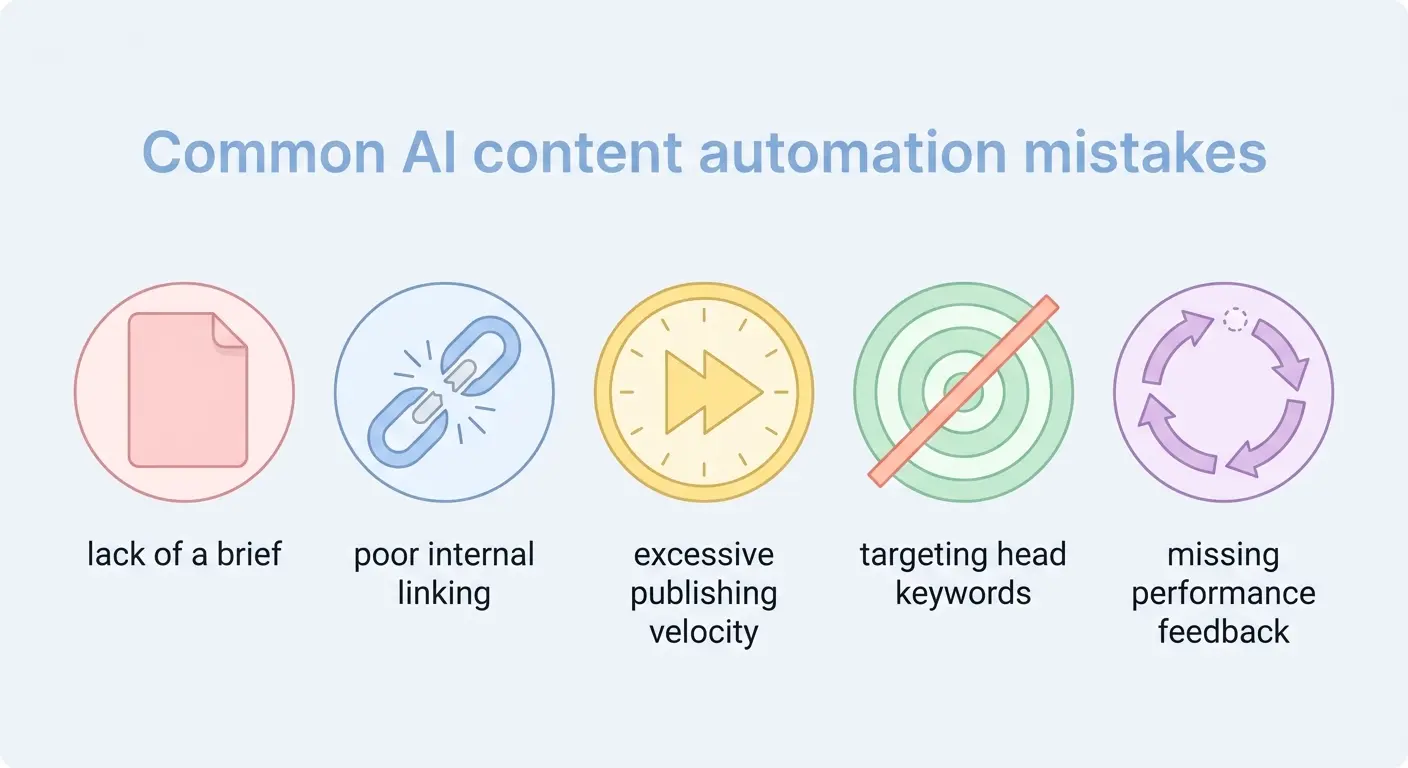
- Skipping the brief structure entirely. Feeding a keyword into a general AI tool and publishing the output is not content automation — it’s content spam. Every automated article needs a structured brief (see Step 2) or you’re producing undifferentiated content that Google will filter out in favor of more authoritative sources.
- Ignoring internal linking architecture. Standalone articles don’t build topical authority. Your automated content needs to link systematically within clusters — cluster articles to pillars, supporting content to clusters. Without this, you’re building a collection of isolated pages instead of an authoritative content hub.
- Publishing at an unsustainable velocity without quality floors. More isn’t always better. Publishing 50 thin 400-word articles per month will tank your domain metrics faster than publishing 10 well-structured 1,500-word cluster articles. Set minimum quality thresholds: minimum word count by content type, required sections (intro, FAQ, conclusion), schema markup inclusion.
- Targeting head keywords with automated content. Highly competitive head keywords (search volume 50,000+) take 12–18 months and significant link authority to rank. Automated content performs best on long-tail and mid-tail keywords (500–5,000 monthly searches) where topical relevance and content structure outweigh raw domain authority.
- No performance feedback loop. Automated content creation without performance tracking is throwing content into a black hole. You need to know which articles rank, which don’t, and why — then feed that insight back into brief templates for your next batch. Semrush Academy’s guide on AI SEO content workflows covers this feedback loop in detail for teams running continuous content programs.
This won’t work for everyone, but for those already publishing content manually without a keyword strategy or internal linking plan — switching to automated blog writing with a proper brief system will produce better results than your current manual process within 60 days. The bar isn’t as high as people fear.
If you’re evaluating which AI SEO tools to add to your stack alongside or instead of an all-in-one platform, Backlinko’s roundup of AI SEO tools for 2026 is the most current and rigorous comparison available — worth bookmarking as a reference.
FAQ: Automated Blog Writing & AI SEO Content Automation
Does automated blog writing hurt SEO rankings?
Automated blog writing does not hurt SEO rankings when done properly — Google’s guidelines evaluate content on helpfulness, structure, and relevance, not the method of creation. The risks come from thin, unstructured, or keyword-stuffed AI content published without proper briefs, schema, or internal linking. AI SEO content automation that follows a structured pillar-cluster architecture and meets readability standards performs comparably to high-quality manual content for most keyword targets.
How many AI-generated articles do I need to see traffic results?
Most sites see meaningful organic traffic movement after publishing 30–50 well-structured, keyword-targeted articles that form at least 3–4 complete topic clusters. The reason is topical authority — Google rewards sites that comprehensively cover a subject, not sites with isolated articles. With automated blog writing publishing 15–20 articles per month, you can expect your first significant ranking movements within 60–90 days of starting.
What’s the difference between AI SEO content automation and just using ChatGPT?
ChatGPT is a general-purpose language model — it generates text but has no native understanding of keyword density, heading hierarchies, schema markup, internal linking, or publishing workflows. AI SEO content automation platforms are purpose-built systems that layer SEO rules, content architecture, WordPress integration, and publishing automation on top of AI generation. The output quality, consistency, and ranking performance differ significantly — similar to comparing a word processor to a full CMS.
Can I automate blog writing for a brand-new WordPress site?
Yes — new WordPress sites benefit most from AI SEO content automation because there’s no legacy architecture to untangle. The ideal approach for a new site is to publish 1 pillar page and 6–8 cluster articles in the first two weeks to establish topical authority signals from the start. Then maintain a consistent publishing cadence of 10–20 articles per month. Avoid publishing to an empty site that hasn’t been indexed — make sure Google Search Console is configured and your sitemap is submitted before your first content batch goes live.
How does automated internal linking work in AI content platforms?
In purpose-built platforms like Authenova, automated internal linking works by crawling your existing site structure at the time of