Autonomous Content Creation in 2026: What It Is, How It Works, and When to Use It
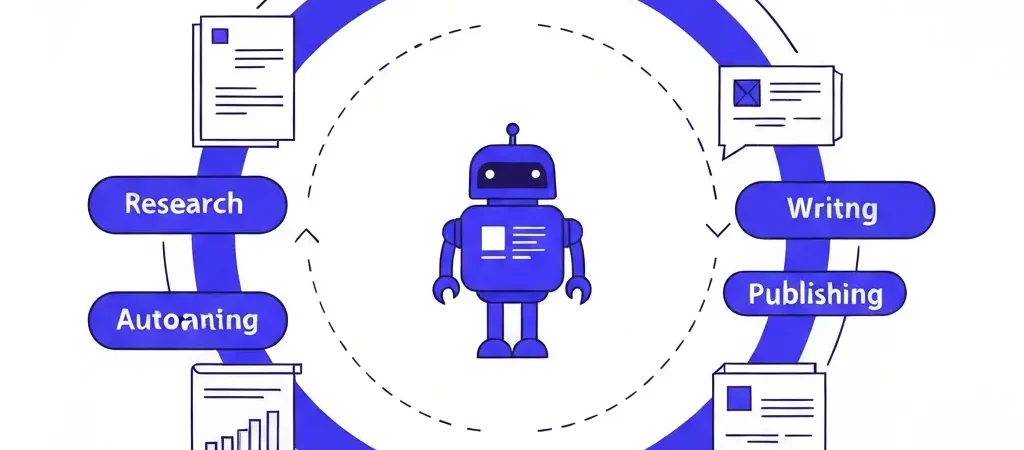
Autonomous content creation is the end state that content automation has been moving toward since the first AI writing tools appeared — a system where a single input (a keyword, a topic, a content calendar) triggers a complete chain of actions: research, drafting, SEO optimization, image generation, and publishing, all executed without manual intervention between steps. In 2026, this state is practically achievable for informational blog content. Understanding what it means, what it requires to work, and where it falls short is essential for anyone building a serious content program.
This guide clarifies what autonomous content creation actually entails in a 2026 context — how it differs from simple AI writing tools, what architecture it requires, what types of content it handles well, and where human judgment remains necessary. No hype about “set it and forget it forever.” A clear-eyed picture of what this technology can and cannot do.
Defining Autonomous Content Creation
The term “autonomous” distinguishes a specific workflow pattern from simpler forms of AI-assisted content:
- AI writing tool: Human provides topic, human prompts AI, human edits output, human publishes. AI assists one step.
- AI content generator: Human inputs keyword, AI generates article, human reviews and publishes. AI handles writing; human handles before and after.
- Autonomous content creation: Human configures strategy once, platform generates and publishes on schedule, human reviews performance periodically. AI handles the full production-to-publication pipeline.
The shift from AI-assisted to autonomous is not about removing the human entirely — it is about moving the human from the production loop to the strategy and governance loop. A content strategist who previously spent 30 hours per week writing and publishing now spends 4 hours per week configuring strategy and reviewing performance. The 26 hours difference is the value of autonomy.
How Autonomous Content Creation Works in Practice
In a functional autonomous content system, here is what happens after the initial configuration:
- Schedule trigger: The platform’s scheduler identifies that a new article is due based on the configured cadence (e.g., every Tuesday and Friday at 08:00 UTC)
- Keyword selection: The system selects the next keyword from the configured strategy’s keyword list, prioritizing by search volume, content type (pillar, cluster, supporting), and what has not yet been published
- Research layer: Advanced platforms query external sources (web search, SERP analysis) to inform the article with current data — not just training data from the model’s knowledge cutoff
- Content generation: The article is generated according to the strategy’s brand voice, content type, target audience, and structural requirements (heading hierarchy, FAQ section, word count range)
- SEO layer: Schema markup is generated, focus keyword is verified in required positions, meta description is generated, OG metadata is populated
- Image generation: A featured image is generated based on the article topic and set as the WordPress featured image with descriptive alt text
- Publishing: The article is pushed to WordPress at the scheduled time with correct category, tags, slug, and publish status
This entire sequence executes without any human action per article. Authenova implements this pipeline exactly as described — the configuration happens in the strategy dashboard and every subsequent article runs automatically within those parameters.
What Content Types It Handles Well
Autonomous content creation performs reliably well for:
Informational SEO content
How-to guides, explainer articles, comparison content, FAQ articles, and educational resources are the strongest use cases for autonomous generation. These content types follow predictable structures, the quality bar is measurable against competing search results, and the success metric (organic ranking) is objective. This is where autonomous content creation delivers its strongest ROI.
Supporting content in established clusters
When a topical cluster already has its pillar and major cluster articles in place, supporting articles targeting long-tail questions can be generated and published autonomously with high confidence — the context is established, the internal linking targets are clear, and the scope is narrow enough that AI handles it consistently.
Evergreen reference content
Resource articles that remain relevant over time (glossary definitions, category overviews, methodology explanations) are strong candidates for autonomous generation because they do not require real-time information and their quality does not degrade quickly after publication.
High-volume topical coverage
When you need to cover an entire topic area comprehensively — 50 articles targeting every variant of a keyword cluster — autonomous generation lets you execute that coverage plan without the linear time cost that manual writing would require. Topical authority builds faster when coverage gaps close quickly.
What Still Requires Human Judgment
Intellectual honesty about autonomous content creation’s limits:
Original research and data production
Autonomous systems can synthesize existing information. They cannot conduct surveys, run experiments, collect proprietary data, or generate insights that do not already exist in some form. Content that derives its value from original data — the kind that earns backlinks and citation — requires human research input.
Expert interviews and named perspectives
Quotes from named industry figures, expert commentary, and first-person case studies are E-E-A-T signals that AI cannot fabricate without creating false attribution risk. Content programs that rely on expert sourcing for authority signals require a human sourcing layer.
Breaking news and real-time events
Autonomous generation is configured on a schedule and works from a keyword list. It cannot respond to breaking developments, trending topics that emerged since strategy configuration, or real-time events that create content opportunities. News-driven content requires human monitoring and trigger.
Strategy pivots
Autonomous content creation executes the strategy you configure. It does not recognize when that strategy should change — when a competitor emerges, when Google updates its algorithm in ways that affect your approach, or when your audience’s needs shift. Human strategic review is required at least quarterly to evaluate performance and adjust the strategy configuration accordingly.
Getting Started: Configuration Over Automation
The counterintuitive truth about autonomous content creation: more upfront configuration produces better autonomous output. Operators who rush through strategy setup to get to the “autonomous” part produce worse content than those who spend significant time on the configuration layer.
Essential configuration elements for quality autonomous output:
- Keyword strategy: Define target keywords explicitly — not topics, not themes, but specific keywords with volume data and content type assignments (pillar vs cluster vs supporting)
- Brand voice document: Describe your brand voice in concrete, distinctive terms. “Professional but approachable” is too vague. “Writes like a knowledgeable friend who has 10 years of WordPress experience, uses second person, avoids jargon but does not dumb things down, includes practical examples from real implementations” is actionable.
- Target audience definition: Who is the reader? What do they already know? What problem are they trying to solve? This determines vocabulary level, assumed knowledge, and content depth.
- Content cluster map: Lay out your pillar-cluster architecture before generating anything. Knowing which article is the pillar, which are clusters, and how they link to each other makes every generated article more coherent.
- External link sources: Define which external domains your content should cite as authoritative — industry publications, official documentation, research organizations relevant to your niche.
In Authenova, all of these configuration elements live in the Strategy dashboard. Time invested in strategy configuration directly translates to content quality — autonomous systems produce better output within tighter parameters.
Quality Governance at Scale
Autonomous does not mean unmonitored. A sustainable autonomous content program includes a governance layer:
Weekly: Quick review of new articles
Scan the previous week’s published content for obvious quality issues: factual errors, brand voice drift, structural problems. This is a 20–30 minute review, not a deep editorial pass. Flag articles that need revision and update them.
Monthly: Performance review in Google Search Console
Which articles are gaining impressions? Which have high impressions but low CTR (schema opportunity)? Which have been published for 3+ months with no indexation (technical issue)? Monthly GSC review drives your refresh and optimization priorities.
Quarterly: Strategy review and update
Evaluate whether your keyword targets, content types, and publishing cadence are producing the organic growth you expect. Update keyword lists, retire completed clusters, launch new topic areas. This is the strategic adjustment layer that keeps the autonomous system aligned with your actual business goals.
For the broader ecosystem that supports an autonomous content program, read our guide on the 4-tool content automation stack. For a framework on the content quality that makes autonomous publishing effective, see AI blog content that ranks: the five-layer framework.
If you are ready to implement autonomous content creation for your site, Authenova provides the strategy configuration, content generation, image creation, and WordPress publishing pipeline in a single connected system. For inspiration on how content automation connects to broader marketing workflows, CampaignOS’s email marketing automation guide covers the distribution layer that amplifies autonomous content reach.
FAQ
What is the difference between autonomous content creation and regular AI content generation?
Regular AI content generation requires human input for each article — prompting the AI, reviewing the output, handling SEO optimization, and publishing manually. Autonomous content creation runs the entire pipeline automatically on a schedule: keyword selection, generation, SEO optimization, image creation, and WordPress publishing all happen without per-article human action. The human role shifts from production to strategy and governance.
Is autonomous content creation safe from Google penalties?
Google does not penalize content for being autonomously generated — it penalizes content for being low-quality, thin, spammy, or unhelpful. Autonomous systems that produce well-structured, keyword-targeted, schema-enhanced content on relevant topics perform well in search. Autonomous systems that produce generic, repetitive, or thin content get the same treatment any low-quality content would. The generation method is not the risk factor — the output quality is.
How much time does setting up autonomous content creation require?
Initial setup in a platform like Authenova takes 4–8 hours for a thorough strategy configuration — keyword research, cluster planning, brand voice documentation, WordPress plugin connection, and publishing schedule setup. After the initial setup, ongoing management runs 2–4 hours per week for quality review and performance monitoring. The front-loaded investment pays back in the production time it eliminates every subsequent week.
Can autonomous content creation work for B2B content marketing?
Yes, for the informational content layer of a B2B program — comparison guides, how-to articles, tool evaluations, FAQ content. Autonomous generation handles this category well. The high-authority assets typical of B2B programs (whitepapers, research reports, case studies with customer interviews) require human production. A strong B2B content program uses autonomous generation for the volume layer and reserves human effort for signature content that drives brand authority and demand generation.
What happens when an autonomous content system publishes an error?
Errors in autonomously published content are addressed through the governance layer: weekly review catches obvious issues before they generate significant traffic. When a factual error is identified, update the article body and the dateModified field to signal Google that the content has been corrected. Serious errors (dangerous medical or legal misinformation) should be unpublished immediately and corrected before republishing. A weekly review cadence means errors rarely stay live longer than 7 days — significantly better than many human-managed editorial processes.