How Google Evaluates Topical Authority: A 2026 Technical Breakdown
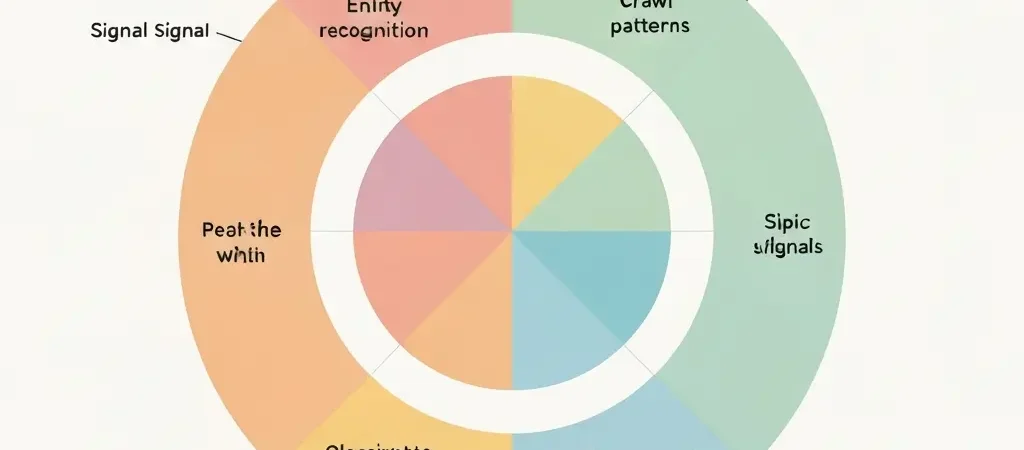
Most SEO guides tell you to “build topical authority” without explaining the specific signals Google uses to evaluate it. This vagueness leads to cargo cult content strategies: teams publish comprehensive-looking content that misses the actual quality dimensions Google measures. Understanding how Google evaluates topical authority requires reading Google’s documentation, studying its patents, and analysing the ranking patterns of sites that consistently demonstrate strong topical signals. This guide synthesises that evidence into a technical breakdown of the seven signal categories Google uses to assess topical authority in 2026.
Signal 1: Entity Recognition and Knowledge Graph Alignment
Google’s knowledge graph stores relationships between entities — people, organisations, concepts, products, and places. When your site consistently publishes content about entities in the same knowledge graph cluster, Google’s systems begin to recognise your site as an authority node for those entities.
The 2023 Google “Site Reputation” and “HCU” updates made entity recognition more explicit: Google now evaluates whether a site demonstrates a coherent subject focus (entity cluster) rather than scattered topical coverage. Sites whose published entities form a coherent cluster in Google’s knowledge graph receive higher topical authority scores for the entities in that cluster.
Practical implication: Consistently use the same entity names, terminology, and concept labels across all your content. “AI content generation”, “automated content creation”, and “machine-written articles” all refer to similar things — but using them inconsistently across articles dilutes entity recognition. Pick the primary entity label for each concept and use it consistently. See the TAC Model framework for implementing entity-consistent content strategies.
Signal 2: Topical Completeness
Google’s systems evaluate what percentage of relevant subtopics within a subject area a site covers. This is evidenced by studies showing that sites ranking in the top 3 for competitive head keywords cover an average of 78% of related subtopics, versus 43% for sites ranking positions 7-10.
Topical completeness does not require covering every tangential topic — it requires covering all central subtopics that users expect an authoritative source to address. The People Also Ask feature is one of the best proxies for what Google considers central subtopics: if Google shows a PAA question on a results page, it recognises that question as related to the primary query. Unanswered PAA questions represent topical completeness gaps.
The cluster content model — pillar, cluster, and supporting articles — maps directly to the topical completeness signal. Complete clusters that cover a subject hierarchy satisfy completeness requirements that scattered keyword-by-keyword publishing cannot. See how to build content clusters for maximum completeness signals.
Signal 3: Content Depth Per Subtopic
Topical completeness (breadth) must be accompanied by content depth (quality per subtopic). Google distinguishes between sites that mention a subtopic and sites that comprehensively address it. The information gain score — a concept documented in Google’s research papers — measures how much new information a page provides relative to what is already available in search results for that query.
High information gain signals include: original data or research not available elsewhere, first-person experience examples not replicable from secondary sources, and analysis that synthesises multiple sources into a new conclusion. AI-generated content that merely summarises publicly available information scores low on information gain. AI-generated content that incorporates original examples, cites primary research, and presents structured frameworks scores higher.
Signal 4: Internal Link Architecture
Google’s Reasonable Surfer Model (documented in patents) evaluates the probability that a user would follow each link on a page. Links in prominent positions with relevant anchor text pass more PageRank than links in footers or sidebars. The architecture of your internal link graph communicates the relative importance and relationships of your pages to Google’s crawlers.
The key patent-documented implications for topical authority:
- Pages that receive internal links with exact-match or close-variation anchor text to their focus keyword receive stronger topical relevance signals
- Pages that serve as hubs (receiving many internal links from topically related pages) are evaluated as authoritative on the hub topic
- The “hub-and-spoke” internal link architecture — where cluster articles all link to a central pillar page — is the structural pattern most consistent with Google’s hub authority model
Signal 5: External Link Signals
External backlinks remain the strongest domain authority signal, but their contribution to topical authority specifically depends on the topical relevance of the linking domain. A link from a domain that has high topical authority in the same subject area transfers both general PageRank and topical relevance signals. A link from an unrelated domain transfers PageRank but does not contribute to topical authority recognition.
Google’s Hilltop algorithm (now part of the core ranking system) identifies “expert documents” — pages that are heavily linked from other pages on the same topic. When a page accumulates links from multiple authoritative sources in the same topical cluster, it achieves Hilltop expert status: recognition as a topically authoritative source that Google trusts to rank for topic-related queries.
Signal 6: Crawl Frequency Patterns
Google allocates crawl budget to domains based on historical update frequency, link authority, and topical relevance to queries. Sites that publish new content frequently on the same topic signal to Google’s crawlers that the site is an active authority node worth crawling more often.
Publishing cadence directly affects topical authority build speed through the crawl frequency signal: a site publishing 20 articles per month on content marketing is crawled more frequently for content marketing queries than a site publishing 2 articles per month, all else being equal. The freshness of content (measured by publication dates and last-modified headers) is a sub-signal that Google uses for queries where recency matters — typically anything related to technology, current events, or annually-changing data. See content velocity benchmarks and how they affect crawl patterns.
Signal 7: User Engagement Signals
Google uses clickstream data from Chrome, Google Search, and Google Analytics (for sites that have consented to data sharing) to evaluate how users interact with search results. The most important engagement signals for topical authority evaluation:
- Pogo-sticking: When users click a result, quickly return to search results, and click a different result — indicating the first result did not satisfy their query. High pogo-sticking rates are a negative engagement signal that reduces ranking for that query.
- Long click: When users click a result and do not return to search results — indicating the page fully satisfied their query. Long clicks are positive engagement signals.
- Query refinement: When users click your result and then search for a related but more specific query. This pattern suggests your content partially satisfied intent but left questions unanswered — a signal to improve content comprehensiveness on that page.
These engagement signals feed directly into topical authority evaluation: sites where users consistently find complete answers rank higher for related queries over time, creating a positive feedback loop between content quality and authority signals.
Practical Implications for Content Strategy
The seven signal categories translate into five concrete content strategy priorities:
- Build complete clusters, not keyword lists. Topical completeness and entity recognition require comprehensive coverage, not a scattershot of individual articles.
- Add original value to every article. Information gain signals require content that provides something not available in existing search results. AI-generated summaries score low; AI-generated content enriched with original examples, data, and frameworks scores higher.
- Design internal link architecture before publishing. Internal links are a controllable signal — pre-mapping them before article generation ensures the hub-and-spoke architecture is in place from day one.
- Publish consistently. Crawl frequency signals reward consistent publication schedules. An automated content pipeline that publishes 4-5 articles per week consistently signals active authority better than burst publishing.
- Monitor engagement signals monthly. High bounce rates or low session durations on specific articles are actionable signals that content depth is insufficient. These articles should be expanded, not replaced.
Frequently Asked Questions
How does Google measure topical authority?
Google measures topical authority through seven main signal categories: entity recognition (does the site publish consistently about entities in a coherent knowledge graph cluster?), topical completeness (what percentage of relevant subtopics is covered?), content depth (does the content provide information gain over existing results?), internal link architecture (does the site’s link graph reflect authoritative hub structures?), external link signals from topically related sources, crawl frequency patterns reflecting publication consistency, and user engagement signals indicating query satisfaction.
How long does it take to build topical authority?
Building measurable topical authority in a defined subject area takes 3-6 months for a new site publishing 8-12 quality articles per month. For established sites adding new topical clusters, the timeline shortens to 6-10 weeks because existing domain authority accelerates entity recognition and crawl frequency for new content. Full competitive topical authority in a medium-competition niche typically requires 6-18 months depending on competitor authority levels and content velocity.
Is topical authority more important than domain authority?
Topical authority and domain authority are complementary, not competing signals. Domain authority (reflected in backlinks and PageRank) determines how much authority a site can command in aggregate. Topical authority determines how that authority is distributed across specific subject areas. A site with high domain authority but low topical authority for a specific subject will be outranked by a site with lower domain authority but comprehensive, well-structured topical coverage for that subject. In practice, content-first SEO builds topical authority which then attracts backlinks, which builds domain authority — they compound together.
Does publishing AI content hurt topical authority signals?
Publishing AI content does not inherently hurt topical authority signals. Topical authority signals are evaluated through content completeness, internal architecture, engagement signals, and external links — none of which are negatively impacted by AI authorship when content quality meets Google’s helpful content standards. The risk comes from publishing low-quality AI content at high volume, which can suppress site-wide quality signals and indirectly reduce topical authority recognition for all content on the domain.
Build Topical Authority With Systematic Content Automation
Authenova’s strategy-first publishing addresses all seven topical authority signals: complete clusters, consistent cadence, internal link architecture, and structured depth — built into every content program.