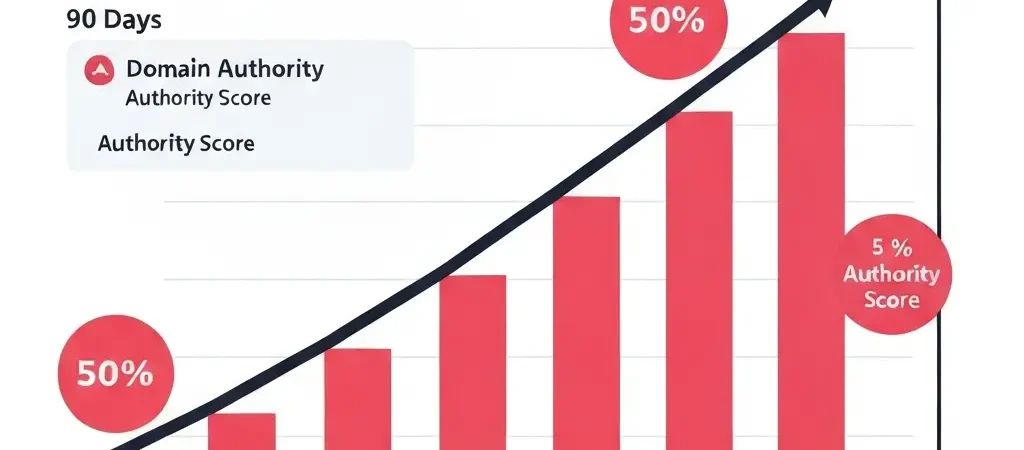
How to Build Domain Authority in 2026: A Data-Backed 90-Day Playbook
Domain authority building is one of the highest-leverage investments in SEO — and one of the most misunderstood. It is not a metric you optimize directly (Moz’s DA score is a proxy, not a Google ranking factor). It is the emergent result of four compounding inputs: topical content depth, quality external backlinks, strong technical SEO, and E-E-A-T signals. Build all four and you build a site that Google trusts enough to rank for competitive keywords. This playbook gives you the 90-day structure to make that happen.
The research is clear: sites with comprehensive topical coverage in their niche rank significantly higher for competitive keywords than sites with scattered content, even when those sites have higher raw link counts. Topical authority has partially displaced raw domain authority as Google’s primary trust signal since 2024. That shifts the strategic focus from purely link acquisition to a dual program of content depth and link building.
What Domain Authority Actually Is in 2026
Moz’s Domain Authority (DA) and Ahrefs’ Domain Rating (DR) are third-party proxies that correlate with Google rankings — they are not Google signals. Google does not use a “domain authority score.” What Google does use is a complex set of trust and relevance signals that these tools attempt to approximate.
The signals that actually matter to Google in 2026:
- Topical authority: How comprehensively do you cover your target topic space? (Entity recognition, semantic coverage)
- PageRank / link equity: How many quality external sites link to you and to specific pages? (Still significant)
- E-E-A-T: Do you demonstrate Experience, Expertise, Authoritativeness, and Trustworthiness?
- User engagement signals: Do users engage with your content and return to your site?
- Technical quality: Is your site fast, mobile-friendly, and crawlable?
The Authority Flywheel framework we developed maps how these signals interact: each strengthens the others, creating a compounding dynamic that accelerates once the flywheel is spinning.
Pillar 1: Topical Content Depth
Topical content depth is the most accessible pillar for new or mid-tier domains. Unlike backlinks, it doesn’t require third-party cooperation — you control your content program entirely. And in 2026, it has become more influential as Google’s entity recognition systems have matured.
What Topical Depth Looks Like in Practice
Pick a single niche. Build a comprehensive keyword cluster map with 50–100 target keywords. Then execute that map with a pillar-cluster-supporting content hierarchy. Every subtopic covered, every question answered, every comparison written. By the time you have 50–80 articles in a coherent cluster, Google’s entity recognition identifies your site as a comprehensive resource — and begins ranking you for queries you’ve never directly targeted.
This is the core of the TAC Model (Topical Authority SEO Framework): Topical Mapping + Architectural Linking + Cadence Signaling. Miss any one of the three and topical authority stalls.
Content Velocity as a Trust Signal
Google’s crawl rate increases for sites publishing consistently. A site publishing 5+ quality articles per week gets crawled more frequently, which means new content gets indexed faster, which means ranking signals accumulate faster. AI content automation is the practical enabler of this cadence for teams without large editorial budgets. See our analysis of content velocity and its impact on rankings.
Pillar 2: Quality Backlink Acquisition
Links remain a primary ranking factor, but the quality distribution has shifted. Ten links from topically relevant, mid-authority sites in your niche outperform 100 links from unrelated directories. Relevance has always mattered; it matters even more now.
The Four Highest-ROI Link Building Tactics in 2026
- Original research and data: Publish a study, survey, or proprietary dataset. Academic and industry sites link to original data far more reliably than to opinion content. A single well-executed study can generate 50–200 links over 6–12 months.
- Linkable assets: Comprehensive guides, templates, tools, and calculators earn links passively as other sites reference them. The Internal Linking Definitive Guide format is an example — comprehensive resources naturally attract citations.
- Digital PR: Journalists and bloggers covering your niche will link to expert sources. Become quotable by publishing opinionated, data-backed commentary on industry trends.
- Strategic partnerships: Mutually beneficial link exchanges with non-competing, complementary businesses. For example, an AI content tool linking to a marketing automation platform (like CampaignOS) — both serve overlapping audiences without competing.
Pillar 3: Technical SEO Foundation
Technical SEO issues don’t build authority — but they can destroy it. A site with excellent content and strong backlinks can still rank poorly if it fails Core Web Vitals, has crawl budget issues, or serves mobile users a broken experience.
Non-Negotiable Technical Baselines
- Core Web Vitals: LCP under 2.5s, CLS under 0.1, FID/INP under 200ms
- Mobile-first rendering: all content visible and functional on mobile
- Crawlability: no accidental noindex directives, correct robots.txt, XML sitemap submitted
- HTTPS with valid SSL certificate
- Structured data: Article and FAQPage schema on relevant content
- Internal link health: no broken links, no orphan pages, logical URL structure
Pillar 4: E-E-A-T Signals
Google’s E-E-A-T framework (Experience, Expertise, Authoritativeness, Trustworthiness) is not a single ranking factor — it is a set of signals that quality raters use to evaluate whether a page should rank for its target query. Building E-E-A-T means building the evidence that you have real-world experience and expertise in your topic area.
Practical E-E-A-T Actions
- Add author bio pages with credentials, publications, and professional links
- Cite primary sources (studies, research papers, official documentation) in every article
- Include original examples, case studies, and data from your own experience
- Establish author expertise on external platforms (LinkedIn, Google Scholar profile, industry forums)
- Build About and Contact pages that clearly identify the people and organization behind the content
- Get expert quotes and include them with attribution
The 90-Day Execution Plan
| Month | Content | Links | Technical |
|---|---|---|---|
| Month 1 | Build topical map; publish 20–25 articles (pillars + clusters) | Technical audit; fix crawl issues; publish original research asset | Technical audit; fix CWV issues; schema deployment |
| Month 2 | Complete cluster content (15–20 more articles); add supporting layer | Outreach for research asset links; 3–5 digital PR placements | Monitor GSC for index issues; optimize meta tags on early articles |
| Month 3 | First content refresh cycle; add adjacent topic cluster | Strategic partnership links; continue digital PR; guest posts | Review content decay signals; optimize E-E-A-T markers |
Measuring Progress: What to Track
Domain authority building is a long-game investment. Track these leading and lagging indicators:
- Referring domains (Ahrefs/Moz): New unique domains linking to you each month — target 5–15 new RDs per month for a growing site
- Indexed content: Are all your new articles getting indexed within 2 weeks of publication?
- Topical cluster impressions (GSC): Total impressions for your target keyword cluster — this should grow monthly
- Position tracking: Pillar keyword ranking movement — focus on positions 11–20 moving to page 1
- Domain Rating / DA trend: Moz DA and Ahrefs DR as 90-day trend indicators, not absolutes
Frequently Asked Questions
What is domain authority and does Google use it?
Domain authority (DA) is a metric developed by Moz that predicts how likely a domain is to rank in search results, based on backlink data. Google does not use Moz’s DA score as a ranking factor — it uses its own internal trust signals including PageRank, topical authority, E-E-A-T, and technical quality. DA is a useful proxy for comparing sites competitively but should not be optimized directly.
How long does it take to build domain authority?
Meaningful domain authority growth typically takes 3–6 months with a consistent program. New sites in competitive niches can take 12–18 months to achieve Domain Rating 40+. The timeline accelerates with higher content velocity (more articles indexed = more topical authority signals) and consistent link acquisition (new referring domains per month).
Is content or backlinks more important for domain authority?
Both matter, but the balance has shifted toward content depth since 2023. For new and mid-tier sites, topical authority (comprehensive content cluster coverage) now has outsized influence on rankings relative to raw link counts. The optimal strategy runs both in parallel: build topical depth through content clusters while acquiring links through original research and digital PR.
Can I build domain authority without buying links?
Yes. The most durable domain authority comes from earned links: links from sites that reference your content voluntarily because it is useful, original, or authoritative. Original research, comprehensive guides, free tools, and digital PR placements earn links without payment. Buying links violates Google’s guidelines and carries penalty risk — earned links compound sustainably.
Build Topical Authority at Scale
Authenova’s strategy builder creates your topical keyword map and executes your content program with AI-generated articles at publishing cadence. Build the content depth that drives domain authority without the manual workload.