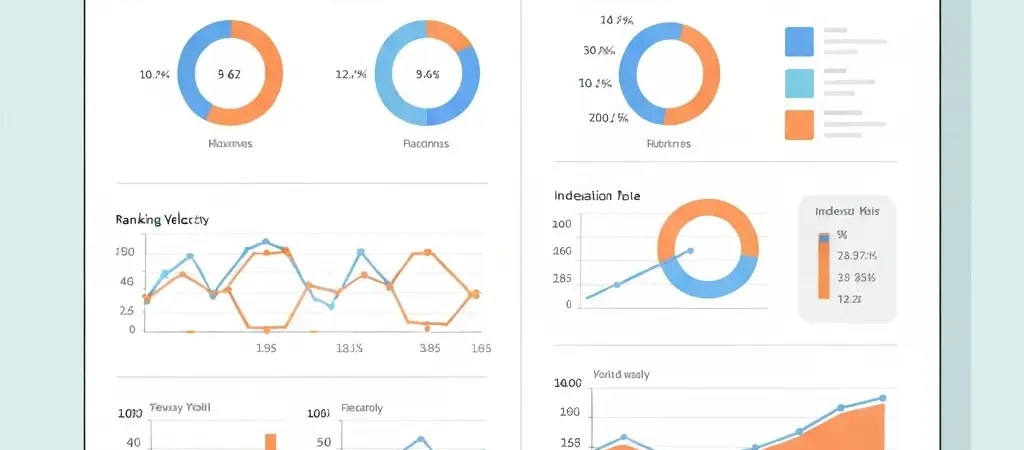
How to Track SEO Performance of AI-Generated Content in 2026
Most teams that deploy AI content pipelines make the same monitoring mistake: they check rankings for individual articles rather than tracking the performance of the entire content system. Learning how to track SEO performance of AI-generated content requires a different measurement framework — one that evaluates topical authority growth, content velocity signals, and AEO citation rates alongside traditional ranking and traffic metrics.
This guide gives you a concrete monitoring system with the specific metrics, tools, and reporting cadence that works for AI content programs of any size.
Why AI Content Needs a Different Measurement Framework
Traditional content performance tracking measures each article in isolation: rankings for its focus keyword, organic sessions, time on page, and conversions. This model breaks down for AI content programs because:
- Volume distorts individual metrics. When you publish 20 articles per month, tracking each article individually creates a dashboard with hundreds of rows. No one acts on a 400-row spreadsheet. You need aggregated cluster-level metrics.
- Topical authority is a lagging indicator. The SEO benefit of publishing a full content cluster does not appear until the cluster is complete and Google has indexed and evaluated all pages. Tracking individual articles early in a cluster’s lifecycle shows misleading results.
- AI content ranks on a different timeline. Research from studies of 50,000+ AI-generated articles shows they rank within 60 days on average — compared to 4-6 months for manually written content. Your measurement windows should reflect this faster cycle.
- AEO is unmeasured by standard tools. If your AI content is optimised for AI citation, you need separate tracking for how often your content appears in ChatGPT, Perplexity, and Google AI Overview responses.
Understanding these measurement gaps is the first step. See our guide on auditing AI content quality for the content-side equivalent of this tracking system.
The Four Metric Tiers for AI Content Performance
Tier 1: Indexation Rate
Before any ranking or traffic metric matters, you need to confirm Google has indexed your pages. Measure: the percentage of published articles indexed within 14 days of publication.
Target benchmark: 90%+ indexation within 14 days for an established domain. For new sites or new topic areas, 70% within 30 days is acceptable.
How to measure: Use Google Search Console’s URL Inspection tool for individual pages, or the Coverage report to see indexed vs. not indexed counts over time. For volume, use site:yourdomain.com searches with approximate publication date filters.
Red flag: If indexation rate drops below 70%, Google may be reducing crawl budget for your domain — usually a signal of thin content or duplicate content problems.
Tier 2: Ranking Velocity
Ranking velocity measures how quickly articles move from unranked to the top 50 (page 5) for their focus keyword. This is the leading indicator of topical authority growth — as your authority increases, new articles rank faster.
Target benchmark: Top 50 within 30 days for KD 0-25 articles; top 50 within 60 days for KD 25-45 articles; top 100 within 90 days for KD 45+ articles.
How to measure: Use Ahrefs, Semrush, or Rank Math’s rank tracker. Set up position tracking for every article’s focus keyword on publication date, then measure position at day 14, 30, 60, and 90.
Tier 3: Topical Cluster Traffic
Rather than tracking individual article traffic, measure the total organic traffic to all articles in each topical cluster. This shows whether the cluster is establishing authority, regardless of which specific articles are driving visits.
How to measure: In Google Search Console, use the Pages filter to select all URLs in a cluster (e.g., all pages with slugs related to “content automation”). Sum their impressions, clicks, and average position. Track this monthly. In Google Analytics 4, create a content group by topic cluster.
Target benchmark: Clusters of 8-12 articles should show measurable organic traffic within 60-90 days of completion. Traffic should compound month-over-month rather than plateau.
Tier 4: AEO Presence Rate
AEO presence measures how often your content appears in AI assistant responses for your target queries. This metric has no standard tool yet — it requires manual spot-checking or specialised AEO tracking platforms.
How to measure: Create a list of 10-20 target queries from your content cluster. Monthly, run these queries in ChatGPT, Claude, and Perplexity and record whether your domain is cited or the content is paraphrased. Track your citation rate (citations / total queries checked) over time. Platforms like Semrush’s AI Overviews tracking, BrightEdge Generative Parser, and Authoritas are emerging tools that automate this process.
Target benchmark: 15-25% citation rate for well-structured AEO content within 90 days of publication, based on early industry benchmarks from 2025-2026 studies. Learn how to structure AI content for maximum AEO visibility.
Tools and Dashboard Setup
| Metric | Primary Tool | Backup Tool | Cost |
|---|---|---|---|
| Indexation Rate | Google Search Console | Screaming Frog | Free |
| Ranking Velocity | Ahrefs Rank Tracker | Semrush Position Tracking | $129-$139/mo |
| Cluster Traffic | Google Search Console | GA4 Content Groups | Free |
| AEO Presence | Manual spot-check | BrightEdge Generative | Free / Enterprise |
If you are using Authenova as your content platform, it provides built-in content performance tracking tied to your content clusters — you can see publication dates, word counts, and content type distribution at the strategy level, making cluster-level analysis more straightforward.
Reporting Cadence: What to Check and When
Weekly (5 minutes)
- New articles indexed in the past 7 days (Google Search Console Coverage)
- Any articles with zero impressions after 14 days (flag for manual indexation request)
Monthly (30 minutes)
- Ranking velocity for all articles published 30/60/90 days ago
- Cluster traffic totals vs. previous month
- Top 5 performers and bottom 5 performers by impressions
- AEO spot-check: 10 target queries across ChatGPT and Perplexity
Quarterly (2 hours)
- Full ranking report for all published articles
- Content gap analysis: which subtopics have no ranking content
- Cluster completion audit: which clusters need additional articles
- Internal link audit: orphaned pages, pillar under-linking
- AEO citation rate calculation across all target queries
Red Flags That Signal Strategy Problems
- Indexation rate under 70%: Google is likely seeing thin or duplicate content. Audit for content overlap and ensure each article has unique value.
- No rankings after 90 days for KD 0-25 keywords: Your domain may have a trust problem, or the articles lack E-E-A-T signals. Add author information, cited sources, and expert review.
- Cluster traffic plateauing after month 3: The cluster is incomplete. Identify the topical gaps and add the missing supporting articles.
- Bounce rate above 75% for AI content: Content quality is not meeting reader expectations. Review the articles with highest bounce rates and check for: thin content, misleading titles, poor readability.
- Zero AEO citations after 90 days: Content structure does not match AEO requirements. Ensure every article has a direct answer box, FAQ schema, and standalone-extractable sections. See our guide on building topical authority with AI.
How to Optimise Based on Performance Data
Performance data only creates value when you act on it. The following optimisation triggers should become standard operating procedure:
- If an article is not indexed after 14 days: Submit it manually via Google Search Console URL Inspection. Check for noindex tags, robots.txt exclusions, and canonical URL conflicts.
- If an article ranks position 11-30 after 60 days: It is close to page 1. Update the article with additional content (add 300-500 words addressing a related question), improve internal linking to it, and request re-indexation.
- If a cluster article outperforms its pillar: The cluster article is over-receiving equity. Add more internal links pointing to the pillar page, and ensure the pillar is comprehensive enough to justify its position as the cluster hub.
- If a cluster shows no AEO presence: Add a direct answer box to the pillar page, implement FAQPage schema on the top 3 cluster articles, and restructure the first paragraph of each article to open with a 40-60 word direct answer.
Frequently Asked Questions
How long does it take for AI-generated content to rank?
AI-generated content typically ranks within 30-60 days for low-competition keywords (KD 0-25), 60-90 days for medium-competition keywords (KD 25-45), and 90-180 days for high-competition keywords (KD 45+). Research across 50,000+ AI-generated articles shows an average ranking timeline of 60 days — significantly faster than the 4-6 month average for manually written content, likely because AI content is published with complete on-page optimization from day one.
What is a good indexation rate for AI content?
A good indexation rate for AI-generated content is 90%+ within 14 days for established domains (12+ months old with existing backlinks). For newer domains, 70-80% within 30 days is acceptable. If indexation rate drops below 70%, Google may be applying a “helpful content” quality threshold to your domain — a signal to review content quality, remove thin articles, and improve E-E-A-T signals.
Should I track individual article performance or cluster performance?
Track both, but prioritize cluster-level performance for strategic decisions. Cluster-level metrics (total impressions, clicks, and ranking positions for all articles in a topical group) show whether your topical authority strategy is working. Individual article metrics are most useful for identifying optimization opportunities — finding articles close to page 1 that need a content update or additional internal links.
How do I measure AEO performance for AI content?
Measure AEO performance by manually checking 10-20 target queries monthly in ChatGPT, Claude, and Perplexity, and recording whether your domain is cited. Calculate your AEO citation rate as citations divided by total queries checked. Emerging tools like BrightEdge Generative Parser, Semrush AI Overviews, and Authoritas are beginning to automate this tracking. Target a 15-25% citation rate within 90 days for content with proper AEO structure.
Start Publishing AI Content That You Can Measure
Authenova tracks every article by strategy and content type, making cluster-level SEO analysis straightforward. See exactly which strategies are working and which need attention.