Internal Linking Strategy for SEO: The Complete Technical Guide for 2026
Internal linking is the most consistently under-utilized SEO tactic in content programs. Most site owners add internal links as an afterthought — a few links sprinkled into articles without systematic logic. A disciplined internal linking strategy, by contrast, functions as the PageRank plumbing of your site: it routes link equity to your most important pages, signals topical relationships to Google’s crawlers, and creates clear navigation paths for both users and bots. The gap between a site that does this well and one that doesn’t is measurable in ranking positions.
This guide covers the technical mechanics — link equity flow, anchor text optimization, crawl depth, and cluster architecture — as well as the practical workflow for executing internal linking at scale using automation.
Why Internal Links Matter More Than You Think
Internal links serve three simultaneous functions that directly affect SEO performance:
- Link equity distribution: Internal links pass PageRank between pages. Pages with more internal links pointing to them accumulate more link equity — and link equity correlates strongly with ranking ability
- Topical signaling: The anchor text of internal links tells Google what the destination page is about. A cluster of articles all linking to a pillar with keyword-rich anchor text reinforces the pillar’s relevance for that topic
- Crawl efficiency: Internal links guide Googlebot’s crawling path through your site. Pages with no internal links pointing to them (orphan pages) are crawled infrequently and may never accumulate ranking signals
Research consistently shows that pages receiving strong internal link equity from authority pages rank significantly higher than comparable pages with few internal links. It is, in many respects, the link building you can fully control.
PageRank Mechanics: How Link Equity Flows
Google’s original PageRank algorithm assigned each page a score based on the quality and quantity of links pointing to it — and each page passed a fraction of its score to pages it linked to. While the exact algorithm has evolved significantly, the core principle holds: link equity flows through internal links.
The Equity Flow Model
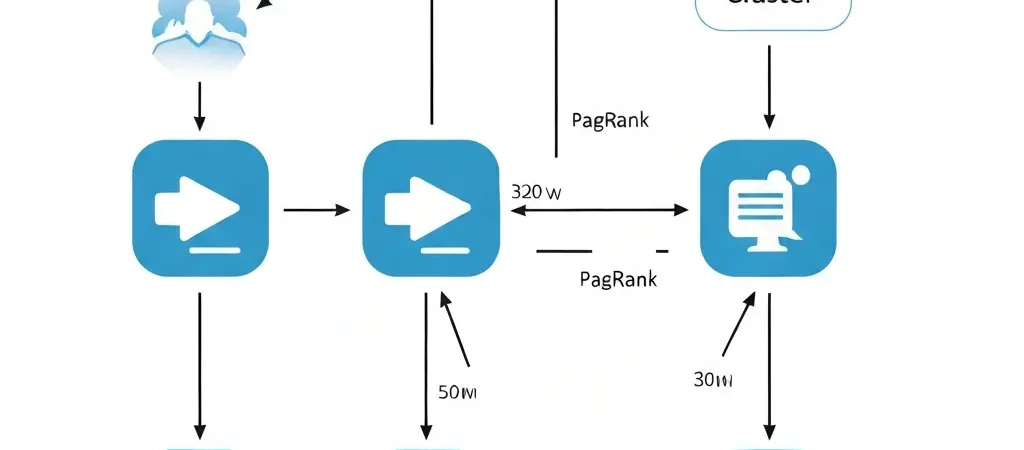
Think of link equity as a budget. Your homepage has the most (assuming your external links point to it). Each page it links to receives a fraction of that budget. Those pages pass fractions of their received equity to the pages they link to. Pages linked from many high-equity pages accumulate significantly more ranking ability than pages linked from few low-equity pages.
Implications for Content Architecture
This means your most important pages — your pillar articles targeting competitive head keywords — should receive internal links from as many other pages as possible. The pillar-cluster architecture, where every cluster article links to its parent pillar, is the most efficient structural implementation of this principle. Read the detailed mechanics in our Internal Linking Definitive Guide.
Anchor Text: The Science of Relevance Signals
Anchor text is the clickable text of a link. Google uses it as an explicit relevance signal: when many internal links to a page use anchor text like “AI content strategy,” Google understands that page is about AI content strategy and weighs it accordingly for that query.
Anchor Text Best Practices
- Use the focus keyword as anchor text when linking to a pillar article — once per linking page
- Vary anchor text across the site — multiple links to the same destination should use semantically related but distinct phrases (“content strategy guide,” “SEO content strategy,” “how to build a content strategy”)
- Never use “click here,” “read more,” or “learn more” as sole anchor text — these waste the relevance signal opportunity
- Avoid over-optimization: 10+ links to the same page with identical anchor text triggers spam signals
- Match anchor text to destination intent: The link text should accurately describe what the reader will find at the destination
Building a Topical Link Hierarchy
The most effective internal linking architecture maps directly to your content hierarchy. The rules are consistent:
Pillar Articles
Every cluster article in the same topic should link to its parent pillar. If you have 10 cluster articles about “email marketing automation,” each should include at least one link to your pillar article on that topic using the pillar’s focus keyword as anchor text. This concentrates link equity at the pillar level and signals comprehensive topical coverage.
Cluster Articles
Cluster articles link up (to the pillar) and sideways (to related cluster articles covering complementary subtopics). Avoid linking cluster articles to unrelated topics — this weakens the topical signal. Also link down to relevant supporting articles.
Supporting Articles
Supporting articles link to 1–2 cluster articles and, where highly relevant, the pillar. They rarely receive links from cluster articles unless they’re unusually comprehensive — keep the equity flow directional, not circular.
This is the architectural layer of the TAC Model — the “A” in Topical Mapping + Architectural Linking + Cadence Signaling.
Crawl Depth and Click Depth Optimization
Click depth is the number of clicks required to reach a page from the homepage. Google’s crawlers follow link paths — pages buried 5+ clicks deep get crawled less frequently and accumulate ranking signals more slowly.
Click Depth Guidelines
- Homepage → Pillar article: maximum 2 clicks (ideally 1, via top navigation or featured links)
- Pillar article → Cluster article: 1 click (via body links or sidebar)
- Cluster article → Supporting article: 1 click
- No important page should be more than 3 clicks from the homepage
Category pages and cornerstone content hubs are useful structures for managing click depth when you have large content libraries.
How to Automate Internal Linking
Manual internal linking at scale is not sustainable. At 100+ articles, keeping track of which pages should link to which becomes a full-time job. Automation solves this at two levels:
At Content Generation (Best Practice)
The highest-quality internal linking happens at the content generation stage, when the AI system has context about your existing content library and can place contextually natural links within the article body as it writes. This is how Authenova handles internal linking — the strategy layer knows your content inventory and instructs the generator to include specific internal links per article.
Post-Publishing Automation
WordPress plugins like LinkWhisper scan existing content for orphan pages and suggest contextually relevant internal links to add. This is useful for retroactively fixing a large existing content library that lacks systematic linking. See our guide on setting up internal linking automation for the workflow.
7 Internal Linking Mistakes That Hurt Rankings
- Orphan pages: Articles with no internal links pointing to them receive minimal crawl attention and no link equity. Fix orphans immediately after publishing.
- Over-linking to the homepage: Excessive internal links back to the homepage dilutes equity distribution to your important content pages.
- Generic anchor text: “Click here” and “read more” waste the relevance signal opportunity of every link.
- Circular linking traps: Pages that link to each other in closed loops without links pointing outward to pillar content waste equity.
- Linking to unrelated topics: A food blog article about pasta recipes linking to a financial planning article — both topic-wise and architecturally inappropriate.
- Too many links per page: More than 100 internal links on a page dilutes the value of each individual link. For most articles, 5–15 internal links is optimal.
- Broken internal links: 404 errors on internal links waste crawl budget and destroy link equity. Audit for broken links quarterly.
Frequently Asked Questions
How many internal links should an article have?
Most articles benefit from 5–15 contextually relevant internal links. Supporting articles typically have 3–6, cluster articles 5–10, and pillar articles 8–15. The key constraint is that links should be contextually natural — forced links that don’t serve the reader signal poor quality. Avoid exceeding 100 total links per page (including navigation).
Does anchor text matter for internal links?
Yes, significantly. Anchor text is a direct relevance signal — it tells Google what the destination page is about. Use keyword-rich anchor text when linking to pillar articles, vary anchor text across multiple links to the same destination, and never use generic phrases like “click here” or “read more” as your sole anchor text.
Can internal links improve rankings by themselves?
Yes, in many cases. Improving internal links to a page in position 11–20 can push it to page 1 without any other changes, particularly when those links come from high-equity pages using relevant anchor text. Internal linking is the fastest and most controllable ranking lever available for existing content libraries.
What is an orphan page in SEO?
An orphan page is a page with no internal links pointing to it from other pages on the same domain. Orphan pages are crawled infrequently, receive no link equity, and rarely accumulate strong ranking signals. They should be identified via crawl audit and integrated into the internal linking structure of relevant content clusters.
Automate Internal Linking Across Your Entire Content Library
Authenova’s AI content system builds internal links into every article at generation time — based on your existing content library and topical cluster architecture. No retroactive patching. No orphan pages. Just a compounding link equity system from day one.