Keyword Strategy Tool Selection Guide: What Actually Matters in 2026
A keyword strategy tool is not just a research instrument — it is the foundation on which your entire content architecture is built. Choose the wrong tool, or use the right tool incorrectly, and every article you publish is working from a flawed map. In 2026, keyword strategy has evolved significantly beyond volume and difficulty scores. The tools that drive real organic outcomes now handle keyword clustering, semantic relationship mapping, topical authority gap analysis, and AEO (Answer Engine Optimization) query identification — not just keyword volume lookups.
This guide is a decision framework, not a product ranking. It explains what to evaluate in a keyword strategy tool, what differentiates genuinely useful features from marketing-layer additions, and how to integrate keyword strategy tooling into a production-grade content system.
What Changed in Keyword Strategy in 2026
The keyword research paradigm of 2020–2023 — find a high-volume, low-difficulty keyword, write an article targeting it, repeat — is structurally broken in 2026 for two reasons.
First, Google’s entity and topical relevance models have matured to the point where isolated keyword targeting is less predictive of ranking success than topical cluster coverage. A site with 20 tightly clustered articles on a topic regularly outranks a site with one authoritative article on the main keyword but no supporting content. The keyword strategy tool you use must understand this — generating not just individual keywords but the cluster architecture that gives each keyword its ranking context.
Second, AI Overview citations and GEO have created a new competitive surface. According to SEOmator’s 2026 AI SEO statistics, 40% of AI Overview citations come from pages ranking below position 10. This means keyword strategy must now account for AEO query formats — the question-based, comparative, and definitional queries that AI systems prefer to cite as sources. A keyword tool that surfaces only transactional and navigational queries misses this entire opportunity layer.
Core Evaluation Criteria for Keyword Strategy Tools
1. Keyword Clustering Quality
Clustering is the most important capability of a modern keyword strategy tool. It groups semantically related keywords into topical clusters that can be addressed by a single pillar page plus supporting cluster articles. Evaluate clustering quality by testing whether the tool correctly groups: (a) parent and child variants of the same intent, (b) informational and commercial versions of related queries, and (c) long-tail variants that share the same answer as a head term.
Poor clustering produces topic overlap that leads to keyword cannibalization. Strong clustering produces the topical map architecture that drives authority compounding. The relationship between keyword strategy and topical map execution is covered in detail in the topical map SEO building guide.
2. Intent Classification Accuracy
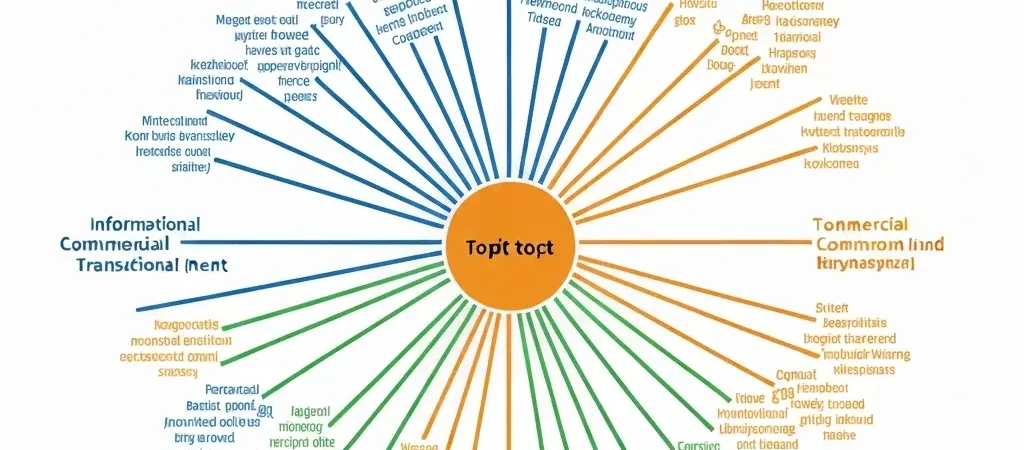
Every keyword in your strategy needs an intent label: informational, navigational, commercial, transactional. This classification determines the content type, format, and CTA structure for each article. Tools that provide accurate intent classification allow you to automate content type assignment — routing informational queries to cluster articles, commercial queries to comparison and review content, and transactional queries to landing pages.
3. Topical Gap Analysis
A keyword strategy tool should be able to identify the gaps in your current content coverage relative to your topic authority goals. This means comparing your published content against the full keyword landscape for your niche and surfacing the clusters you have not yet addressed. This is the operational foundation of a strategic content calendar — the gap analysis drives the production queue.
4. SERP Feature Identification
In 2026, a significant portion of high-value keyword opportunities are SERP feature placements rather than traditional rank-10 positions: featured snippets, People Also Ask boxes, AI Overviews, knowledge panels, and video carousels. A keyword strategy tool that identifies which SERP features are active for target keywords allows you to optimize content structure specifically for those features, not just for traditional organic rankings.
5. Workflow Integration
A keyword tool that produces a spreadsheet you then manually transfer to a content brief system adds friction at scale. The best keyword strategy tools in 2026 either export directly to content management platforms or have native integrations with platforms like Authenova that ingest keyword data and translate it into generation-ready strategy configurations.
Features That Add Real Value vs Marketing Theatre
Real Value
- Semantic entity mapping: Identifies the entities (brands, concepts, organizations) associated with a keyword cluster, informing content depth requirements
- Historical volatility scoring: Shows how unstable a keyword’s SERP has been — high volatility means algorithmic uncertainty, which represents both risk and opportunity
- SERP feature triggers: Shows which content formats (lists, tables, FAQ sections) trigger featured snippet capture for specific queries
- Competitor content gap output: Generates a list of keywords your competitors rank for that you do not — the fastest source of immediately actionable keyword opportunities
Marketing Theatre
- Proprietary “opportunity scores” without methodology transparency: If a tool cannot explain how its opportunity score is calculated, treat it as directional noise rather than a decision driver
- AI-generated content briefs as a premium feature: If a tool charges a significant premium for briefs that are essentially keyword lists with a few header suggestions, the incremental value over manual brief creation is minimal
- Real-time rank tracking in a keyword research tool: Rank tracking and keyword research are different functions — bundling them together usually means both are underpowered relative to specialized tools in each category
Tool Types and Their Optimal Use Cases
| Tool Type | Examples | Optimal Use Case | Limitation |
|---|---|---|---|
| Full-suite SEO platform | Ahrefs, Semrush | Competitive research, backlink data, SERP history | High cost; cluster mapping requires manual work |
| Clustering-specialist tool | Keyword Insights, Clusteric | Bulk cluster mapping for large keyword lists | No data enrichment (volume, difficulty must come from elsewhere) |
| Topic modeling tool | MarketMuse, Topic | Deep topical authority gap analysis | Expensive; overkill for sites under 500 pages |
| Strategy-integrated platform | Authenova Strategy Builder | Keyword → strategy → content in one workflow | Less data for competitive research vs Ahrefs/Semrush |
According to DigibirdsAI’s keyword research in 2026 analysis, AI tools reduce keyword research time by approximately 80% and overall content optimization efficiency by 30%. The practical implication for tool selection: the investment in a proper keyword strategy tool pays back within weeks of adoption if you are currently doing manual keyword research and cluster mapping in spreadsheets.
Integrating Keyword Strategy Into Your Content Pipeline
The keyword strategy tool is the starting point, not the endpoint, of your content pipeline. The output of a keyword strategy session — a clustered, intent-mapped, prioritized list of keywords — needs to flow directly into content production without manual re-entry.
The most efficient pipeline for 2026 works as follows:
- Discovery phase: Use Ahrefs or Semrush to build your initial keyword universe. Export all keywords in your topic space with volume, difficulty, and SERP feature data.
- Clustering phase: Run the export through a clustering tool (Keyword Insights or Authenova’s strategy builder) to group keywords into pillar-cluster hierarchies. This is where individual keywords become a topical architecture.
- Prioritization phase: Score clusters by: search volume aggregate (the sum of all keywords in the cluster), competitive gap (your current coverage vs competitors), and intent value (commercial and transactional clusters first, informational clusters for authority building).
- Strategy configuration phase: Load the prioritized cluster map into your content platform (Authenova) as a strategy configuration. Assign keyword roles (primary, secondary, supporting), content types, and target schedules. This is the step where keyword strategy becomes executable without further manual decisions.
- Generation and publishing phase: The platform generates articles from the keyword queue on the configured schedule. Keyword strategy becomes content velocity automatically.
This pipeline is what separates sites that use keyword strategy to plan from sites that use keyword strategy to compound. The difference is not the quality of the initial research — it is whether the research output becomes a self-executing production system. The organic traffic growth data guide quantifies what this compounding looks like at the site level over 12-month periods.
Frequently Asked Questions
What is the best keyword strategy tool for a small website in 2026?
For small sites (under 100 pages), the best starting combination is Ahrefs (for competitive and volume data) plus a free or low-cost clustering tool like Keyword Insights or Authenova’s strategy builder. Avoid investing in enterprise topic modeling tools like MarketMuse until your site has enough content to generate meaningful internal data. The priority at the small site stage is building a clear cluster architecture from a targeted keyword list — not exhaustive competitive analysis.
How do I choose between Ahrefs and Semrush for keyword strategy?
Ahrefs is generally preferred for backlink data depth and content gap analysis, while Semrush offers stronger keyword grouping features and a more comprehensive SERP feature tracking system. For keyword strategy specifically, Semrush’s Keyword Magic Tool and Keyword Gap feature provide better out-of-the-box clustering than Ahrefs. For competitive research and link building strategy, Ahrefs has the edge. Many serious SEO teams use both, but if forced to choose one, Semrush is slightly stronger for keyword strategy workflows in 2026.
Do I need a separate keyword clustering tool if I use Semrush or Ahrefs?
For keyword lists under 500 terms, Semrush’s built-in grouping is sufficient. For lists over 1,000 terms — which is common when doing comprehensive topical map planning — a dedicated clustering tool like Keyword Insights provides better output quality and handles large volumes faster than the grouping features in full-suite platforms. The investment is worthwhile if you are building a content calendar covering 50+ cluster articles.
How often should I refresh my keyword strategy research?
For most content programs, a full keyword strategy refresh every 6 months is appropriate. Within those periods, a monthly check for: (a) new keywords surfacing in Search Console impressions data that are not in your current strategy, and (b) emerging competitor content that has captured keywords you targeted but not yet ranked for. The keyword landscape in any given niche changes meaningfully over 6 months, and programs that never revisit their original research end up optimizing for a strategy that no longer reflects the actual competitive environment.
Your Keyword Strategy, Automated
Authenova’s Strategy Builder translates your keyword cluster map into a self-executing content calendar. Upload your keyword list, define cluster roles and content types, set your publishing schedule — and the platform handles generation, image creation, and WordPress publishing automatically.