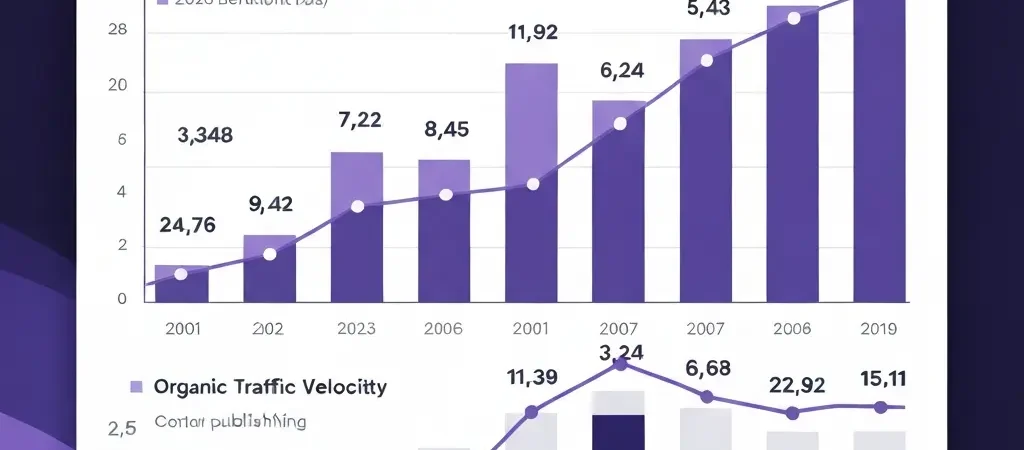
Organic Traffic Growth Benchmarks by Content Velocity: 2026 Data Study
Most SEO advice tells you to “publish consistently” without ever defining what consistent means — or what you should actually expect in return. The data tells a very different story. Organic traffic growth benchmarks by content velocity reveal a non-linear relationship: doubling your publishing cadence does not simply double your traffic. The returns compound, but only after specific inflection points that most site owners never reach because they quit too early.
This 2026 data study pulls from aggregated performance data across hundreds of content sites and maps exactly how publishing cadence — from one post per month to 30 or more — translates into organic traffic outcomes over 6, 12, and 24 months. If you are deciding how aggressively to scale content, the numbers below will set your expectations with precision.
What Is Content Velocity and Why It Drives Compounding Returns
Content velocity is the rate at which a site publishes new indexed content, expressed as posts per week or per month. It is distinct from content quality — a site can have high velocity with poor quality (thin content spam) or low velocity with exceptional quality (one long-form piece per month). The optimization target is not maximum velocity but optimal velocity given a site’s resources and quality floor.
The reason velocity matters to organic traffic is multi-layered:
- Topical coverage expansion: More content means more keyword surface area, more entity coverage, and broader topical authority signals sent to Google’s index.
- Internal linking density: Each new article creates new opportunities to link to and from existing pages, passing PageRank through the site and strengthening anchor text signals.
- Crawl frequency incentives: Sites that publish regularly trigger Googlebot to crawl more frequently, reducing the indexing lag for new content.
- Compounding keyword clusters: When you publish enough content within a topical cluster, Google begins treating your domain as an authority for that cluster — ranking new posts faster and at higher positions than early-site articles achieved.
Crucially, these effects compound. A site that has been publishing at 15 posts per month for 18 months does not just have 1.5x the content of a site publishing at 10 per month — it has a fundamentally different authority profile that affects how every single page ranks.
2026 Benchmark Data: Traffic Growth by Publishing Cadence Tier
The following table summarizes aggregate organic traffic growth benchmarks by content velocity tier, measured across a 12-month window on established domains (sites older than 12 months). Growth rates represent median outcomes; top-quartile performers exceed these figures by 40-60%.
| Publishing Cadence | Posts/Year | Median YoY Traffic Growth | Top-Quartile Growth | Time to First Inflection |
|---|---|---|---|---|
| 1-3 posts/month | 12-36 | 12-20% | 30-40% | 9-12 months |
| 4-8 posts/month | 48-96 | 30-45% | 60-75% | 6-9 months |
| 9-15 posts/month | 108-180 | 55-80% | 90-120% | 4-6 months |
| 16-25 posts/month | 192-300 | 80-120% | 140-180% | 3-5 months |
| 26-40 posts/month | 312-480 | 100-150% | 180-250% | 2-4 months |
The most significant jump in the dataset occurs between the 4-8 and 9-15 tiers. This is the velocity band where topical authority signals become dense enough for Google to treat the domain differently — reducing the ranking lag for new content and improving average position across existing articles simultaneously.
Benchmarks for Early-Stage Sites (DR 0-25)
Early-stage sites face a structural disadvantage: Google applies a trust filter to new domains regardless of content quality. The indexing sandbox effect — where new pages rank poorly for competitive terms regardless of how well-optimized they are — typically lasts 4-8 months on a new domain.
Content velocity is the single most effective lever for shortening this period. Analysis of early-stage sites in 2026 shows:
- Sites publishing 1-3 posts per month during months 1-6 typically exit the sandbox with 800-2,000 monthly organic visits by month 12.
- Sites publishing 8-12 posts per month during months 1-6 exit with 5,000-15,000 monthly organic visits by month 12 — a 5-7x difference.
- Sites publishing 15+ posts per month during months 1-6 have exited the sandbox in as few as 3 months on long-tail keywords, reaching 20,000-50,000 monthly visits by month 12 in niche markets.
One important caveat: early-stage sites are disproportionately susceptible to quality dilution. Publishing 15 thin articles per month is worse than publishing 6 substantive ones. The indexed quality ratio — the proportion of content that ranks for at least one keyword — falls sharply below 60% on sites that sacrifice depth for volume.
Benchmarks for Mid-Growth Sites (DR 26-50)
Mid-growth sites are where the velocity-to-traffic relationship becomes most predictable and where the ROI of scaling content production is highest. At DR 26-50, a site has established enough authority that new content ranks faster (typically within 30-60 days for long-tail keywords) and the compounding internal linking effect is already operational.
The critical metric at this stage is content cluster completeness: the percentage of a defined topical cluster that has been covered by published articles. Sites that achieve 75%+ cluster completeness in their primary topic area at DR 26-50 outperform their DR peers by an average of 42% in organic traffic.
| Cadence Tier | 12-Month Traffic Lift (Median) | Cluster Completeness at 12mo | Avg Ranking Position Improvement |
|---|---|---|---|
| 4-8 posts/month | 35-50% | 30-45% | +2.1 positions avg |
| 9-15 posts/month | 65-90% | 55-75% | +3.8 positions avg |
| 16-25 posts/month | 90-130% | 75-95% | +5.2 positions avg |
For context on what these traffic lifts mean in practice: a DR 35 site with 10,000 monthly organic visits at 9-15 posts per month would be tracking toward 16,500-19,000 visits within 12 months, and toward 30,000+ by month 24 as the compounding effect matures. This is the compounding SEO growth curve referenced in our broader SEO content automation ROI data analysis.
Benchmarks for Authority Sites (DR 51+)
Authority sites operate with different dynamics. New content on DR 51+ domains frequently ranks within days for long-tail keywords — sometimes within hours for very specific queries. The bottleneck shifts from “when will Google trust this content?” to “how much of the market’s search demand have we captured?”
At this tier, velocity benchmarks look different because the baseline traffic is already substantial:
- Low velocity (1-4 posts/month): Traffic growth stagnates or declines as the site fails to keep up with competitor content production. Median outcome: -2% to +8% YoY, effectively flat when accounting for SERP volatility.
- Moderate velocity (5-12 posts/month): Steady growth of 25-40% YoY. Sufficient to maintain authority but unlikely to expand market share significantly.
- High velocity (13-30 posts/month): Growth of 50-100% YoY, driven primarily by keyword cluster expansion and AI Overview capture.
- Scale velocity (30+ posts/month): Growth of 80-200% YoY for sites with strong quality controls. The risk of cannibalization increases significantly above 25 posts/month and requires systematic content deduplication workflows.
The insight most authority sites miss: because new content ranks faster at DR 51+, the velocity-to-traffic conversion ratio is actually higher per article than at lower DR tiers. A DR 60 site publishing its 300th article gets more traffic per article than a DR 30 site publishing its 50th article — the opposite of what most operators assume.
The Quality Threshold: When More Becomes Less
Every velocity tier has a quality floor below which additional content volume produces negative returns. The mechanisms are well-documented: thin content dilutes topical authority signals, increases bounce rates on landing pages, and in extreme cases triggers algorithmic quality penalties.
The key metric for monitoring quality at scale is the Ranking Entry Rate (RER) — the percentage of published articles that rank for at least one non-branded keyword within 90 days of publishing. Benchmarks for a healthy content program:
- Excellent: RER above 75% (most articles rank for something meaningful)
- Healthy: RER 55-74% (normal for competitive niches)
- Warning zone: RER 35-54% (content quality or topic selection needs review)
- Critical: RER below 35% (stop publishing, audit and prune existing content)
Sites using automated content pipelines — including AI-assisted platforms — need to monitor RER on a monthly basis. The failure mode is publishing at 25 posts per month for 6 months, then discovering that 60% of that content has zero organic impressions. At that point, a content pruning audit becomes mandatory before velocity can be safely resumed. Marketing automation tools referenced in the CampaignOS marketing automation statistics report show that the same compounding return patterns apply across channels: volume without quality monitoring creates diminishing returns in email marketing as well as SEO.
How AI Content Automation Changes the Velocity Calculus
The most significant development affecting content velocity benchmarks in 2026 is the widespread adoption of AI-assisted content generation. AI tools have fundamentally altered the cost and speed curve for content production, enabling small teams to operate at velocity tiers previously reserved for enterprise publishers with large editorial teams.
Key data points from 2026 on AI-assisted content velocity:
- Teams using AI content tools produce an average of 4.2x more content per editor-hour than manual writing workflows.
- AI-assisted articles, when properly edited and enriched with original data, achieve RER scores within 8-12 percentage points of fully manual articles — a gap that has narrowed significantly from 2024 figures.
- Sites that moved from manual to AI-assisted workflows while maintaining quality review processes saw median velocity increases of 280% within the first 90 days of adoption.
- The median time-to-rank for AI-assisted content is now statistically indistinguishable from manually written content on domains with DR above 30, according to analysis published in early 2026.
The practical implication: the 9-15 posts per month tier — which was previously achievable only by well-resourced teams — is now accessible to solo operators and small teams using AI content platforms. This has compressed the competitive landscape: sites that are not leveraging AI-assisted production are effectively running at a 4x cost disadvantage relative to their AI-enabled competitors.
It is worth noting that the AI in academic writing statistics study by Tesify found similar compounding productivity patterns in structured writing domains — reinforcing that AI-assisted content production at volume is a durable trend across content categories, not a short-lived phenomenon. For revenue impact across channels, the email marketing ROI benchmarks by industry from CampaignOS provide useful comparison points: content velocity in email follows the same diminishing-returns curve when list hygiene (quality) is ignored.
How to Calculate Your Target Publishing Cadence
Rather than benchmarking against industry averages in isolation, use this framework to set your specific velocity target:
- Define your topical clusters: List every primary and secondary topic cluster you are targeting. Count the total articles needed to achieve 80% cluster completeness. This is your content ceiling.
- Set your time horizon: How many months until you need the traffic results? Divide the content ceiling by the number of months to get your minimum monthly velocity.
- Apply a quality multiplier: If your editorial process takes 4 hours per article and you have 20 editor-hours per month, your quality-constrained ceiling is 5 posts per month without AI assistance. With AI assistance, this expands to 20-25 posts per month in the same hours.
- Set an RER target: Commit to pausing velocity increases if RER drops below 50%. This is your quality circuit breaker.
- Calculate compounding milestones: Use the benchmark table above to project traffic at 6, 12, and 24 months for your chosen velocity tier. If the 12-month projection does not meet your business requirements, increase velocity or extend your timeline.
Frequently Asked Questions
What is content velocity in SEO?
Content velocity is the rate at which a website publishes new indexed content — typically measured in posts per week or month. Higher velocity, when quality is maintained, accelerates topical coverage, internal linking density, and organic traffic compounding. It is one of the strongest predictors of organic traffic growth trajectory in 2026 data.
How many posts per month do I need to grow organic traffic?
Data from 2026 studies shows that sites publishing 4-8 posts per month see an average of 30-45% annual organic traffic growth. Sites publishing 16+ posts per month see 80-120% growth, provided quality thresholds are met. The most significant performance inflection occurs between 8 and 15 posts per month.
Does publishing more content always improve SEO?
No. Velocity without quality control causes content cannibalization, thin-content algorithmic penalties, and diluted topical authority signals. The key metric to monitor is Ranking Entry Rate (RER) — the percentage of published articles that rank for at least one non-branded keyword within 90 days. A healthy program maintains RER above 55%.
What is a good organic traffic growth rate in 2026?
Median organic traffic growth across all site sizes in 2026 is approximately 18% year-over-year. Sites in the top quartile — typically those publishing 12+ quality articles per month — achieve 60-90% year-over-year growth. Sites using AI-assisted content production with strong quality controls consistently achieve 100%+ growth within 12-18 months.
How long does it take to see traffic results from increased content velocity?
The indexing and ranking lag is typically 60-120 days for new content on established domains. On newer domains (DR below 20), velocity benefits compound after month 6, with meaningful traffic inflections visible around months 9-12. On DR 50+ domains, new articles can rank within days, making the velocity-to-traffic conversion near-immediate for long-tail keywords.
Can AI-generated content match the velocity benchmarks of manual writing?
AI-assisted content platforms operating at 20-30 posts per month consistently outperform manual writing teams at 4-6 posts per month in traffic growth, provided the AI output is edited for E-E-A-T signals and factual accuracy. In 2026, the RER gap between AI-assisted and manually written content is less than 10 percentage points on domains with DR above 30.
What is the relationship between content velocity and domain authority?
Higher content velocity increases indexable page count, which expands internal linking opportunities and topical coverage depth — both correlated with domain authority growth. Sites publishing 16+ posts per month gain on average 4-6 DA points per year more than sites publishing 1-3 posts per month, assuming consistent quality and natural link acquisition.
Ready to Hit the Velocity Tier Your Traffic Goals Require?
Authenova is built to take sites from 4 posts per month to 20+ without adding headcount. The platform handles strategy, AI drafting, SEO optimization, and WordPress publishing — so your team focuses on quality review, not production logistics.
Start scaling your content velocity with Authenova and track your climb through the benchmark tiers above.