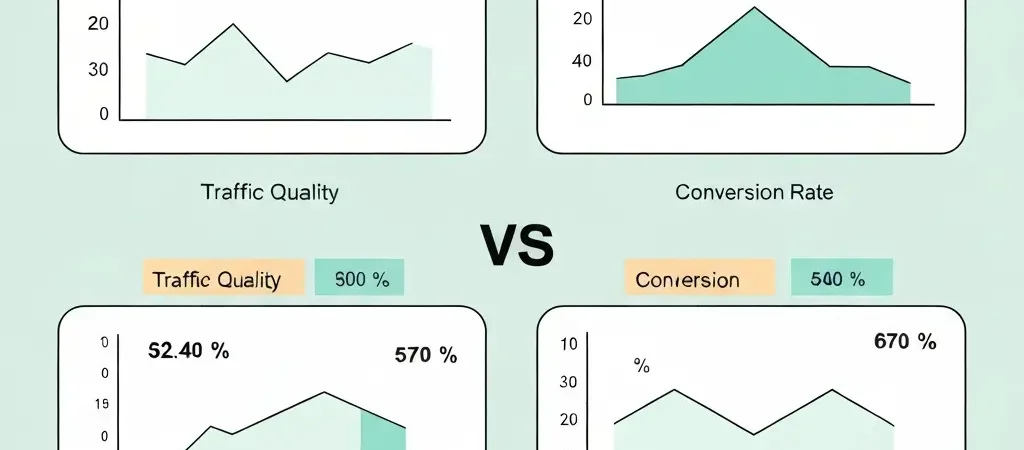
Programmatic SEO vs Content Marketing: Which Strategy Wins in 2026?
Programmatic SEO and content marketing are both legitimate organic growth strategies — but they serve different goals, require different skill sets, and produce different traffic quality profiles. Teams choosing between them often do so based on which they have heard more about recently rather than a systematic comparison. This analysis compares the two approaches across the dimensions that actually determine organic growth success in 2026: traffic volume, traffic quality, topical authority, conversion performance, and technical risk.
What Are Programmatic SEO and Content Marketing?
Programmatic SEO
Programmatic SEO is the practice of generating large numbers of pages from structured data templates. A single template + a data source (spreadsheet, database, API) produces hundreds or thousands of URL-unique pages automatically. Classic examples: Zillow’s city pages (“homes for sale in [city]”), TripAdvisor’s location pages, G2’s comparison pages (“tool A vs tool B”). The defining characteristic is that page content is generated programmatically from data, not created individually by writers or AI.
Content Marketing
Content marketing is the creation of original, valuable content — articles, guides, videos, research — designed to attract and engage a target audience. It focuses on topical depth, brand authority, and audience education rather than template-based scale. In 2026, AI-assisted content marketing can achieve significantly higher volume than traditional manual content marketing, but retains the editorial intent of providing genuine value per article.
Head-to-Head: 8 Dimensions Compared
| Dimension | Programmatic SEO | Content Marketing | Winner |
|---|---|---|---|
| Content volume ceiling | Millions of pages (template-limited) | Hundreds to thousands (quality-limited) | Programmatic |
| Traffic quality | Variable; often low engagement | High engagement, qualified audience | Content Marketing |
| Topical authority | Weak; template repetition signals low quality | Strong; depth signals expertise | Content Marketing |
| Conversion rate | Low (0.1-1% for most programmatic traffic) | Higher (1-5% for editorial content) | Content Marketing |
| Implementation cost | High upfront (template + data engineering) | Ongoing (per-article creation cost) | Depends on scale |
| Google penalty risk | High (HCU, spam, thin content risk) | Low when quality standards maintained | Content Marketing |
| Speed to traffic | Fast (many pages indexed quickly) | Slower (quality indexation takes time) | Programmatic |
| AI Overview citations | Low (template pages rarely cited) | High (editorial content cited frequently) | Content Marketing |
Content marketing wins 5 of 8 dimensions. But the programmatic advantages — volume and speed — are significant for specific business models. The question is not which is “better” universally but which fits your business model and growth goal.
When Programmatic SEO Wins
Programmatic SEO is the right approach when all three of the following are true:
- You have structured data at scale. Programmatic SEO requires a data source: product databases, location data, user-generated reviews, salary data, job listings, etc. Without a data source that varies meaningfully per page, programmatic pages are near-duplicate content — a quality penalty risk.
- Your business model monetises volume over quality. Marketplaces, directories, comparison sites, and affiliate aggregators convert traffic at low rates but across massive page volumes. Content marketing’s higher conversion rate per visitor is less relevant when the monetisation model is CPM advertising or affiliate volume.
- Template variation produces genuinely distinct pages. The difference between programmatic SEO and thin content is whether each generated page provides unique value to a user who specifically searches for that page’s combination. “Best restaurants in [city]” × 50,000 cities provides unique value. “AI tools for [industry]” × 200 industries where you have no industry-specific data does not.
Businesses fitting this profile: Zillow-model real estate sites, job boards, price comparison sites, accommodation directories, review aggregators, and legal case lookup services. See our programmatic SEO at scale guide for the full implementation approach.
When Content Marketing Wins
Content marketing is the right approach for businesses where:
- Brand authority drives conversion. SaaS companies, professional service firms, and B2B businesses where buyers evaluate credibility before purchasing benefit from topical authority content that positions the company as an expert. Programmatic pages cannot build this positioning.
- Organic traffic needs to convert to leads or customers. For businesses with CAC-sensitive growth models, content marketing’s higher conversion rate per visitor produces better revenue efficiency than high-volume, low-quality programmatic traffic.
- AI citation drives discovery. As AI assistants become primary research tools for decision-makers, being cited in responses to research queries is a high-value acquisition channel. Editorial content earns AI citations; template-generated programmatic content almost never does.
The Hybrid: AI Content Marketing at Programmatic Scale
The most significant development in 2026 is that AI content automation has partially collapsed the distinction between programmatic SEO and content marketing. With an AI content platform, you can publish editorial-quality content at 50-100 articles per month — approaching programmatic volume while maintaining the depth, structure, and authority signals of content marketing.
This hybrid approach combines:
- Content marketing structure: topical clusters, pillar-cluster architecture, editorial quality, E-E-A-T signals, AEO formatting
- Programmatic scale: automated generation and publishing, strategy-level keyword planning, consistent cadence at high volume
Authenova represents this hybrid model: it generates editorial-quality AI content at programmatic scale, then publishes it to WordPress via a strategy-defined pipeline. The result is content that earns topical authority (content marketing benefit) at the velocity required to compete with well-funded content teams (programmatic speed benefit). See our AI content strategy guide for the full hybrid approach.
Frequently Asked Questions
What is the difference between programmatic SEO and content marketing?
Programmatic SEO generates pages at scale from structured data templates — each page contains the same template populated with different data variables. Content marketing creates original editorial content — articles, guides, research — that provides unique value per piece. Programmatic SEO optimises for volume and coverage of keyword-location or keyword-entity combinations. Content marketing optimises for topical authority, engagement quality, and audience education. In 2026, AI automation enables a hybrid: editorial-quality content at higher-than-manual volume.
Is programmatic SEO safe after Google’s Helpful Content updates?
Programmatic SEO is safe after Google’s Helpful Content updates only when each generated page provides genuinely unique value to users searching for that specific page’s content. Template pages that are near-identical except for a variable (like a location or keyword) without meaningful data variation are at high risk of HCU suppression. Google’s March 2024 update significantly reduced rankings for template-heavy programmatic sites with thin content. Safe programmatic SEO requires a data source that produces genuinely distinct, useful content per page.
Can content marketing compete with programmatic SEO on volume?
AI content automation has significantly reduced the volume gap between content marketing and programmatic SEO. While pure programmatic SEO can generate millions of pages, most competitive markets are better served by thousands of high-quality editorial pages than millions of thin template pages. AI-powered content marketing programs publishing 50-100 articles/month produce more sustainable organic traffic growth than equivalent programmatic approaches in markets where Google’s quality thresholds are enforced strictly.
Get Programmatic Scale With Content Marketing Quality
Authenova publishes editorial-quality AI content at 20-100 articles/month — the hybrid approach that wins in 2026’s competitive search environment.