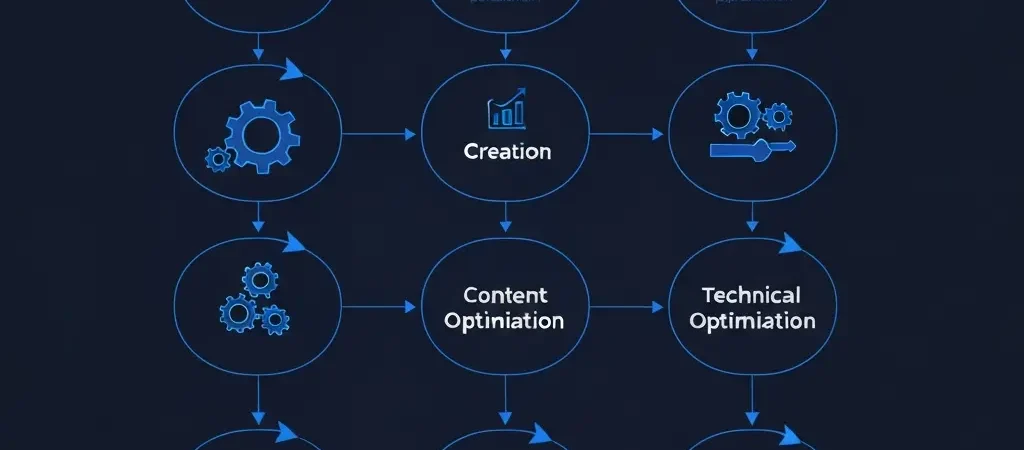
SEO Automation Stack: The Advanced Workflow Guide for 2026
The practitioners who are winning in organic search in 2026 are not the ones writing the best individual articles — they are the ones who have assembled the most efficient SEO automation stacks. The gap between a team managing SEO manually and a team running an automated workflow is not 20% efficiency. It is 15–25 hours per week of saved time, a 10x increase in content output, and the difference between a site that grows by 30% per year and one that compounds at 300%.
This guide covers the architecture of an advanced SEO automation stack for 2026: the five core workflow stages, the tools that cover each stage, how AI agents have changed the automation landscape, and the integration patterns that turn a collection of separate tools into a single compounding engine. If you are already familiar with basic SEO — keyword research in Ahrefs, content briefs, manual publishing — this guide is for practitioners ready to automate the work between those steps.
Why Stack Architecture Matters More Than Individual Tools
Most SEO teams approach automation tool-by-tool: they adopt Semrush for keyword research, then add Surfer for content scoring, then add a scheduling plugin, then try to connect them manually. The result is a collection of powerful individual tools that each require their own workflow, their own data export, and their own human handoff step. The bottleneck is not the tools — it is the gaps between them.
An automation stack is different from a tool collection. A stack is designed so that the output of one stage feeds directly into the next without human intervention at each handoff. Keyword opportunity identified in Stage 1 triggers a content brief in Stage 2. Approved content triggers schema generation in Stage 3. Published schema triggers sitemap update and IndexNow ping in Stage 4. Traffic data from Stage 4 feeds back into Stage 1 to refine future keyword targeting.
When this loop runs without manual intervention, you get compounding improvement. According to 2026 SEO automation research, a well-configured stack reduces active SEO management time to 2–5 hours per week while increasing content output by 10x compared to manual workflows. That is the goal of stack architecture — not saving 20 minutes on a task, but removing the task from the human workflow entirely.
Complete SEO Course — Ahrefs. A strong foundation in SEO principles is the prerequisite for automation stack design.
The Five-Stage SEO Automation Framework
The advanced SEO automation stack operates across five interconnected stages. Each stage has clear inputs, outputs, and handoff triggers. Understanding the full pipeline before selecting individual tools prevents the common mistake of automating Stage 2 while leaving critical bottlenecks in Stages 1 and 3.
The five stages are:
- Discovery — continuously identify content opportunities
- Content Creation — generate optimised content from prioritised opportunities
- Technical Optimisation — apply schema, internal links, and on-page SEO
- Publishing and Distribution — deploy to CMS and notify search engines
- Performance Tracking — measure results and feed data back into Stage 1
Stage 1: Continuous Discovery
Continuous discovery replaces the quarterly keyword research sprint with an always-on intelligence system. The goal is to surface content opportunities the moment they emerge — before competitors have covered them.
What to Automate in Stage 1
- Keyword gap monitoring: Automated scans of competitor content to identify topics they rank for that you do not. Tools like Semrush’s automated gap analysis run this daily.
- SERP feature tracking: Monitor which queries in your target cluster are showing featured snippets, People Also Ask boxes, or AI Overviews. These are high-priority content targets with clear format requirements.
- AI visibility tracking: A 2026 addition to the discovery stage — monitoring whether your brand and content appear in ChatGPT, Perplexity, and Google AI Mode responses. SE Ranking ($65/month) is one of the earliest platforms to automate this tracking.
- Trending topic detection: Google Trends API integration or tools like LowFruits ($29.99/month) that surface low-competition, rising-volume keywords before they become contested.
Stage 1 Integration Pattern
Output from Stage 1 is a prioritised content opportunity queue — not a spreadsheet you review weekly, but a live list that feeds directly into Stage 2’s generation trigger. Tools like Gumloop ($37/month) or n8n ($24/month for self-hosted) can connect your keyword monitoring tool to your content generation platform via API, removing the human handoff step entirely.
Stage 2: Content Creation Automation
Stage 2 transforms a content opportunity — a keyword, a topic angle, a SERP gap — into a fully optimised article. The key distinction in 2026 is between tools that generate a draft and platforms that generate a deployment-ready article.
Draft Generation vs Deployment-Ready Content
A draft generator (ChatGPT, Claude) produces text. A deployment-ready content platform (Authenova, Surfer AI, Jasper) produces text plus keyword-optimised structure, meta title and description, schema markup, internal link recommendations, and CMS-formatted output. The former requires 3–5 hours of manual work per article to reach publication readiness. The latter requires 15–30 minutes of review.
The complete guide to automating SEO content creation covers the full technical setup for this stage. The key architectural decision is whether your content platform integrates natively with your SEO content strategy — meaning it understands your target keywords, existing content inventory, and topical clusters — or whether it generates generic content that you then need to manually position within your architecture.
Specialised AI Content Agents
An emerging pattern in 2026 is specialised AI agents for different content formats. A pillar page agent trained on comprehensive guide structures. A FAQ agent that generates schema-compliant question-and-answer content. A product comparison agent that formats tables and scoring criteria. Using format-specific agents rather than a single general-purpose AI improves output quality and reduces post-generation editing time by 40–60%.
Stage 3: Technical Optimisation Layer
Stage 3 is where most SEO automation stacks have gaps. Teams automate content creation but apply technical optimisation manually — adding schema in a WordPress plugin interface, manually inserting internal links, manually configuring meta titles. This is the stage that typically consumes the most skilled SEO time and is the most important to automate.
Schema Markup Automation
Automatic schema generation based on content type is now table stakes for any SEO-native content platform. The schema types relevant for blog content in 2026:
- Article: Core schema for all editorial content, supports E-E-A-T signal and AI Mode citation eligibility
- FAQPage: Generates structured Q&A that surfaces in People Also Ask and AI Overviews (note: Google’s March 2026 update narrowed eligibility to pages where FAQ is the primary content purpose)
- HowTo: Step-by-step instructional content with eligibility for rich results
- BreadcrumbList: Site structure navigation for SERP display
Pages with correct schema markup see a 25% higher click-through rate compared to non-marked-up pages, making automated schema generation one of the highest-ROI automation investments in Stage 3. See the full schema markup implementation guide for blog posts for the complete type-by-type breakdown.
Internal Linking Automation
Automated internal linking scans your existing content inventory and inserts contextually relevant links at generation time — or retrospectively across published content. This is a core function of internal linking strategy for authority building: distributing PageRank signals from high-authority pages to cluster content, and from cluster content back to pillar pages. Tools like Alli AI ($169/month) automate this at scale across CMS content. Authenova handles it natively for all generated content.
On-Page SEO Automation
Automated on-page optimisation covers: heading hierarchy validation, keyword density checking, meta title/description generation within character limits, image alt text generation, and canonical URL assignment. These are individually small tasks, but across a content programme publishing 20+ articles per month, the cumulative time saving is 8–12 hours per month.
Stage 4: Publishing and Distribution
Stage 4 converts deployment-ready content into live pages and notifies search engines. A fully automated publishing stage eliminates the gap between content approval and content going live — historically the most common source of SEO delay.
Scheduled CMS Publishing
Content queued in a publishing platform should deploy automatically at optimal times (typically 08:00–10:00 local time on weekday mornings, based on crawl pattern analysis). Platforms with native WordPress integration push the full article package — body content, featured image, categories, tags, meta title, meta description, schema markup, canonical URL — in a single API call. The WordPress auto blog setup guide covers the technical configuration in detail.
Search Engine Notification
After publishing, an automated Stage 4 triggers: sitemap refresh, IndexNow API ping (supported by Bing, Yandex), and Google Search Console URL inspection API submission. This reduces the time between publication and first crawl from days to hours.
Content Distribution
Advanced stacks include social distribution triggers — LinkedIn post drafts, Twitter/X thread summaries, newsletter content snippets — generated from the same article content and queued in a scheduling tool. n8n workflows handle this API orchestration for teams that want cross-channel distribution without separate content creation effort.
Stage 5: Performance Tracking and Feedback Loops
Stage 5 closes the loop: performance data from published content feeds back into Stage 1’s opportunity prioritisation. Articles that rank well signal which topic areas and content formats are working. Articles that rank poorly trigger content refresh workflows. This closed loop is what transforms an SEO automation stack from a one-time setup into a self-improving system.
Key Metrics to Track Automatically
- Position tracking for target keywords per article (automated daily scans in Semrush/Ahrefs)
- Organic click-through rate from Google Search Console API (automated weekly export)
- AI visibility — brand mentions and citation frequency in ChatGPT, Perplexity, AI Overviews (SE Ranking automated tracking)
- Content decay alerts — articles that have dropped more than 5 positions triggering a review queue (Clearscope $189/month includes this)
The feedback loop completes when performance data reaches Stage 1 in a structured format. A Looker Studio dashboard (free) connecting GSC, Ahrefs, and your content platform gives your team a live view of the entire pipeline in one place — without logging into four separate tools.
AI Agents: The Next Tier of SEO Automation
The most significant shift in SEO automation between 2024 and 2026 is the emergence of autonomous AI agents — systems that handle not just individual tasks but entire workflow sequences end-to-end. The distinction matters: traditional automation tools automate data collection and provide recommendations that humans implement. AI agents automate both the analysis and the implementation.
A practical example: an AI SEO agent detects that a competitor published a comprehensive guide on “content cluster strategy” and now ranks #2 for a keyword you are targeting. The agent identifies the gap, generates a brief addressing the competitor’s weaknesses, triggers content creation, applies technical optimisation, and queues the article for publication — with a human review checkpoint before the final step. Total active human time: 30 minutes of review versus 6 hours of manual workflow.
AirOps and Gumloop are the leading agent platforms for SEO workflows in 2026. Both offer free or low-cost entry tiers and integrate with the major SEO data providers through API connections. The complete guide to automating SEO covers agent setup in detail.
Sample Stack Configurations by Budget
| Budget | Discovery | Content Creation | Technical SEO | Publishing | Tracking |
|---|---|---|---|---|---|
| ~$100/mo | LowFruits ($30) | Authenova (included) | Authenova (included) | Authenova WP plugin | GSC + Looker Studio (free) |
| ~$250/mo | SE Ranking ($65) | Authenova + Surfer AI | Yoast SEO ($15) | Authenova WP plugin | SE Ranking + GSC |
| ~$400/mo | Semrush ($100) | Authenova + AirOps | Alli AI ($169) | Authenova + Gumloop | Semrush + SE Ranking |
The $100/month configuration covers the full five stages for a single site. The $250/month configuration adds AI visibility tracking and content scoring for teams where quality consistency matters. The $400/month configuration adds enterprise-grade internal linking automation and workflow orchestration for agencies or sites with 500+ articles under management.
Frequently Asked Questions
What does an SEO automation stack actually save in time?
A well-configured SEO automation stack saves 15–25 hours per week for a typical SEO professional, reducing active management time to 2–5 hours per week. The biggest time savings come from eliminating manual content briefs, manual CMS publishing, manual schema addition, and manual performance reporting. Research from automation practitioners found that content production time dropped from 8 hours to 3 hours per article — a 62.5% reduction per piece that compounds across a full content programme.
Which SEO tasks cannot be automated in 2026?
Strategy and creative direction remain human tasks: defining your brand voice, choosing which markets to compete in, making editorial calls on sensitive topics, building relationships for link acquisition, and interpreting ambiguous performance data. Technical SEO auditing and implementation increasingly automates, but strategic judgment about what to do with audit findings stays with experienced practitioners. AI agents handle task execution; human strategists handle direction-setting.
What is the difference between SEO automation tools and SEO AI agents?
SEO automation tools automate data collection and analysis, then surface recommendations for humans to implement. SEO AI agents automate both the analysis and the implementation. A tool tells you “this article needs more internal links.” An agent adds those links automatically across your site. Agents represent a significant reduction in human time-on-task, but require careful configuration and review checkpoints to prevent compounding errors at scale.
How much does a full SEO automation stack cost in 2026?
A functional five-stage SEO automation stack runs $100–$400 per month depending on site scale and team requirements. An entry-level stack covering content generation, technical optimisation, and WordPress publishing starts around $100/month. A full enterprise configuration with AI visibility tracking, automated internal linking, and workflow orchestration runs $350–$500/month. For agencies, these costs are typically divided across 5–15 client sites, bringing the per-client cost to $20–$80/month.
Can SEO automation work for small sites with low domain authority?
Yes — in fact, automation is disproportionately valuable for low-authority sites because it enables the content velocity needed to build topical depth quickly. New sites that publish 15–20 topically coherent articles per month consistently outpace older, lower-velocity sites in topical authority metrics within 6–9 months. The key is using the discovery stage to target low-competition, long-tail keywords rather than broad head terms — a strategy that automation tools execute at scale far more efficiently than manual processes.