SEO for B2B SaaS and Ecommerce 2026: The Strategies That Actually Drive Qualified Organic Traffic
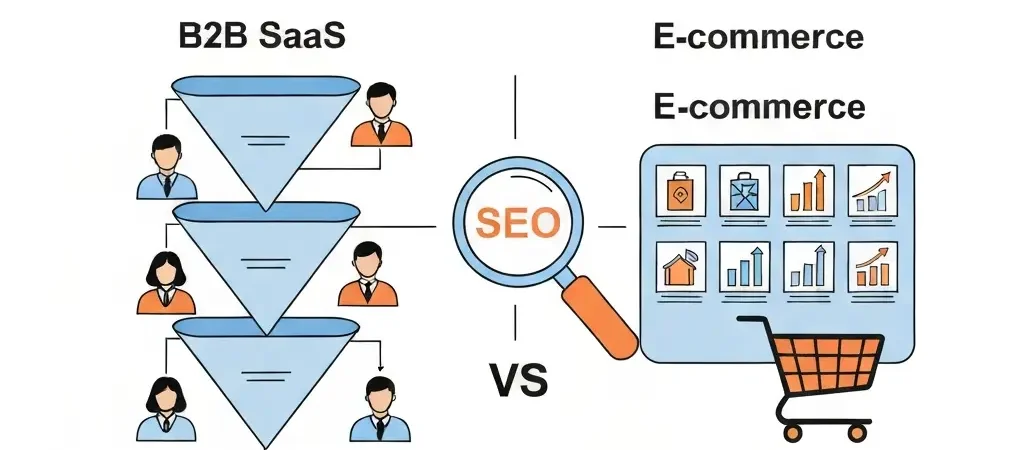
Most SEO advice is written for generic websites. But if you run a B2B SaaS company or an ecommerce store, the same tactics that work for a lifestyle blog will fail you — because your buyers behave differently, your keyword landscape has different intent profiles, and your conversion funnel is fundamentally distinct. A B2B SaaS prospect researching a $24,000/year enterprise platform has a 90-day decision cycle and needs content at every stage of that journey. An ecommerce shopper comparing running shoes has a 20-minute window before they buy elsewhere. Both need SEO — but radically different approaches.
This guide covers the specific SEO strategies that work for B2B SaaS and ecommerce in 2026, drawing on documented case studies and current search behaviour data. The two categories share some foundations — technical excellence, topical authority, E-E-A-T — but diverge sharply on content strategy, keyword targeting, and conversion optimisation.
B2B SaaS vs Ecommerce SEO: The Fundamental Differences
| B2B SaaS | Ecommerce | |
|---|---|---|
| Sales cycle | 30–180 days (enterprise) | Minutes to hours |
| Decision makers | 3–10 stakeholders | 1 (the buyer) |
| Primary keyword intent | Informational, navigational, commercial | Transactional, commercial |
| Content volume needed | Deep — full funnel coverage | Wide — category and product pages at scale |
| Page templates driving revenue | Comparison pages, use case pages, landing pages | Category pages, product pages, collection pages |
| SEO content format | Long-form guides, comparison articles | Optimised category copy, product descriptions |
B2B SaaS SEO Strategy in 2026
The most common B2B SaaS SEO mistake is over-investing in top-of-funnel informational content and under-investing in the pages that capture buyers who have already decided they need a solution. In 2026, the highest-ROI B2B SaaS SEO investments are bottom-of-funnel.
The B2B SaaS Keyword Funnel
- Top of funnel (problem-aware): “how to [solve problem]”, “what is [problem category]”, “[industry] challenges” — these generate traffic but convert slowly
- Middle of funnel (solution-aware): “best [solution category] tools”, “[solution category] software”, “[use case] platform” — high buyer intent
- Bottom of funnel (vendor-aware): “[Your product] vs [competitor]”, “[competitor] alternative”, “[Your product] review”, “[Your product] pricing” — highest conversion rate, often underinvested
According to Ten Speed’s 2026 B2B SEO analysis, bottom-of-funnel pages (comparison and alternative content) convert at 5–8x the rate of top-of-funnel informational pages. Yet most B2B SaaS companies publish 80% of their content at the top of funnel where conversions are lowest.
Alternative and Comparison Pages
These are the highest-ROI B2B SaaS content investments available:
- “[Competitor] alternative”: Targets buyers who are unhappy with a competitor and actively searching for a switch. These pages have 10–20% conversion rates in documented SaaS case studies.
- “[Your product] vs [Competitor]”: Targets buyers in the final evaluation stage comparing two or three shortlisted vendors. Own this search query before a competitor or third-party review site does.
- “Best [category] software for [use case]”: Captures buyers at the solution-research stage with intent to purchase. These are often high-competition but worth targeting because the buyer is genuinely ready to spend.
Integration and Use Case Pages at Scale
For SaaS products with integrations, each integration is an SEO opportunity. “[Your product] + [popular tool] integration” pages capture buyers searching for workflow-specific solutions. A SaaS with 50 integrations can generate 50 landing pages each targeting a distinct, low-competition keyword with high commercial intent. This is a form of programmatic SEO — see our guide to programmatic SEO for the implementation details.
Content Types That Convert in B2B SaaS
1. Problem-Aware Pillar Content
Long-form guides (3,000–5,000 words) targeting the core problem your product solves. These build topical authority, attract backlinks, and capture early-stage buyers. The key is making them genuinely educational — not thinly veiled product pitches — while positioning your product as the natural solution in a dedicated section.
2. Use Case Pages
Dedicated landing pages for each major use case your product addresses. “[Product] for [industry]”, “[Product] for [team type]”, “[Product] for [company size]” — each targets a distinct buyer persona with different pain points, proof points, and CTAs. These pages perform best when they include industry-specific case studies or testimonials.
3. Comparison and Alternative Content
As described above, these are the highest-converting page type in B2B SaaS SEO. Publish one comparison page for each major competitor, and maintain them with current pricing and feature data. Outdated comparison pages lose trust — and trust is the primary factor in B2B purchase decisions.
4. Integration Hub
A dedicated section of your site documenting every integration, partner, and connected tool. Each integration page targets “[Partner tool] + [Your product]” queries and captures buyers who are already committed to the partner tool and need a compatible solution.
Ecommerce SEO Strategy in 2026
Ecommerce SEO operates at scale by necessity. A store with 5,000 SKUs cannot individually optimise each product page — it needs systematic approaches that produce quality at volume. The two highest-impact ecommerce SEO levers in 2026 are category page optimisation and structured data implementation.
The Ecommerce Keyword Architecture
Ecommerce keyword research should map to your site architecture:
- Category pages target high-volume, broad commercial terms (“running shoes”, “men’s running shoes”)
- Subcategory/filter pages target mid-volume modifier terms (“running shoes for flat feet”, “waterproof running shoes under $100”)
- Product pages target specific product names, model numbers, and long-tail specifications
- Blog content targets informational queries that precede purchase intent (“how to choose running shoes”, “best running shoes for beginners 2026”)
The common error is investing heavily in product page optimisation while neglecting category pages. Category pages aggregate authority from internal links, drive the highest organic volume, and have the clearest transactional intent signal — making them the most valuable ecommerce SEO real estate. See our guide to programmatic SEO for ecommerce for how to scale category page optimisation systematically.
Ecommerce Category Page Optimization
A well-optimised ecommerce category page in 2026 includes:
- Target keyword in H1 and page title. The category name should match the way buyers search — not internal taxonomy. “Men’s Trail Running Shoes” outperforms “Men’s Outdoor Footwear — Running” for search intent alignment.
- 200–400 word SEO introduction above the product grid. This gives Google substantive text to evaluate, includes the focus keyword naturally 2–3 times, and provides buying guidance that improves UX. Below the grid, include 400–600 words of supplementary content covering buying guides, FAQs, and brand information.
- Faceted navigation handled correctly. Faceted filtering (colour, size, price range) creates URL proliferation that can cause duplicate content issues. Use canonical tags pointing to the category page for filter combinations, and noindex filter URLs that produce thin or duplicate content.
- Internal links to subcategories and blog content. Category pages should link to relevant buying guides and subcategories, distributing authority down to product-level pages and up to higher-level categories.
- User-generated content integration. Category-level review counts and star ratings improve both E-E-A-T signals and CTR from search results. Aggregate rating schema on category pages (where supported by platform) can generate rich snippets.
Product Schema and Rich Results
Product schema is one of the highest-ROI technical SEO investments for ecommerce. Properly implemented Product schema enables:
- Price and availability in search results — reduces clicks from unqualified buyers (price mismatch) and increases clicks from qualified ones
- Review stars in organic results — documented to improve CTR by 15–35% in A/B tests
- Google Shopping free listings — Product schema feeds directly into the Merchant Center ecosystem
- AI Overview citations — structured data makes your product information machine-readable and more likely to be cited in Google’s AI responses to product queries
The minimum viable Product schema in 2026 includes: name, description, image, sku, brand, offers (with price, priceCurrency, availability), and aggregateRating. Omitting aggregateRating means losing review stars in search results — the highest-CTR enhancement available for product pages.
Shared Tactics: What Both Models Need
Despite their differences, B2B SaaS and ecommerce share several SEO foundations that are non-negotiable in 2026:
Topical Authority
Both models benefit from publishing comprehensively within their niche. A B2B SaaS covering every aspect of its problem space, and an ecommerce store covering every buyer question for its product category, develop topical authority that lifts rankings across the entire content library — not just individually optimised pages. The internal linking infrastructure that supports topical authority is covered in our internal linking strategy guide.
Technical SEO Excellence
Both models require fast page loads, clean crawl paths, comprehensive schema markup, and correct canonical tag implementation. For high-volume ecommerce (10,000+ URLs) and high-velocity SaaS blogs (50+ articles/month), crawl budget management becomes an active concern — ensure Googlebot can efficiently discover and index your highest-value pages.
AI Search Optimisation
Google AI Overviews now appear in over 50% of searches. Both B2B SaaS and ecommerce companies need to optimise for AI citation — which requires the same E-E-A-T signals discussed above, plus structured data, comprehensive coverage of buyer questions, and clear, direct answers that AI systems can extract. Our guide to Google AI Overviews SEO covers the full optimisation playbook.
Measuring SEO Success for Each Model
| Metric | B2B SaaS | Ecommerce |
|---|---|---|
| Primary revenue metric | Organic MQLs / SQLs | Organic revenue / organic transactions |
| Ranking priority | Bottom-of-funnel commercial keywords | Category and subcategory page rankings |
| CTR signal | Title/description relevance to buyer persona | Rich results (review stars, price, availability) |
| Technical priority | Core Web Vitals, crawl efficiency | Faceted nav management, product schema, image optimisation |
| Content ROI signal | Trial signups / demo requests from organic | Add-to-cart rate from organic category pages |
FAQ
What makes B2B SaaS SEO different from regular SEO?
B2B SaaS SEO differs from general SEO in three key ways: the sales cycle is 30–180 days (versus minutes for ecommerce), the buying decision involves multiple stakeholders, and the highest-converting content types are comparison and alternative pages rather than informational articles. Bottom-of-funnel keywords like “[Competitor] alternative” and “[Your product] vs [Competitor]” convert at 5–8x the rate of top-of-funnel guides. Most B2B SaaS companies underinvest in bottom-of-funnel content — their most common SEO mistake — because it requires naming competitors explicitly, which feels uncomfortable but delivers the highest organic conversion rates.
What are the most important ecommerce SEO ranking factors in 2026?
The most important ecommerce SEO ranking factors in 2026 are: (1) category page optimisation — well-structured category pages with keyword-aligned H1s, substantive copy, and strong internal linking drive the most organic revenue; (2) Core Web Vitals — Google’s performance benchmarks are a confirmed ranking signal and ecommerce sites frequently fail them due to heavy product image loading and JavaScript-heavy filter interfaces; (3) product structured data — Product schema enables review stars, price display, and AI Overview citations; (4) E-E-A-T signals — product review integrations, expert buying guides, and transparent business information all contribute to trust signals that influence rankings in competitive categories.
Should B2B SaaS companies target competitor keywords?
Yes — targeting competitor alternative and comparison keywords is one of the highest-ROI B2B SaaS SEO strategies available. Buyers searching “[Competitor] alternative” or “best [Competitor] alternatives” have already decided they need a solution and are actively evaluating vendors. These keywords have documented conversion rates of 10–20% for well-executed comparison pages. The key is to present fair, factual comparisons that respect the competitor’s strengths while clearly communicating your differentiation — not to disparage competitors. Buyers can detect bias and it damages trust, which is the primary purchase decision factor in B2B.
How do I handle faceted navigation in ecommerce SEO?
Faceted navigation (filter combinations like colour + size + price range) creates URL proliferation that can cause duplicate content issues and waste crawl budget. The recommended approach in 2026 is: (1) use canonical tags pointing to the primary category URL for filter combinations that produce thin or duplicate content; (2) noindex filter URLs that have fewer than 5–10 unique products; (3) allow indexing of filter combinations that represent genuine buyer intent and have substantial search volume (e.g., “waterproof running shoes” may deserve its own indexed URL if it has significant monthly searches); (4) use rel=”nofollow” on faceted navigation links when the combinations should not be crawled.
What is product-led SEO for SaaS?
Product-led SEO is a strategy where SaaS companies create publicly-indexable pages generated by their product itself — user-created profiles, project pages, generated reports, or tool outputs — that capture long-tail search queries at scale without manual content creation. Examples include Canva (indexable design templates), Figma (public design files), and Airtable (public base templates). Each user-created page targets a specific long-tail query, creating a compounding SEO asset as the user base grows. Product-led SEO is particularly effective for tools-based SaaS products where users create shareable outputs, and it is a form of programmatic SEO that leverages user-generated content rather than editorial content.
Build Your B2B or Ecommerce SEO Content System with Authenova
Authenova’s AI content automation platform is purpose-built for high-velocity, high-quality SEO content production — whether you need comparison pages and use-case content for B2B SaaS, or category guides and buying content for ecommerce. See how growth teams use Authenova to scale organic traffic at authenova.site.